Exploring the Park of the Aqueducts in Rome
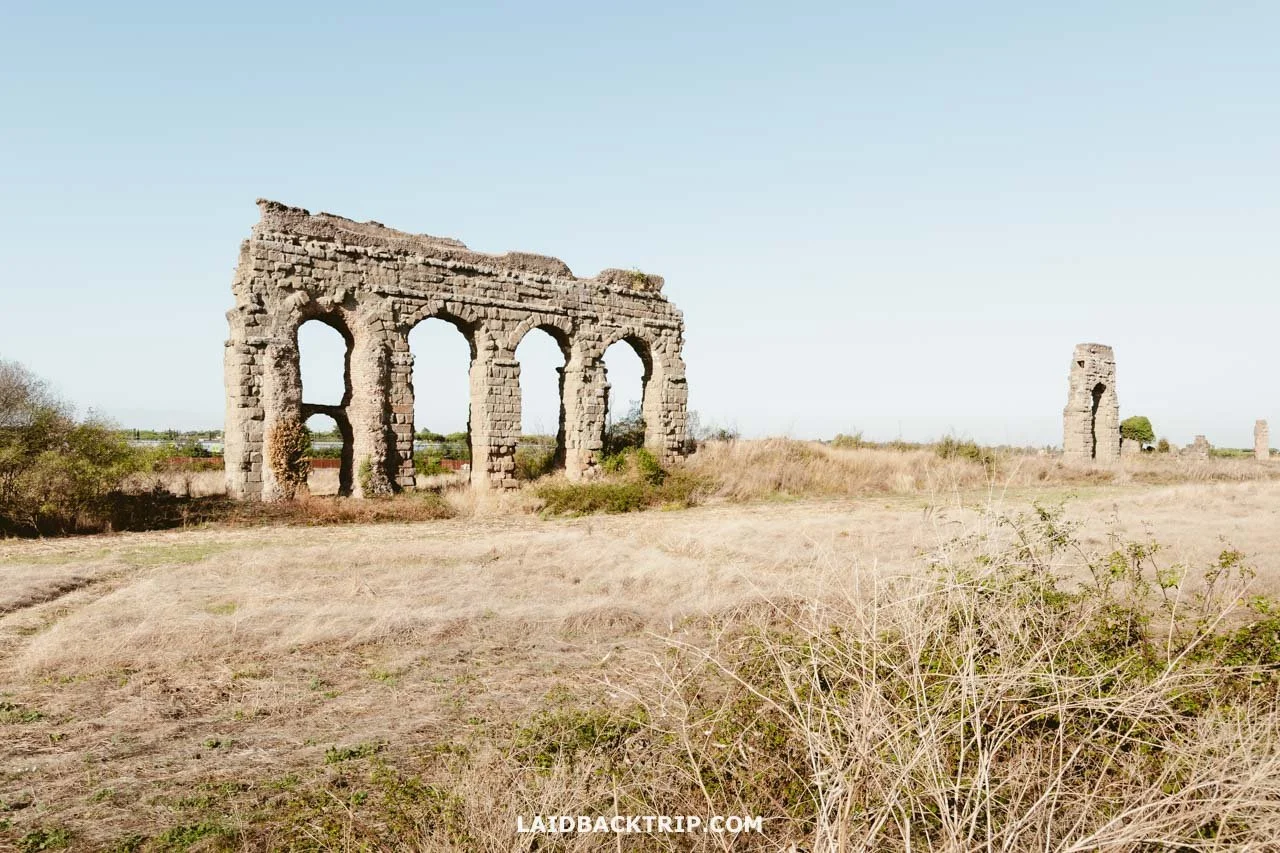
Towering arches of Aqua Claudia are the park's main highlight.
The vast Park of Aqueducts offers a great opportunity to see the ancient aqueduct ruins that once provided Rome with fresh water. We couldn't wait to explore them!
The famous aqueducts that supplied fresh water to cities were one of the marvels of Roman engineering. And there really wasn't a better place to explore them than at the Park of the Aqueducts, located in Appian Way Regional Park on Rome's outskirts. Still craving more ancient history, that's where we headed next.
Admittedly, the Park of the Aqueducts was a place we visited only because we added it to our plans at the last minute. On our last day in Rome, we had originally planned to do the Via Appia Antica, Rome's most famous ancient road. But when figuring out how we would actually get there, we noticed that if we took the metro instead of the bus, we'd have to walk through the Park of the Aqueducts first. The park's name sounded interesting and immediately caught our attention.
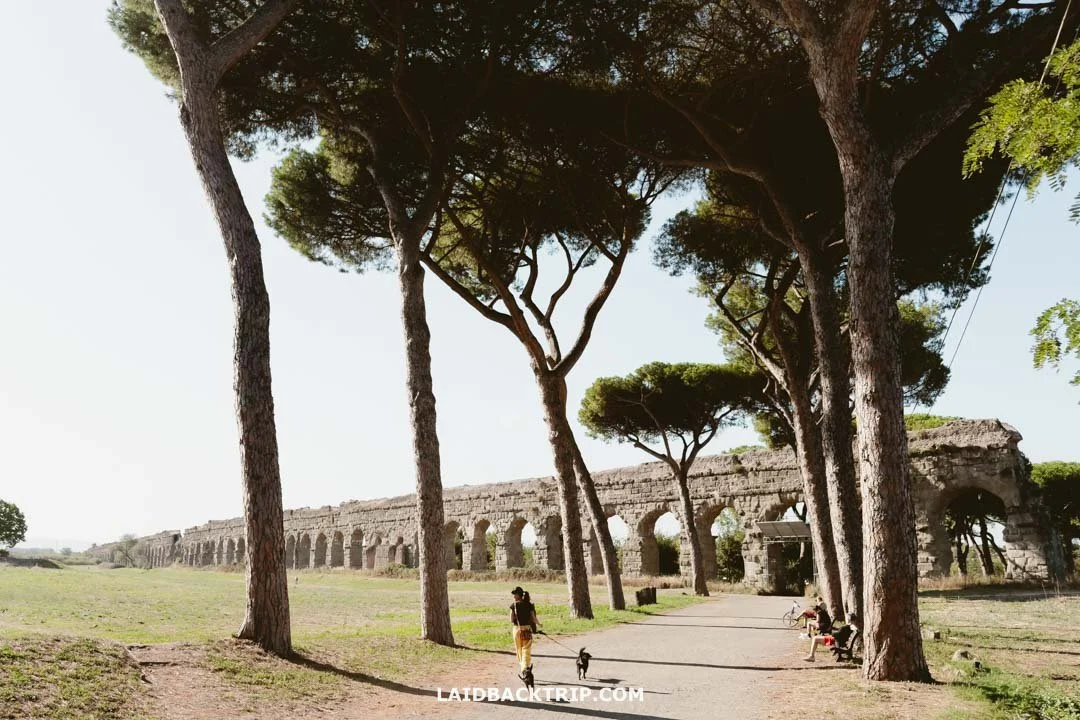
It turned out to be a great idea, as we had so much fun exploring the Park of the Aqueducts.
Before the trip, we really wanted to see some well-preserved Roman aqueducts. But even though we'd been in the Eternal City for seven days and had heard and read all about them, we still hadn't seen one up close. This seemed like the ideal opportunity, and it took us only a moment to decide we would visit both places in a single trip, even if it seemed a bit less convenient. So we ditched the bus option and focused on the metro as our way to get there.
The funny thing is that we actually saw the Park of the Aqueducts from the plane as we landed at Ciampino Airport about a week ago. But that was only through the window of a fast-moving plane, so the whole experience didn't last more than a few seconds. To be honest, at the time, we really had no idea what we were looking at. I was sitting by the window, and when I first spotted them, I said, "Hey Lucie, there are some Roman ruins below us," and she replied, "That's awesome, but you know, I can't really see them." A few moments later, we landed.
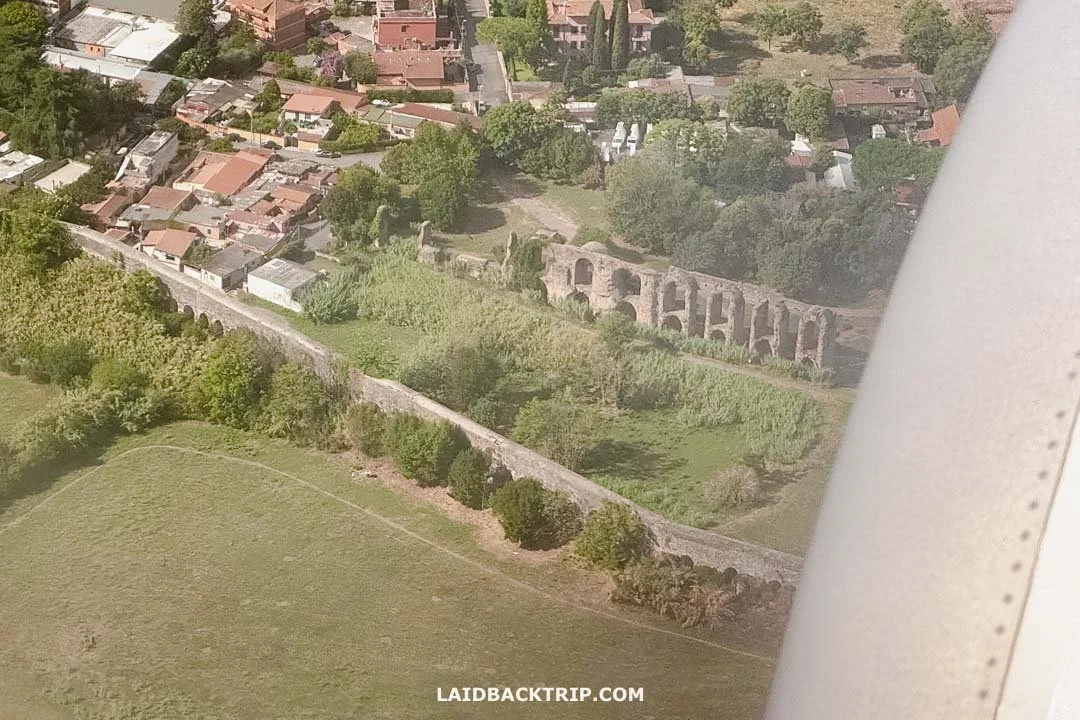
I actually managed to snap a photo of the Park of Aqueducts as we were landing at Ciampino.
Our main problem was that we really weren't sure how to approach the whole day. Our main goal was the famous ancient road, and we worried that this side trip would obviously take some time and energy, both of which we worried might be lacking later in the day. So we came up with a rough plan to visit the Park of the Aqueducts first and then see how things went from there.
Getting to the Park of the Aqueducts
From what we learned, the best place to see aqueducts in Rome was, fittingly, the Park of the Aqueducts. It was near Ciampino Airport, and that's when I realized these were the Roman ruins we had seen just before the plane touched down on the runway. They were on the city's outskirts, which made us wonder how we would reach them. We traveled from the airport by bus, but we soon found out we could simply take the metro to the Park of the Aqueducts.
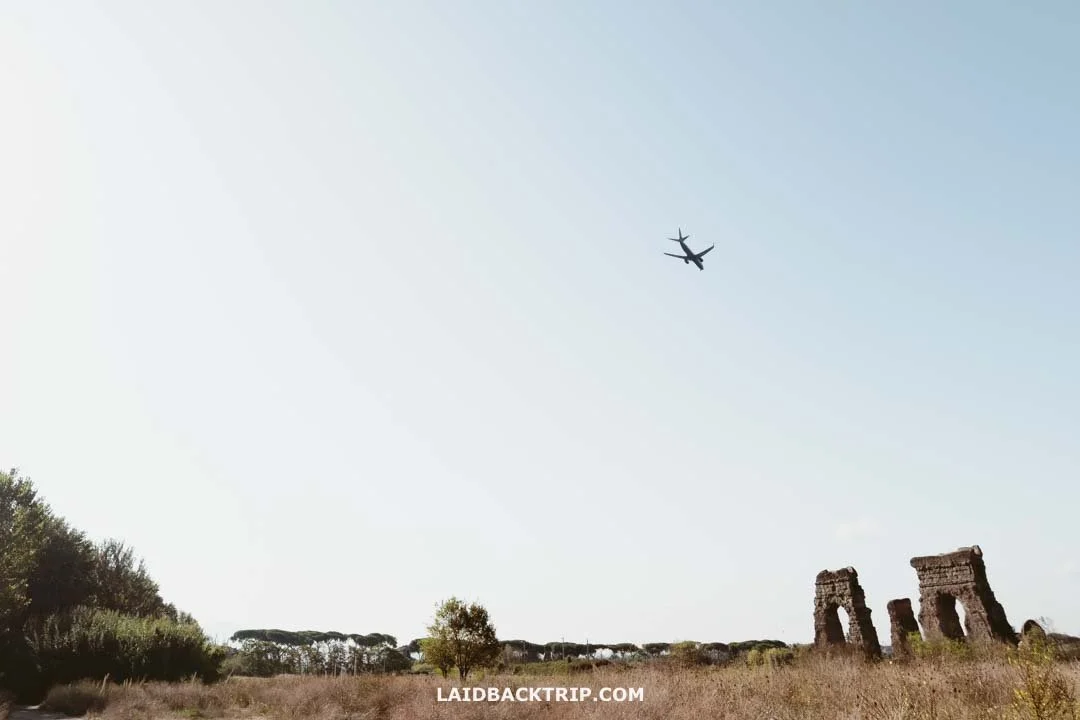
From time to time, we could see planes landing at Ciampino because the park is so close to the airport.
At the time, we were staying in Leonardo Boutique Hotel close to Termini Station, which made things easy since we could just hop on the A line metro there, taking us directly to Giulio Agricola station on the same line. This was definitely the best way for us to get to the Park of the Aqueducts, as the entire trip took about 40 minutes total: a 10-minute walk to Termini, a 15-minute metro ride, and under 10 minutes to reach the park from Giulio Agricola (plus time for tickets and waiting).
As we wandered the park, we came upon a map of the Park of the Aqueducts that offered a suggested route for exploring with as little backtracking as possible. While checking it out, we saw that another entry point, Porta Furba. It was a metro station also on the A line, which we passed on the way to Giulio Agricola, and as we discovered, it would have been a great option too. I'll discuss this alternative in a moment, so stay tuned.
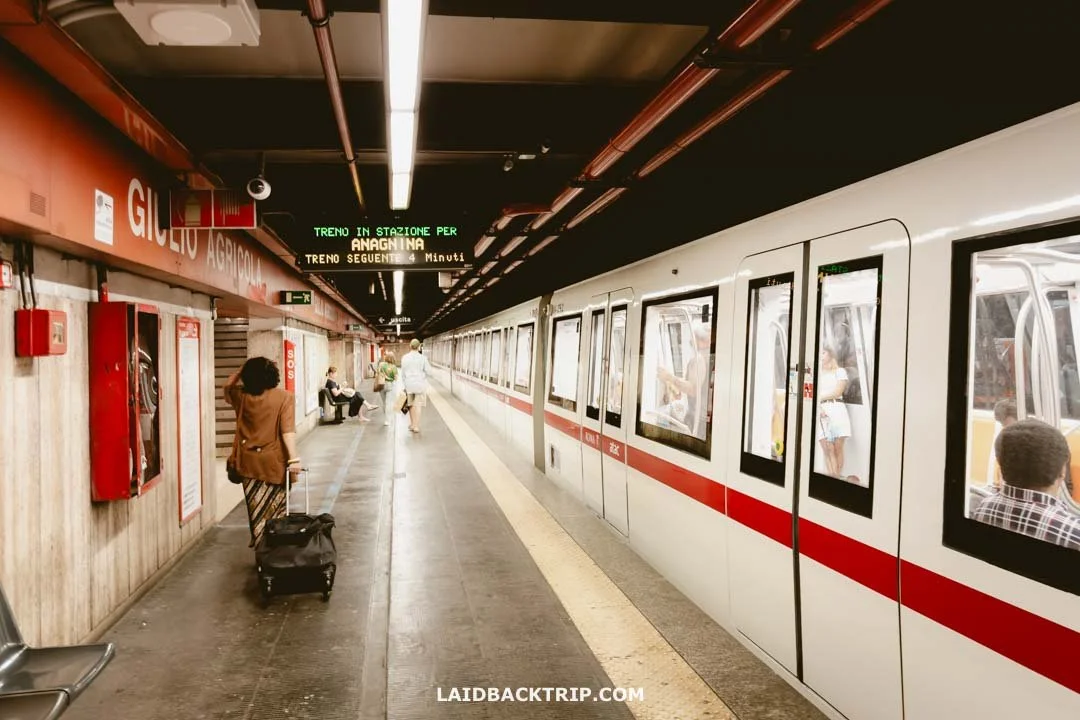
On our way to the Park of Aqueducts, we took the metro from Rome's city center to Giulio Agricola Station.
Because the park is so large, and since the metro line runs almost parallel to it, you can also get off at Subaugusta, Cinecitta, or Anagnina stations. The Anagnina stop is especially convenient if you're interested in exploring the Villa of Sette Bassi first.
What’s There to See in the Park of the Aqueducts
We went to the Park of the Aqueducts mainly to see some aqueducts, but we were surprised to find there were actually seven of them, at least, what was left. Even though the name is plural, we figured there would just be one or two. The main attractions were the Roman-built Aqua Claudia and the Aqua Felice, which was a Renaissance-era construction. The rest of the aqueducts were underground, lost to time, or merged into the previous ones.
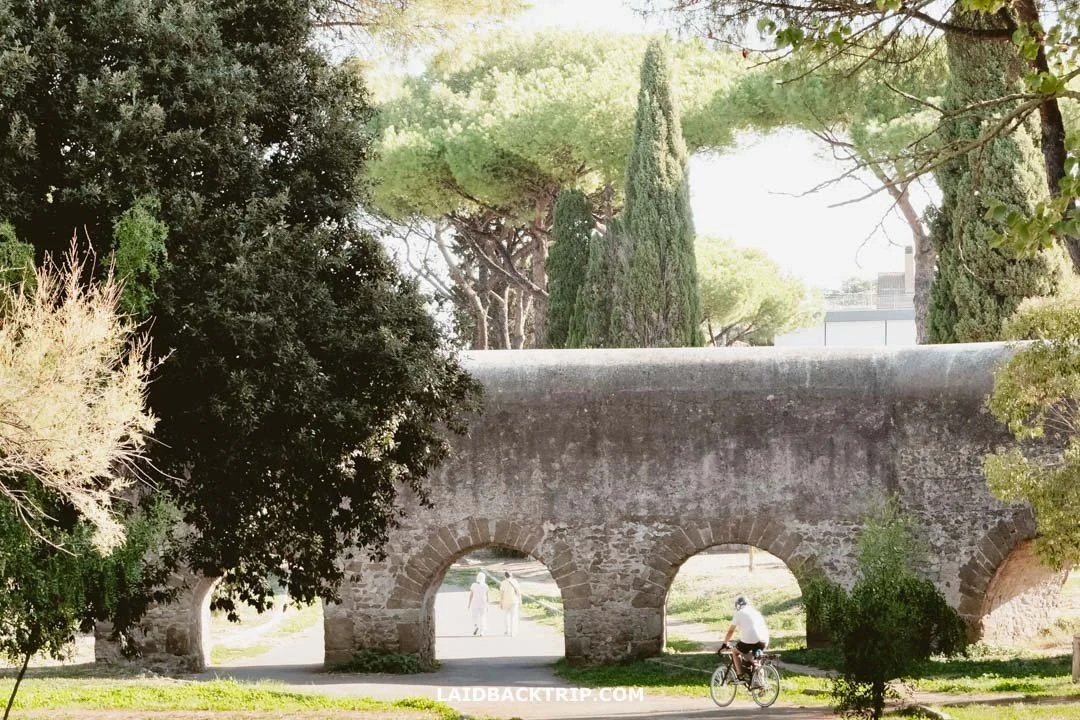
This aqueduct was actually not built in Roman times but during the Renaissance.
Besides these two main aqueducts, the park was laced with walking and cycling trails, all of which we found were dirt paths. There were a few more things to see in the Park of the Aqueducts, such as a modern church called Chiesa Parrocchiale di San Policarpo and the Fosso dell'Acqua Mariana, a water channel from the Middle Ages.
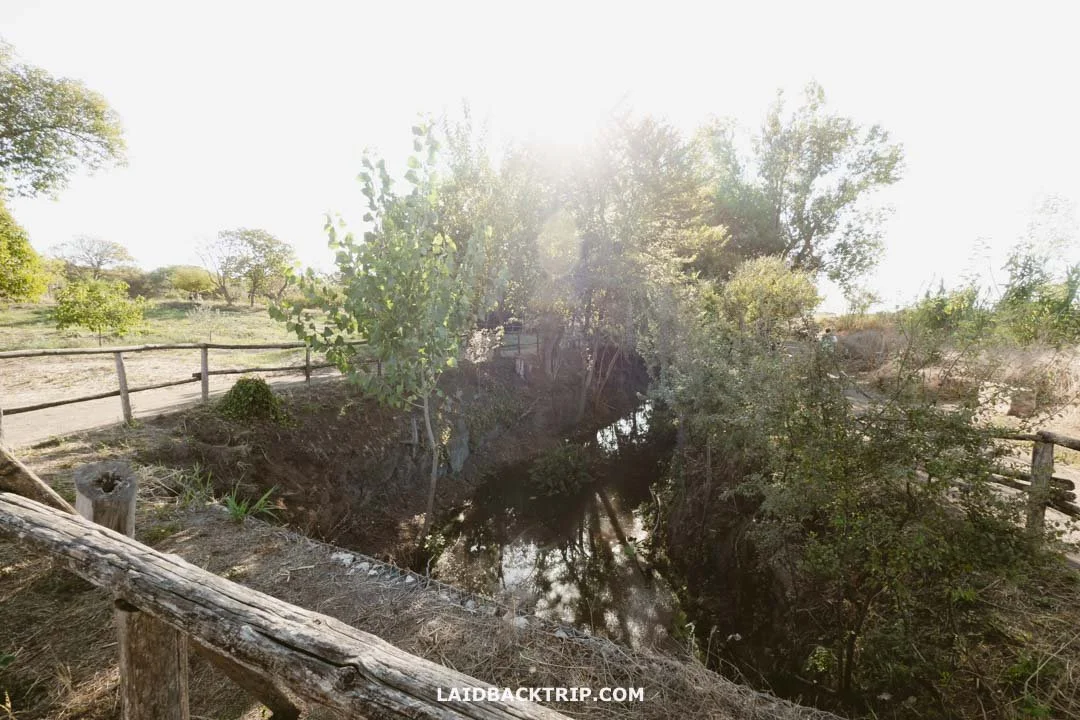
Fosso dell'Acqua Mariana is a water channel built in 1122.
We also checked out other Roman ruins, like Villa delle Vignacce. There was a 13th-century farmhouse called Casale di Roma Vecchia, and a fish pond where turtles were basking in the sun. We also found remnants of the Via Latina, which used to connect Rome to Capua and is considered one of the park's most historically important walking trails. About three kilometers farther are the Tombs of Via Latina, which you can visit if you want to venture beyond the Park of the Aqueducts.
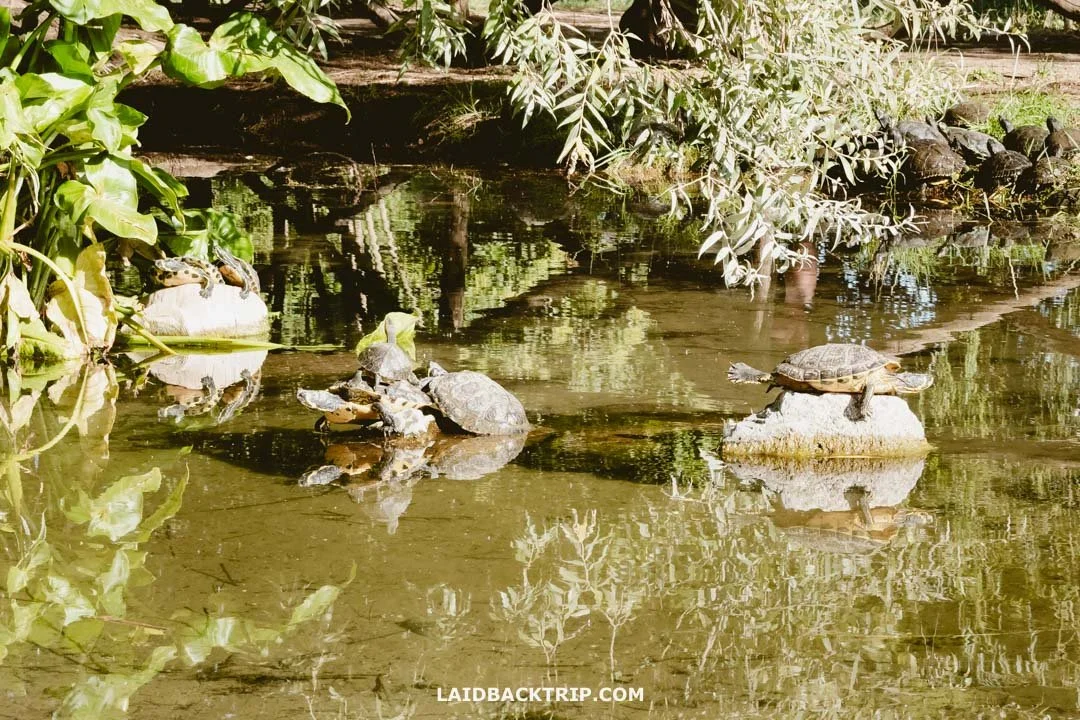
The park also had a small pond with turtles!
Overall, the Park of the Aqueducts was a great place to walk around and was easily among the most beautiful parks we visited in Rome. However, we were here mostly for the sightseeing, so our main focus was on the aqueducts.
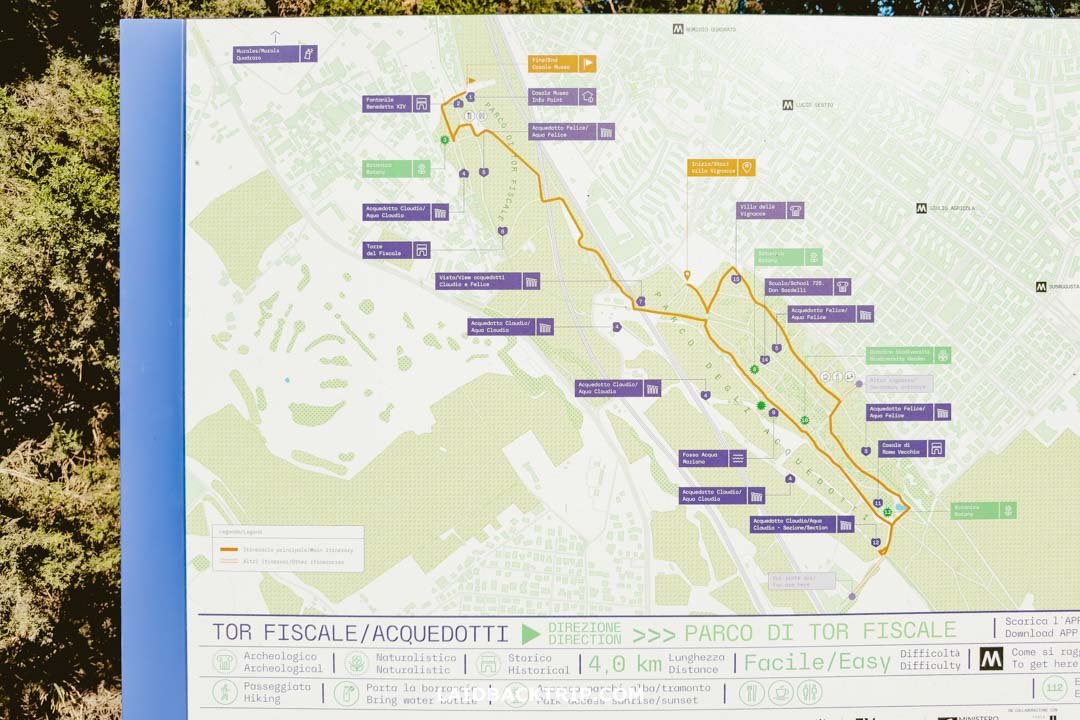
The official walking path at the Park of Aqueducts is 4 kilometers long and includes 15 stops.
Walking in the Park of the Aqueducts
As I mentioned earlier, we chose to get off the metro at Giulio Agricola station. This station was about 550 meters from one of the many entry points to the Park of the Aqueducts, and I thought it would be the best option for us. It worked well, although we later learned there might have been a slightly better choice: Porta Furba.
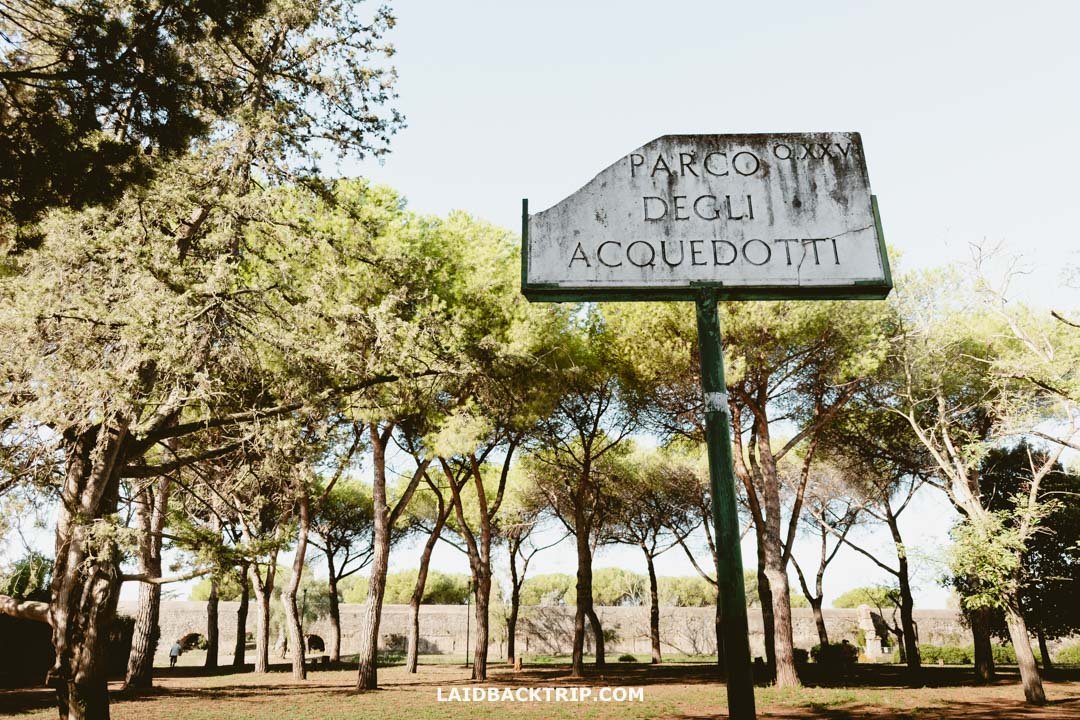
We were at the right place!
If we had started there, we would have first seen Parco di Torre Fiscale before continuing to the Park of the Aqueducts itself. This was actually the recommended route on one of the park's information panels, and although it was tempting to visit the other park, we both agreed we just didn't have the time, so we skipped it.
I really don't think this part was essential, but I will admit it might have made a little more sense to start (or finish) there. If you do begin your visit there, you'll get the chance to see more aqueducts or additional ruins, such as the Tor Fiscale. This 30-meter-high tower from the 13th century was built to protect the Via Latina, the Fosso dell'Acqua Mariana channel, and the surrounding farmsteads.
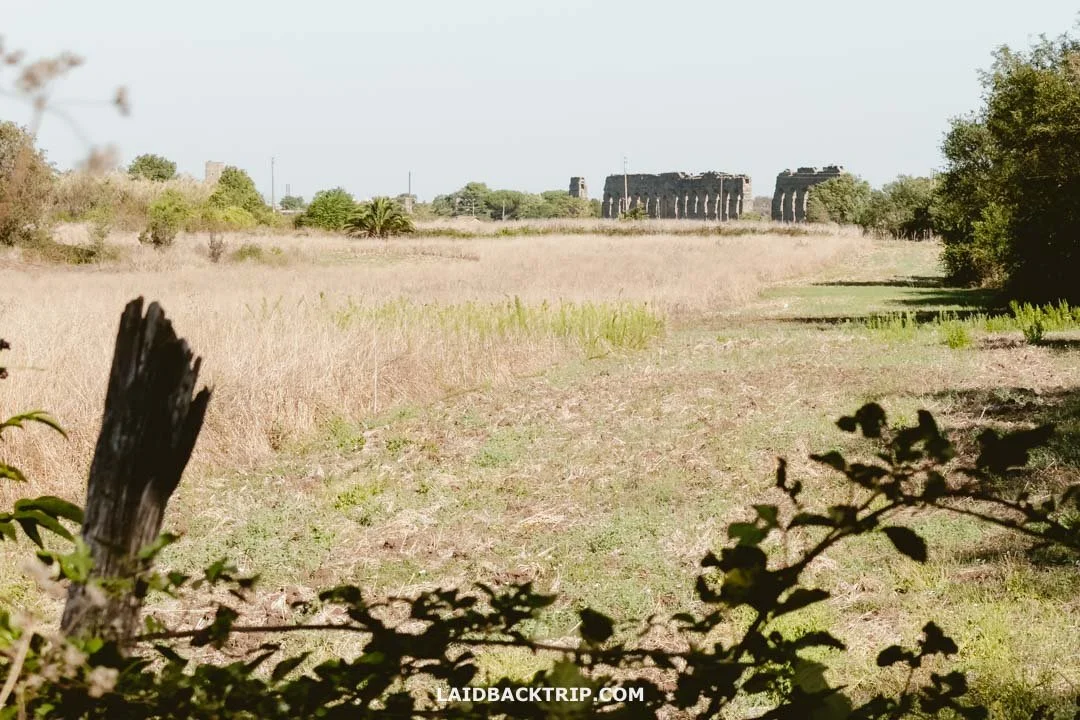
We managed to catch a glimpse of Tor Fiscale from a distance (it's the one poking from behind the tree on the left).
Before entering the park, we made a quick stop at the Chiesa Parrocchiale di San Policarpo. Over the past few days, we had seen countless classical churches with Baroque architecture, so when we reached this church at the end of Viale Giulio Agricola, it stood out as something truly different.
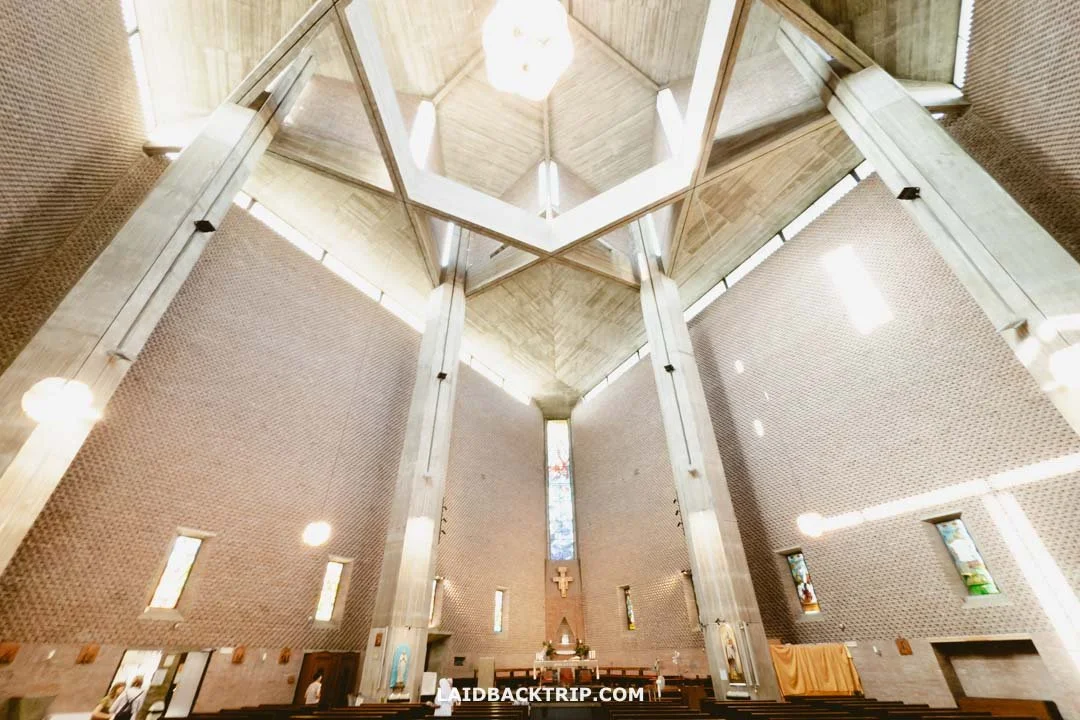
The modern architecture of the Parrocchiale di San Policarpo felt completely different from what we had seen so far in Rome.
Our curiosity got the best of us, so we stepped inside as we arrived here just after a morning mass ended. The interior was striking and completely different from the classics like St. Peter's Basilica or the Chiesa del Gesu. We took a quick look and then continued to the park, entering just to the right of the church.
After entering the park, we chose to follow the trail to the right, and then looped back. We didn't have much of a plan and, since we hadn't learned about the visitor's path yet, simply decided to wander. The park was an enormous, flat, open space, so it was easy to see where we were headed. It ran for several kilometers in length but was just a few hundred meters wide, making it nearly impossible to get lost.
It turned out we didn't need much of a plan at all. The Park of the Aqueducts was especially easy to explore on foot. We thought about renting bikes, since we were heading on to the Via Appia, but decided walking suited the trip better. Bikes would have let us see more, but with a whole day to spend here, they really weren't necessary.
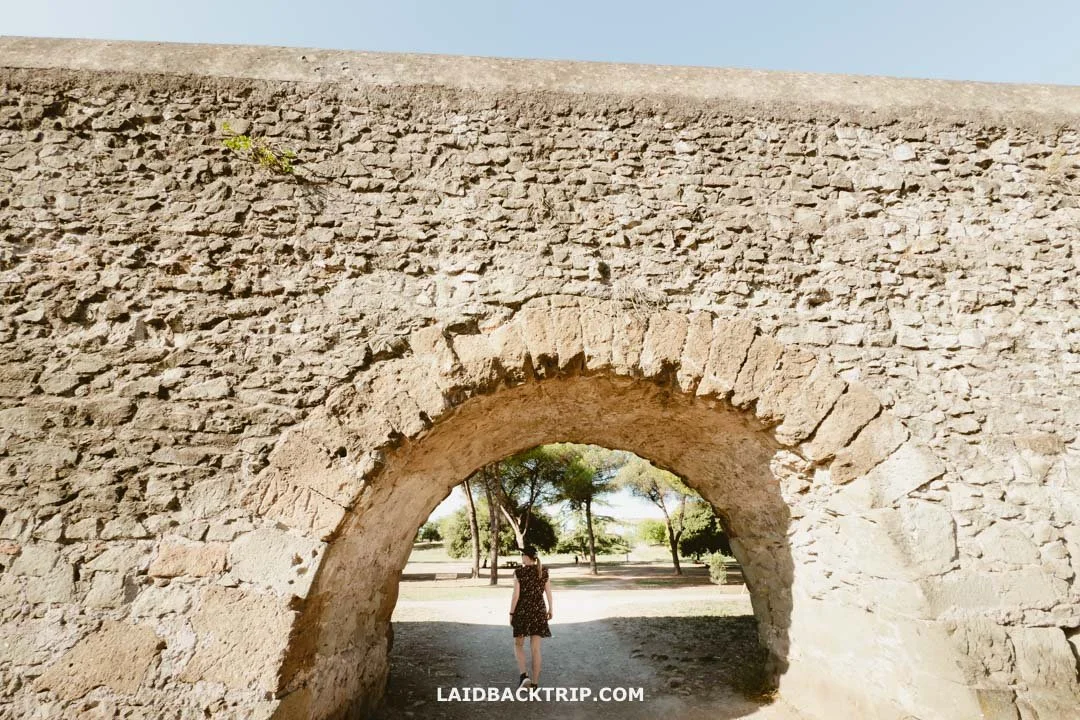
The aqueducts were very easy to explore on foot.
The Aqueducts of Ancient Rome
Stretching tens of kilometers, we think of Roman aqueducts as extraordinary structures that transformed daily life across ancient Rome. From the 4th century BCE onward, Romans built them to carry fresh water from faraway springs and rivers into the city, feeding baths, fountains, households, and farms.
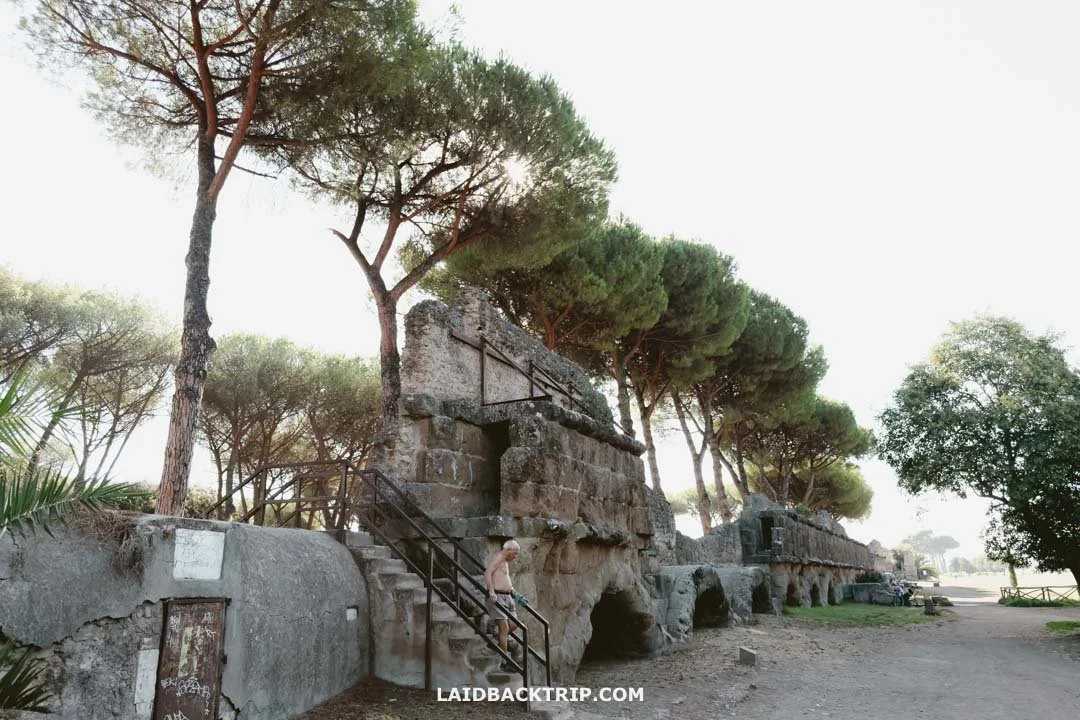
We could also use the stairs over Aqua Felice.
Gravity did the work, moving water through stone, brick, and concrete channels, sometimes hidden underground but also soaring in arcades like the Aqua Claudia. At its height, Rome had eleven aqueducts, supporting over a million people. They were true engineering marvels, improving public health while showing off the mighty power of the empire.
Aqua Felice
The Aqua Felice, the newest of the park's aqueducts, was built on the orders of Pope Sixtus V between 1585 and 1590, nearly 1500 years after the Claudia aqueduct we discussed earlier. Its purpose was to supply water to Rome's central hills, especially the Quirinal, Viminal, and Esquiline, and it was constructed in part over the old arches of Aqua Marcia, reusing its ancient structure and alignment. While the old Roman aqueducts have stopped working, Acqua Felice still operates today and brings water into Rome.
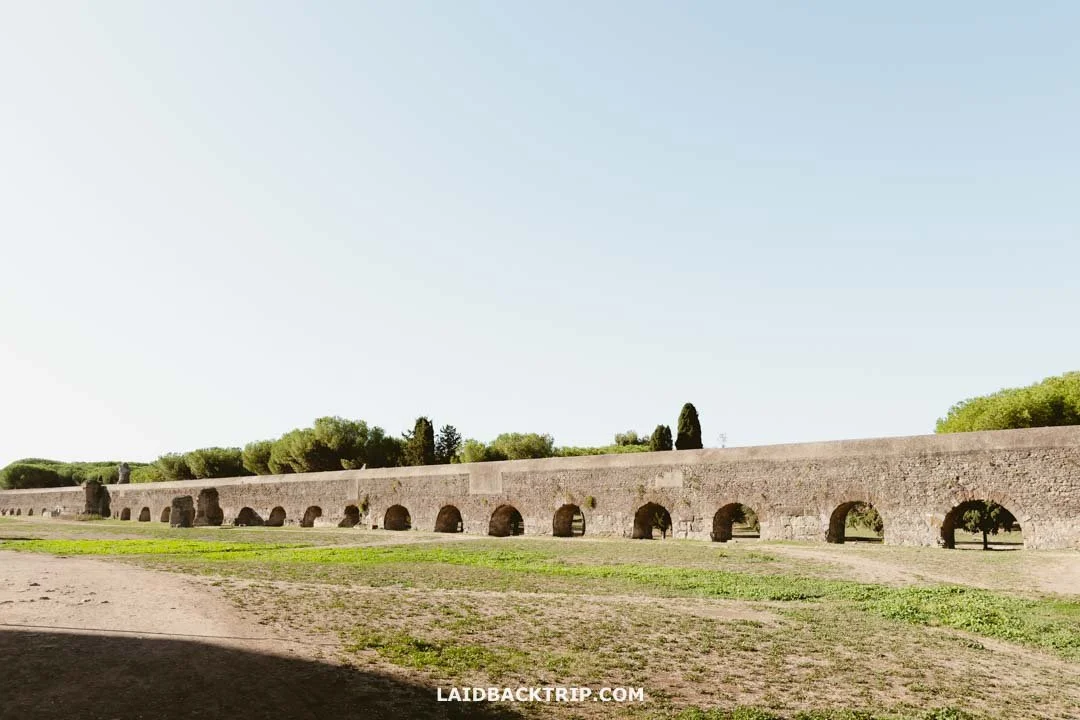
The Renaissance-era Acqua Felice still carries fresh water into Rome.
Aqua Felice was actually the first aqueduct we saw in the park, just 100 meters from Via Lemonia, a street from which we entered. It was beautifully preserved (not surprising since it still functions) and stretched as far as we could see in both directions. The aqueduct wasn't very tall in this section, and though it had some arches, it wasn't as impressive as the Aqua Claudia we saw a bit later.
Aqua Claudia
Standing as high as 28 meters, the 69-kilometer-long Aqua Claudia was once one of Rome's most important aqueducts. Construction started under Emperor Caligula and was completed by Emperor Claudius in 52 CE. Besides this, we also learned that the Anio Novus aqueduct was incorporated into the same arched structure at a later stage.
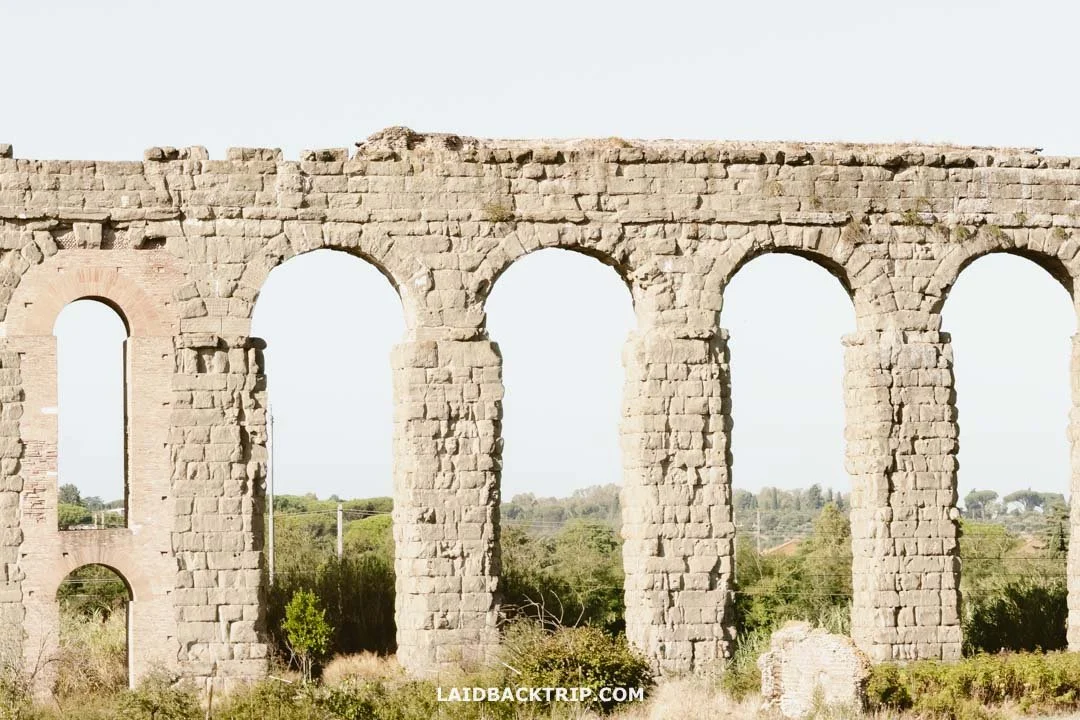
The magnificent arches of the Aqua Claudia still stand even after 2,000 years.
The part of Aqua Claudia visible in the park is among the best-preserved sections of its whole original length, which made for incredible views and perfect photo opportunities. Lucie and I came expecting to see the classic aqueduct look with giant arches, and it was Aqua Claudia's remains that lived up to what we pictured.
Our favorite part of Aqua Claudia was beside Viale Appio Claudio (the exit we used later), but even the solitary arches we passed before that had tons of charm. At that spot, we came across an informative sign about Aqua Claudia's history. Not only did we pick up a bit more about this ancient structure but there was a short note saying we should be able to see St. Peter's Dome when facing the center, which we, since it was a clear day, actually did!
Besides the two main structures, the park also features ruins or underground traces of five other aqueducts, such as Anio Vetus, Aqua Julia, and Aqua Tepula.
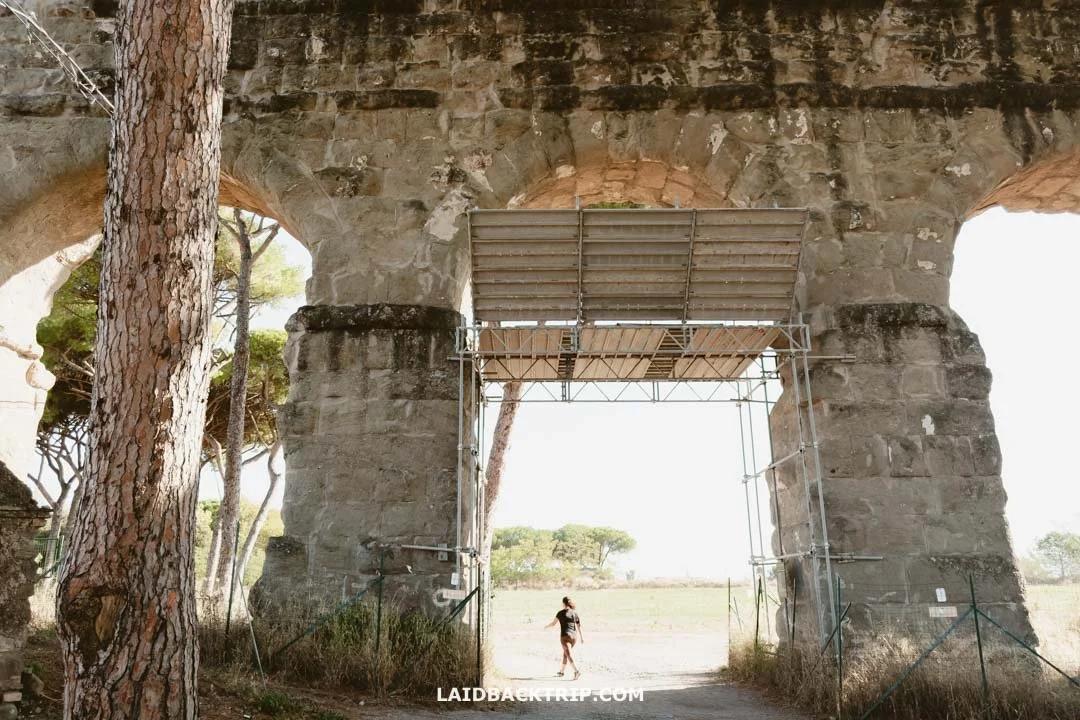
Under this arch with scaffolding, it was safe to pass under Aqua Claudia.
We Visited the Park of the Aqueducts in the Morning
We made it a point to arrive at the Park of the Aqueducts early in the morning, planning to spend as much time there as possible so that we could reach the Villa dei Quintili, our first stop on Appia Antica, by 10 AM at the latest.
The thing we enjoyed most at the Park of the Aqueducts was how quiet it was, at least in terms of crowds. By now, we were completely tired of the crowds at the Pantheon or Roman Forum, but here, it felt like entering a different realm. Since it was a weekend morning, the place was still waking up. Only a handful of locals came for their fitness walks, dog strolls, bike rides, or jogs. Even then, there weren’t many, and as far as tourists go, I think we were the only ones present.
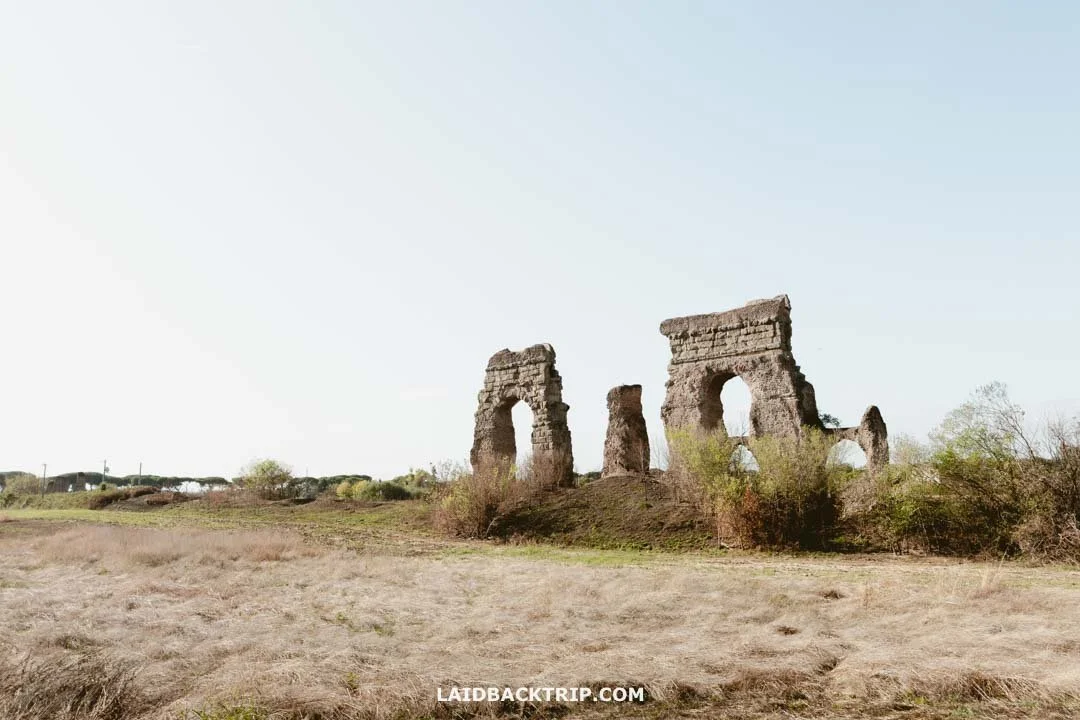
A large part of the park was quite exposed to the sun.
Even though it was still before 9 AM when we arrived, it was already quite warm. We visited the Park of the Aqueducts in summer, technically early September, and the temperatures were expected to climb well above 30 degrees Celsius during the day.
The skies were clear, so we could tell it would be another scorching day in Rome. The park had plenty of open spaces, and although there were tall pines and other shaded spots, we ended up spending a lot of time walking in the sun. Since the Via Appia was similar, we made sure to pack plenty of sunscreen for the day.
I wished we could have visited at sunrise or sunset because I knew the Park of the Aqueducts must be magical at those times. Unfortunately, sunrise was around 6:30 AM at this time of year, and it was just too early to be there.
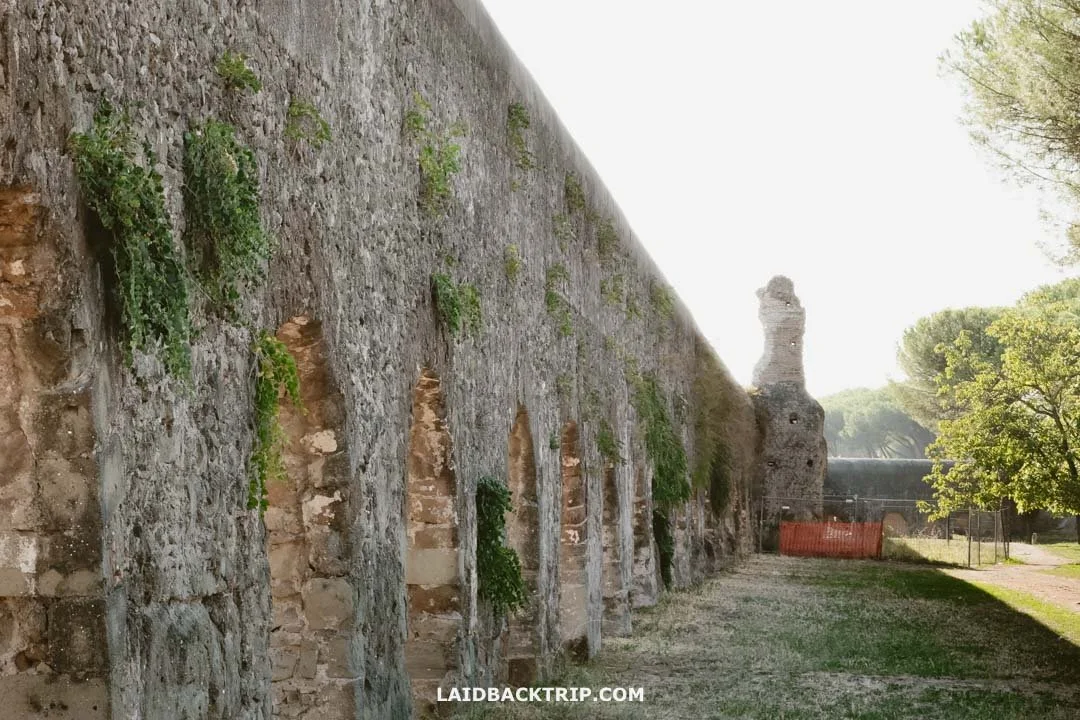
So we took every chance we could to stay in the shade of pine trees and aqueducts.
How Long Did We Spend in the Park of the Aqueducts
Since we were planning a roughly 3-kilometer easy walk on flat ground, we set aside an hour for the Park of the Aqueducts. As it was early in the day and everything around us was peaceful, we walked slowly, stopped often, and enjoyed the park's morning atmosphere. I had hoped it might take less time, but once we arrived, I realized this was the kind of place where rushing just didn't make sense.
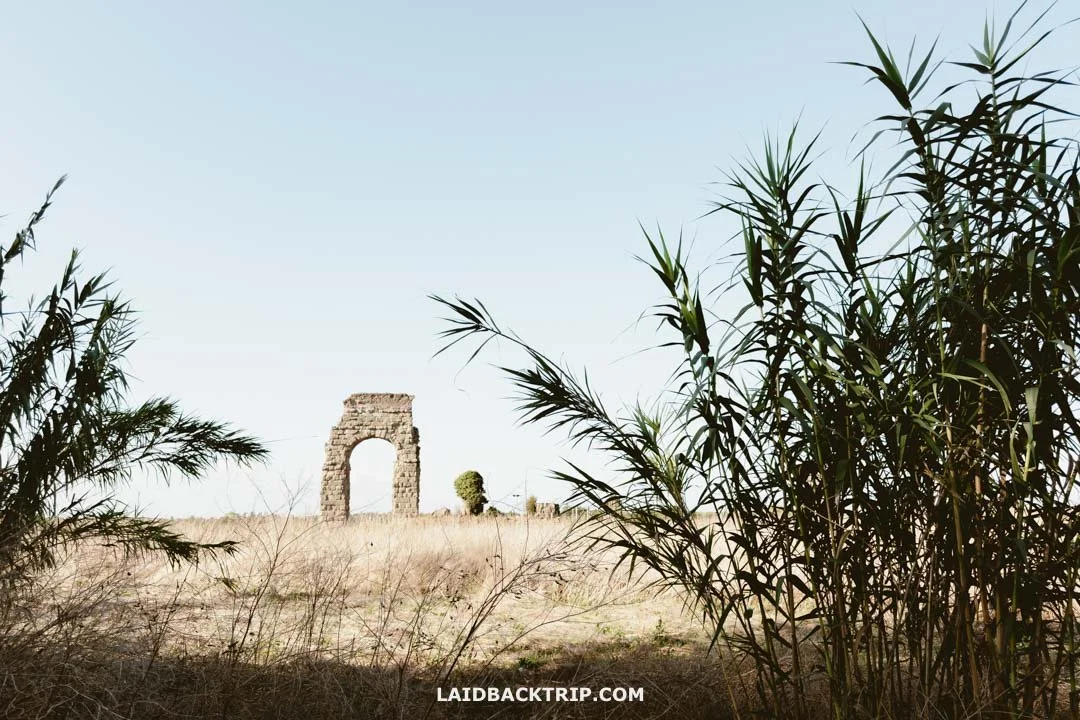
It's easy to spend a few hours exploring the aqueducts in this park.
The recommended 4-kilometer route could also be walked in an hour or a little more, based on your speed. Of course, being a park, we could have stayed longer if the day was open, but with Via Appia so close, we didn't see much reason to extend our visit.
The Park of the Aqueducts is Free to Enter
Since the Park of the Aqueducts is a public park, it's free to explore. By this point, we'd already spent quite a bit on admission fees for Rome's top sights like the Colosseum and Capitoline Museums, so seeing the aqueducts at no cost was a welcome change.
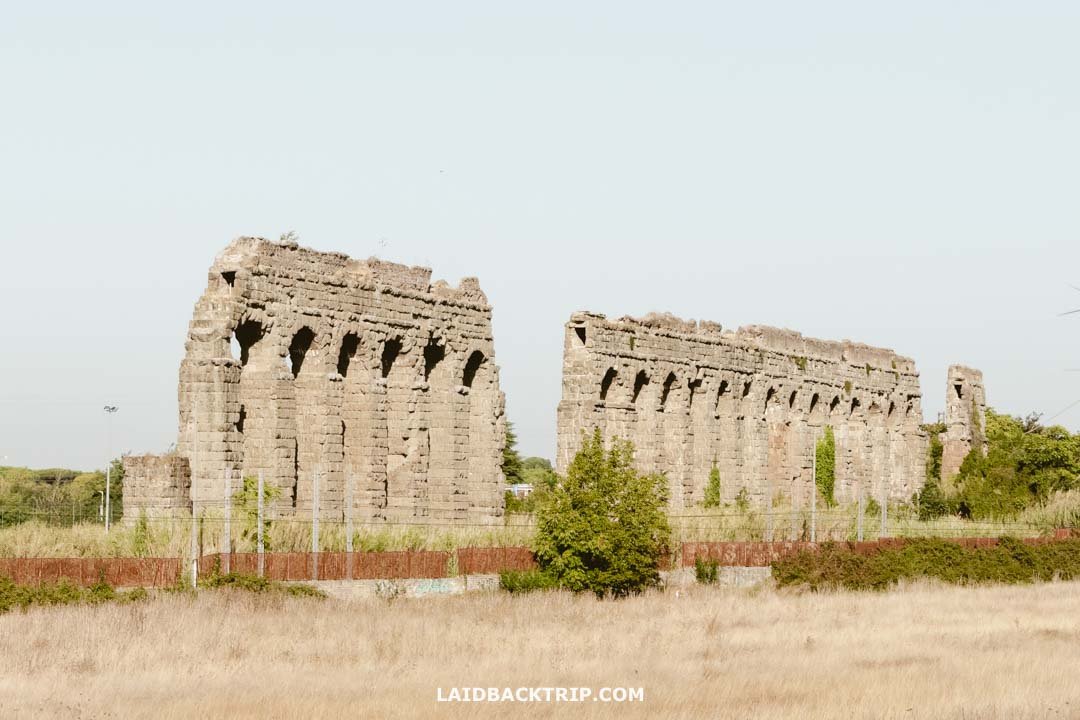
It was great that we could see all the aqueducts for free.
Getting from the Park of the Aqueducts to Via Appia Antica
Although we really enjoyed the Park of the Aqueducts, it was just one part of a packed day. As much as we would have liked to stay longer, we needed to keep moving since we still had almost the entire day ahead of us. From the Park of the Aqueducts, we continued to Via Appia Antica on foot.
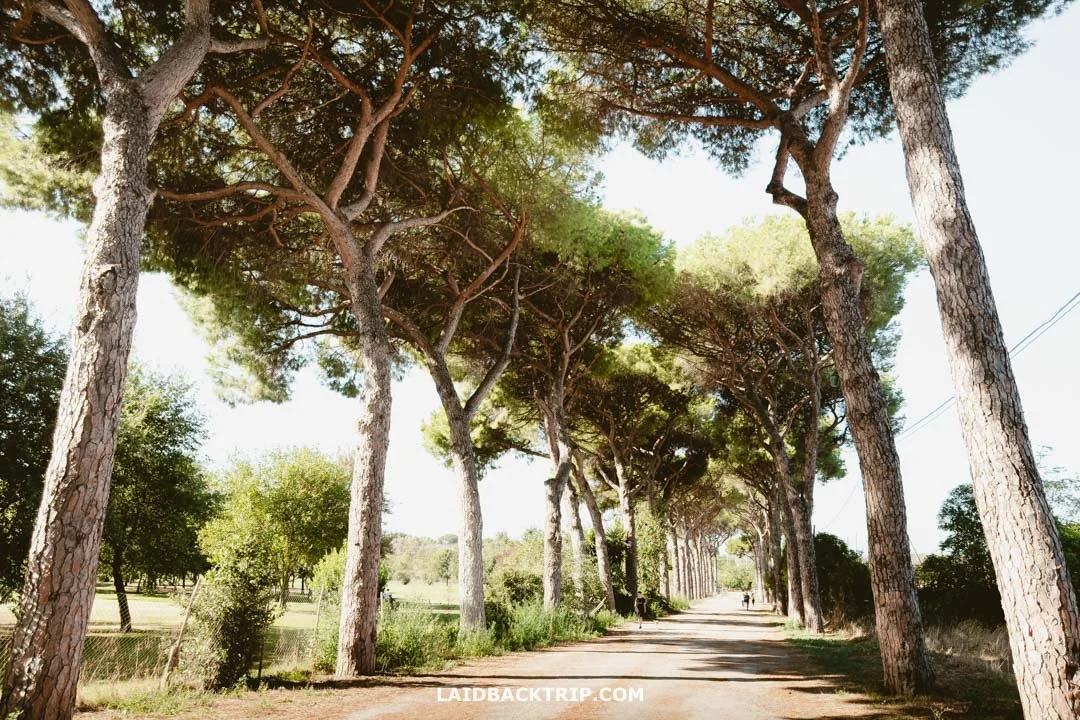
This is where we left the Park of Aqueducts and walked onward to Via Appia.
Our first stop was Villa dei Quintili, so we mapped out a 1.7-kilometer walk along a back road, through the Quartiere Statuario neighborhood, and finally onto Via Appia Nuova before reaching the museum. I wasn't sure about the path between the park and the neighborhood, so I checked the street view, and since it looked fine, we decided to go ahead.
World Nomads provides travel insurance for travelers to cover their trip essentials, including sports and adventure activities.
SafetyWing is affordable travel insurance for backpackers, long-term travelers, and digital nomads.
Starting at the large arch of the Claudian aqueduct, we followed an alley lined with stone pines, passing the golf course on our right for about 250 meters. When the road curved left, we stayed with it, and after another 100 meters, we reached the intersection of Viale Appio Claudio and Via Gamiana.
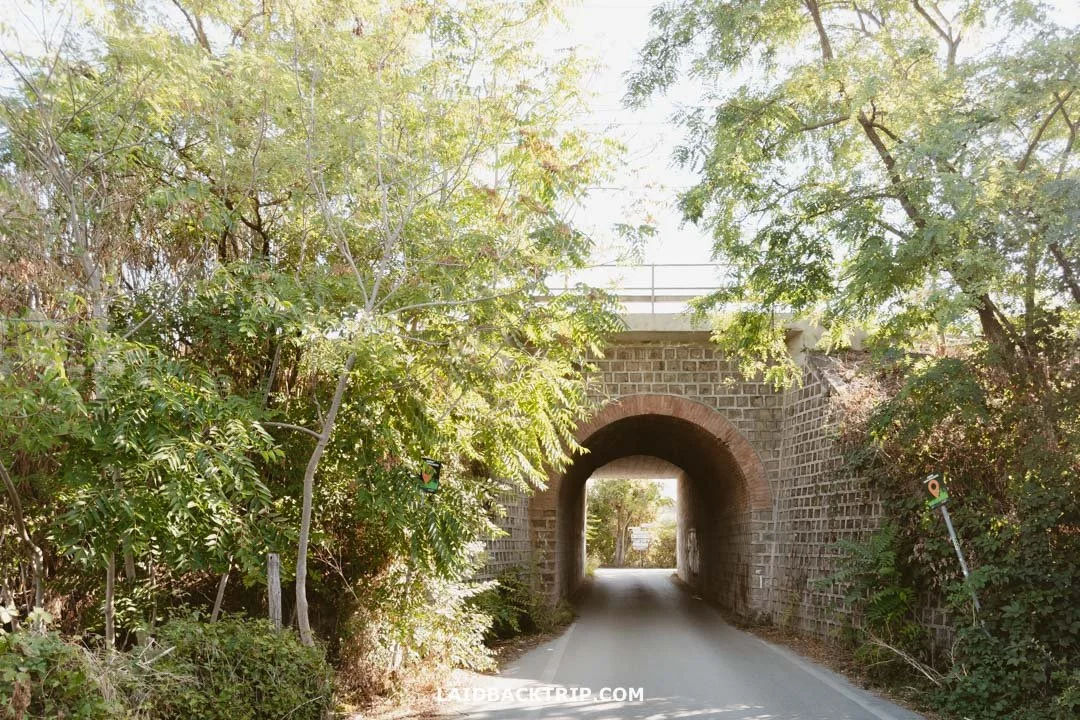
Here is the first underpass we passed on our route (I took the photo after we had walked beneath it).
We turned right here and went through a railway underpass, then kept going straight. After about 200 meters, we passed beneath another underpass. Once we left the tree-lined alley at the edge of the park, we walked along a quiet paved road. It was narrow, but there was a painted pedestrian lane on the right, even if it was mostly hidden by dead leaves. Either way, with so little traffic that morning, we felt completely safe on this stretch, even if the lane hadn't been there.
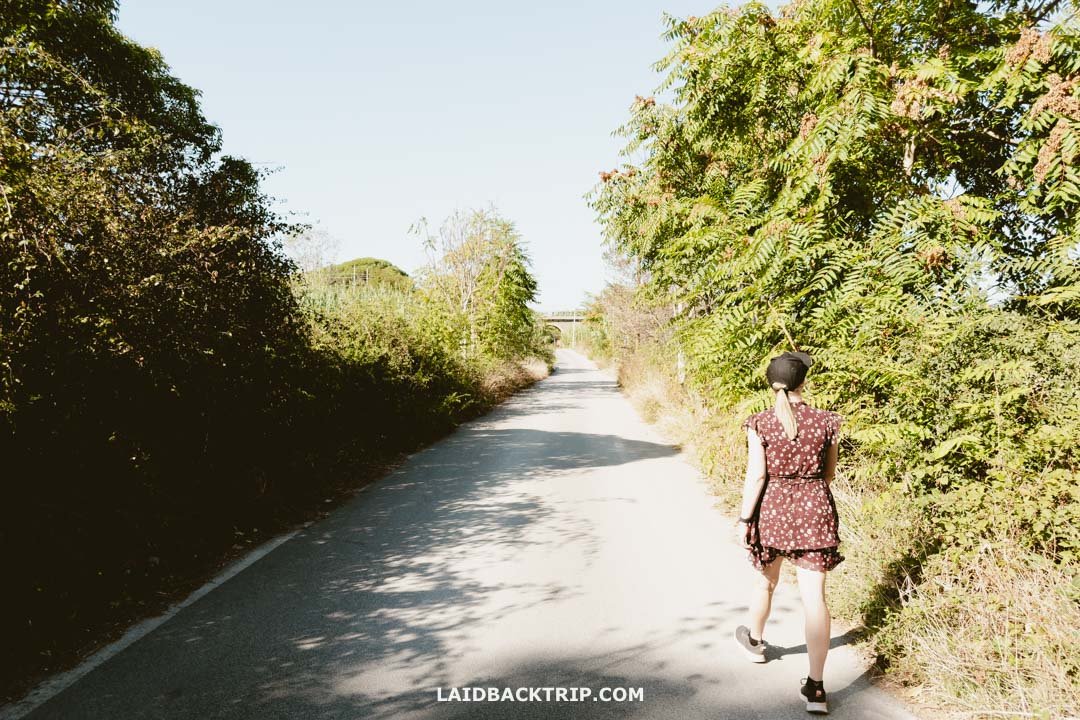
This stretch of Viale Appio Claudio was narrow but had very little traffic.
From here, we followed Viale Appio Claudio all the way to Via Appia Nuova. Once we arrived, we turned left and continued along the busy road toward the museum. The only tricky part was that we thought there would be a pedestrian crossing right in front of the museum, but there wasn't, so we had to walk an extra 150 meters to the next one, and then another 150 meters back to the museum. As I mentioned before, this was just the start of our day. Now we were finally ready to explore the Villa dei Quintili and the famous Via Appia!
Was It Worth It to Visit the Park of the Aqueducts?
It turned out that the Park of the Aqueducts was truly the top spot for seeing the ancient aqueducts in Rome, and while we couldn’t stay as long as we wanted, the whole trip to this site was definitely worth it. The Claudian aqueduct was among the most striking Roman ruins we saw on the entire trip, and the Aqua Felice was impressive as well. The reason, however, we enjoyed this park (probably even more than the Villa Borghese) was that we also explored the Via Appia. By combining both areas, we had a fantastic adventure on our last day in Rome!
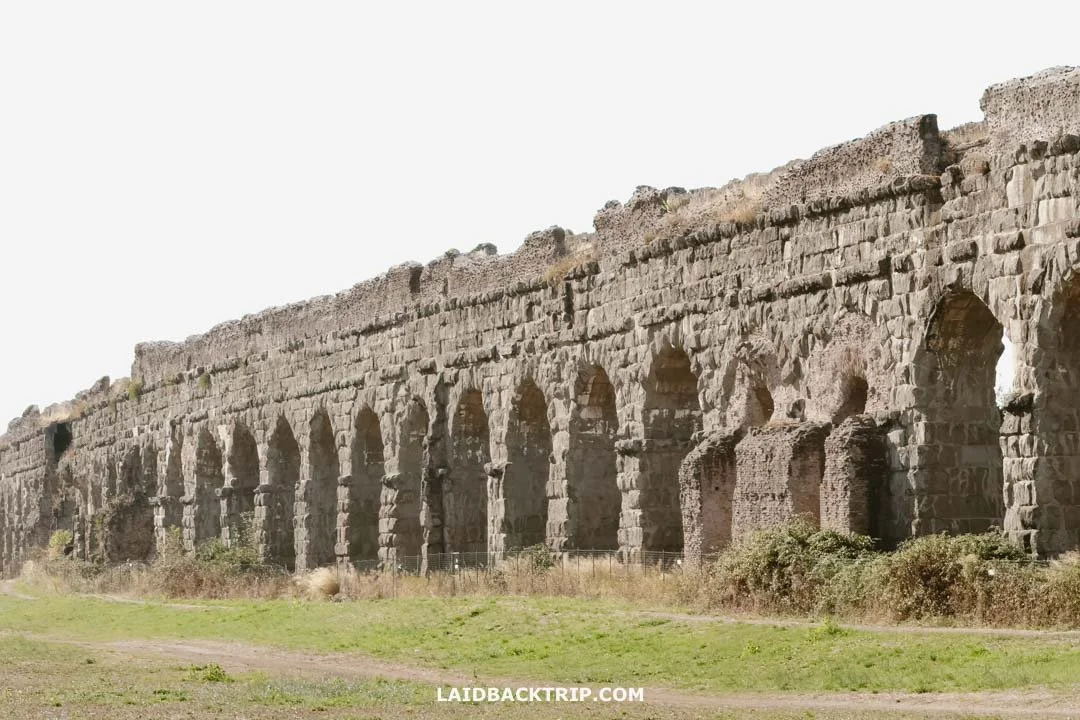
The Claudian aqueduct was incredible from every angle.
Travel Resources
Here you can find links to all the travel resources we use and which you might find helpful when planning your next holiday.
Accommodation: When looking for accommodation, we usually search hotels via Booking.com or Hostelworld.
Tours: Although we love to travel independently, some places are better to visit with a guided tour.
We prefer GetYourGuide for its easy-to-use interface and solid reputation. Another great alternative is Viator.
Rental Cars: When going on a road trip, we always use Rentalcars.com, a reliable site for booking a rental car in advance.
Flight Tickets: When looking for flight tickets, you can search Skyscanner to find the best price.
Travel Insurance: World Nomads and SafetyWing cover against risks of travel.
Discover everything you need to know before visiting St. Peter's Basilica in Vatican City, including what to see inside, how to climb the iconic dome, opening hours, ticket prices, guided tours, and the easiest ways to get there.