How We Spent a Day on the Ancient Via Appia
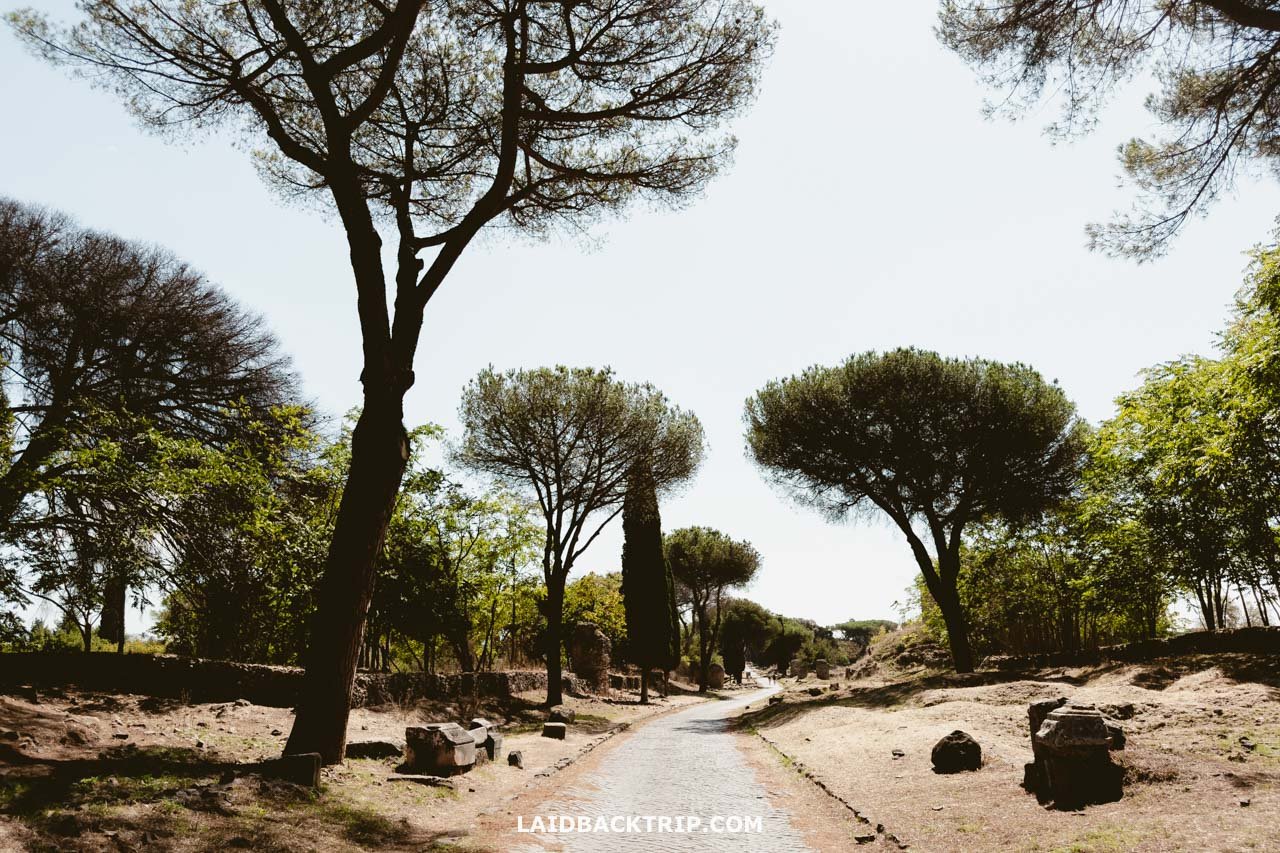
We all know the saying that all roads lead to Rome. Via Appia Antica was where it all began. We couldn't wait to explore it!
On our last day in Rome before flying home, we thought there couldn't be a better place to say goodbye to this amazing city than by visiting the ancient Via Appia, one of the oldest paved roads in the world. Ever since we landed at Ciampino Airport (which is nearby, so we saw the whole area from the plane and then the ruins along it from the bus heading to the city center), we had been debating whether to visit it.
Lucie insisted that this was one of the most significant projects the Romans ever built, while I was leaning toward a trip to the coast to see the sea. It was a tie until I found out about the nearby aqueducts, which looked fascinating. That settled it! We would come to see the Queen of the Roads, with its origins in the 4th century BCE.
During our day on the Via Appia, we had the chance to see many interesting places. Maybe the best part of the day was that the stretch of road and the museums along it, which we decided to explore, did a fantastic job of showing us its story from its ancient origins and its transformation in the Middle Ages to modern-day challenges.
Still, our favorite part of Via Appia was the laid-back atmosphere throughout the area. Even though the site is well-known and there were tourists around, it genuinely felt like we went off the beaten path, especially whenever we stepped inside one of the museums or historical sites. I won't spoil anything by saying we truly enjoyed our day exploring Via Appia, and with this guide full of practical tips, we hope you'll enjoy a trip back to Roman times with us as well.
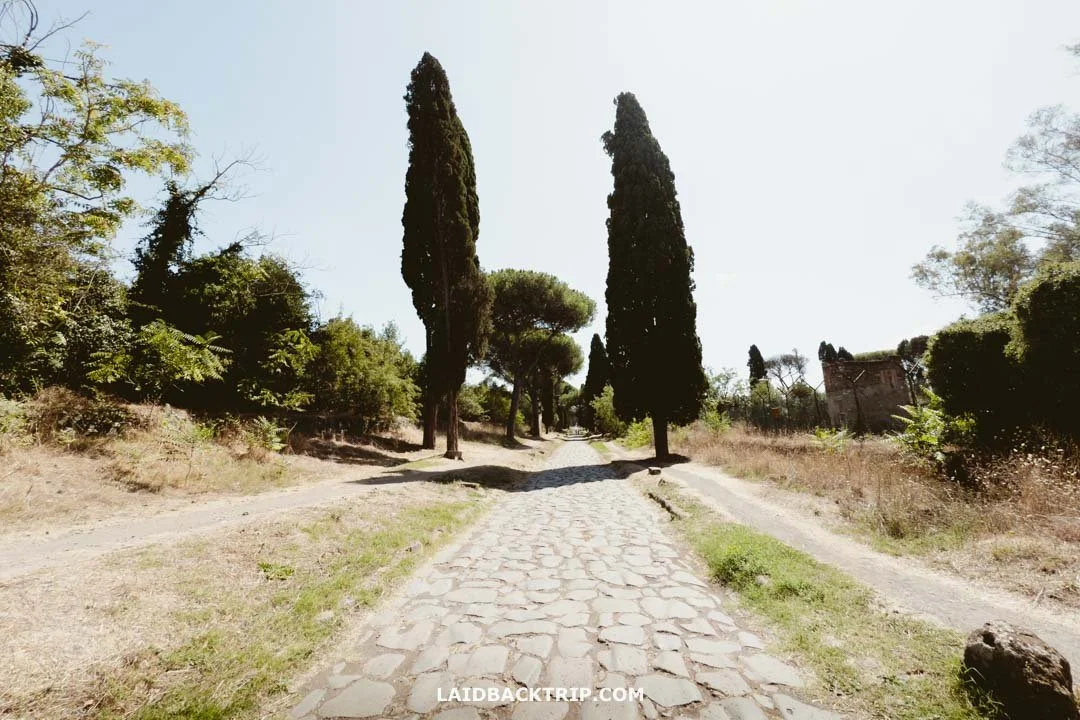
Via Appia was easily the most beautiful ancient road we ever visited.
Walking or Cycling the Via Appia?
The biggest riddle we had to solve was how we would actually get around the Via Appia, since both walking and cycling looked really tempting. We knew that cycling the Via Appia was a more popular option, and we knew that we would cover a bigger area in less time.
We were really tempted to choose this option, but Lucie pointed out that it wasn't how the Romans traveled in ancient times. The first Roman soldiers marched here. Since the section of Via Appia we planned to explore was just under five kilometers, biking really didn't make much sense.
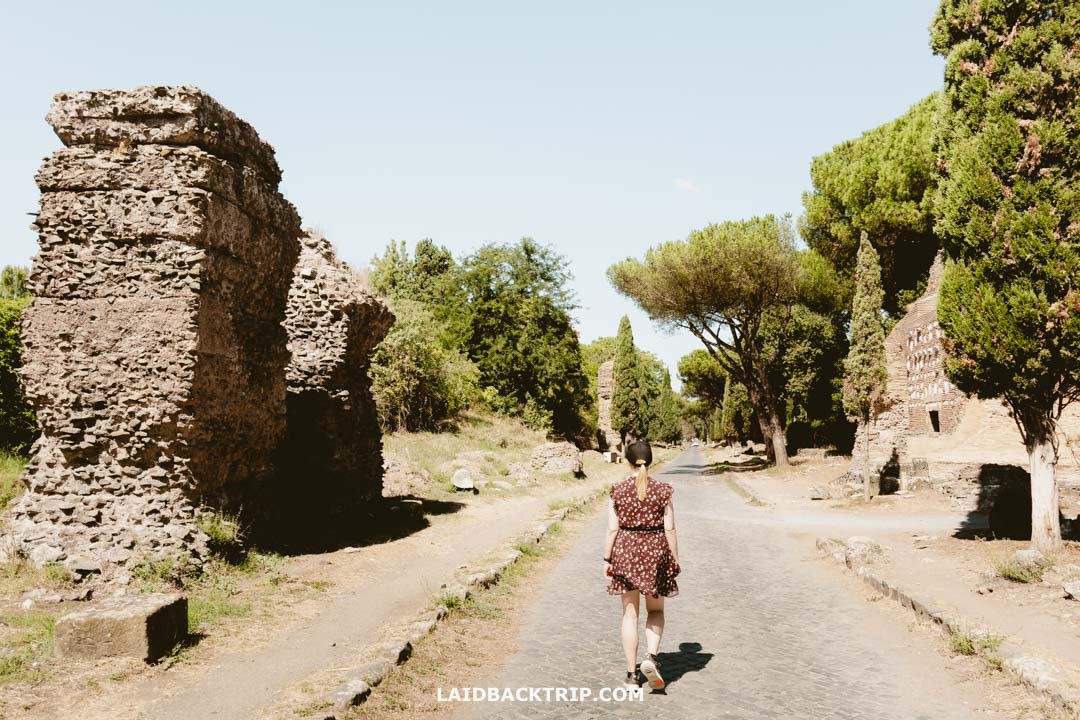
We did Via Appia on foot.
Another thing was that we wanted to visit the Park of Aqueducts before going to the Via Appia. This side trip would add six more kilometers to our plans, which was fine with us. Since we had the whole day for this area, we weren't in any rush.
Throughout the day, we saw plenty of people from both camps, and everyone seemed happy with their choice. Bikes were definitely more popular since they attracted guided tours. Because they mostly used e-bikes, it was likely the easiest way to explore the Via Appia.
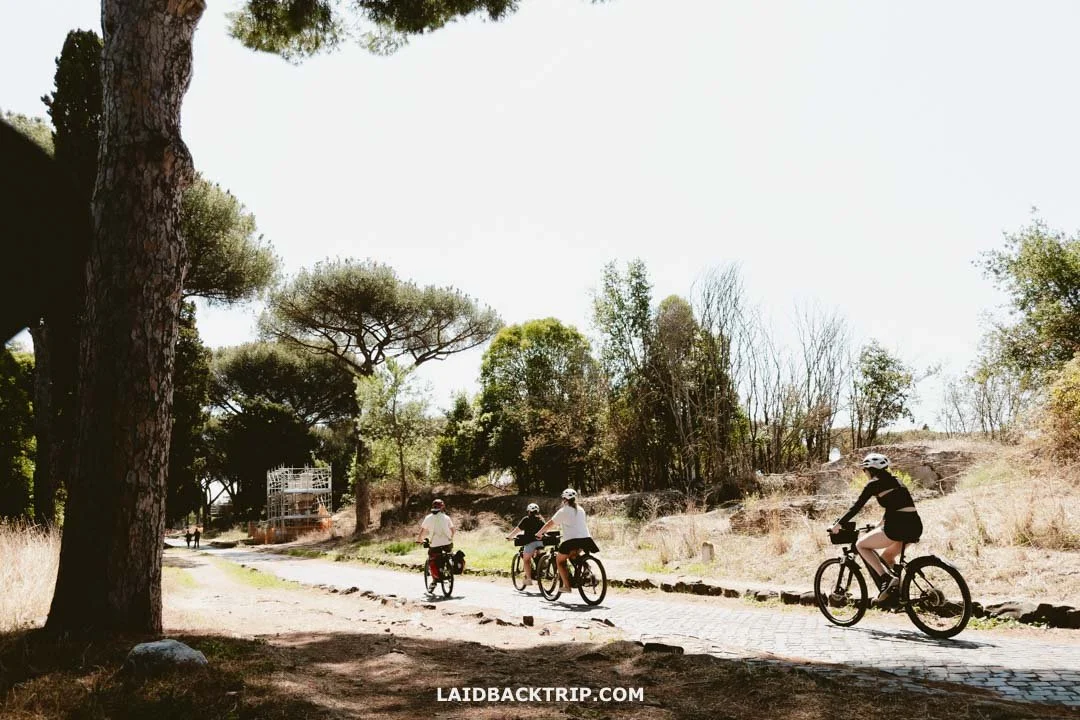
Cycling offers a fun way to explore Via Appia.
The only thing worth noting was that the ancient road still has basalt rocks, making the surface pretty uneven. Even walking on this kind of surface in some sections wasn't as comfortable as it might look from the pictures I took. The idea of biking here looked even less appealing.
World Nomads provides travel insurance for travelers to cover their trip essentials, including sports and adventure activities.
SafetyWing is affordable travel insurance for backpackers, long-term travelers, and digital nomads.
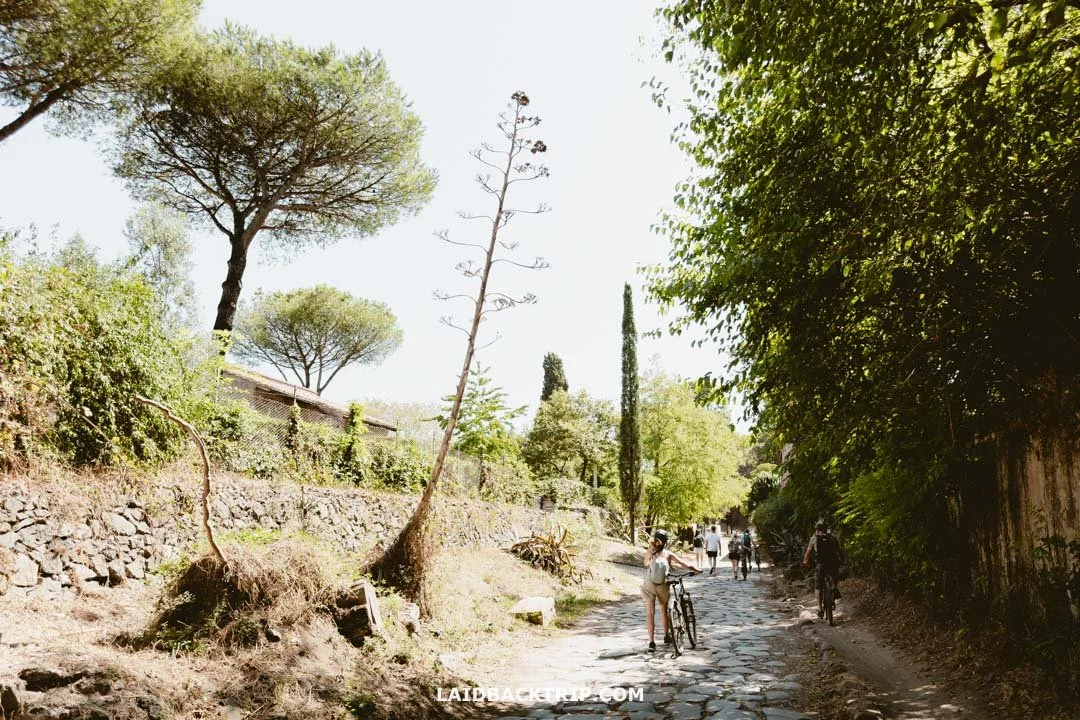
Some stretches of Via Appia were pretty rough for cycling.
I'm not exaggerating. Wherever possible, the ancient road was lined by a dirt 'comfort path' on each side, used by both walkers and cyclists. In the worst sections, we saw plenty of people even pushing their bikes. This obviously depends on how comfortable you are with cycling (we saw some brave souls even on gravel bikes here), but it's still good to know and prepare your body for the rattling experience.
However, since cycling allows you to see more in less time, there were definitely more people exploring Via Appia on bikes, often as part of guided tours.
Renting a bike on Via Appia is straightforward. We spotted a rental shop roughly halfway between the Mausoleum of Cecilia Metella and Capo di Bove (we came from the latter, so it was on our right), and another called Centro Servizi Appia Antica - EcoBike by the Sepolcro di Priscilla. If you decide to do Via Appia with a tour, you don't need to worry about renting a bike, obviously.
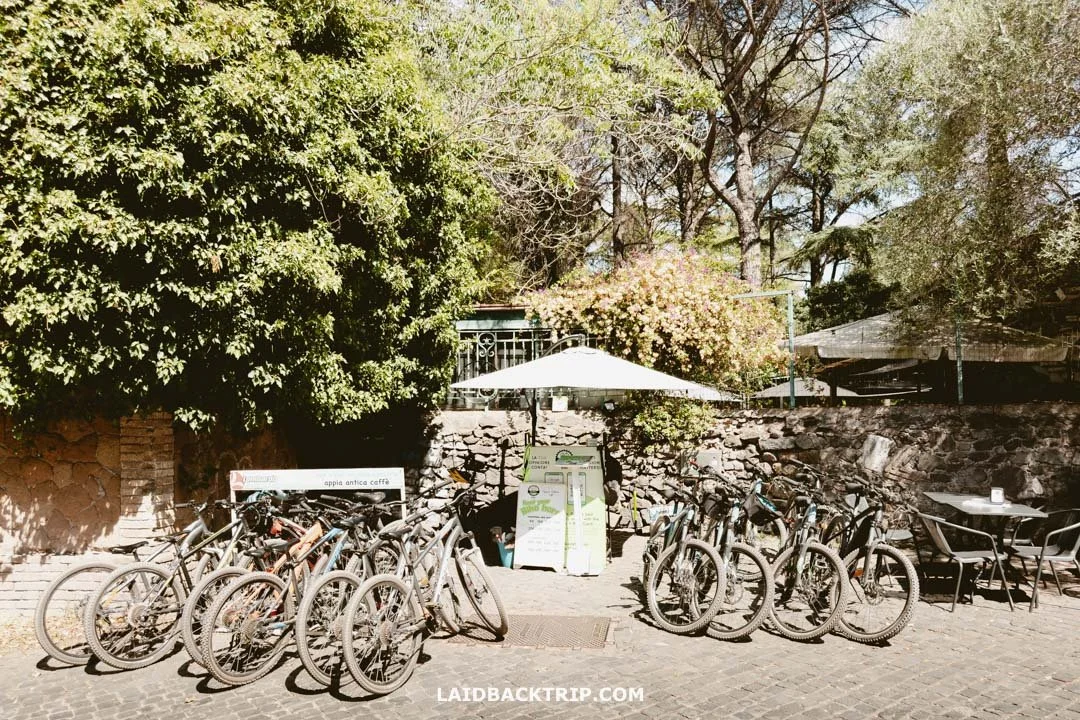
This rental bike shop was about 200 meters northwest of Capo di Bove.
Where to Start the Via Appia Trip?
Another reason we chose to explore the Via Appia on foot was that we considered starting at the Villa dei Quintili, which we reached by walking from the nearby Park of Aqueducts, easily accessible by metro. We planned to visit Via Appia independently, so combining the metro and walking seemed like a great idea to us. If we had skipped the Park of Aqueducts, then bus 118 stopped basically in front of the Villa dei Quintili.
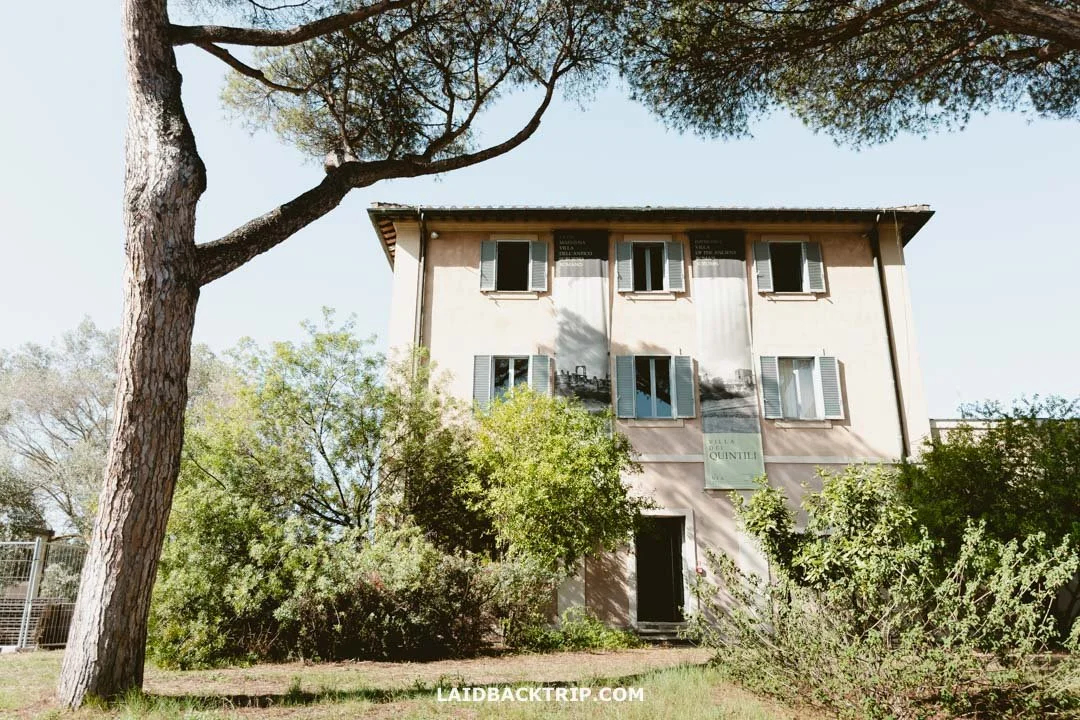
We entered Via Appia at Villa dei Quintili.
It's useful to remember the 118 bus because it connects the Via Appia with Piazza Venezia, Circus Maximus, and the Colosseum. Later that day, we took this bus from the Basilica of Saint Sebastian Outside the Walls, which marked the end of our Via Appia adventure.
We started our Via Appia walk at Villa dei Quintili and finished at the Basilica of Saint Sebastian, but of course, we could have done it in the opposite direction. We picked this route because we stayed closer to Termini metro station than the 118 bus stops and wanted to visit the Park of Aqueducts before it got too hot. After we finished the trip, we both agreed that this truly was the most beautiful stretch of the Via Appia.
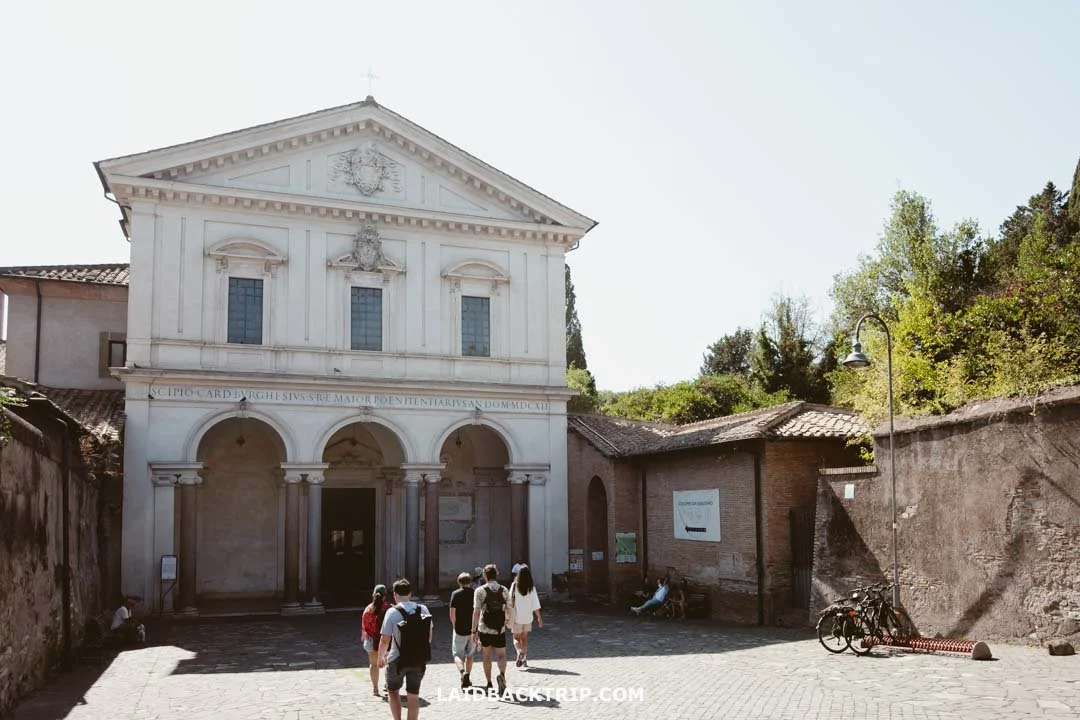
We finished our journey along Via Appia at the Basilica of Saint Sebastian.
At first, I thought we could start from our place in Rome's center and walk all the way to Villa dei Quintili. On paper, the idea seemed exciting, but we ultimately decided against it. We would have needed to walk to the Baths of Caracalla first, but we'd already done that a few days earlier.
Mainly, I didn't like that the stretch between those baths and Basilica S. Sebastiano was just a regular road with a lot of traffic. While it was possible, it didn't sound like fun to us, especially since that section is definitely not as charming as the one we chose.
Via Appia Is Not Completely Car-Free
Probably the biggest surprise for us was that the narrow, cobblestone road was not just used by pedestrians and cyclists, but also by cars. When we saw the first car, we thought it was just tourists who got lost. But after a few more, we realized it wasn't just a coincidence. Later, we watched a short documentary about the local properties, which explained the presence of cars here.
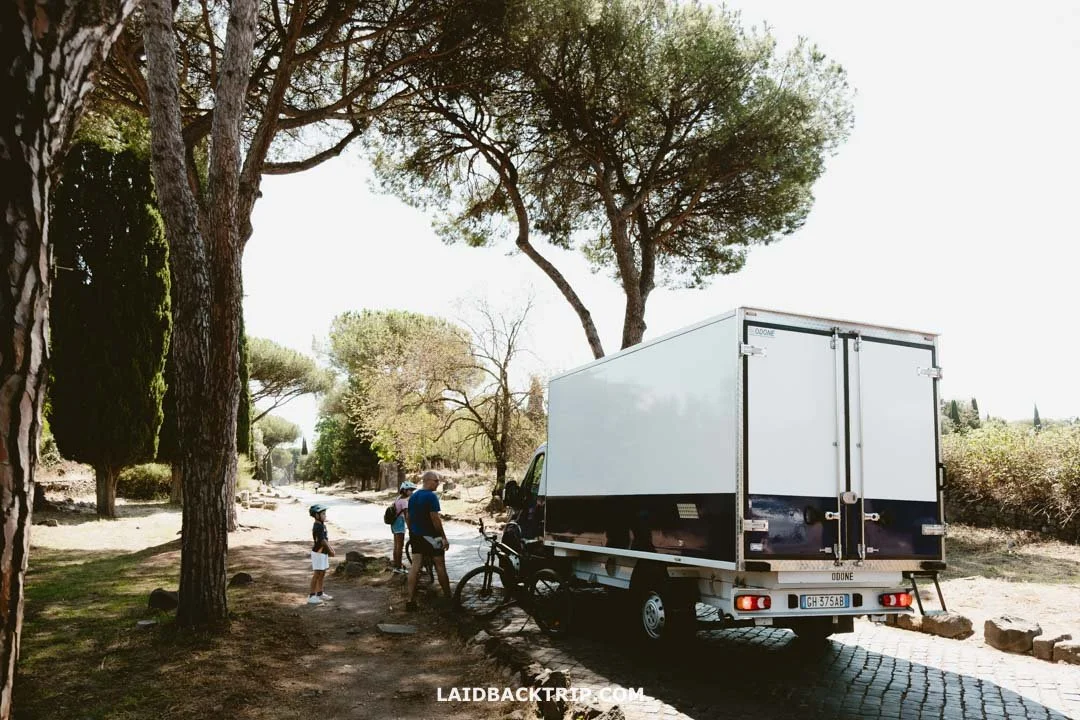
We passed a few cars and even this truck on Via Appia.
The traffic was very light here, usually just one car every so often, and they drove quite slowly, so it wasn't that big of a deal, but it definitely took away some of the charm. Still, Via Appia had plenty of it, even after 2300 years. Seeing a big delivery truck moving along this road was not how we had pictured it.
The Museums Were Quiet and Without Crowds
Another nice thing we discovered was that while we weren't the only ones visiting Via Appia that day, we were among the few who actually went inside the museums along the way. We've been in Rome for seven days already, and it was more common than we first thought, so it wasn't much of a surprise. Even places like the Baths of Diocletian or the Trajan's Market weren't really busy, so we expected these smaller museums to be even quieter. And they were.
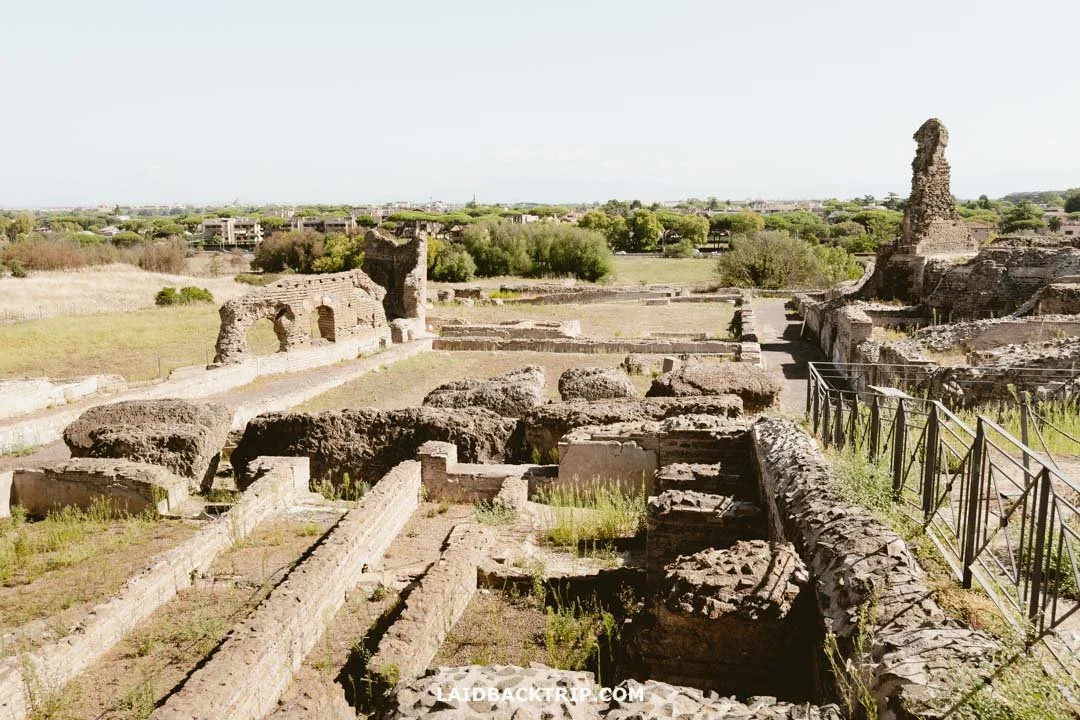
Pretty much all sites with entries along Via Appia were quiet.
Still, it was great because we could enjoy these less famous spots without the crowds we've been dealing with every day in Rome's historic center. Sure, the Pantheon or Colosseum were pretty amazing, but we have to admit that the number of visitors could be a bit overwhelming at times. The quiet museums on Via Appia balanced that out for us.
The Entry Fee to Via Appia
While technically the Via Appia Antica is free to explore, we decided to buy the ticket that would let us visit the museums along it.
The ticket cost €12 and gave us access to all the sites of the Appia Antica Archaeological Park: Antiquarium di Lucrezia Romana, Mausoleo di Cecilia Metella, Villa di Capo di Bove, Villa dei Quintili – Santa Maria Nova, Tombe della Via Latina, Villa di Sette Bassi.
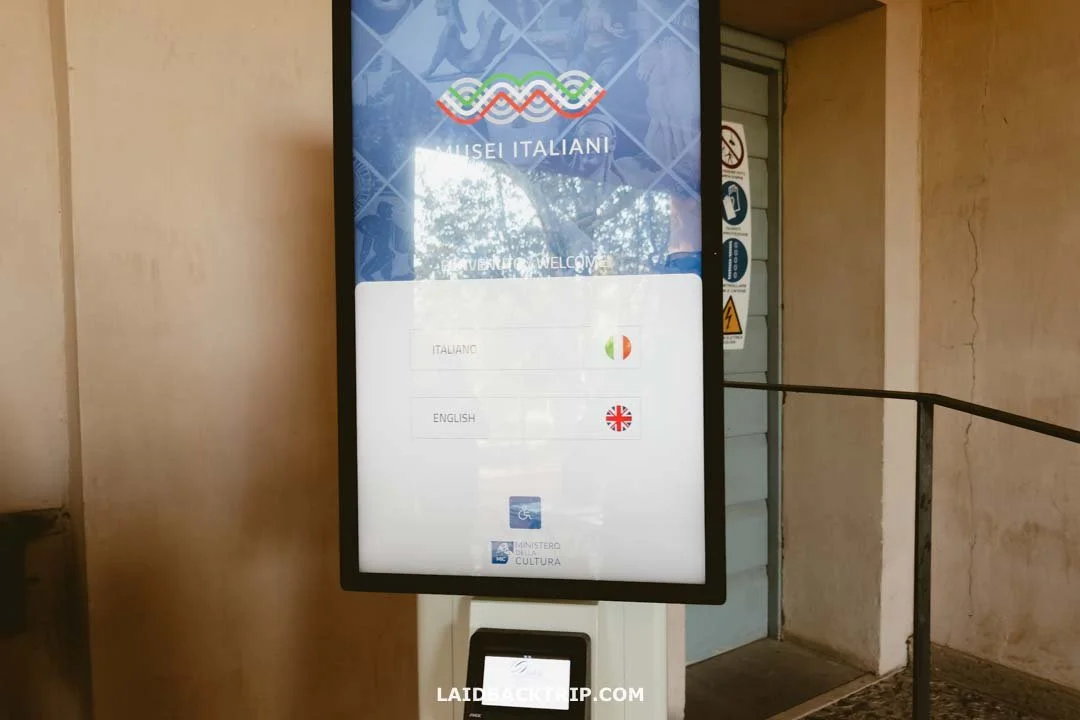
We bought the ticket for Via Appia's sites with entries at this ticket machine at Villa dei Quintili.
Even though these sites weren't as big or famous as their counterparts, they were quite interesting, and it was definitely money well spent. The ticket could be booked at the Musei Italiani website in advance or simply on the spot, as we did.
The ticket included more sites than we could possibly visit in a day, so we concentrated on the four located right on Via Appia: Mausoleo di Cecilia Metella, Villa di Capo di Bove, Villa dei Quintili, and Santa Maria Nova. The ticket was valid for seven days from the first time you used it, but we think only the most passionate history lovers would spread their visit out over several days. I also discovered from the list that Villa di Sette Bassi needed a reservation, and when I checked, there weren't any slots available on our visit day.
What to See on Via Appia
We originally thought that visiting Via Appia would be pretty straightforward. It's just a road, right? So we were pleasantly surprised to find out there was much more to see and do on Via Appia than we had expected. I imagined the experience would mostly be walking along the road, but there were also interesting ruins and museums along the way. Here, we include the places we thought were worth seeing on Via Appia, but we obviously don't list every single ruin we saw.
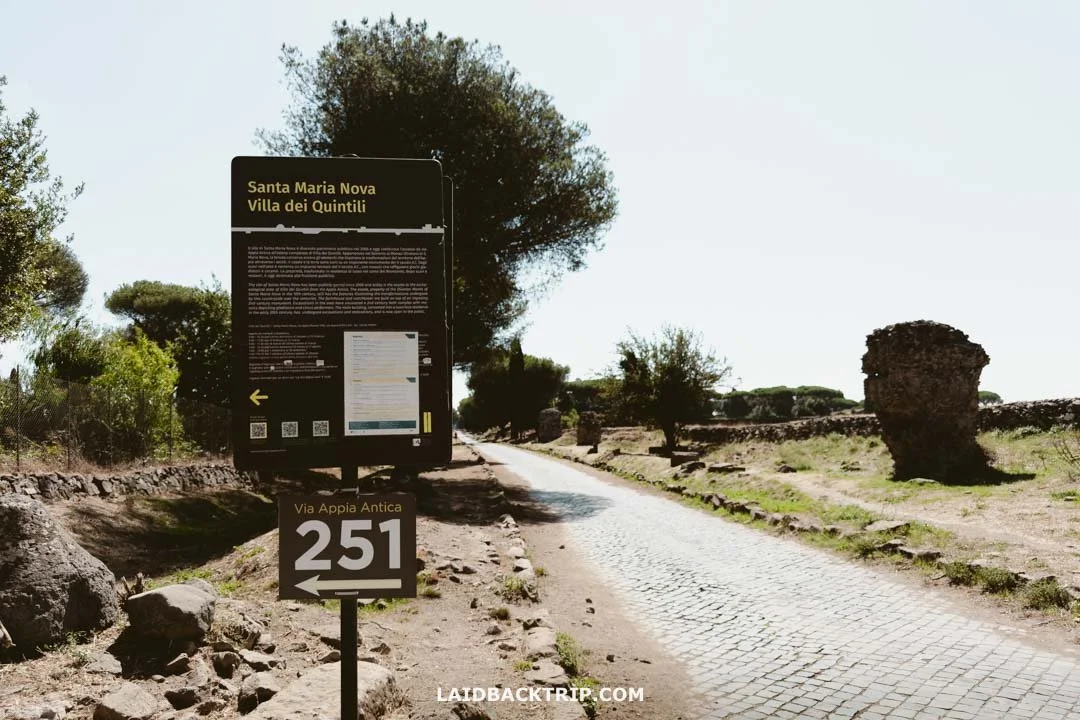
We didn't focus only on the ancient road but also visited a few museums connected to its history.
Probably our favorite part of all this was that Via Appia had a good number of small but very interesting museums. While we could have explored the road without technically stepping into any museums, they were actually the reason we enjoyed our day here, as they helped us really immerse ourselves in the experience.
The Park of Aqueducts
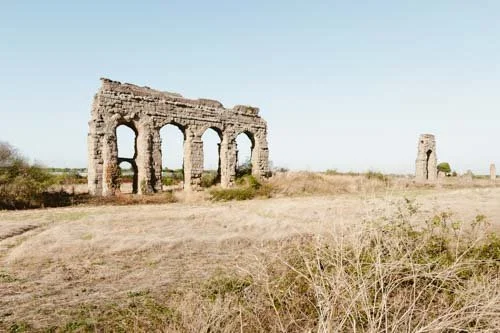
Technically, the Park of Aqueducts isn't on the Via Appia, but it's part of the greater Appian Way Regional Park. It was our first stop of the day, so we added it to this list because it was really interesting. We knew there were supposed to be ancient Roman aqueducts (which we wanted to see), but we weren't sure if it would be worth seeing on its own.
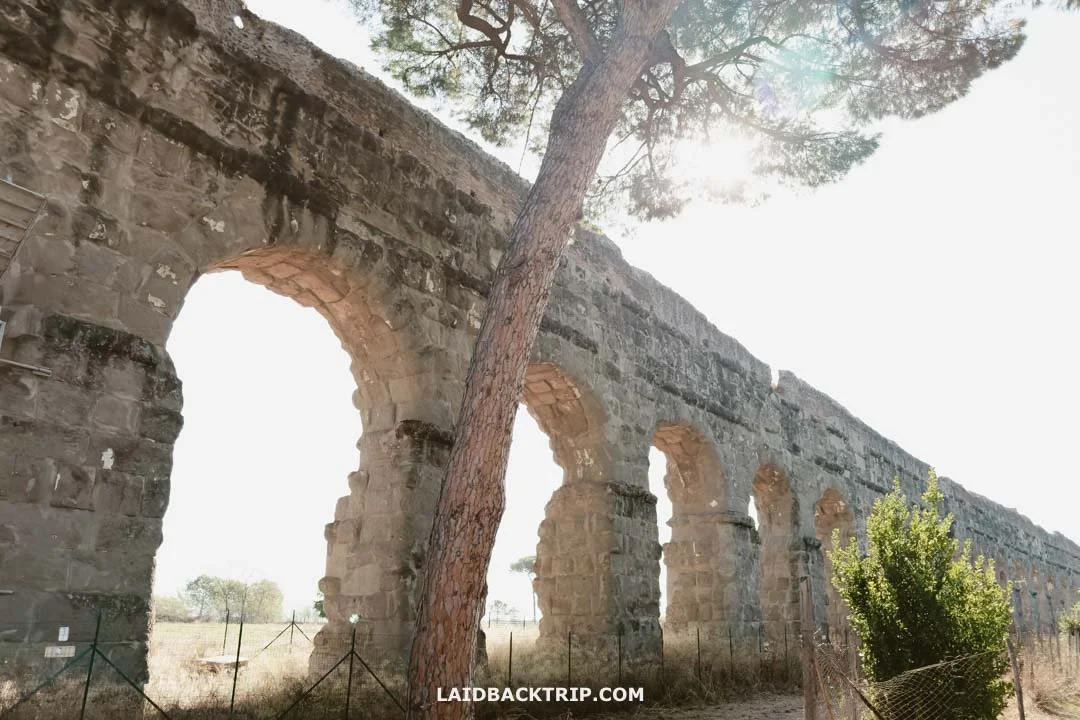
Before Via Appia, we visited the nearby Park of Aqueducts.
After realizing both areas were just a 2-kilometer walk apart, we decided to see them together. It was a great choice because we learned not just how the Romans transported their legions and goods, but also how they supplied drinking water to their city. In addition to the aqueducts, we explored nice walking trails, found some other ruins, and even saw a pond with turtles!
If you make it to Via Appia and are interested in Roman history (and have enough time), don't miss it. It's really worth visiting, and since it's close to the metro, it's easy to reach. We put together a helpful guide on what to see in the Park of Aqueducts, so be sure to check it out!
The walk from the Park of Aqueducts to Villa dei Quintili wasn't exactly scenic, a back road, a quiet neighborhood, and the noisy Via Nuova, but it was at least short. If you're visiting by bike, the journey is even faster.
Villa dei Quintili
The first place we visited on the Via Appia was the Villa dei Quintili. Interestingly, we entered the site from Via Appia Nuova, a newer road built parallel in the 18th century by Pope Pius VI. We had already traveled this modern, busy road on our trip from Ciampino Airport a few days earlier, but we had no idea then that we would return here (we didn’t even know what this place was).
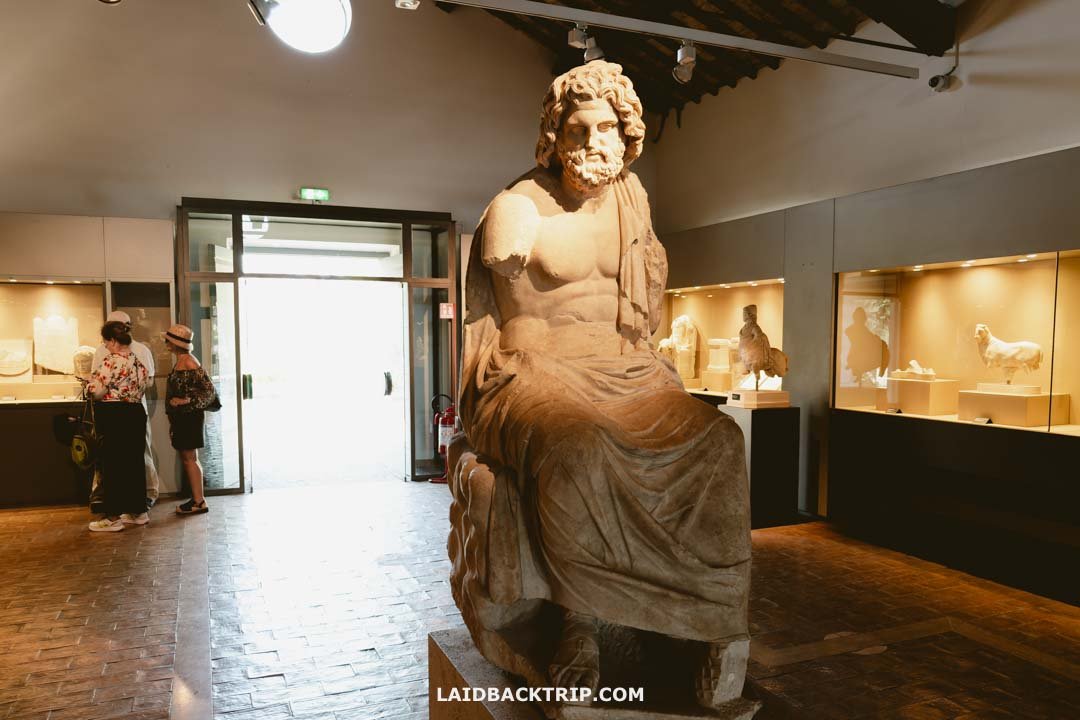
Villa dei Quintili even had a small museum with ancient artifacts.
Once we entered Villa dei Quintili, one of the staff members greeted us and explained how the site worked, how the tickets worked, handed us a paper map with information, and pointed us to the ticket machine next to him. He also answered my burning question about whether we could actually pass from Villa dei Quintili onto the Via Appia, since I wasn't sure that was possible when planning the day. To my relief, he said it was.
The museum entrance at Villa dei Quintili was the busiest place we saw on the Via Appia, but only because a large group of kids was there on a school trip. Once we left the 'villa' and headed to the main site atop a small hill, we were alone. During our visit to the ruins, it was just us, a family of three with a private guide. A highlight was reaching the Nymphaeum and discovering an event with locals dressed in traditional Roman attire, which was really cool.
The day before, we visited the charming town of Tivoli from Rome, where we explored some fascinating UNESCO sites. One of them was Villa Adriana, which definitely came to mind as we wandered around Villa dei Quintili.
Built in the 2nd century CE by the wealthy brothers Sextus Quintilius Condianus and Sextus Quintilius Valerius Maximus, the villa was quite large and luxurious, with private thermal baths, a nymphaeum, and a massive stadium. In 182 CE, Emperor Commodus had them executed on false charges to seize the property for himself. Under imperial ownership, it was expanded into an even more luxurious palace.
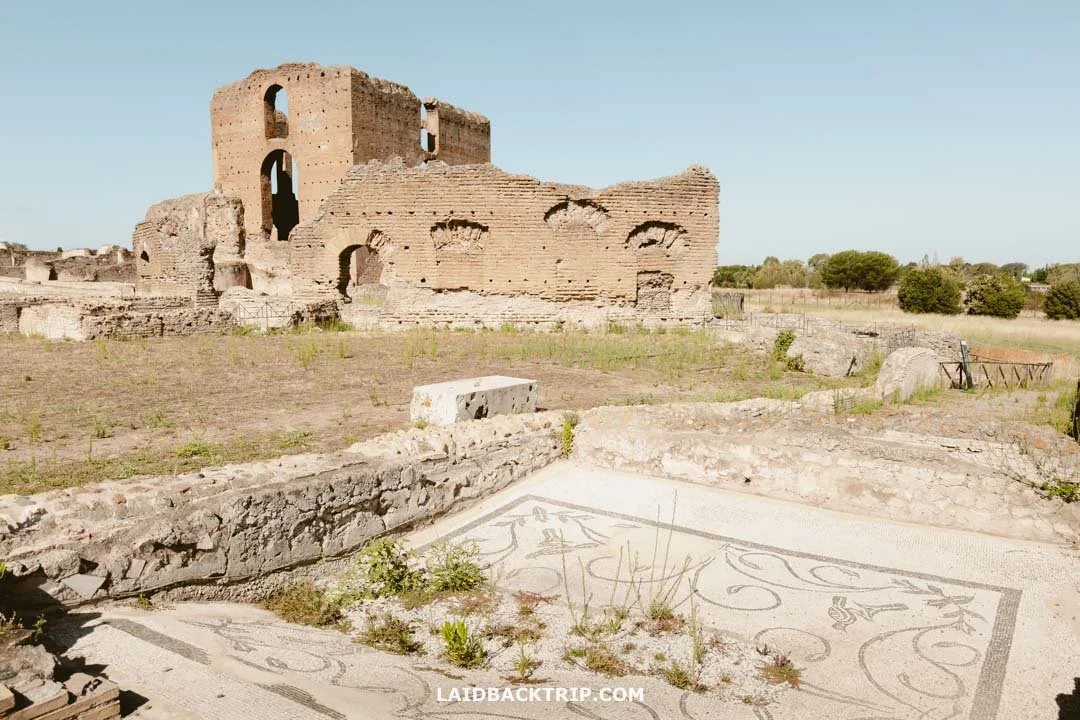
Villa dei Quintili was an opulent residence built in the 2nd century CE.
Today, its sprawling ruins are the largest suburban villa complex in the Roman countryside. Though it wasn't as grand as Emperor Hadrian's villa, it was fascinating, and we couldn't have chosen a better place to begin our Via Appia adventure.
From there, we followed the exit signs toward the Via Appia. Before we managed to step onto the ancient road (even though we could see it through the fence), we had the chance to explore another site included in our ticket: Santa Maria Nova. Since both sites are right next to each other, they share the same hours: 9 AM to 6:30 PM. In summer, they're open until 7:15 PM, and in winter, they close at 4:30 PM.
Santa Maria Nova Complex
We made our way under a metal bridge, which also served as a viewpoint platform, beside the Piranesi Cistern at the west corner of Villa dei Quintili, and followed the dirt path to Santa Maria Nova. When we got there, we noticed Santa Maria Nova was pretty quiet. We entered the museum through the wrong door, but it didn't make a difference since the space was small and we quickly figured things out.
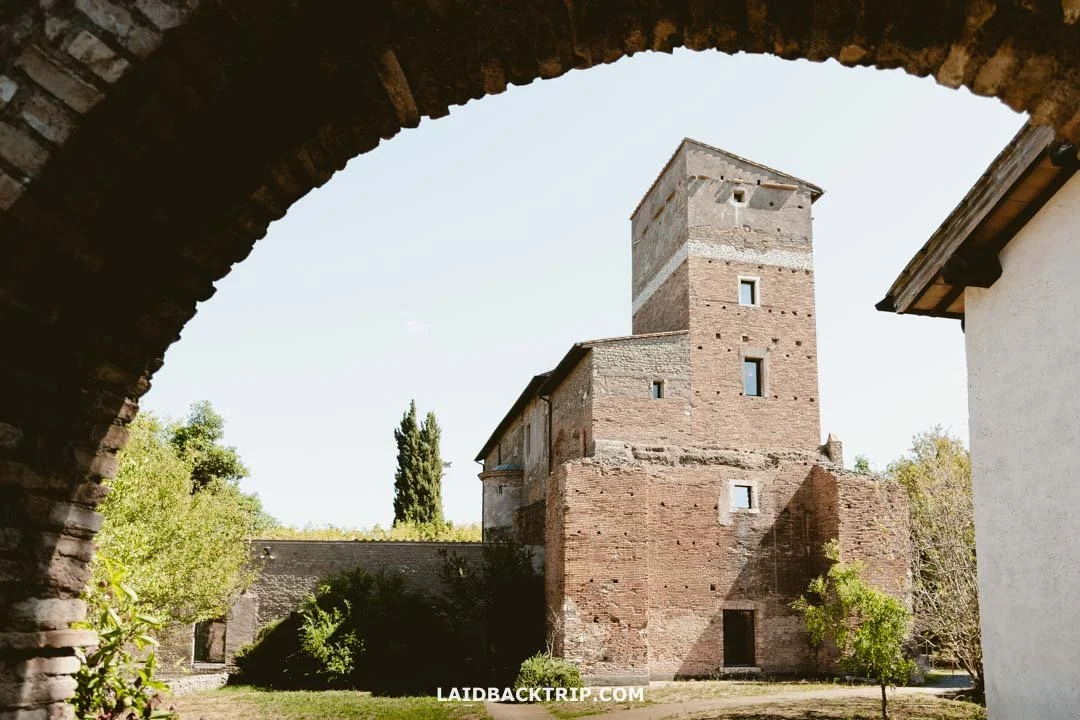
Even though it doesn't look like it today, Santa Maria Nova was built as thermal baths.
Inside, we learned that Santa Maria Nova was originally built in the 2nd century CE as a bath complex. In the 16th century, it belonged to the Olivetan Monks of Santa Maria Nova, and in the early 20th century, it was converted into a luxurious residence. Today, it's a quiet museum in a beautiful building centered around a medieval tower. While we met some staff outside the entrance gate, inside, it felt like we were the only visitors.
One sign of how quiet things were here was that the only other tourists we met actually talked to us about a movie they had just seen, saying it was really good and that we should see it too. This kind of short interaction would be rare in busier places like the Capitoline Museums. Since we had nothing else planned, we watched the film next. The short movie focused on Via Appia and its ancient history, and while it wasn't a James Cameron production, it got the job done.
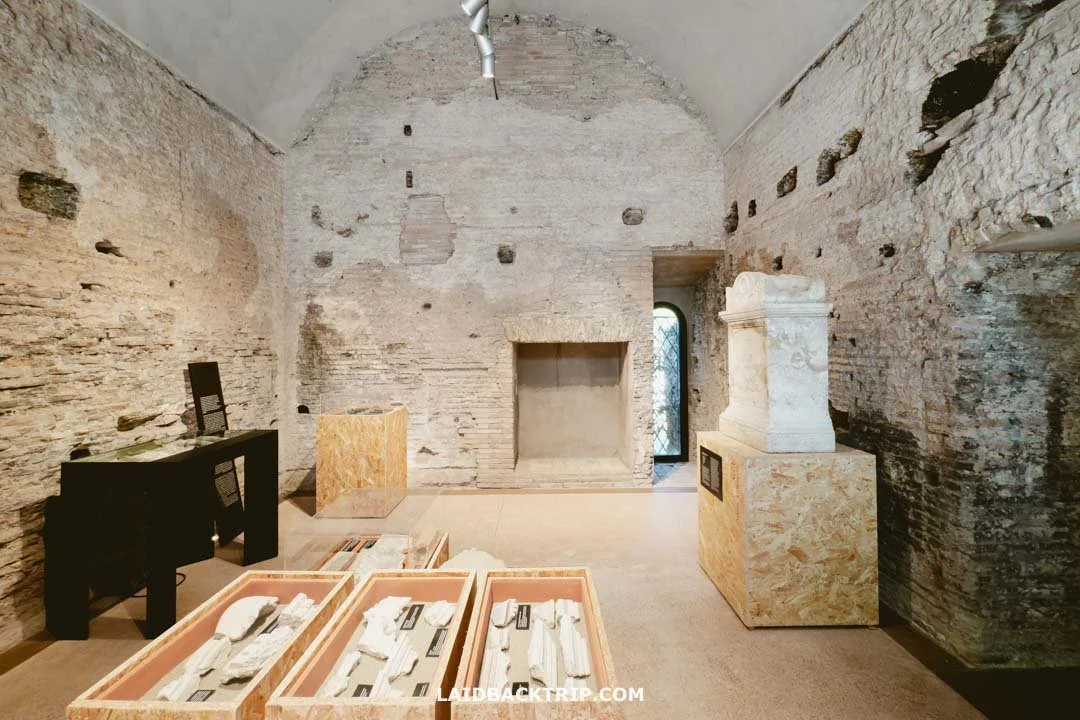
Inside Santa Maria Nova there was a small museum.
Inside, on the lower floor, we saw the usual mix of ancient artifacts from the Via Appia. The upper floor featured a science-themed exhibit mostly for kids, though some interactive displays were interesting even for adults (right, Lucie?).
Of all the places we visited, we didn't find the Santa Maria Nova exhibit as engaging as the others (many displays weren't in English, and we didn't have kids with us), so we focused on the beautiful restoration and enjoyed wandering through the surrounding green garden.
When we finished at Santa Maria Nova, we exited through the main gate and found ourselves on a dirt path. Turning left, we walked less than 50 meters and finally joined the Via Appia Antica, the main reason we took this entire trip.
History of Via Appia Antica
Originally built for military purposes, the Via Appia (Appian Way) was one of the most important roads in the Roman world. Construction began in 312 BCE under Censor Appius Claudius Caecus to connect Rome with Capua. The main purpose of this first long-distance paved road was to move Roman legions quickly into the south during the Samnite Wars. By bypassing marshes and cutting straight through rugged terrain it allowed Rome to send troops and supplies with unprecedented speed, ultimately enabling the conquest of southern Italy.
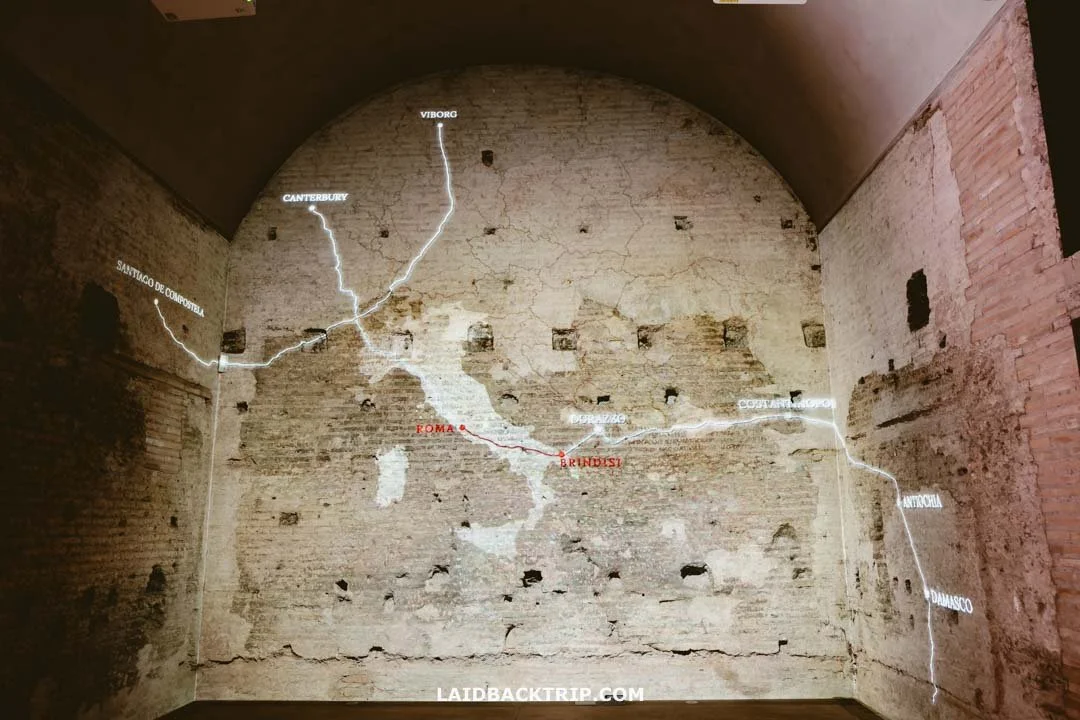
Via Appia extended from Rome to Brindisi.
As the empire expanded, the road was extended to Brindisi, the major port on the Adriatic Sea. This made the Via Appia the primary "highway" to the East, connecting Rome with Greece, Egypt, and Asia Minor. It supported trade by making it easier to bring grain and other goods into the capital and also enabled much faster communication, such as imperial decrees and news, via a network of official way-stations.
Romans could not bury the dead within city walls, so the main road into Rome eventually became the top place for the elite to construct grand tombs and mausoleums. Wealthy families also built villas along the road, and these, along with the impressive memorials, demonstrated the state's power to travelers entering the city. In later years, sites like the Catacombs of Saint Sebastian became sacred to early Christians and drew pilgrims.
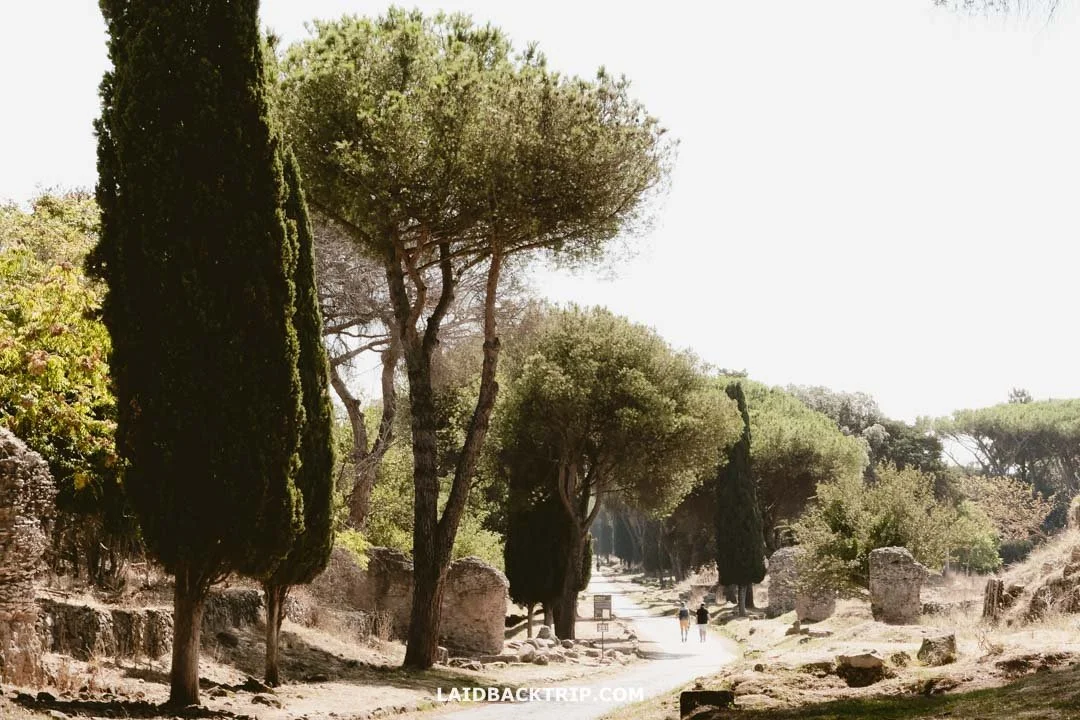
Via Appia was the most important road in Rome.
The road also saw one of Rome's most brutal displays of power. After the defeat of Spartacus's slave revolt in 71 BC during the Third Servile War, the Romans crucified 6,000 rebels along a 120-mile stretch of the Via Appia as a warning to anyone who might challenge the state.
One more interesting detail about Via Appia Antica: In the 18th century, Pope Pius VI ordered a new road to be built parallel to the historic route. This became the Via Appia Nuova, and we had already experienced this busy four-lane road, packed with traffic, on our bus ride from the airport and again earlier that day when we walked along it from the Park of Aqueducts.
Walking the Via Appia Antica
Since we wanted to visit the museums, we planned to explore the 4-kilometer section of Via Appia between Villa dei Quintili and the Catacombs of Saint Sebastian. Our basic plan was to walk along the Via Appia toward Rome. When I checked the map, I realized we could also walk south from Villa dei Quintili almost all the way to Frattocchie town. The distance would be 10 kilometers, which sounded tempting, but without bikes, it wasn't doable since we wanted to visit the museums.
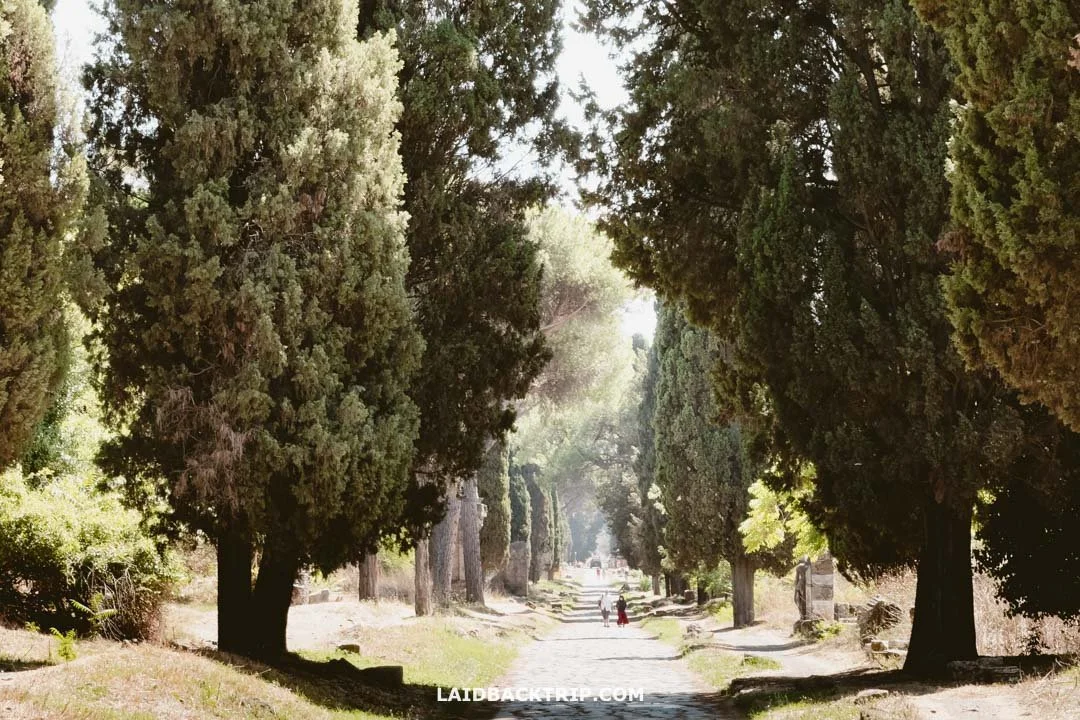
Even after 2300 years, the oldest Roman road still stands as a reminder of Rome's former glory.
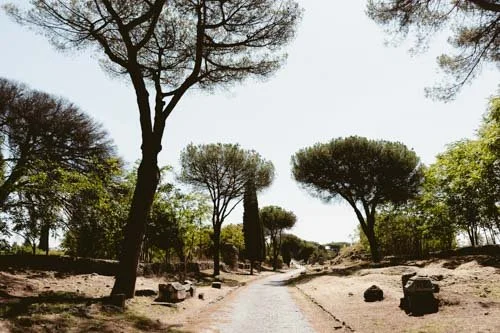
The Via Appia Antica today feels like a timeworn country lane, paved with big basalt stones that are polished and bumpy from centuries of footsteps and wheels. Tall stone pines and cypress trees frame the path, scattered with ancient tombs, marble fragments, and grassy fields. It was the perfect scene, especially as the whole walk was filled with the sound of cicadas and the scent of a hot summer day.
Because of the big basalt stones, walking on the road was more challenging than I thought, but I'm definitely spoiled by today's flat sidewalks. To be fair, for the Romans, this road must have been a game changer compared to the marshes that used to cover southern Rome. The best part was that it's so easy to follow (it's basically a straight line), so there's really no way to get lost. That definitely made our self-guided exploration much more easier.
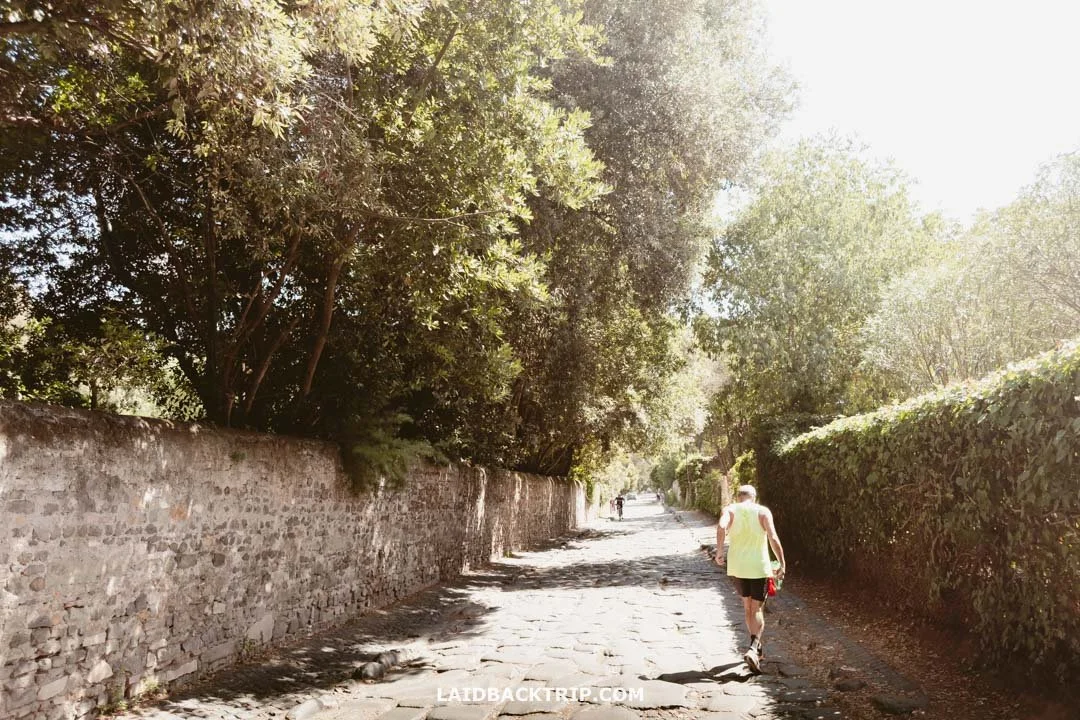
The big basalt stones made walking slightly more challenging than we had expected.
As we walked, we noticed the tombs and monuments along the road varied greatly in shape and condition. Some were still in good shape, some were badly damaged, a few had been restored, and many were covered in scaffolding, while others had nothing left but stones or foundations. We also found it interesting that some burial sites, like the Mausoleum of Romulus or Tomb of the Scipios, were well-documented, while others, like those of Seneca or Horatii and Curiatii, were more legendary than factual.
Capo di Bove
Capo di Bove was built in the mid-2nd century CE as thermal baths and was used until the 4th century CE. Today, it is divided into two areas, and we explored both. The first section, with the foundations of the thermal baths, was free to enter. It was quite small compared to the big ones like the Baths of Diocletian or Baths of Caracalla, and with excavations still ongoing, the place was not visually striking. Still, it was fascinating to find a spot like this on Via Appia.
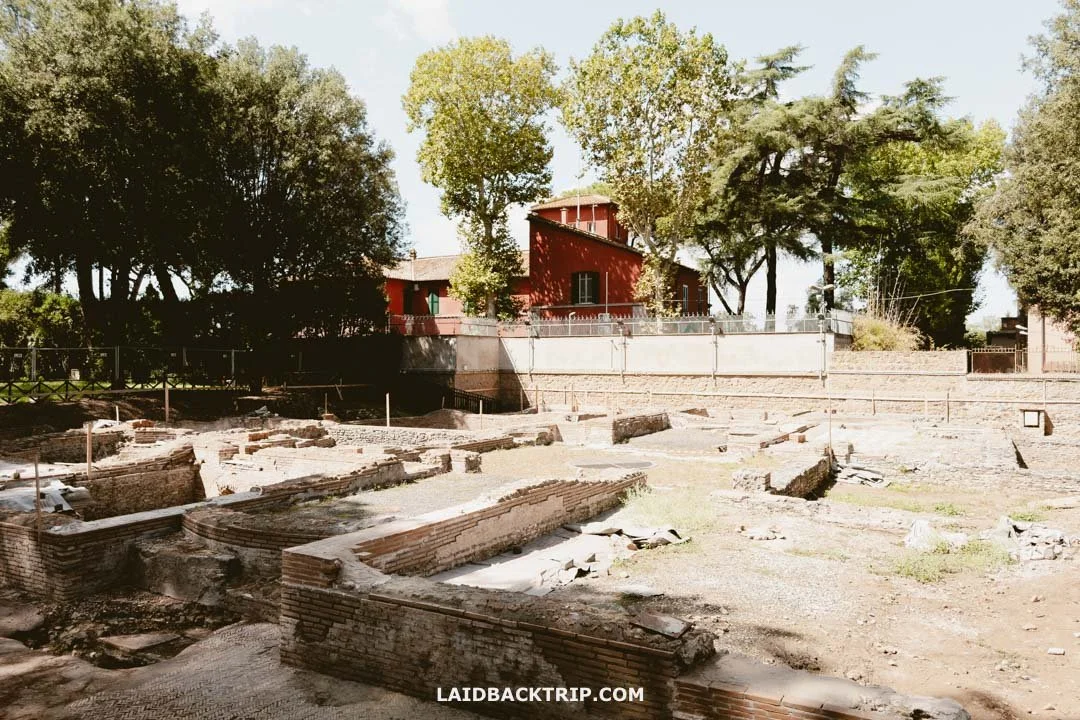
Very little of the original thermal baths survives at Capo di Bove today.
Our favorite part was the next section, which was the main villa accessible only with a ticket. Inside the beautiful country house, we found a small museum that offered us a new perspective on the Via Appia. When we mentioned that the other museums on Via Appia were quiet, when we entered Capo di Bove, it felt like we were the first ones who actually stepped inside the ticket area that day.
The staff greeted us and gave a brief tour, explaining the basics of where we were and what we were about to see. They asked us if we wanted to watch a short movie about the Via Appia and Antonio Cederna, and also suggested that we take time to explore the villa's exterior walls, which were decorated with artifacts found on the Via Appia.
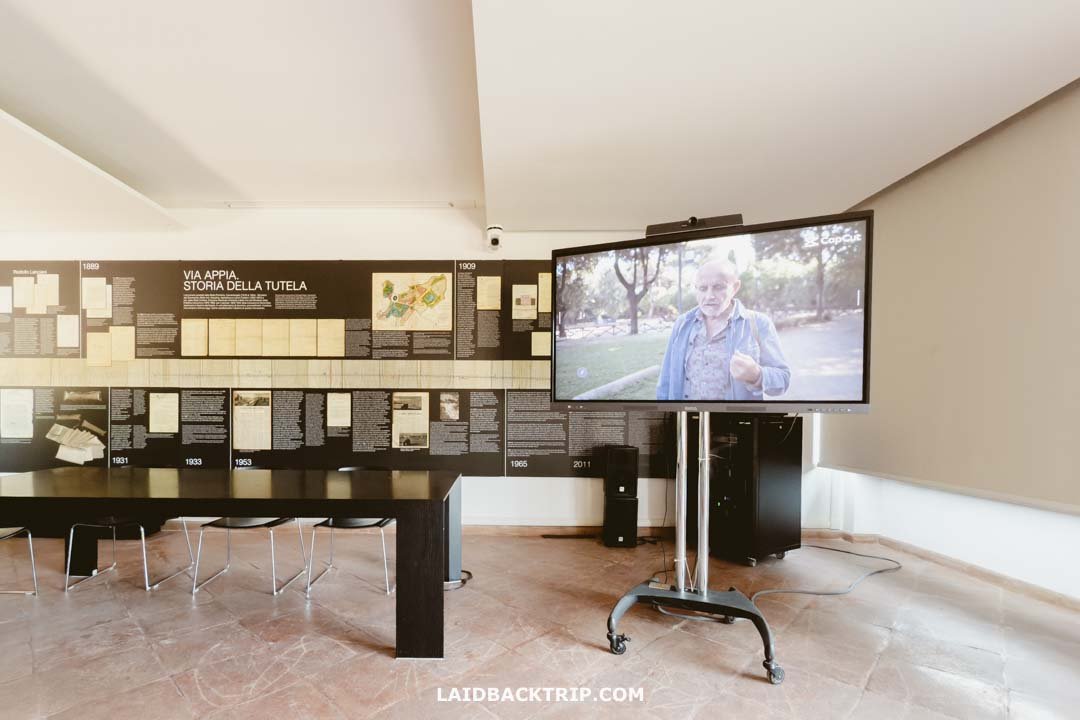
Inside the Capo di Bove villa is a small museum about Antonio Cederna.
I have to admit I was a little skeptical, but before I could say anything, Lucie was already on her way into the museum room with the projector. We spent the next 10-15 minutes watching a film about Via Appia's modern history. Antonio Cederna's story was truly interesting. He was a key Italian journalist and environmentalist who protected this ancient road. His campaigns against illegal building and neglect helped create the Appia Antica Regional Park and turned the ancient Roman road into a protected heritage site.
By the time the credits rolled, I was glad we took the time to discover this piece of history. It definitely made us appreciate the ancient road even more. After the movie, we checked out the small exhibit with more information and photos, and enjoyed being sheltered from the relentless sun. Then we headed outside to explore the small garden and continued toward our final stop, the Mausoleum of Cecilia Metella.
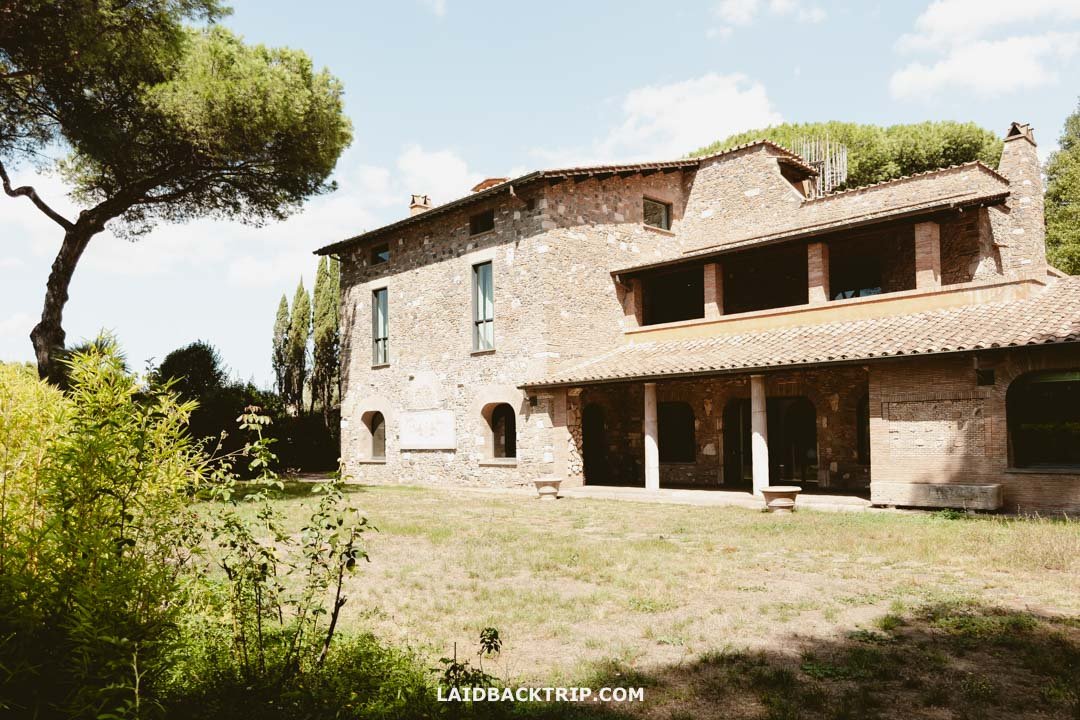
The villa at Capo di Bove was very quiet.
Mausoleum of Cecilia Metella
Our second-to-last stop on the Via Appia was the Mausoleum of Cecilia Metella, which we honestly didn't know much about. But since it was included in our ticket, we were about to change that. The first thing we learned was that the site actually had two structures from different eras: the Mausoleum of Cecilia Metella, built between 30 and 20 BCE, and Palazzo Catani, a 14th-century fortified residence built on the main road by Cardinal Francesco Catani.
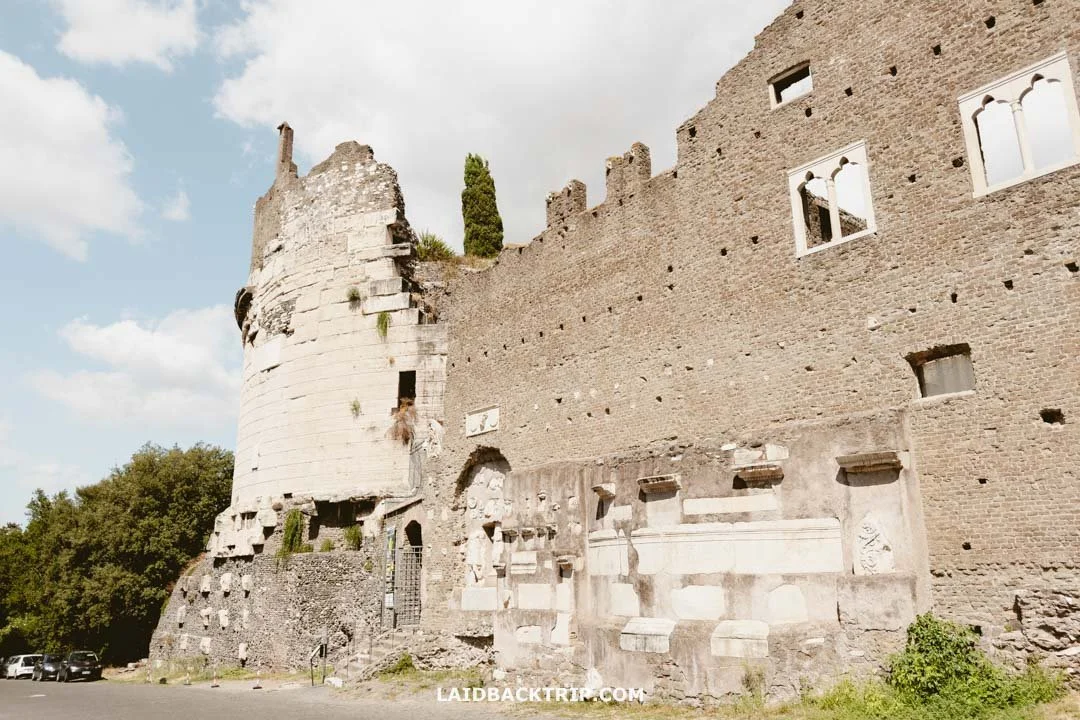
The Mausoleum of Cecilia Metella was constructed in ancient times and rebuilt in the Middle Ages.
We had already visited Castel Sant'Angelo, which was originally built as Hadrian's Mausoleum, and had also passed by the Mausoleum of Augustus (which was still closed). Our first impression of this one, once we entered, was that this one was much more modest. But Cecilia Metella wasn't Augustus or Hadrian, so it's not really a fair comparison. While the structure wasn't as grand, we learned it's one of the best-preserved tombs from Roman times.
When we entered, a staff member welcomed us and quickly explained where we were and what we could see. We followed his advice and first went into the mausoleum, where a short animation about Cecilia Metella played automatically. Other than the conical tower itself, which was turned into the palace's tower during the Middle Ages, there wasn't much else to see. Next, we explored the residence, which, like the mausoleum, had no roof and was basically just a ground floor with a few rooms. There were some VR sets, but after a long day in the sun, trying them was the last thing we wanted to do.
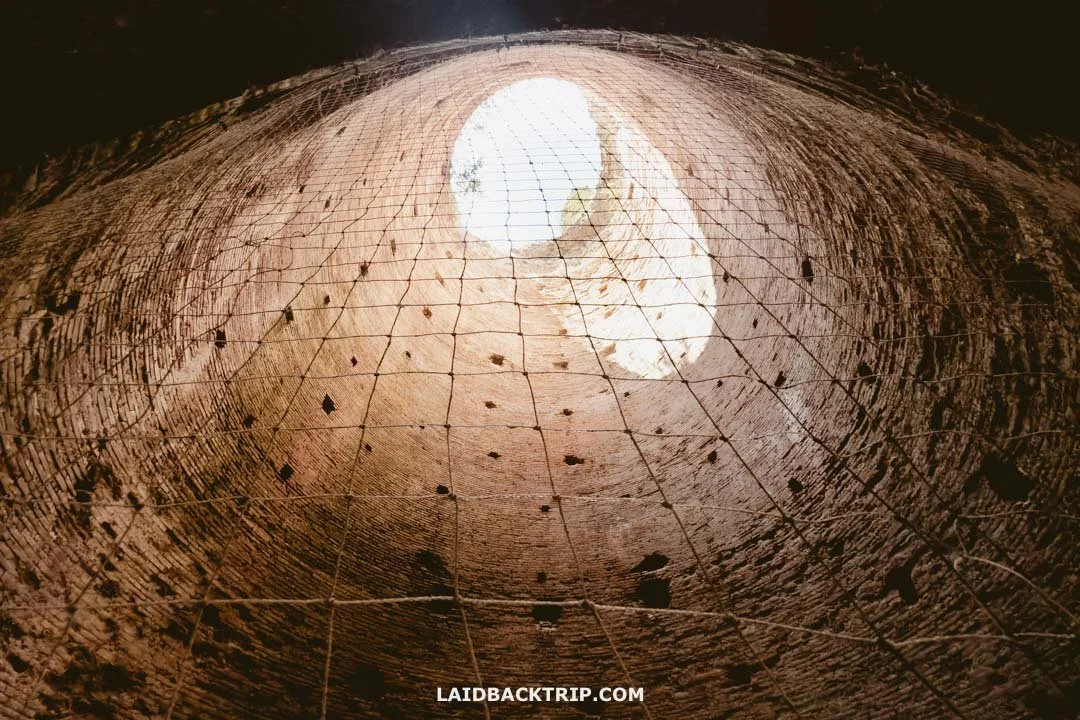
We could go inside the tomb of Cecilia Metella.
Finally, we descended into a small underground section, which, besides the bathroom, contained massive basalt stones and a short film about this essential resource that gave the Via Appia its long-lasting durability and unique look. Here, the Via Appia reaches its highest point, at the end of the lava flow formed in several stages by the Latium Volcano (in the Colli Albani mountains) between 300,000 and 200,000 years ago.
The Mausoleum of Cecilia Metella is open from 9 AM to 6:30 PM. In summer, it stays open until 7:15 PM, and in winter, it closes at 4:30 PM.
After we left, we found the remains of the Church of San Nicola a Capo di Bove just across the road. Built in the 14th century, it's the only church in Rome constructed in the Gothic Cistercian style. It was closed during our visit, so we just walked around outside, but we could see the nave had a podium and seating area, probably used for events.
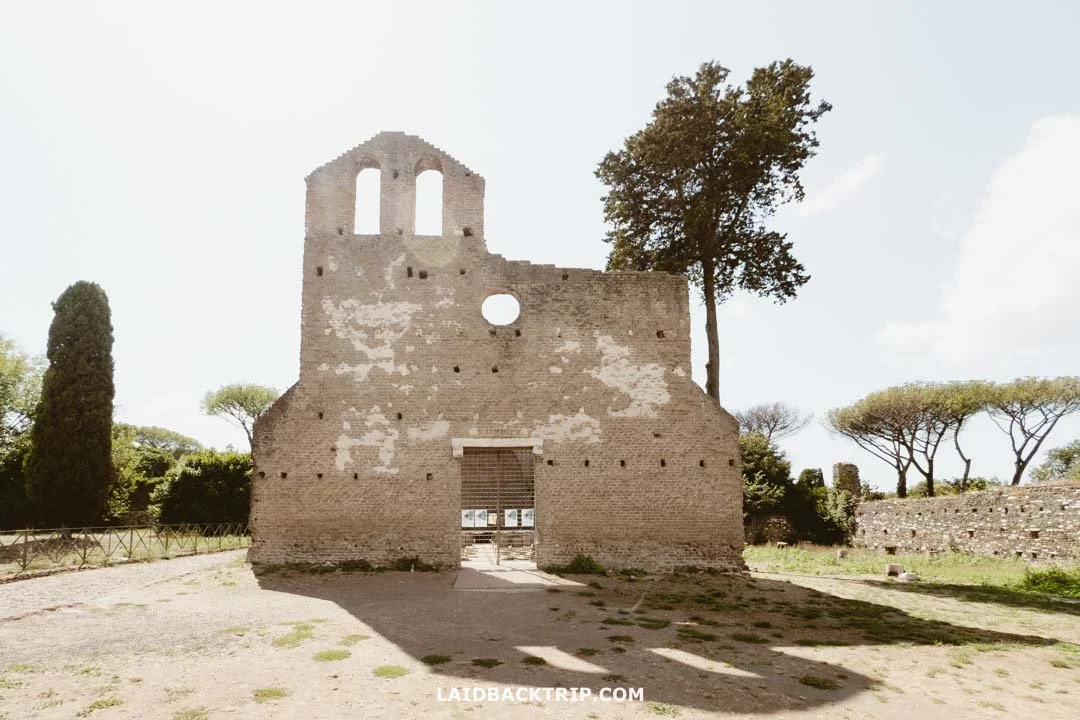
The Church of San Nicola a Capo di Bove sits just across the Mausoleum of Cecilia Metella.
Villa of Maxentius
Just a short walk from the Mausoleum of Cecilia Metella, we saw the ruins of the Villa of Maxentius to our right. Built by Emperor Maxentius between 306 and 312 CE, this complex is known for the world's best-preserved Roman circus. The circus was designed for chariot races, with seating for up to 10,000 spectators, and was famously centered around an obelisk now located in Piazza Navona.
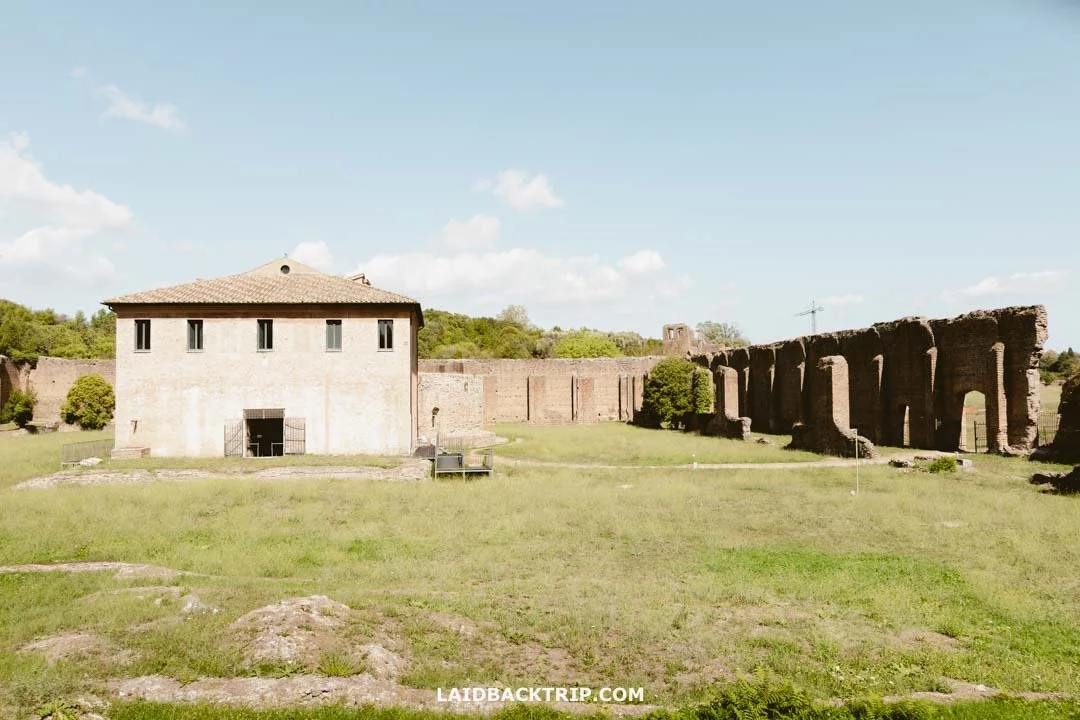
We got to see the Villa of Maxentius just from Via Appia.
The site also features the remains of a residential palace and the circular Mausoleum of Romulus, a dynastic tomb for the emperor's young son, whom we had learned about earlier in the Roman Forum.
There's no entry fee to the Villa of Maxentius. The site is open from 10 AM to 4 PM, and from June to September, it closes at 7 PM on weekends. It was still open when we arrived, but we were already pretty tired, so we just admired the ruins from Via Appia. We hadn't seen anyone in the complex, so if you find the road too busy, this would be another great spot for some quiet moments.
Basilica and Catacombs of Saint Sebastian
Our final stop was the Basilica of Saint Sebastian, a small church best known for its unique catacombs, the oldest in Rome. The church itself was quite small and had a beautiful ceiling made of wooden panels with intricate decorations, but it was much more modest than the ones we saw on previous days (though it's really not fair to compare it to St. Peter's Basilica, right?).
The full name of the church is San Sebastiano fuori le mura, which means Saint Sebastian outside the Walls, indicating that this church is beyond the Aurelian Walls, as there is another with the same name in the city center. We quickly explored the interior and, since we were almost at the end of our journey, didn't linger any longer than necessary.
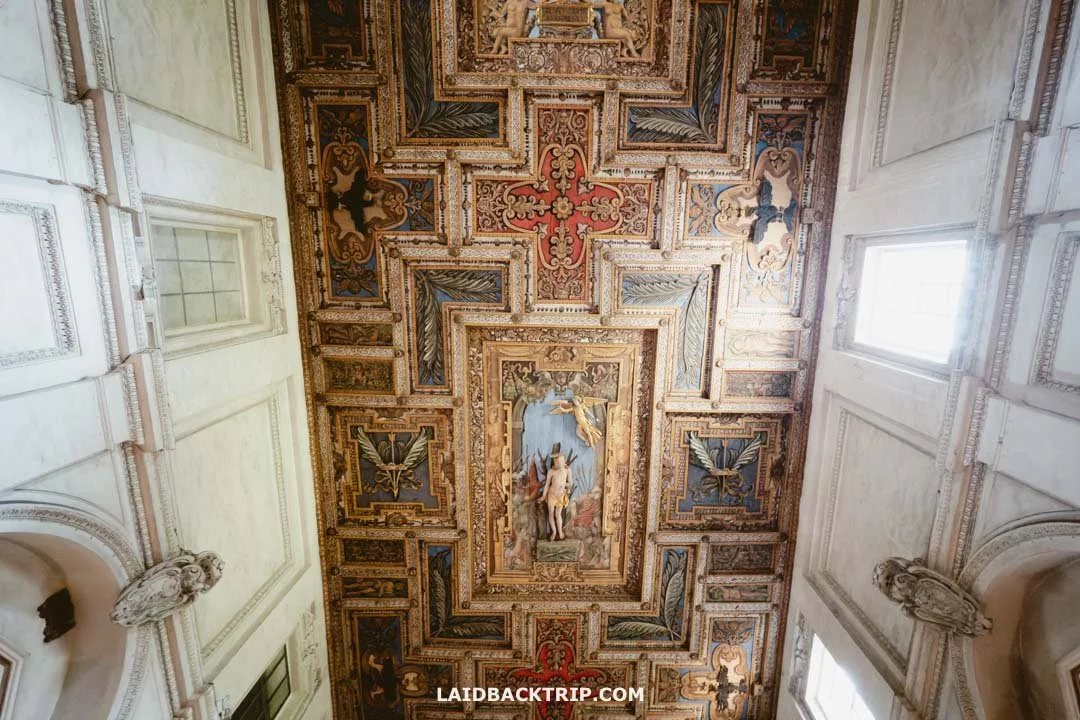
The Basilica of Saint Sebastian was free to enter and had a beautiful ceiling.
Unfortunately, we weren't able to visit the Catacombs of Saint Sebastian (once simply called ad catacumbas) because all the tickets were sold out. It was a site we really wanted to see, so we checked the official website several times that week, hoping more tickets would become available, but with no luck. Since the guided tours on GetYourGuide were also sold out, we had to miss out.
If you do manage to get tickets, you're in for a treat. The Catacombs of Saint Sebastian are essentially an underground cemetery spanning four stories. Originally a pagan quarry, they became a Christian burial site for the remains of Saint Sebastian. They're especially famous for early inscriptions honoring Saints Peter and Paul and for three remarkably preserved 2nd-century pagan mausoleums.
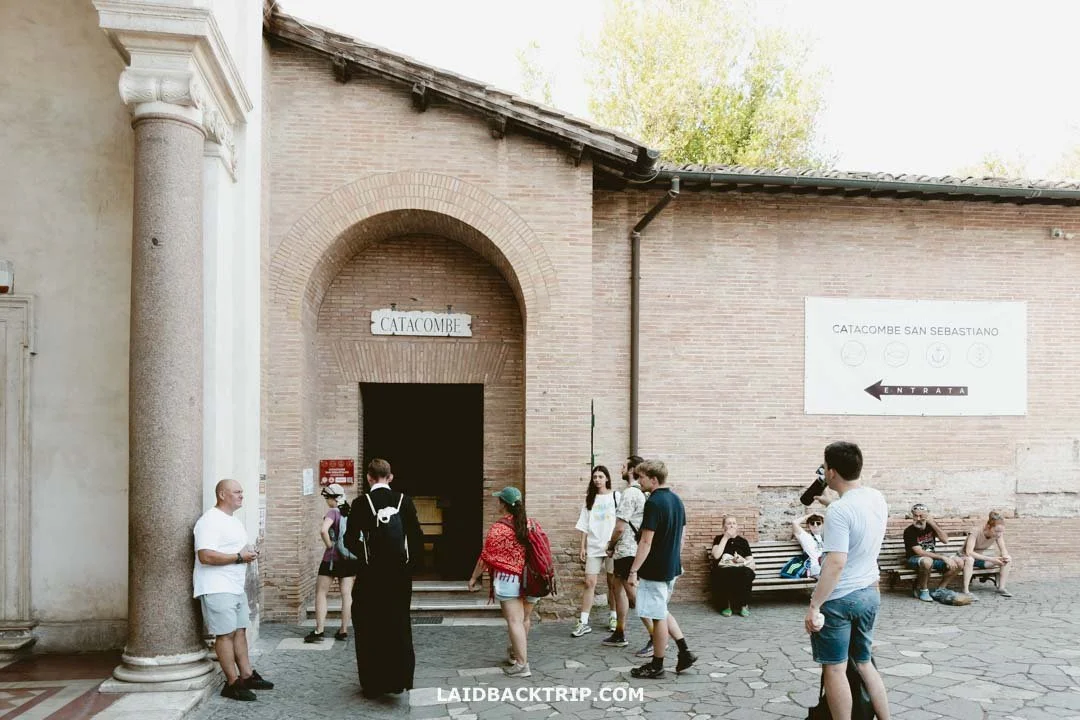
The entrance to the Catacombs of Saint Sebastian was right next to the church main entrance.
By the way, the Catacombs of Saint Sebastian are not the only 'catacombs' along Via Appia. Just a short walk from here are the Catacombs of San Callisto, Rome's most important underground cemetery.
They also house the Crypt of the Popes, which contains the remains of nine early popes, and the Crypt of Saint Cecilia, the tomb of a 3rd-century CE martyr adorned with mosaics and paintings. As with the Catacombs of Saint Sebastian, you'll need a reservation to visit the Catacombs of San Callisto, and both are accessible only with a guided tour.
How Much Time to Spend on Via Appia
Given that we also visited the Park of Aqueducts, and with travel times included, we spent almost 10 hours on the Via Appia trip (including breaks for snacks, etc.). We started fairly early in the morning and didn't return to Rome's city center until late afternoon. Besides the ancient road and its museums, we also visited the Park of the Aqueducts, which took about 90 minutes of those 10 hours.
It was a long and, honestly, pretty tiring day, especially with the heat. Still, because everything was so interesting, the day didn't feel as exhausting as I expected.
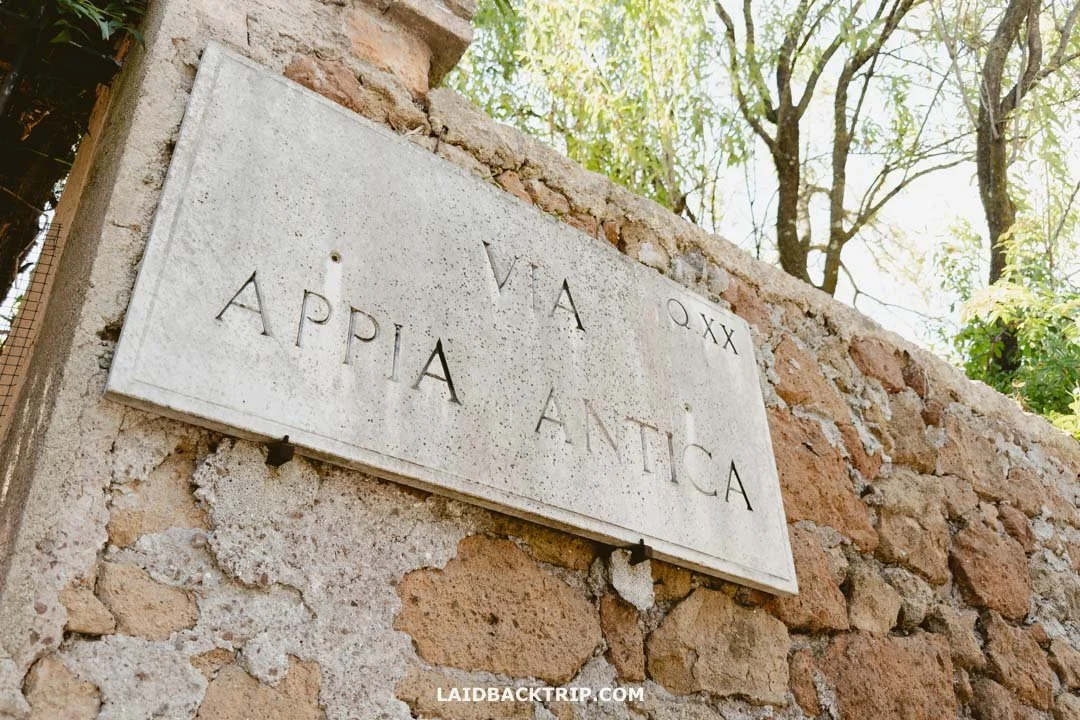
For us, Via Appia turned into a full day trip.
If we had rented bikes, skipped some museums, and not visited the Park of Aqueducts, I think we could have done Via Appia in four to five hours. Even guided excursions like the popular Via Appia Bike Tour take about four hours, so our estimate seems realistic. But the more time we spent there, and the more we learned about it, the more we enjoyed this adventure.
Is Via Appia Worth Seeing?
As I mentioned earlier, it was our last day in Rome before flying home, so we wanted to slow down and get away from the crowds at the Trevi Fountain or Pantheon. Via Appia was perfect for that. It was quiet and, to be honest, quite different from the other sites we'd seen so far. Of course, it still had plenty of Roman-era charm and was lined by small but interesting museums.
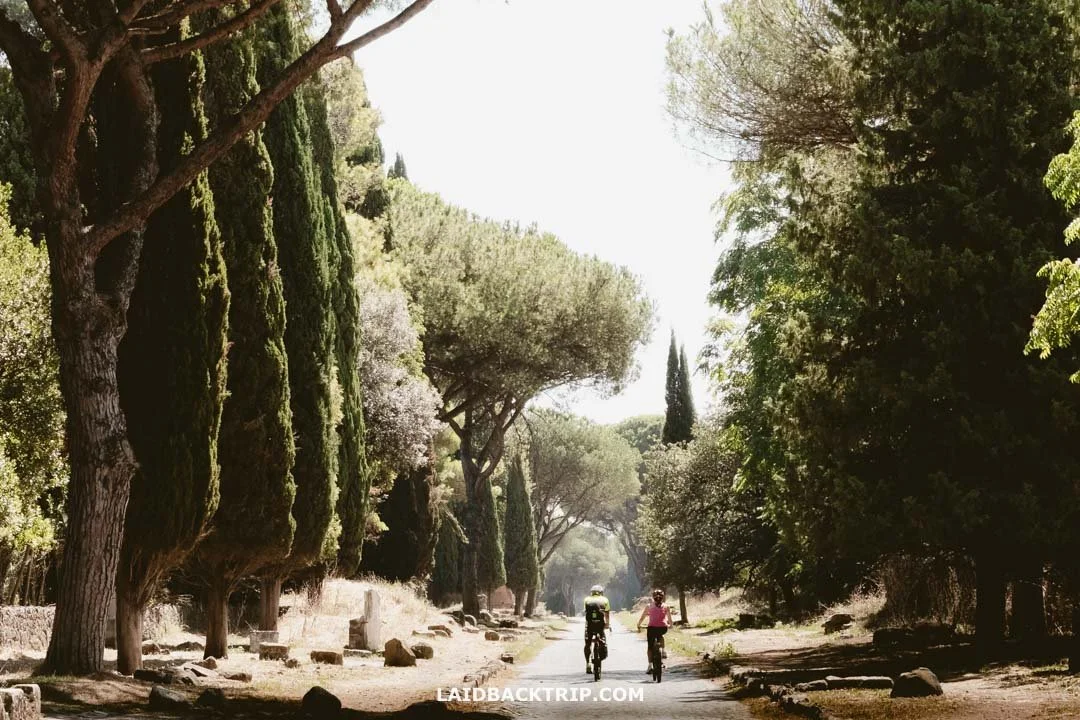
Despite its fame, Via Appia ended up being a great place to escape the crowds of central Rome.
The real reason we think Via Appia was worth seeing is that, even though it ended up being a long day, we didn't rush and really tried to enjoy ourselves. This place was perfect for that. Without any timed entries as we had at the Vatican Museums and other sites, we could explore the area at our own relaxed pace. By this point, we'd seen everything we wanted in Rome, so we let go of any travel worries and just enjoyed the present moment surrounded by ancient history.
Food and Water on Via Appia
Because we spent nearly the whole day outside, we had to plan our food in advance. We ate a large breakfast at our hotel and packed our own lunch (muesli, bananas, hummus, tomatoes, and focaccia) so we could get through the day without needing to find food. This turned out to be a smart choice, since there weren't many options apart from a few expensive restaurants between the Mausoleum of Cecilia Metella and the Basilica of Saint Sebastian, which we would have skipped anyway.
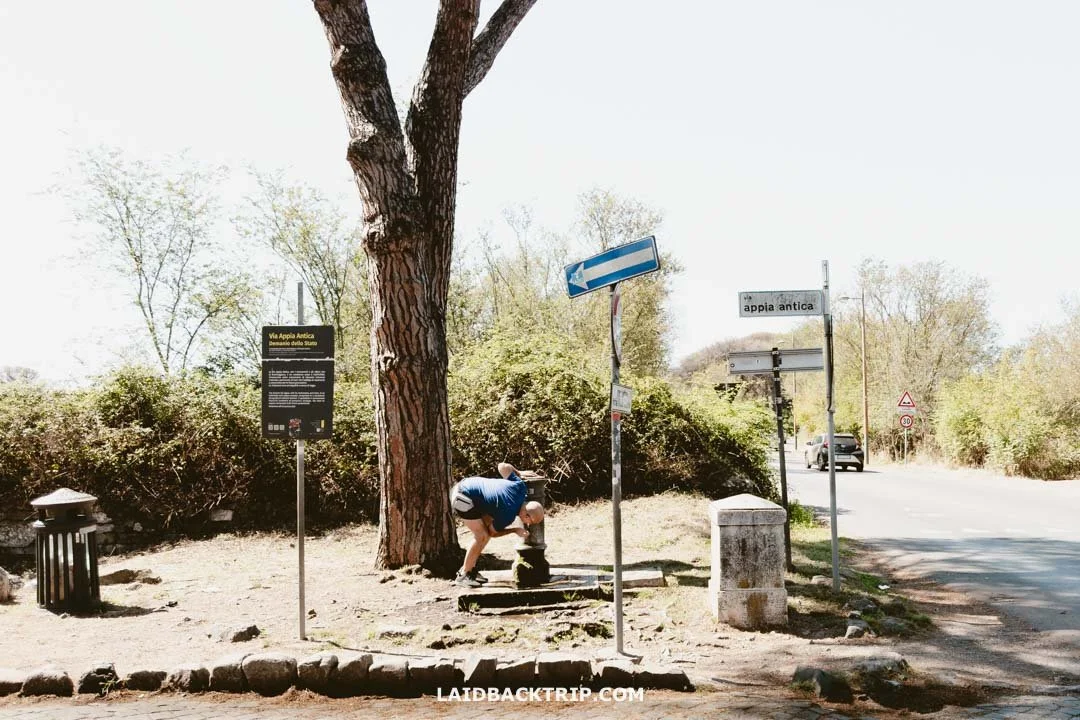
One of the water fountains we found along the Via Appia.
Even though we spent a lot of time in the sun and temperatures exceeded 30 degrees Celsius, we didn't carry too much water with us since we assumed there would be water fountains on the Via Appia, just like in Rome's center. Our guess was correct.
We refilled our water bottles several times, for example, at Villa dei Quintili or at the intersection of Via Appia and Via di Tor Carbone. The only place with non-drinking water was the bathrooms at Santa Maria Nova, but that was just an exception.
Getting from Via Appia back to Rome's City Center
I already mentioned that after finishing Via Appia, we caught bus number 118 at the Basilica of Saint Sebastian. The buses ran pretty often, and we waited less than 10 minutes. Once it arrived, we got on, and I quickly realized I'd made a small planning mistake: I had assumed the bus would loop back to the city center from here.
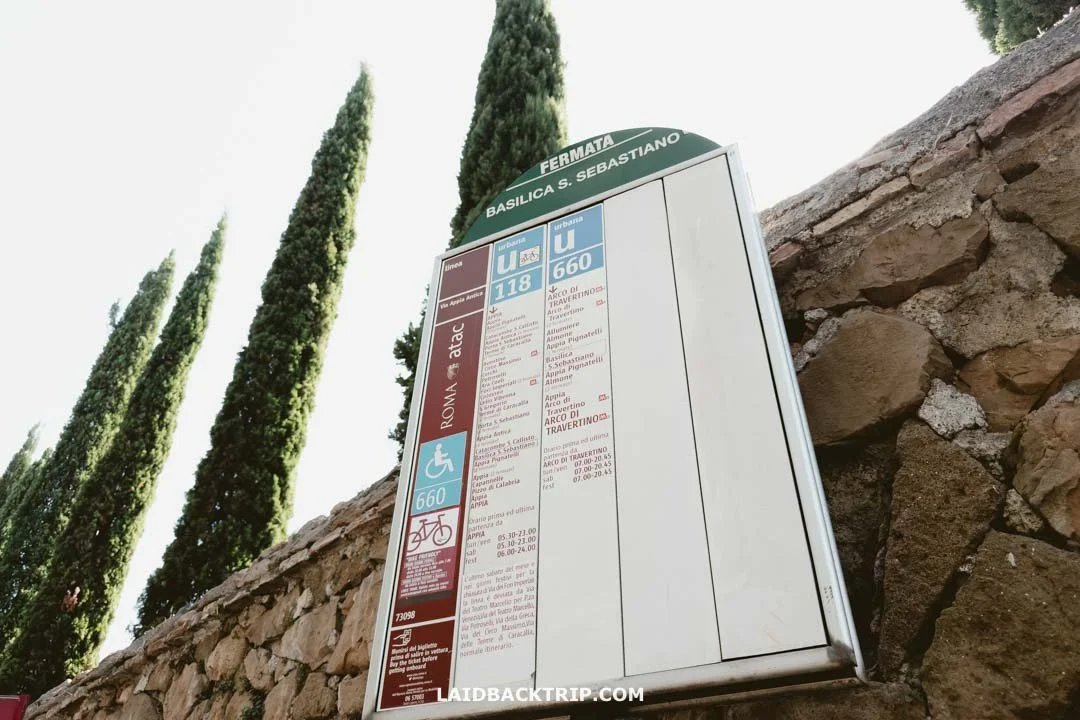
The bus stop on Via Appia.
Unfortunately, from this direction, the eastbound bus kept going along Via Appia Pignatelli toward Villa dei Quintili, which was on the opposite side of the city center. It took us a few minutes to figure out we were going the wrong way.
Luckily, the bus stops for both directions were, in most cases, just across the road from each other, so we simply got off the bus, crossed the street, and waited for another 118 bus, which arrived in about 10 minutes. The good part was that our ticket was valid for 100 minutes, so we didn't have to buy a new one (remember to validate your ticket once you board the bus!).
The entire bus ride from Via Appia to Piazza Venezia took us less than 30 minutes, though it would have been a bit shorter if we had left directly from the Basilica of Saint Sebastian. I checked the map later and realized we should have taken a bus from either the Appia Pignatelli/Appia Antica stop or Catacombe S. Callisto further down Via Appia Antica.
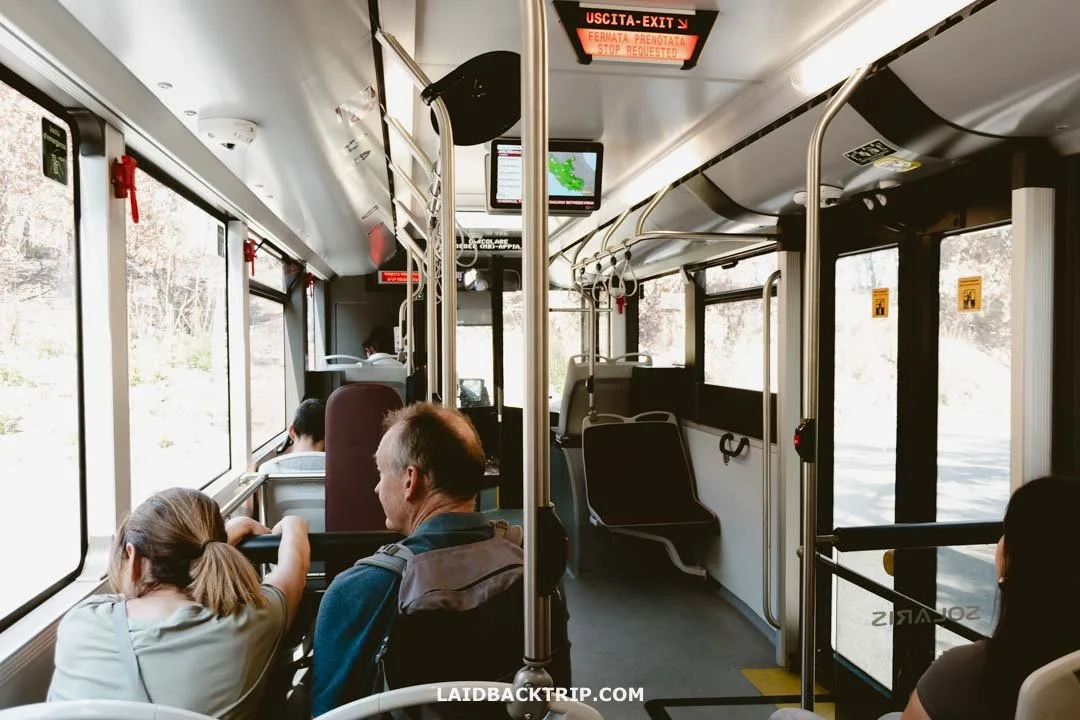
We took bus 118 from the Basilica of Saint Sebastian back to Rome's city center.
For us, this was our last evening in Rome. Even though it had been a long day and we were really tired, we still hadn't visited Villa Borghese. We didn't have tickets (they were sold out), but Lucie insisted we should try to get some on the spot (there are a very limited number) one last time. It was a long shot, but there's always hope. You can see how it all turned out in our full guide to Villa Borghese.

Discover everything you need to know before visiting St. Peter's Basilica in Vatican City, including what to see inside, how to climb the iconic dome, opening hours, ticket prices, guided tours, and the easiest ways to get there.