Hiking Hengifoss Trail in East Iceland
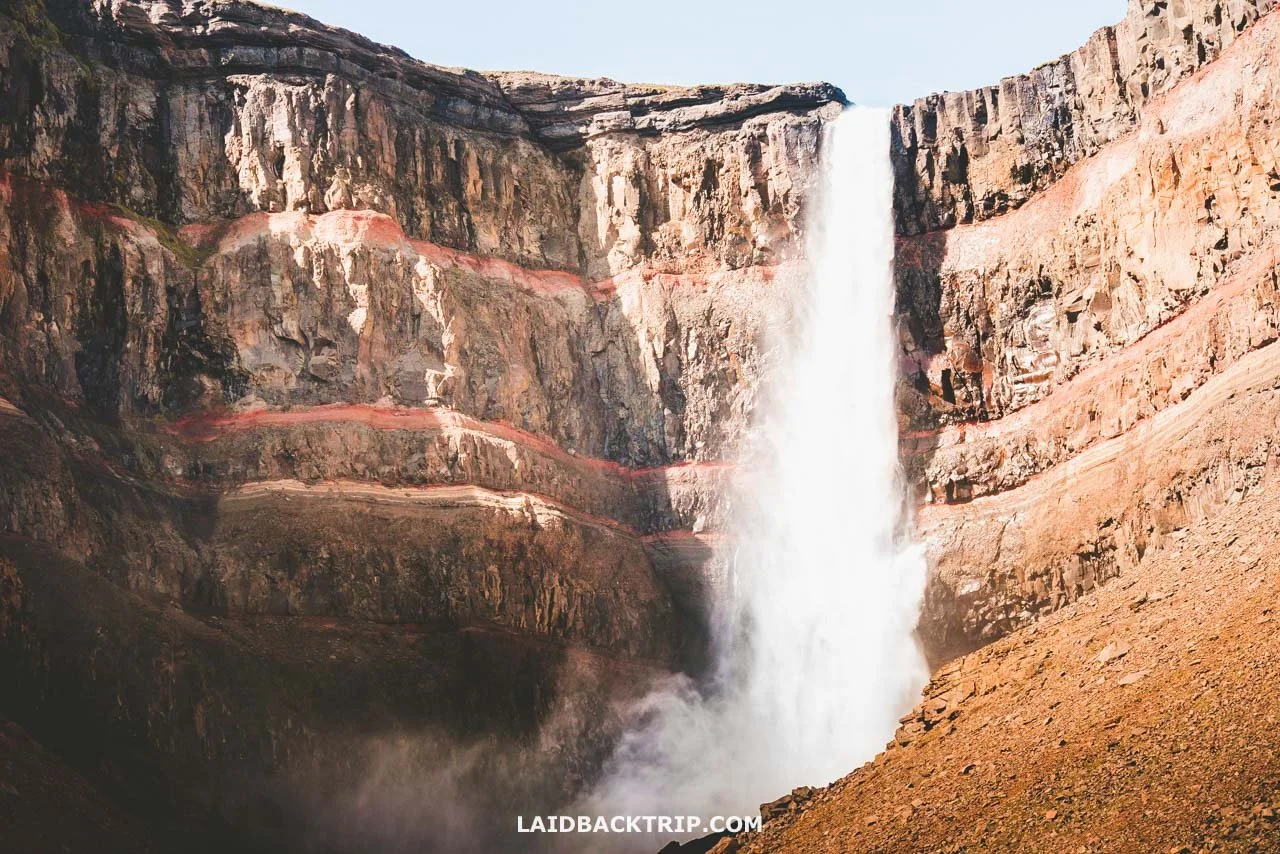
Standing nearly 130 meters tall with striking red clay running through the dark basalt rock, Hengifoss was just incredible.
Hengifoss was our favorite hike in the East Fjords. Here is the full story of our trip.
When we were planning our Iceland itinerary, and specifically the whole Eastern Region, we weren't sure how much of what we wanted to see we could actually fit in. A good example of that was the hike to Hengifoss. The third‑highest waterfall in Iceland was on our list, but so were tons of other places.
Not to mention that our plan for the day was ambitious. We wanted to drive a bit more around the East Fjords, visit Seyðisfjörður, hike to Hengifoss, and finally see puffins in Borgarfjörður eystri, all in just one day.
Both the seaside village and the waterfalls (since Litlanesfoss was also along the way) were optional because we had no idea how long everything would take. A big reason was the weather, since the last couple of days on the South Coast showed us how rainy conditions can seriously tamper with our plans.
But the weather was great today, and despite being on the road since early morning, we still weren't tired. So when we reached Egilsstaðir again after returning from Seyðisfjörður, it took Lucie and me about ten seconds to decide whether we should make the detour for this hike.
Another reason we wanted to hike to Hengifoss was that we'd been in the car since early morning, and while we did some sightseeing in Seyðisfjörður, walked the short trail to Gufufoss, and made lots of stops along the way, we already felt like we needed to stretch our legs in a more active way.
Especially since the rest of the day was basically more driving and puffin watching, which is just very slow walking too. So all things considered, the Hengifoss trail was perfect for us at that moment. It wasn't strenuous or super long, but it wasn't too easy either.
How to Get to Hengifoss Trailhead
The Hengifoss trailhead was easy to reach from Egilsstaðir, about 35 kilometers away. Travelers coming from the coast along Road 95 don't actually need to drive all the way to Egilsstaðir, since they can join Road 931 a bit earlier. Because we stayed on the Ring Road a bit longer and stopped at Seyðisfjörður first, we were heading to Hengifoss from Egilsstaðir. So it just made sense for us to follow Road 95 back toward the coast and then turn right onto Road 931 after about 10 kilometers.
This route took us along Lagarfljót (or Lögurinn), a narrow lake where, according to legend, a monster called the Lagarfljót Wyrm is supposed to live, basically Iceland's version of the Loch Ness Monster. Iceland was full of myths and stories (Ásbyrgi and Dimmuborgir were our favorites), and this was another one.
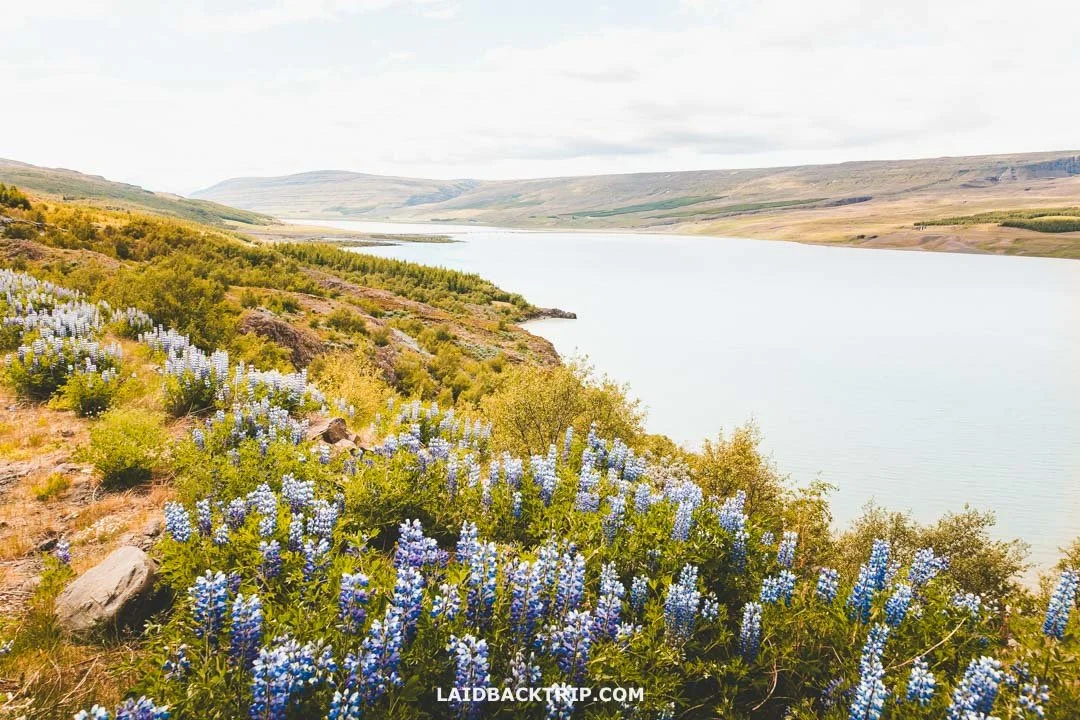
Driving to Hengifoss along Lagarfljót meant we could enjoy these gorgeous views.
We didn't spot the creature, mostly because we were focused on the scenery, which was lovely, though not as dramatic as the fjords we had just explored. After crossing the bridge over the lake, we turned left at the next T‑junction, and in about 500 meters reached the waterfall's parking lot on our right.
On the way back, we could either return the same way or follow Road 931 along the western side of Lagarfljót. When we visited, that stretch wasn't fully paved, and we had just a small 2WD campervan, so we drove back to Egilsstaðir the same way we came. The last time I checked, even that part is paved now, so it would make sense to follow it instead and make a nice loop around the lake.
Without a car, reaching Hengifoss would be tough. The bus runs from Reykjavík to Egilsstaðir, but not to the waterfall. We saw a few cyclists on the way, which is one way to get there, but the 70‑kilometer ride along the lake would definitely take much longer than driving. We also found that Hengifoss wasn't on most tour itineraries, so even that option wouldn't be very common here.
Parking at Hengifoss
The parking lot was quite large and not very busy when we arrived, so we found a spot without any issues. Hengifoss had free parking when we were there, but that's no longer the case, and now there's a 1000 ISK fee per car.
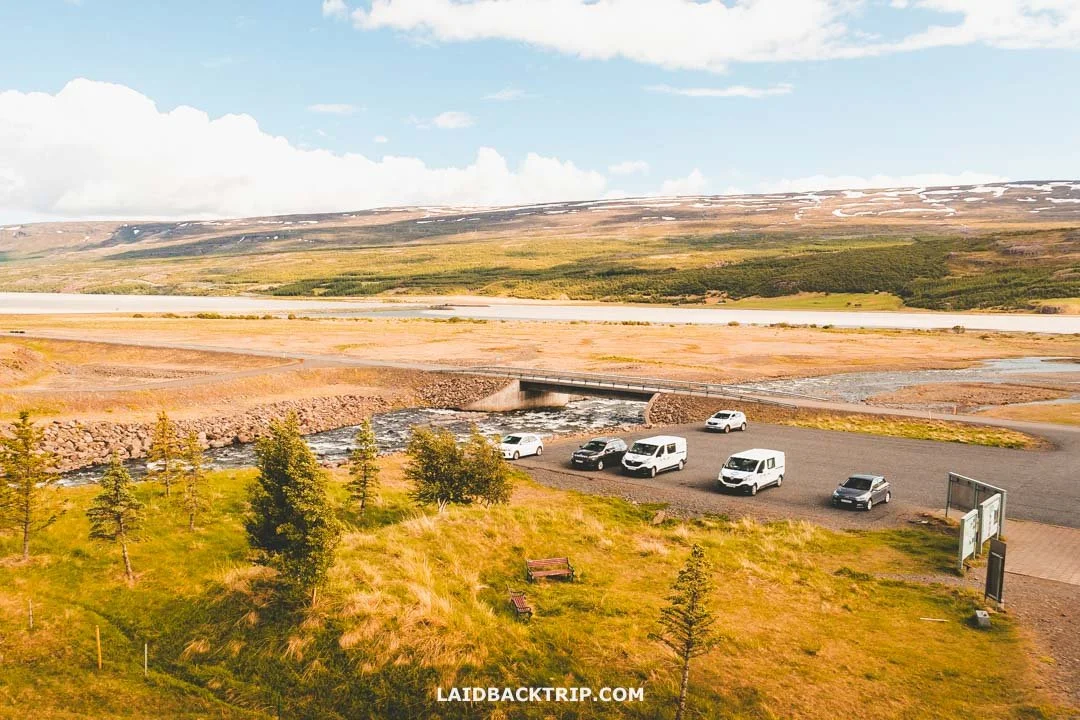
Parking at Hengifoss was super easy.
The parking area was enlarged and improved, and a new building with Hengifoss Café was added. There were also toilets and garbage cans.
No Entry Fee at Hengifoss
The trail to Hengifoss was free, and it still remains without a fee even now. But since the parking fee was introduced, a visit to Hengifoss isn't as free as it used to be. This happened to most big attractions easily accessible from Route 1 (like Jökulsárlón or Fjaðrárgljúfur), so that's just how it is now.
How to Visit Hengifoss
After we parked, we first grabbed something to eat. It was already late in the afternoon, and we hadn't eaten since we left the East Fjords. But by this point, we knew we were on schedule, so we relaxed a bit, took a break, and used the time to get some energy back.
It was a beautiful day, and we almost thought about leaving our daypack behind and hiking as light as possible. But since it wasn't our first day in Iceland, we didn't want to take that risk.
What We Packed to Hengifoss
We still kept our rain jackets in the backpack, and the new thing was that we hiked just in T‑shirts. The first section with the wooden staircase was pretty steep, so we did that mostly to avoid getting too sweaty, but what made this hike different from all the others was that we stayed this way the whole time, even after the trail leveled out.
Along with Hraunfossar, it was one of the few times we hiked in short sleeves. The next evening we went whale watching in Húsavík, wearing down jackets and dry suits, so the contrast in feel-like temperatures was huge.
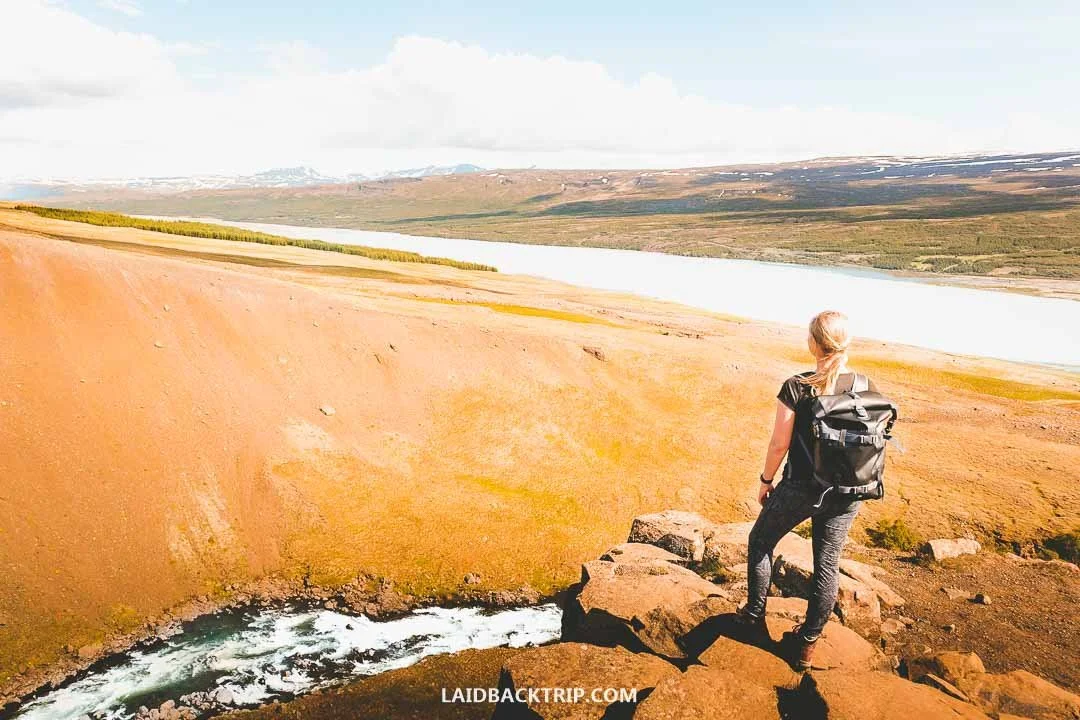
It was a warm, beautiful day, and every time we looked back, the views over Fljótsdalur valley were absolutely incredible.
But anyway, we weren't here for whales. We were here for waterfalls. We also considered hiking in our sneakers, but decided not to risk it and put on our hiking boots. The trail ended up being dry, but we crossed a few streams where the boots definitely helped. Since then, the trail has been improved, and wooden boardwalks were added, so I'm not sure how relevant that detail still is.
Hengifoss Trail
We knew that Hengifoss was an out-and-back trail, about 2.2 kilometers one way (4.4 kilometers total) with an elevation gain of 250 meters. This sounded like a perfect little adventure. Not too difficult and time-consuming, but not that easy either. When we did the trail, we really had to walk the same way back, as there was no other option.
But as I mentioned, the trail has been improved, not only by smoothing out the surface and adding wooden boardwalks, but also by building a bridge on the way from Litlanesfoss to Hengifoss. It lets you cross to the other side of the valley and walk back along a new path. Both trails meet again at the parking lot. You could also start on the eastern side first since it has a more gradual incline, but I don't think it makes a big difference.
Hengifoss Trailhead
The Hengifoss trailhead started right at the parking lot, just a few meters from where we left the car. Similar to Skógafoss's Waterfall Way, the trail to Hengifoss began with a steep wooden staircase. The first part, and practically the whole trail, was as straightforward as it could've been.
First, we went through a gate and climbed a short set of stairs. It was a nice warm‑up, but nothing strenuous. Then we walked through another gate, closed it behind us, and stepped onto a natural trail that we followed for the rest of the hike.

The second gate we walked through on our way to Hengifoss.
Litlanesfoss Waterfall
As we were making our way up, we could see the Hengifossá River, which feeds both Hengifoss and Litlanesfoss, on our right. We could actually see the tip of Hengifoss in the distance, but it was still pretty far away. Litlanesfoss remained hidden, but that didn't matter because we could already see our first waterfall on the trail. It didn't have a name, but it was beautiful nevertheless.
Lucie asked me if it was already Litlanesfoss, but we figured it didn't have the basalt columns and it was still too early to be it anyway. My favorite part was that while I was focusing on this waterfall, Lucie also asked if I saw the other one. It took me a few seconds to spot it on the right side of the gorge, sort of tucked into the shadows of the steep cliffs.
After about a kilometer or so, we finally reached Litlanesfoss, but to actually see it, we had to walk to the very edge of the gorge. I knew we were here to see the more famous Hengifoss, but I had to admit that the 30‑meter‑high Litlanesfoss was just as stunning.
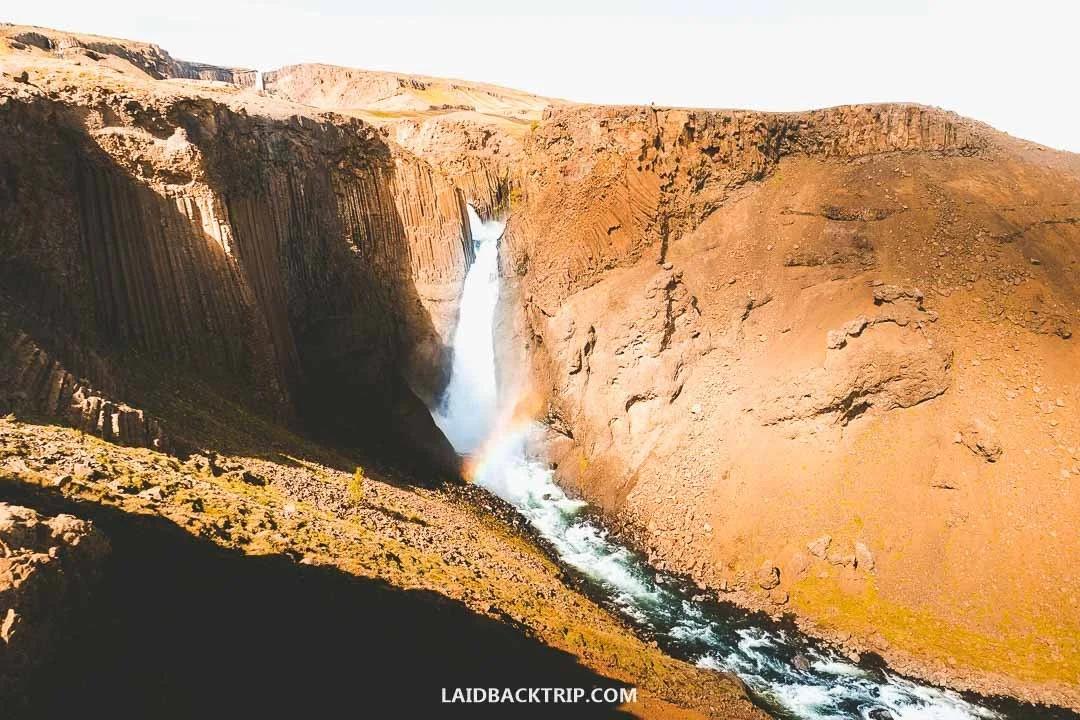
We passed Litlanesfoss along the way, and I thought it was even more beautiful than Hengifoss.
At that moment, I didn't know it yet, but I actually enjoyed the view of this waterfall even more. It was simply incredible. And with the basalt columns around it, it reminded me of Svartifoss and also Reynisfjara, both of which we'd visited in the previous days. The next day we went to see Dettifoss, which had basalt columns too, but in terms of raw power, that one told a very different story.
Hengifoss Waterfall
Once we left Litlanesfoss behind, the trail continued uphill. It was a bit steeper for about 600 meters, but the views of Hengifoss were very close now, so we walked pretty quickly. About 600 meters before Hengifoss, the trail brought us to the Hengifossá River.
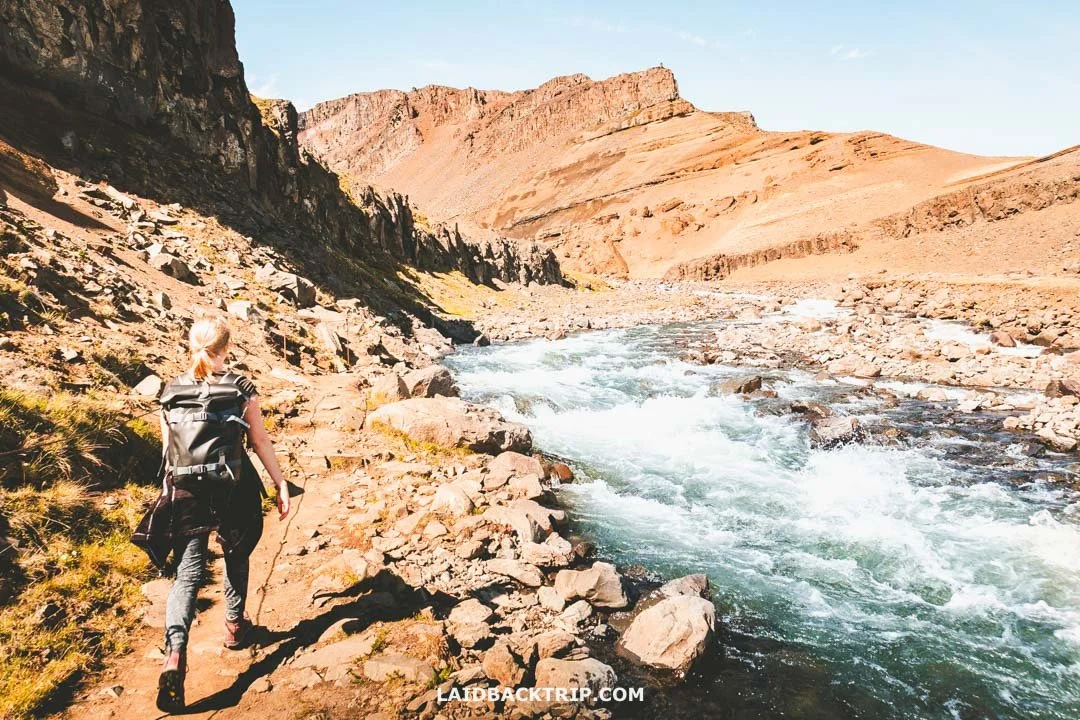
The closer we got to Hengifoss, the more dramatic the scenery became.
On the way from Litlanesfoss, we had to navigate a couple of small fords, but now they should all have small wooden bridges. The trail flattened, so we picked up the pace, followed the river, and enjoyed the view of Hengifoss towering at the end of the valley.
This part of the trail was very scenic, and in a few minutes, we were standing in front of Hengifoss. In this last section, the trail was roped off on both sides to keep us on the path (now it's a boardwalk). Technically, the waterfall was still a bit ahead (this wasn't Seljalandsfoss) when the trail abruptly ended, but we could enjoy some spectacular views nevertheless.

Once we got this view of Hengifoss, we were almost at the end of the trail.
The trail ended with a small sign warning about falling rocks and then continued for a few meters to its very end, which in this case was a big volcanic rock. There was no easy way to climb it, and had we wanted to continue, we would've had to cross to the other side of Hengifossá, which made even less sense. Plus, the warning about falling rocks was very real, as we could see them all around. It was really the end of the trail.
World Nomads provides travel insurance for travelers to cover their trip essentials, including sports and adventure activities.
SafetyWing is affordable travel insurance for backpackers, long-term travelers, and digital nomads.
Since the improvements, there's now a wooden boardwalk with a viewing platform at the end that makes it clear where the trail finishes. Anyway, we were perfectly fine with where we were and just enjoyed the views from there. With a height of 128 meters, Hengifoss was really impressive. After Morsárfoss emerged and Glymur moving on the second place, Hengifoss is now the third‑tallest waterfall in Iceland.
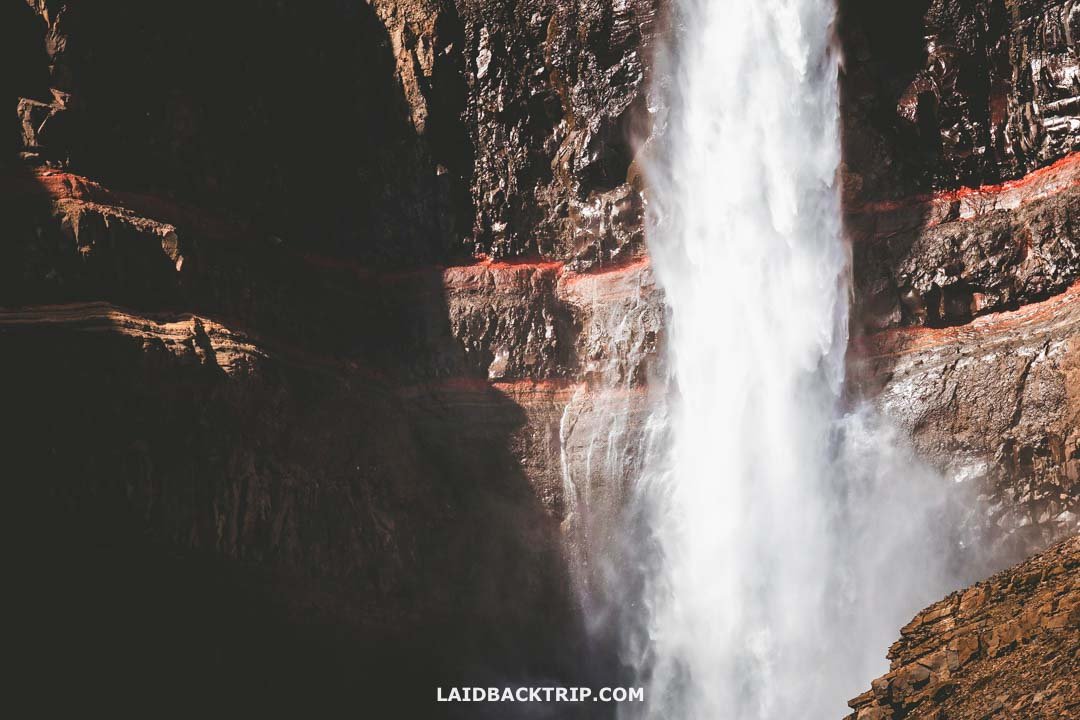
Those red clay layers really set Hengifoss apart from all the other waterfalls we saw in Iceland.
For us, the most interesting part wasn't really its height, no matter how impressive it was, but the clearly visible red layers of clay between the dark basaltic layers. The layers weren't just eye‑catching and photogenic, but also showed various stages of how Iceland was formed through cycles of volcanic activity. It was like looking at the island's geological timeline stacked right in front of us.
Visiting Hengifoss in Summer
As we were watching this beautiful spectacle, we thought we couldn't have picked a better day for this hike. The weather was just great. To be fair, a good part of that was simple luck, since we just happened to be around Egilsstaðir on this day.
But after seeing places like Fjallsárlón in not‑so‑ideal conditions the day before, we simply didn't care. We enjoyed the sunny day with no rain to the fullest, though I can imagine we'd have done the same even if the weather hadn't been on our side.

We did the Hengifoss trail in early summer, the weather was just amazing, and we even got to see a rainbow!
We were there in early July, and both Litlanesfoss and Hengifoss looked quite powerful, though that was true for most waterfalls we'd seen there. Whether it was Gullfoss or Dynjandi, there was tons of water tumbling down each second, and these two were no exception.
Since Hengifoss wasn't some unknown waterfall but a pretty popular attraction thanks to its proximity to Egilsstaðir, we weren't sure how busy the trail would be at the beginning of summer. Whether we went on a quiet day or it was already too late, the trail was fairly calm. It wasn't like Kvernufoss where we didn't meet a single soul, but we still enjoyed plenty of quiet moments on the Hengifoss trail.
The trail was well‑maintained and easy to walk on even before the new improvements, and despite the rainy previous days, it was completely free of mud (unlike the trail to Brúarfoss earlier). I have a feeling the hike would be doable even in winter, though at least some microspikes would definitely be needed on days when the trail is covered in snow and ice.
How Long It Takes Hengifoss Hike
It was time to head back, which was much easier than the other way around, and the walk took us about 30 minutes. The journey back to our car was really straightforward, though this time we had the whole valley in front of us, so we could enjoy some incredible views basically the entire way down. I already mentioned earlier that there's now an option to cross over the gorge and walk along the other side of it, which we definitely would've taken had it been there.
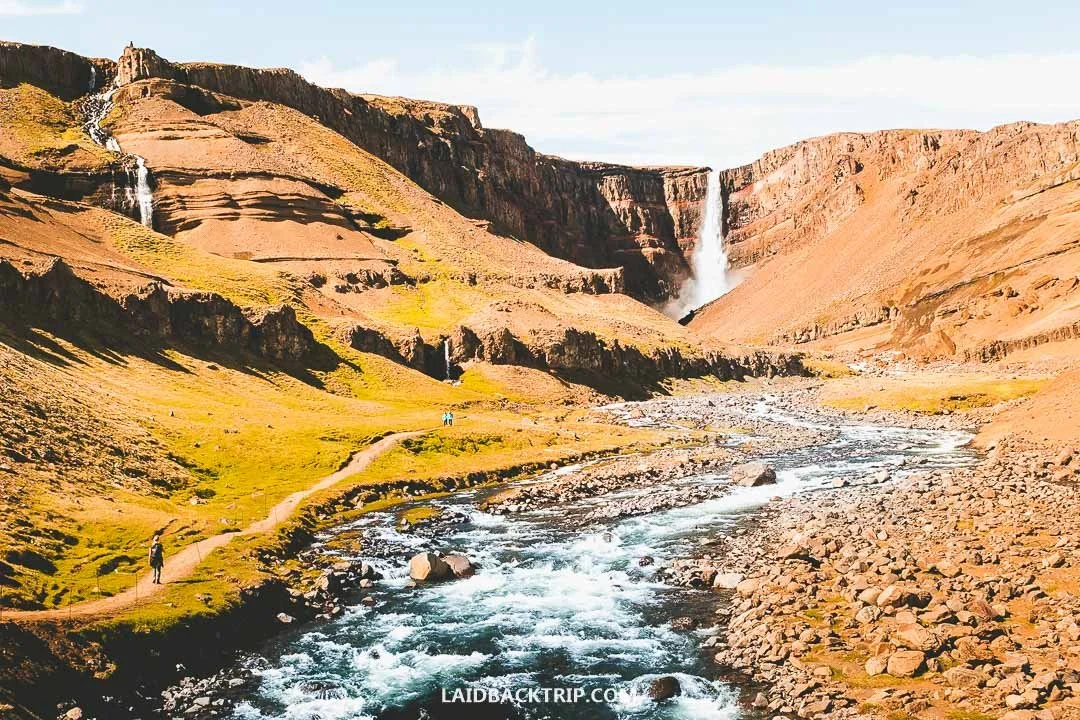
We finished the Hengifoss hike in well under two hours.
The first half of the hike to Hengifoss led steadily uphill with a few steeper sections, but it wasn't difficult, and the second part was definitely easier. It took us about 45 minutes to reach Hengifoss, with around 20 minutes of breaks at the waterfalls. I think we walked faster than most, so we did the whole hike in just over 90 minutes, but I still think this trail can easily be done in about two hours by most people.
Is Hengifoss Worth Visiting?
We came to the Eastern Region mostly to see the fjords, but we also enjoyed black sand beaches and waterfalls. And because both Hengifoss and Litlanesfoss were really beautiful, had interesting volcanic origins, and were only reachable by a great hike, we loved this little adventure. For us, both waterfalls were worth seeing.
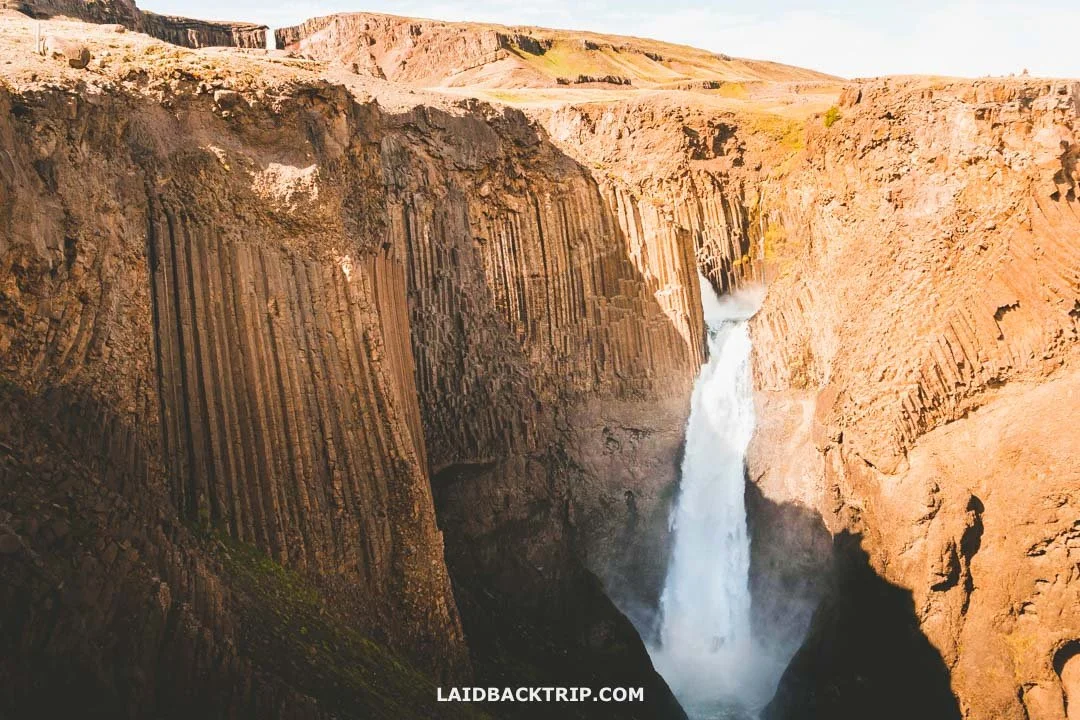
Seeing also Litlanesfoss along the way made the hike to Hengifoss totally worth it.
We lucked out not just with great weather but also with a fairly quiet trail, so there really wasn't anything about this hike that we didn't like. And because the trail has been improved since our visit and now you can also walk on the other side of the gorge, we'd recommend doing this hike even more.
Staying Near Hengifoss
By the time we were done here, it was already evening. We thought about staying in the Egilsstaðir area, but since the weather looked like it would stay good for the rest of the day, we decided to stay on the road a bit longer. It was a bit of a shame that we didn't camp in Egilsstaðir or along Lagarfljót, since the area looked gorgeous and there were actually several great campgrounds (like Atlavík, Höfðavík, Mjóanes, etc.).
There were also some nice accommodations in Egilsstaðir, like Hotel 1001 Nott or Eyjólfsstadir Guesthouse, but we really just stayed in campgrounds throughout the trip. Simply put, our day was far from over. So after we finished here, we drove back to Egilsstaðir, got gas, and headed toward Borgarfjörður eystri. There we found not only more fjords and puffins, but also a really nice campground where we spent the night.
Travel Resources
Here you can find links to all the travel resources we use and which you might find helpful when planning your next holiday.
Accommodation: When looking for accommodation, we usually search hotels via Booking.com or Hostelworld.
Tours: Although we love to travel independently, some places are better to visit with a guided tour.
We prefer GetYourGuide for its easy-to-use interface and solid reputation. Another great alternative is Viator.
Rental Cars: When going on a road trip, we always use Rentalcars.com, a reliable site for booking a rental car in advance.
Flight Tickets: When looking for flight tickets, you can search Skyscanner to find the best price.
Travel Insurance: World Nomads and SafetyWing cover against risks of travel.


Visit Víti in the Krafla volcanic area with our complete guide that covers everything you need, including how to reach the crater, a full description of the hiking trail, what to expect from the geothermal landscape, and the best times to visit for ideal conditions.