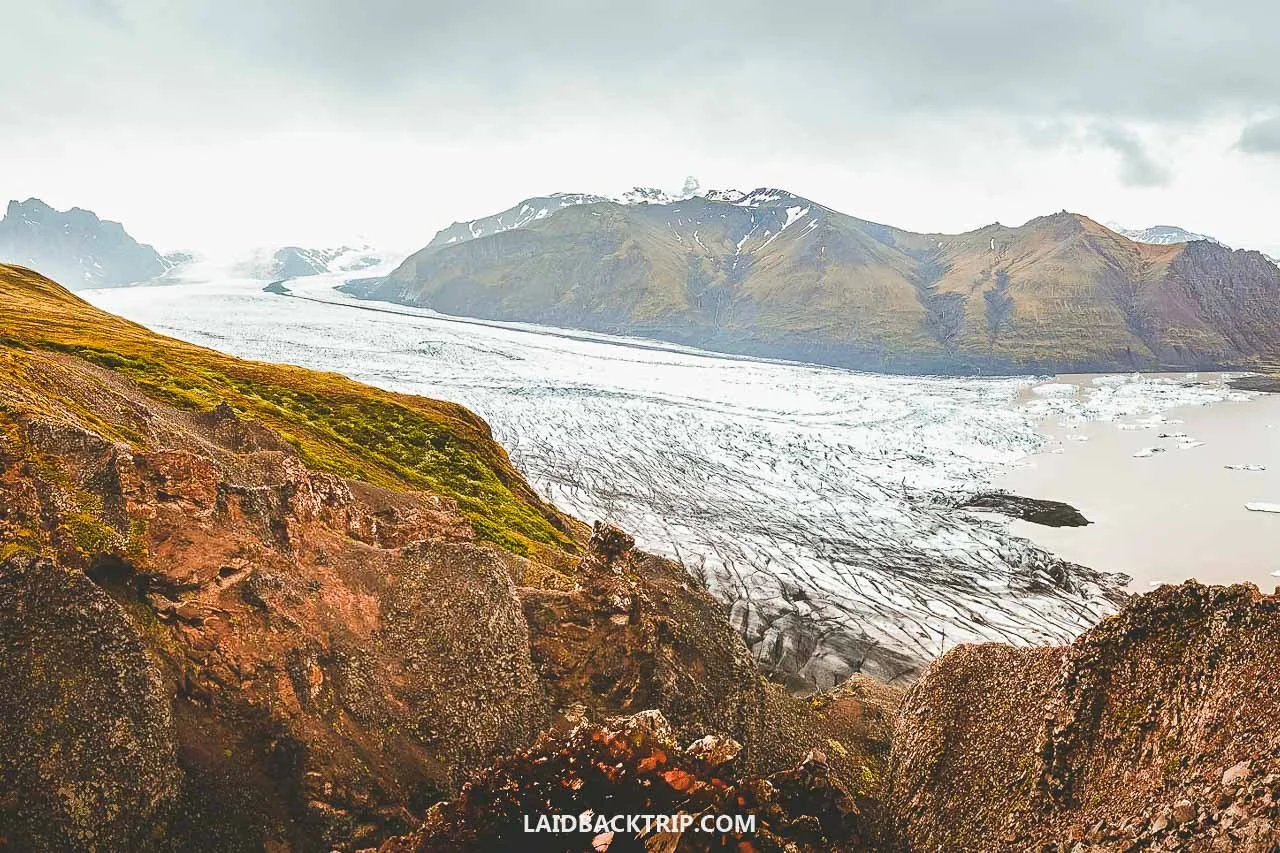
We wanted to visit Skaftafell mainly for its fantastic hiking trails and incredible glacier scenery. We couldn't wait to get out there and explore!
Skaftafell was supposed to be one of the highlights of our South Iceland road trip. This entry point to Vatnajokull National Park, known for outdoor activities like hiking, glacier trekking, and exploring ice caves, was a place we couldn't wait to see. And as the first days showed us that Iceland was even more beautiful than we expected, we had really high hopes for Skaftafell. There was just one tiny problem. Weather.
We spent a beautiful morning at Dyrholaey Peninsula, and when we hiked Fjadrargljufur Canyon after lunch, heavy clouds were already rolling in. As we were nearing Skaftafell, we made a quick stop at Skeidararsandur to check out the glacier views. The weather at this point gave the scenery a dark and gray feel, and when we finally arrived in Skaftafell itself, it started to rain.
We were excited for a proper hiking adventure in Skaftafell, but as we sat in our campervan watching the rain get heavier by the minute, our mood dropped. Since this was our last stop of the day, we weren't in a rush. So we decided to wait a bit and see what happened next. Deep down, we knew it was pointless, but at least we used the break to rest.
After an hour or so, we finally decided that if we wanted to see anything in Skaftafell, we had to get moving. We changed into hiking gear, put on our rain ponchos, and headed toward the visitor center. We roughly knew we wanted to see the glacier, but had no idea what trails the park offered, and we also wanted to find out which ones were suitable in this kind of weather. And while it didn't go exactly as we imagined, we still had a pretty great time in Skaftafell.
Getting to Skaftafell
We started our day in Vik i Myrdal, about 140 kilometers west of Skaftafell. Because of Dyrholaey and Fjadrargljufur, this whole drive took most of the day. The scenery along the way was stunning, so even just driving felt like an experience on its own. We stopped frequently, mostly to soak in the views and snap a few quick photos.
Besides the big stops, we also visited Eldhraun Lava Field, which had a nice little trail, and just before reaching Skaftafell we stopped at Skeidararsandur to learn a bit about the local history and finally enjoy the glacier views.
Skaftafell was roughly a four‑ to five‑hour drive from Reykjavik, but that would only be doable without making any stops. This was our third day in Iceland since landing in Keflavik, about 330 kilometers away, though in our case the journey was about 100 kilometers longer because we also toured the Golden Circle. And since there was so much to see along the way, it really took us almost three full days to get from Reykjavik to Skaftafell.
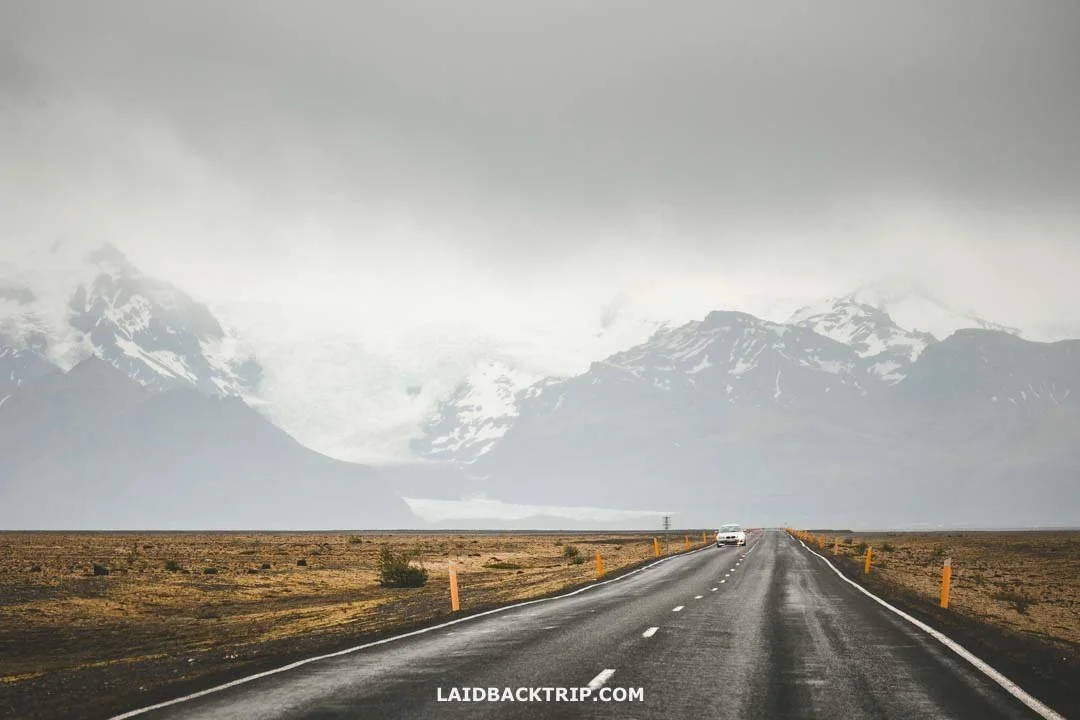
We could see Skaftafell's glaciers even from the Ring Road.
Because Skaftafell sat just off the Ring Road, the whole journey couldn't have been easier. The road was in great shape, paved the entire time, and since it was summer, Skaftafell was easily accessible with the small 2WD rental campervan. Here you can rental car prices.
When we were almost at Skaftafell, we stopped at Skeidararsandur. Because we could see the glaciers ahead, we looked for a safe place to pull over and enjoy the views. This little parking area about 4.5 kilometers from Skaftafell was perfect for that. Skeidararsandur was a huge glacial outwash plain with an interesting backstory.
At this stretch of the Ring Road, there used to be an almost one‑kilometer‑long bridge, but in 1996 massive glacial floods destroyed it. After that, the Skeidara river reshaped the landscape so much that the huge structure lost its purpose, and today we pass only a small bridge across it.
Skaftafell was also served by bus 52 from Reykjavik, which stopped right in front of the visitor's center. The direct trip would take about five hours, but as we said, had we taken the bus, we would've wanted to make a few stops along the way. Surprisingly, most day tours don't stop at Skaftafell, since the ones that go this far usually continue straight to Jokulsarlon instead.
Parking at Skaftafell
When we reached the Skaftafell turnoff, we turned left onto Road 998, which led to a large parking lot. The Skaftafell parking area was just under two kilometers from the junction, and this access road was paved too. Parking cost 1000 ISK per car, and we paid at the machine, though it could also be done through the Parka app.
Things to See and Do in Skaftafell - Vatnajokull National Park
Back home, when we looked up some basic info about Skaftafell, we were a bit puzzled that we kept finding references to Skaftafell National Park and Vatnajokull National Park at the same time. The confusing part was that it seemed like Skaftafell National Park didn't exist anymore. We eventually figured out that the place is obviously still there, but in 2008 it was included into the massive Vatnajokull National Park, even though the old name still pops up now and then.
Vatnajökull is one of the largest national parks in Europe and has several entry points. We picked Skaftafell simply because it was the easiest one to access, especially from the Ring Road. For first-timers like us, this was the simplest way to see the park.
Beyond being easy to reach (even without 4WD), we found it had a good network of hiking trails, a good visitor center, a nice campground, and glaciers everywhere you look, which isn't surprising since Vatnajökull is the largest ice cap in Europe.

Skaftafell lies in Vatnajökull National Park.
The most popular things to do in Skaftafell were supposed to be hiking, glacier trekking, and ice cave adventures, but because we arrived on a rainy day and late in the afternoon, hiking was the only realistic option. It was a bit of a shame because even the drive to the park was spectacular, especially the final stretch when we could finally see the glaciers.
Unfortunately, the views on the day of our visit were limited because of the bad weather, but it could've been worse. Much worse. And in the end, the visibility wasn't that bad, and we still made frequent stops to enjoy the scenery and take photos.
We had some ideas of what we could do in Skaftafell, but eventually we had no choice but to go for a hike. The ice cave tours run between October and March for safety reasons, since lower temperatures are needed to make the glacier stable enough. We were there in June. And the glacier hikes, which can also be done only with a guided tour, were already finished for the day.
By the way, Vatnajokull National Park is home to Iceland's highest peak, Hvannadalshnukur (2110 meters), which can also be accessed from Skaftafell, but again, that wasn't really an option for us. So hiking it was.
Hiking in Skaftafell
Because we arrived in Skaftafell without knowing too much about it, our first steps after leaving the parking lot took us straight to the visitor center, Skaftafellsstofa. From June to August, it was open between 9 AM and 7 PM, which was pretty convenient even for folks like us who showed up in the late afternoon.
It was about half past five when we stepped inside. There were only a few people around, and judging by their looks, they already had their adventures in Skaftafell behind them.
We headed to the desk and asked what we could actually do in Skaftafell in such rainy weather. I knew there was a glacier view I wanted to see, but the guy behind the desk also said we could easily visit Skaftafell's main waterfall, Svartifoss, along the way.

Skaftafell had glacier tours available, but since we didn't plan things properly, we ended up hiking instead.
He mentioned that all glacier tours were done for the day, but if we liked hiking, he recommended the S6 Svartifoss-Sjonarnipa trail, named after both main attractions. It was a 7‑kilometer circular route with 250 meters of elevation gain, which at that moment sounded ideal.
We had been eyeing Kristinartindar (the S4 trail), which at about 17 kilometers and 1000 meters of elevation gain sounded like one of the most rewarding ways to see Skaftafell, but the ranger said it simply didn't make sense in this weather (same for the Skaftafellsheidi S3 trail, an easier version of it).
While the weather down here was already bad, he said it was nothing compared to what it would be up there. He was definitely right, so with a heavy heart, we agreed. But for Sjónarnípa, he said the views would most likely be fine.
Lucie suggested doing the hike the next morning when the forecast showed a window without rain. The problem was that even without rain, the mountains would most likely be covered in clouds, which turned out to be a great guess as we found out the next morning at Fjallsarlon Lagoon. So with another heavy heart, we decided to stick with the original plan and continue along the coast.
Since we were visiting Iceland in summer with super long days, we asked if there was anything else to do in Skaftafell. He said that for Skaftafellsjokull, the S6 hike was basically all there was unless we wanted to hike to the old sod house in Sel (the S2 trail, about 6 kilometers long) or the Jokulslod (S1, an easy 4‑kilometer flat trail). Given the weather, we found them a bit less interesting, so we stuck with the S6.
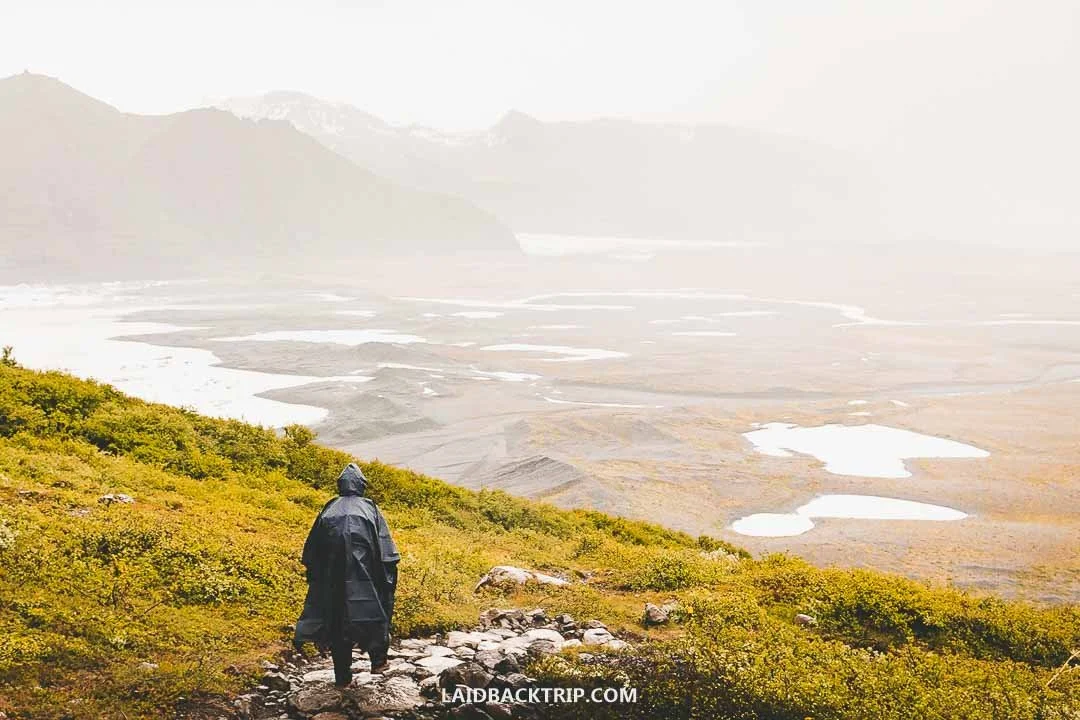
It was pouring rain when we visited Skaftafell, but we still did the Svartifoss - Sjónarnípa trail.
He also mentioned that this was the starting point for the whole Morsardalur valley, which had Morsarjokull. There were three trails named Baejarstadarskogur M1, Morsarjokull M2, and Kjos M3, and while they didn't have much elevation gain, they were long.
The M1 was 15 kilometers, M2 was 20 kilometers, and M3 was 30 kilometers. And they were practically just to reach the glacier. It was an interesting alternative if we had already been in Skaftafell before, but since this was our first visit, we wanted to stick with the Skaftafellsjokull area.
Finally, he mentioned Svinafellsjokull, another outlet glacier easily reached from Skaftafell. He said it could be reached by car, though the road was far from ideal. Still, it was supposed to be incredibly beautiful. Equipped with all the info we could get, we were ready to hit the trail.
Hiking Svartifoss - Sjonarnipa Trail
With our rain ponchos on, we set off. The trail first took us along the northern edge of the Skaftafell campground, whose tent area looked pretty empty. After 250 meters, we turned right and started climbing. In about 70 meters, right after tackling the switchback, we turned left.
From here, the trail climbed steadily. We passed the turnoff for the Sjonarnipa trail and continued straight. Soon we walked past Hundafoss and Magnusarfoss, two beautiful waterfalls fed by the Storilaekur stream. And knowing we'd see a few more waterfalls, it felt like we were back on Waterfall Way Trail.
Svartifoss Waterfall
At the next junction, we turned right and continued hiking uphill. We walked for about 600 meters until we reached the Svartifoss viewpoint with the Sjonarnipa turnoff. The waterfall was still ahead, and we thought about continuing a bit farther, but since it was raining really hard at this point, we were fine with the view we had.
We'd already seen plenty of waterfalls in Iceland even though we'd been on the road just for a few days. And they were all incredible, with Svartifoss being no exception.
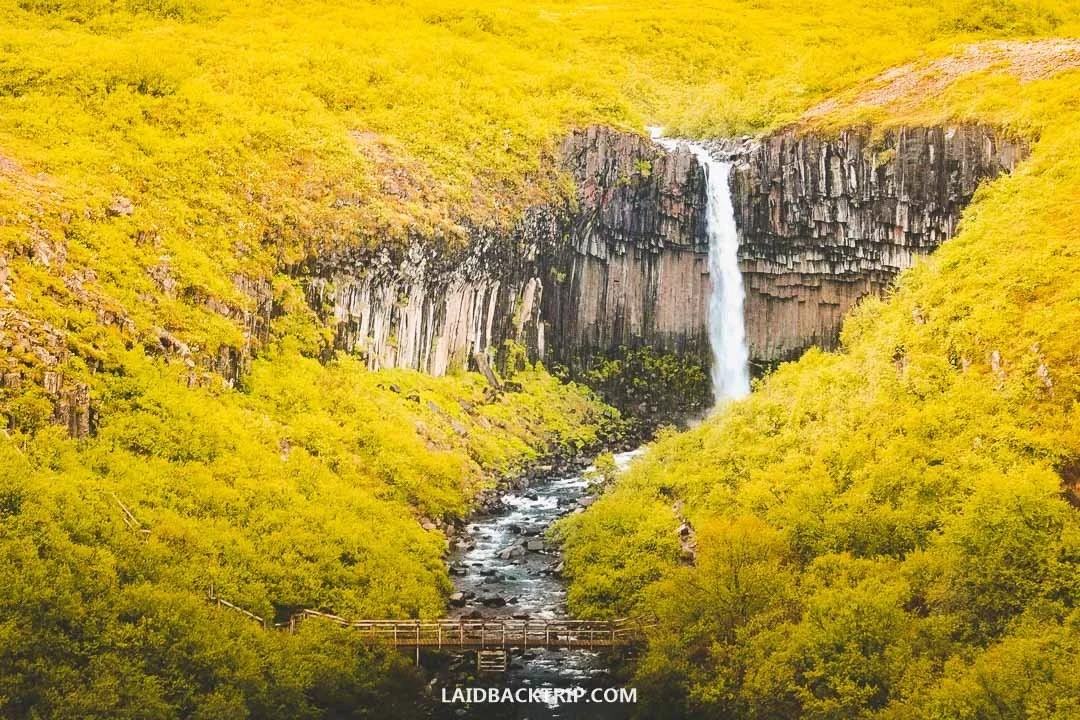
Svartifoss was one of the waterfalls we saw in Iceland with striking basalt columns.
The 20‑meter waterfall was surrounded by hexagonal basalt columns like the ones we'd already seen at Reynisfjara Beach and later would see at Litlanesfoss Trail or Dettifoss Waterfall. Because of the dark lava columns, shaped like everything around here by volcanic activity, its name translates to Black Waterfall in Icelandic. It wasn't as famous Seljalandsfoss Waterfall or as huge as Gullfoss Waterfall, but the basalt columns made it fascinating nonetheless.
Spotting an Arctic Fox
At this point, we turned right and continued for about 600 meters until we reached the Sjonarnipa trail, where we turned left. This stretch had a mild incline, a few muddy sections, and some boardwalks that helped us get through the worst parts.
We walked through rugged heathland covered in low shrubs, mosses, and grass. We moved quietly with no one around. At least that's what we thought. Lucie was walking ahead of me when she suddenly exclaimed, "Fox!"
We both froze, just as it did, for a split second before disappearing into the shrubs. From a distance, it looked as dark as the volcanic plain we'd hiked across to Sólheimasandur. Everything happened so fast that before I even thought about my camera, it was gone.
I'd hoped to see puffins, maybe take a whale‑watching trip, maybe spot some seals, but an Arctic fox was definitely not something we expected to see in the wild. Later in the Westfjords, there was an Arctic Fox Center, but we didn't stop there because we'd already seen one.
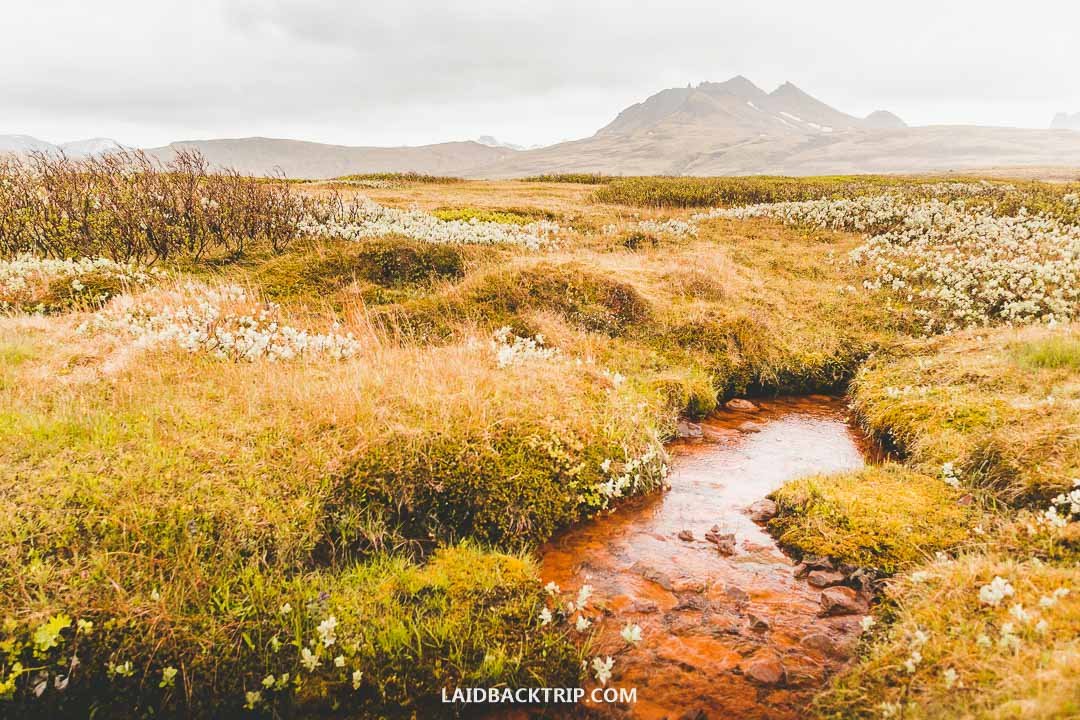
Beyond the rugged heathland we were crossing was Kristínartindar, a peak we couldn't hike because of the weather.
As the trail turned north, we could see the 1126‑meter‑high Kristinartindar ahead. We assumed it would be in the clouds, but surprisingly it wasn't. At least not yet. Lucie had a brief moment of doubt, wondering if we should've gone for that hike instead, but the weather was clearly getting worse. And about 45 minutes later, as we were hiking down, the wind picked up and brought clouds and more rain. We were glad we'd stuck with this trail.
Sjonarnipa Viewpoint
Once we were finally on the Sjonarnipa trail, we had about 1.7 kilometers ahead of us until the main glacier viewpoint. As we kept climbing, another stream appeared on our left, and a few minutes later we passed another waterfall. It didn't have basalt columns like Svartifoss, but it was still a beautiful sight. The trail to Svartifoss was well maintained and easy to walk, and the section toward Sjonarnipa was in great condition too.
Most people were probably discouraged by the weather that day, so we had almost the entire trail to ourselves, including the Sjónarnípa lookout. When we reached it, the rain eased up. And right in front of us opened up Skaftafellsjokull.
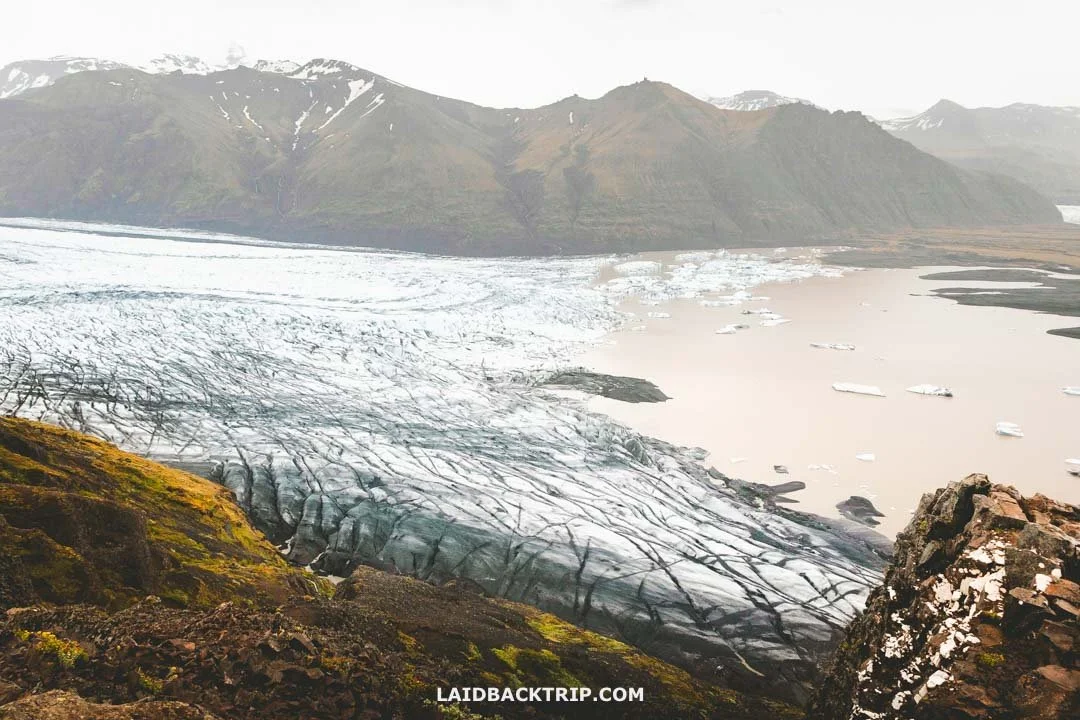
Sjónarnípa viewpoint was easily the highlight of our Skaftafell visit.
The glacier was massive, and the view was simply breathtaking. We were standing roughly in line with its snout, so we also got great views of the lagoon with lots of floating icebergs. Seeing it made us even more excited to visit Jokulsarlon the next morning.
It was an incredible feeling to stand above Skaftafellsjökull Glacier alone. I'd had doubts back at the visitor center about whether the hike would even be worth it in this weather, but they vanished instantly. From Sjónarnípa, we still had about three kilometers ahead of us, but this time it was all downhill.
The path running along the side of the glacial valley stayed interesting. While we eventually lost sight of Skaftafellsjökull, the whole outwash plain opened up in front of us. We reached the Hrútagil lookout, and once again the views were incredible.
As we continued down, the trail disappeared into thick shrubland with dwarf birches. And a few moments later, we were standing back at the visitor center. When we reappeared, it was already closed, so we headed straight to our car to take off the wet rain gear and enjoy a light snack.
Visiting Svinafellsjokull
Once we got back from the trail and shook all the rain off our ponchos, we were done for the day. At least for a few minutes, until Lucie got curious about that Svinafellsjokull Glacier the park ranger mentioned. He'd said the drive wasn't in great condition but should still be doable even with a 2WD.
The issue was that the 2.5‑kilometer dirt road was full of rocks and potholes filled with rainwater, so we had to drive super carefully and slowly to avoid them (which ironically happened to us later near Dynjandi Waterfall on a paved road). When we reached the parking area, it was completely empty.
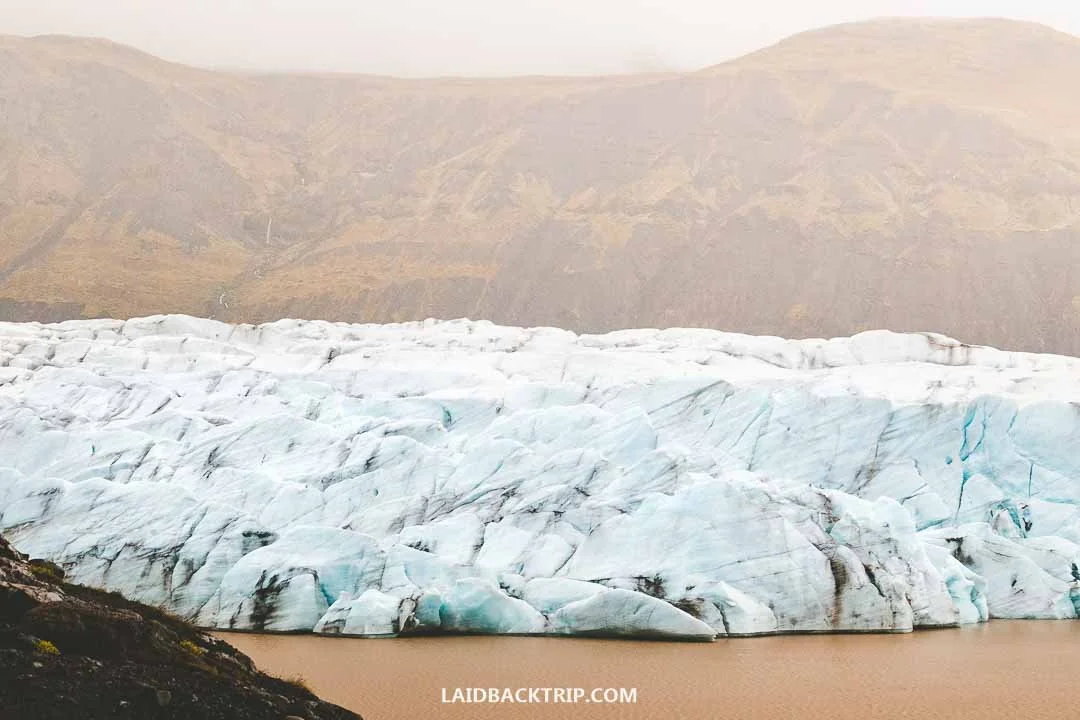
Seeing Svínafellsjökull up close was an amazing experience.
So we put our rain ponchos back on and headed toward the glacier. It wasn't a long walk, maybe 200 meters at most. Once we reached the lagoon, Svinafellsjokull appeared right in front of us. We were really close, staring straight at the glacier's snout.
When we hiked to Sjonarnipa, we were above the glacier, but here we were almost face to face. It was raining, and the glacier blew incredibly cold, strong wind. The view was amazing, but we didn't stay long. It felt like the wind could blow us away.
That was back then. Now the road is closed, but they've opened a new parking area for Svinafellsjokull that's accessible by driving the Ring Road a bit farther. The glacier is about 800 meters from the parking. Because of the rain, Svinafellsjokull was really quiet when we visited, but I have a feeling that even on a good‑weather day, compared to the main Skaftafell area, this would still be a great place to escape the crowds.
Staying at Skaftafell
Because we actually didn't finish our day in Skaftafell but at Svinafellsjokull, we figured it didn't make much sense to drive back when there was another campground just a few kilometers farther down the road.
On a day with great weather, we wouldn't have hesitated to spend the night at Skaftafell Campground, but with the weather this bad, we decided there was no point since we wouldn't get any views anyway.
We could see Skaftafell Campground as we'd parked right next to it. We'd heard it was supposed to be one of Iceland's best campgrounds, though I guess its popularity comes more from the location than the facilities.
From a quick look, it seemed like a solid option, especially on clear days when you can enjoy all the scenery around you. The upside was that because of the weather it didn't feel as busy as we expected, but I'm sure on a sunny day it would look much more packed. The campground had basic facilities like sinks, tap water, and hot showers, but no kitchen.
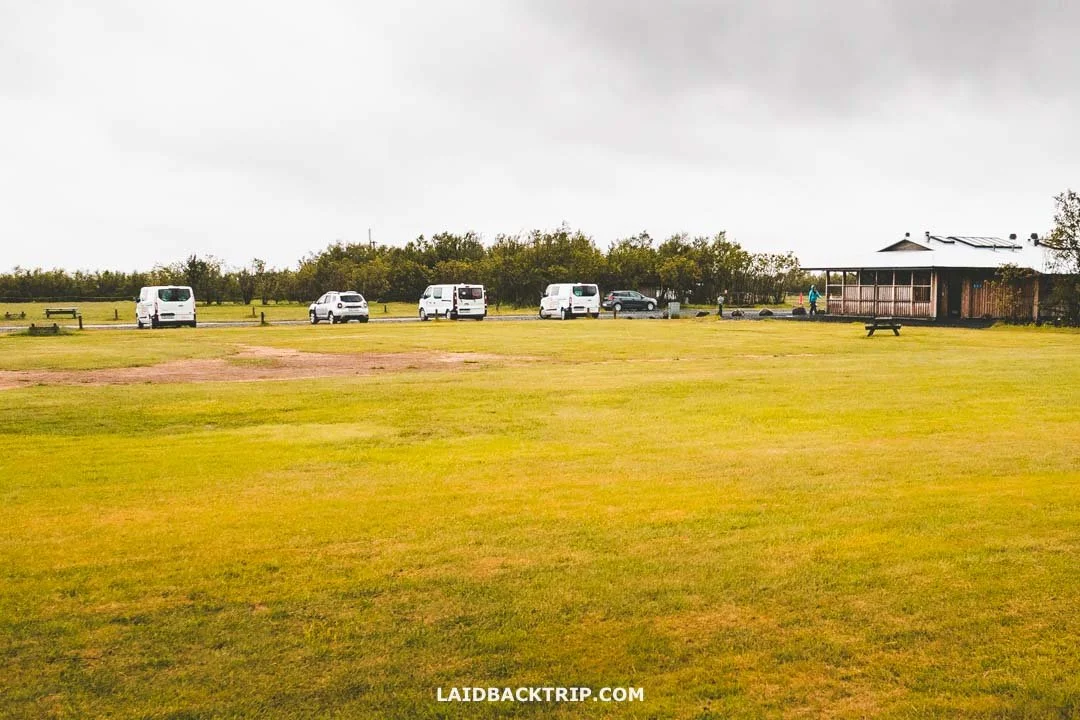
Skaftafell Campground looked pretty quiet when we were there, but we still decided to stay in nearby Svínafelli instead.
Because of the Svinafellsjokull detour, we decided to continue along the Ring Road for a few more kilometers to Svinafelli Campground. This campground was much smaller and very quiet. Only a few bigger RVs were parked there, which turned out great because we had the kitchen to ourselves.
On the way to Svinafelli, we passed Hotel Skaftafell, which we both admitted would've been a much more comfortable option. It had been another long day, and with the rain battering us for hours, we had to remind ourselves that staying there would've been way out of our Iceland budget, not to mention that it was probably fully booked.
But we really wanted to camp in Iceland as much as possible and were prepared for some rain. Besides this place and the two campgrounds I mentioned, Skaftafell didn't have many hotels.
There were some apartments in Svinafelli right across from our campsite called The Potato Storage, and for glacier views there were the Skaftafell Lodges. About 30 kilometers west in Kalfafell were Fosshotel Nupar and Hvoll Hostel, while roughly the same distance to the east was Fosshotel Glacier Lagoon.
When to Visit Skaftafell
We arrived at Skaftafell at the start of summer, which would normally be considered the best time to visit, at least weather‑wise. As I've already repeated a few times, it was a rainy day, at least at this point. The park was really quiet, very different from how we pictured it. By the time we reached the area, it was well after 4 PM, and because we waited for about an hour, we didn't start hiking until around 6 PM.
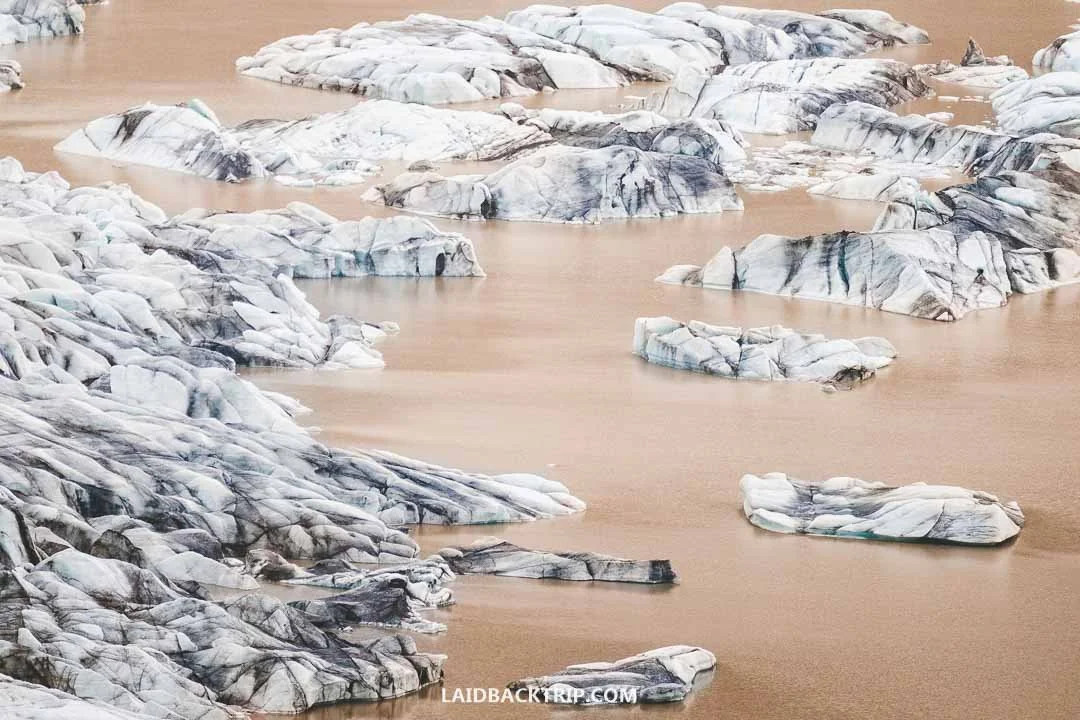
During early summer, we got to enjoy the floating icebergs on one of Skaftafell's lagoons.
Since Skaftafell is part of Vatnajokull National Park, the trails are open 24/7. And because we were here at the end of June, we knew we could take advantage of that, since the days had basically unlimited daylight thanks to the midnight sun. We used the strategy of arriving late at other places like Reykjadalur Hot Springs or Borgarfjordur Eystri during this trip, and it paid off. But those places we visited in good weather. At Skaftafell, it was raining cats and dogs.
The situation was far from ideal. But despite the doom and gloom, there were upsides. The visitor center was still open, and when we walked in, there were only a few people around. After seeing how quiet it was down here, we figured we wouldn't meet many people on the trail.
We were right. Early into the hike toward Svartifoss, we passed a few people heading back to the parking lot, but soon enough the trail got quiet and stayed that way for the rest of the hike.
The combination of miserable weather and late hour, when most day‑trippers were already gone, allowed us to enjoy the whole Sjonarnipa trail without a single soul. I have to admit it felt almost eerie up there, just me and Lucie, the glaciers, and silence around us.
There were also a few downsides. While we dealt with the weather by accepting the poor conditions and using rain ponchos, we couldn't do any glacier adventures. For glacier hikes, it was simply too late in the day. And for ice cave tours, we were here in the wrong season.
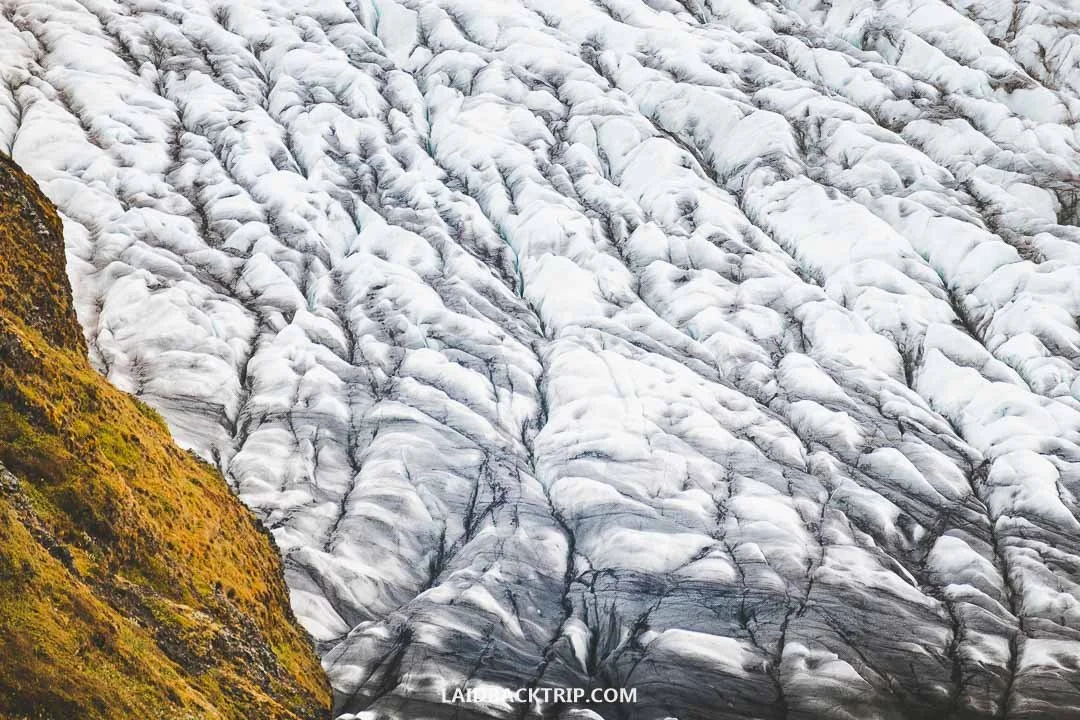
Because we couldn't join any of the tours, we could see the glacier only from a distance at Skaftafell.
It wasn't the end of the world, but we kind of wished we could've done at least one of the tours. The ice cave tours looked more interesting to us, but for safety reasons, they run only in winter when the glaciers are stable.
Speaking of winter, one interesting thing we learned about Skaftafell is that despite being surrounded by glaciers, this area receives rain but very little snow during winter. The trails can be muddy and icy, though. And of course, that applies only to the lower paths, because higher trails like Kristinartindar would be buried in snow.
How Much Time to Spend in Skaftafell
Skaftafell was one of those places where we had no idea how much time we should set aside, simply because we didn't know much about it beyond the basics before our visit. We roughly knew we wanted to do some 2-4 hour hike, but because of the bad weather, we were willing to compromise and tackle even a shorter trail.
When we arrived, we waited to see if the weather would change, but since it didn't, we headed into the visitor center where we learned a bit more about the Skaftafell area. This whole part took us about an hour and a half.
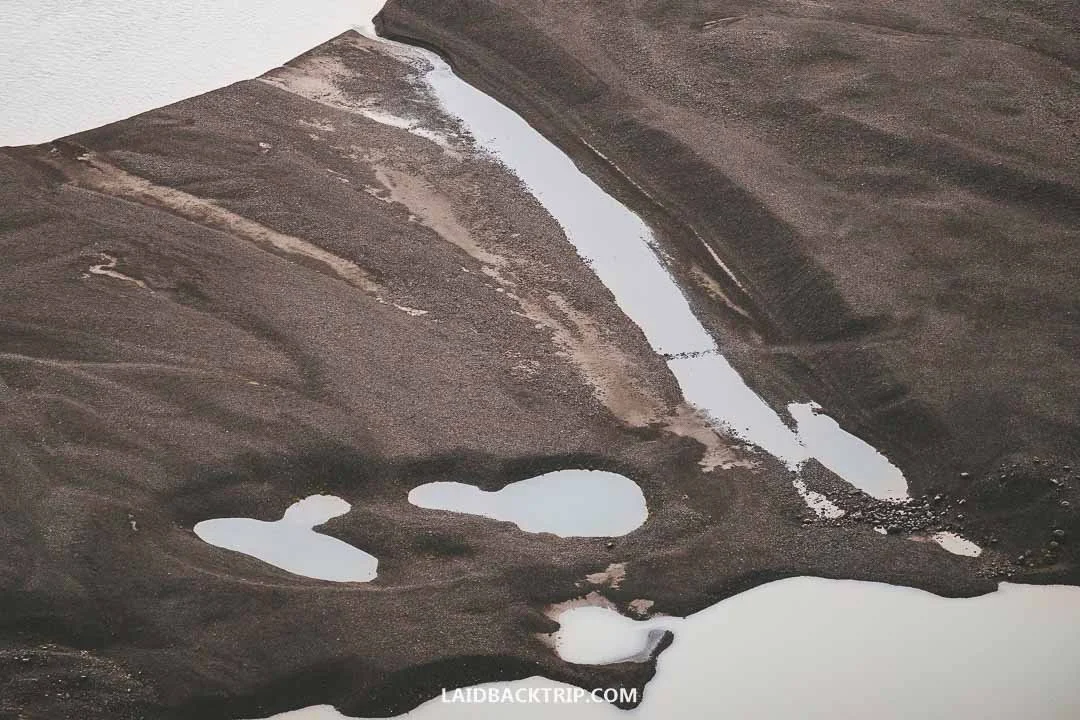
Some of the scenery around us felt like we weren't in Skaftafell at all but somewhere completely out of this world.
Then we did the Svartifoss - Sjonarnipa trail, which took us about two hours, though we walked a bit faster than usual because of the rain and made fewer stops than we normally would. We also spent a few minutes at Skeidararsandur, where we stopped just before reaching Skaftafell to enjoy the glacier views from the Ring Road. And finally, we made that side trip to Svinafellsjokull, which took at least 30, but more like 40 minutes.
In the end, we spent about four and a half hours in Skaftafell, split into three hours of hiking and exploring, and the rest waiting out the rain and getting info at the visitor center. Had we done one of the glacier tours, which take about 3-5 hours, I'm not sure we would've hiked the Svartifoss - Sjonarnipa trail, so I guess we would've spent roughly the same amount of time in Skaftafell either way.

Discover Grjotagja, a tiny lava cave hiding a geothermal pool and the filming location of Jon and Ygritte's famous Game of Thrones scene.