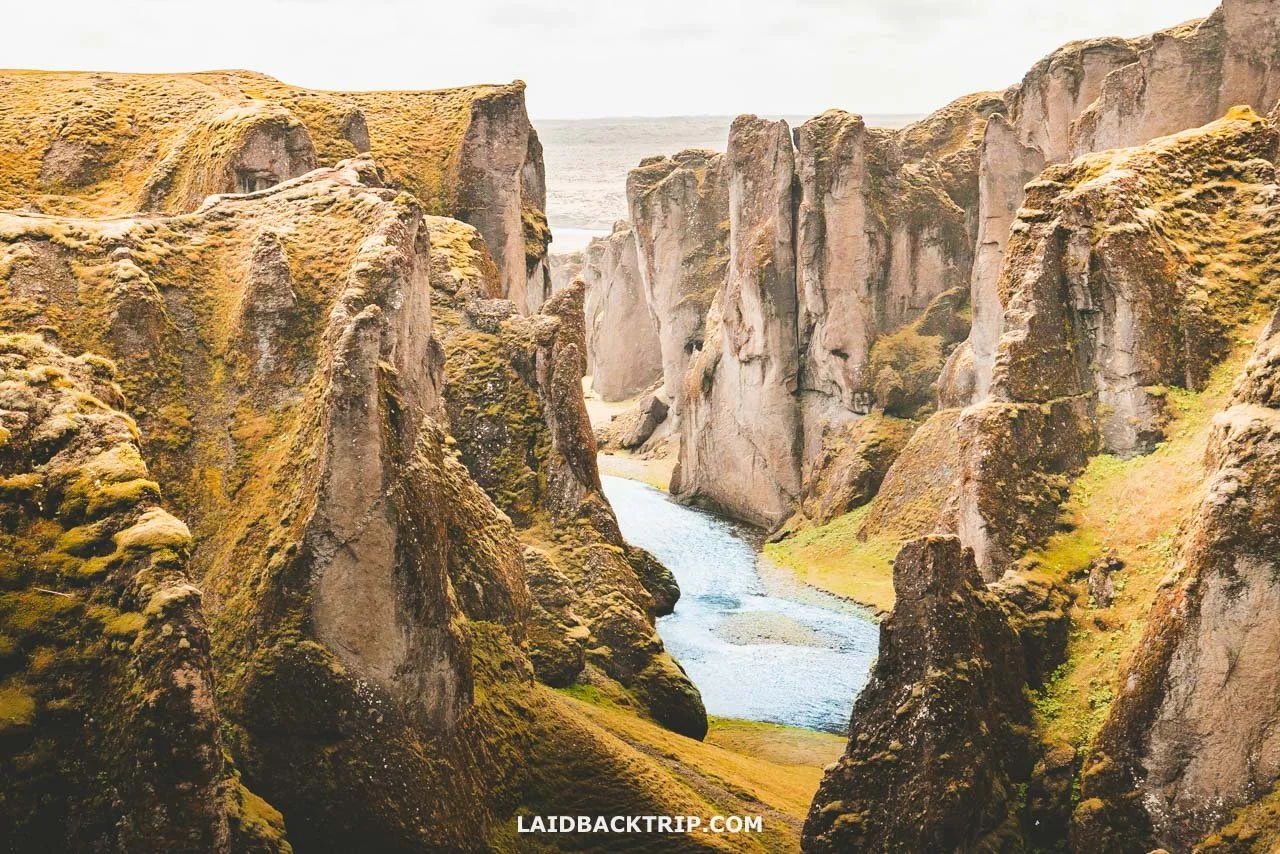
Fjaðrárgljúfur was about to show us not only Iceland's stunning scenery but also the consequences of mass tourism.
It was our third day in Iceland, and we were still in the phase of discovering how incredibly diverse and beautiful this place really was. And our next stop, Fjadrargljufur Canyon, was just proof of that.
We'd already been to geysers, sea cliffs, volcanic plains, black sand beaches, and waterfalls, but now we were heading out to hike along a huge canyon called Fjadrargljufur, about 100 meters deep and 2 kilometers long, in the south of Iceland. We were really curious about visiting it for two reasons.
First, we expected the canyon to be gorgeous, which wasn't exactly a wild guess since all the places we'd visited so far, whether it was the Golden Circle or Skogafoss, had been this way. But Fjadrargljufur felt a bit different from the rest. It had a backstory, and a really interesting one.
So, the other reason was, that Fjadrargljufur wasn't just about its stunning scenery of a deep canyon with high moss‑covered cliffs or the dramatic origin of glacial meltwater carving through ancient volcanic bedrock. It was also about mass tourism and the darker side of what happens when it isn't managed properly.
After leaving the Ring Road behind and driving along the gravel road that took us to the mouth of the canyon, we found ourselves wondering if we'd ever visited a place that had been closed for a while simply because it couldn't handle overtourism anymore. We knew of a few, but we hadn't visited those.
So Fjadrargljufur was probably the first place with that kind of story we were about to see, at least that we were aware of. And because of that, we really didn't know what to expect. If you want to know more, keep on reading!
Getting to Fjadrargljufur Canyon
Fjadrargljufur Canyon is located on the eastern edge of South Iceland, roughly between Vik i Myrdal and Skaftafell, less than 10 kilometers from the village of Kirkjubaejarklaustur. Since we started our day in Vik i Myrdal, we were looking at a 60-kilometer drive.
Normally, this would take us about an hour or so, but because we wanted to explore Dyrholaey first (it was closed on our first visit) and also made a stop at the Eldhraun Lava Field, we arrived at Fjadrargljufur in the still‑early afternoon. At the junction, we turned left onto road 206 (Holtsvegur) and followed it all the way to the main parking area.
Since the trailhead to Fjadrargljufur was just over 3 kilometers from the Ring Road, it made it one of the most accessible canyons we could visit, especially since getting there didn't involve driving on an F‑road. The easy access was definitely one of the reasons we came here, because while about two-thirds of the road was unpaved, the dirt surface was fine even for our 2WD campervan.
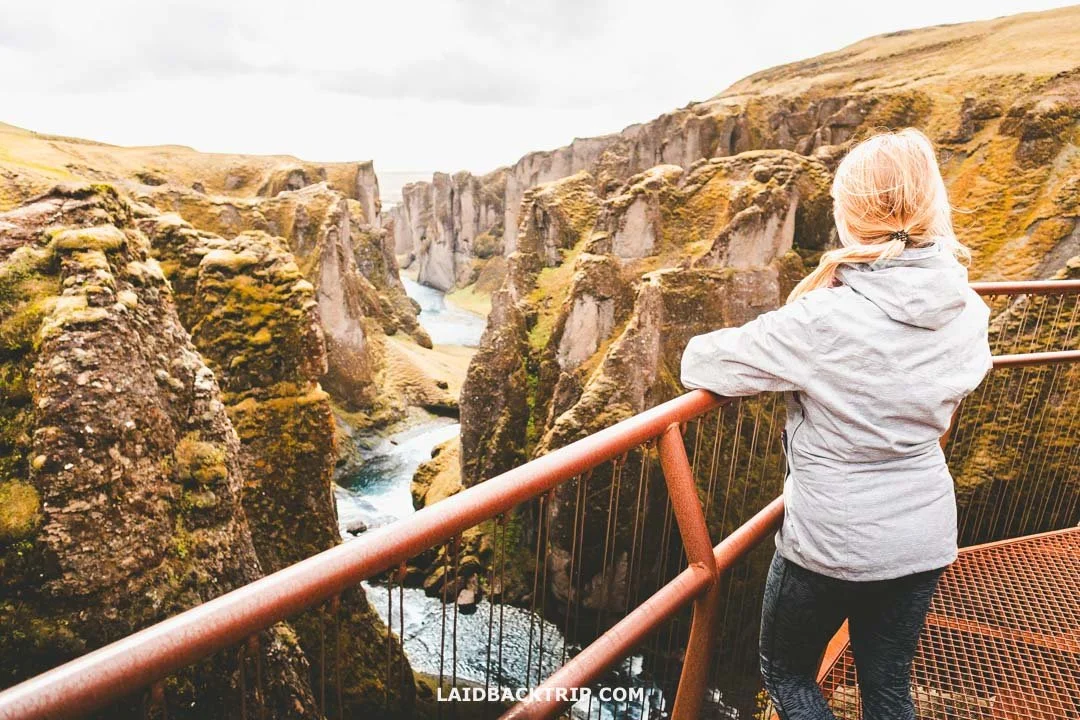
The views were simply breathtaking and well worth the effort to come see this place.
When we were there in late June, the unpaved part of the road was in good condition, at least compared to some gravel roads we encountered in the Westfjords. There were a few narrow sections, but since there wasn't much traffic, we handled them without any issues. However, the last time I checked, the road to Fjadrargljufur is now fully paved, so the canyon is even more accessible than before. Here you can check out rental car prices.
Fjadrargljufur Without a Car
Seeing Fjadrargljufur without a car is easy if you don't mind taking a tour, because even though public transport does exist here and the bus stops in nearby Kirkjubaejarklaustur, it's still almost 10 kilometers away from Fjadrargljufur. So you'd most likely need to hitchhike to cover that stretch (and you'd have to get back the same way).
Fjadrargljufur Tours
If driving wasn't an option for us, we'd probably go with one of the tours that depart from Reykjavik, like, for instance, this one, that stops not only at Fjadrargljufur but also at Seljalandsfoss Waterfall and Jokulsarlon Lagoon.
Parking at Fjadrargljufur
After a short drive, we finally reached the parking lot at Fjadrargljufur. It was a fairly spacious gravel lot with toilets (free of charge) and garbage bins (which wasn't that common as we learned during our Iceland trip). Given the canyon's popularity, I can imagine that on busy summer days it would get full pretty easily.
Luckily, that wasn't the case when we were there, as it was still relatively empty. When we visited, parking was free, but that has changed since then, and it's now 1000 ISK per car. So even though there's no entry fee for Fjadrargljufur Canyon itself, the parking fee would make it feel to us like we were paying to see the place.
Plus it would be another expense to keep in mind when creating your Iceland budget. By the way, the same thing also happened at places like Hengifoss, Dynjandi, and tons of others.
There was another parking lot at the far end of the canyon, usually called the upper parking. Since it was only accessible via an F-road, we didn't drive there. Not just because we didn't have 4WD, but also because there wasn't much point.
We found a spot in the lower lot without any issues, and since the upper one is located at the opposite end of the canyon, which we wanted to explore in full, it didn't really matter where we parked. It's also worth noting that the upper parking is about 500 meters from the canyon, so you'd add an extra kilometer of walking to your visit.
Fjadrargljufur Trail Is Easy
Since we planned to do the whole Fjadrargljufur Trail, we were looking at a 1.1-kilometer walk one way with about 60 meters of elevation gain. On paper, it looked like one of the easiest hikes we had lined up for those two weeks in Iceland. While we had no idea what the trail would actually be like, we already knew a bit of the canyon's backstory, which kind of hinted at what we should expect.
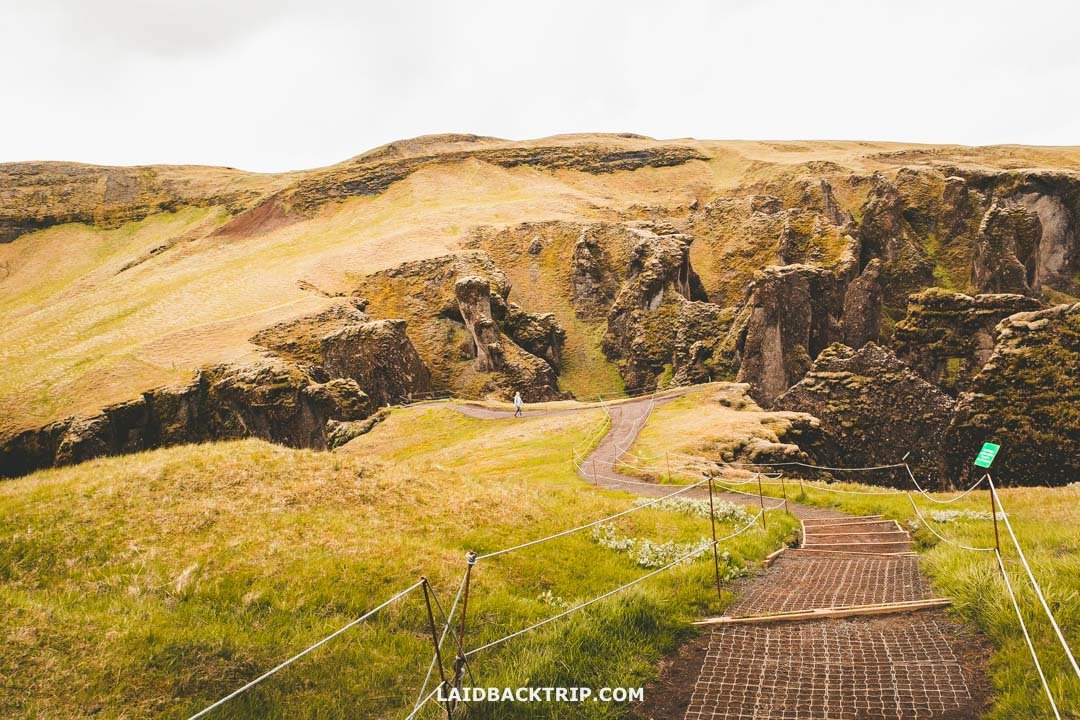
The path running along Fjaðrárgljúfur was in great condition and really easy to follow.
Fjadrargljufur Is Open
After Fjadrargljufur appeared in Justin Bieber's 2015 music video "I'll Show You," the still fairly unknown canyon suddenly surged in popularity. In the following years, the number of people wanting to see it skyrocketed. So many people came every day that the area simply wasn't ready for it. And a lot of visitors ignored the trails, which caused noticeable damage to the landscape.
Everything came to a breaking point in 2019 when the local authorities closed the canyon for several months so it could recover, and they could improve and add the missing infrastructure. After some time, it was eventually reopened, and has remained open ever since, because despite that it saw even more people visiting, the new rules and designated trail helped.
We visited after the closure, so we experienced the canyon after it had been "upgraded" to handle heavy crowds. In reality, this meant the trail was roped off and turned into a mesh walkway to prevent further erosion, and a new viewing area was installed at the end of the canyon. It made following the trail much more straightforward since there was no room to wander off.
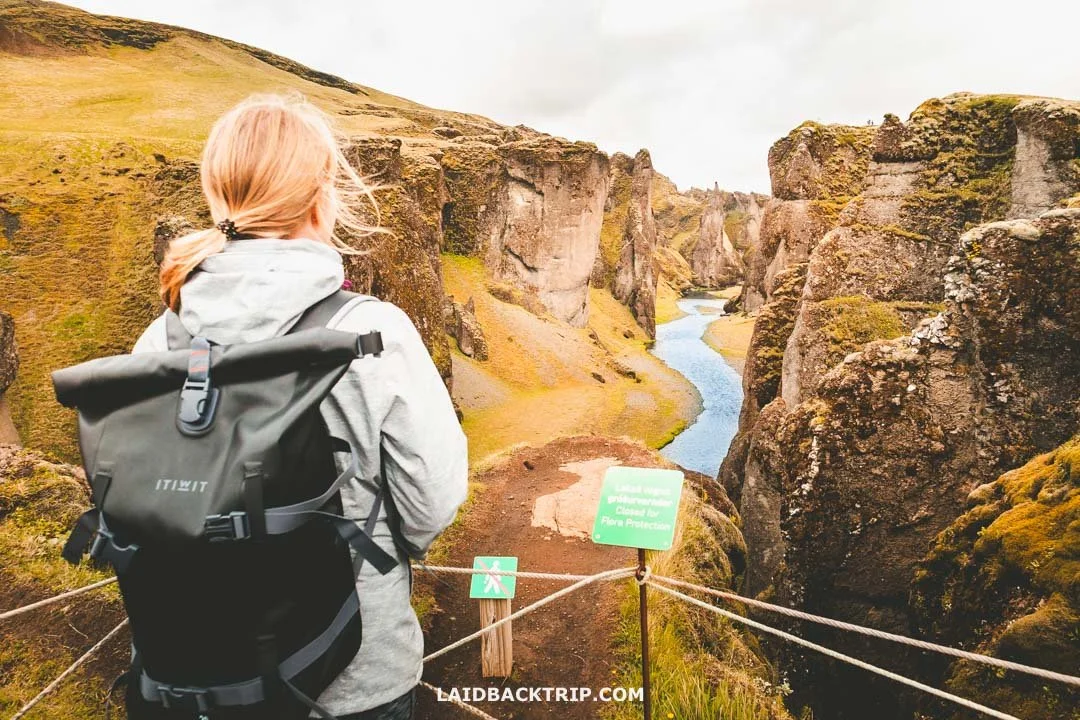
A few years ago, Fjaðrárgljúfur was temporarily closed to recover from the effects of mass tourism.
We could still see the old trodden paths branching off from the main trail every now and then, and at the newer viewing areas, we could still spot the remnants of the old viewpoints that sat right on the canyon's edge, usually dangerously close to the cliffs. The whole walk was dotted with small green stay‑on‑the‑trail signs reminding everyone to stick to the designated path to protect the fragile vegetation.
Hiking Along the Fjadrargljufur
Since we left our car at the main parking, it meant the whole trail ahead was uphill. It wasn't a steep climb, and once we tackled those 60 meters or so of elevation, the trail leveled out and turned into a very easy walk. The path went pretty much straight the whole time, sometimes really close to the canyon's edge and sometimes a bit farther away. It had three main viewing areas that broke up the walk.
First Viewing Area
The higher we got, the more dramatic the views became. And the farther we went, the better they were. We reached the first viewing platform, where we could admire the Fjadra River winding through the canyon. The river starts on the slopes of Geirlandshraun mountain before joining the much bigger Skafta River, and what is pretty incredible is that the bedrock here is made of palagonite that is about two million years old.
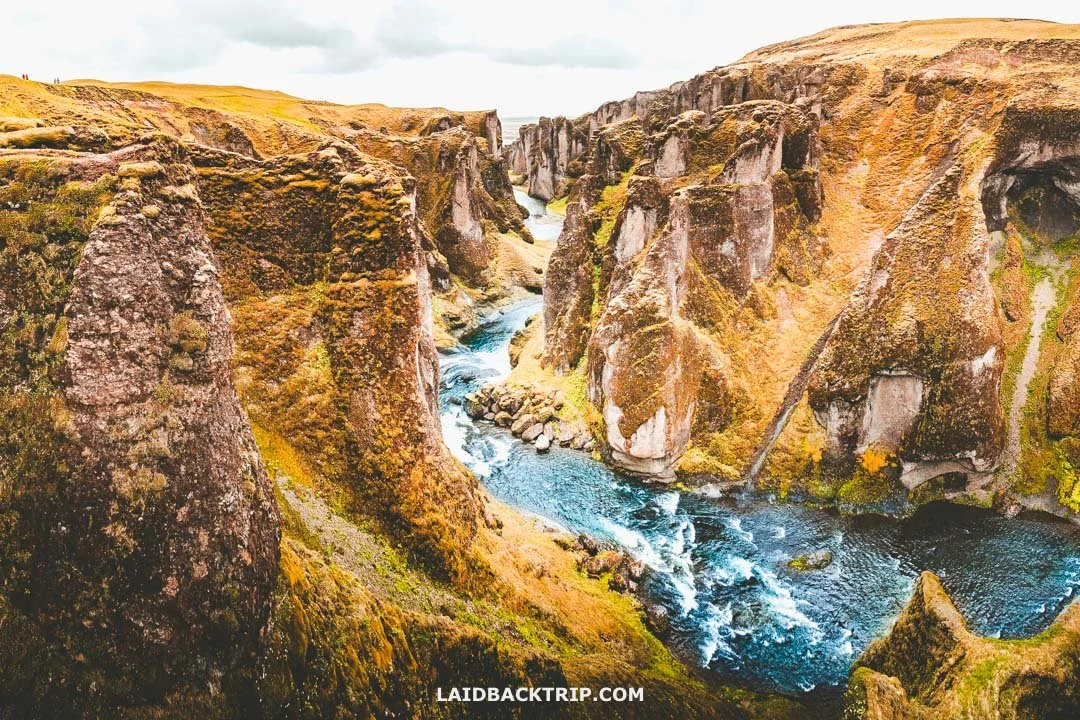
Looking down from the top of the cliffs at the Fjaðrá River making its way through Fjaðrárgljúfur was nothing short of incredible.
Fjadrargljufur itself was carved by the river during the last Ice Age about 9000 years ago. The first viewpoint was already impressive and definitely worth seeing, even if you parked at the upper parking. It also proved my point that it doesn't matter where you leave your car, just like the view from the bridge by the lower lot.
Second Viewing Area
We reached the second viewpoint fairly quickly. The views were nice too, but they were a bit limited by the boundaries of the viewpoint. From here, we could still see where people in the past walked, even closer to the edge, since those worn paths still haven't recovered.
But if there was one spot where it really didn't look safe to be that close to the canyon, it was this one, so we could understand exactly why the viewpoint was designed the way it was.
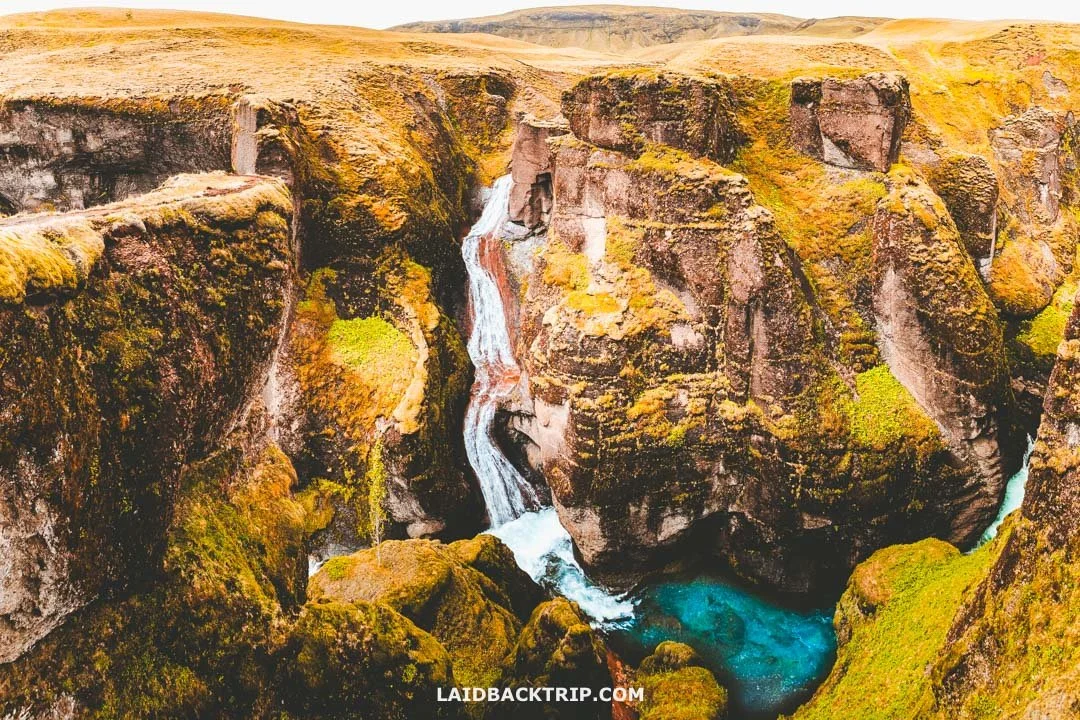
At the end of the canyon's trail, we could enjoy this beautiful view of Mögárfoss.
Last Viewing Area
The last viewpoint was easily the most dramatic. At this point, Fjadrargljufur forked, and soon after, the canyon ended. The left branch had the beautiful Magarfoss waterfall, while the right one had a few smaller cascades that were partly hidden behind the canyon walls. The best part was the big metal viewing platform, which let us get as close to the edge as possible while staying safe and not damaging the fragile vegetation.
Walking Inside Fjadrargljufur Canyon Is Not Allowed
I know that back then, before it got closed, people used to wade through the canyon, at least when conditions allowed it, which was usually in the summer when the water level of the Fjaðrá was low, and the temperatures were suitable for that kind of activity.
I admit that the idea of hiking along the canyon floor sounded interesting, but we had no intention of going down there because walking through Fjadrargljufur is now prohibited since it's an important breeding ground for sea trout.
And even if it had been allowed, the rain was coming, and the temperature was already dropping. We were more than happy to stay on the trail because we wanted to stay nice and dry for as long as we could.
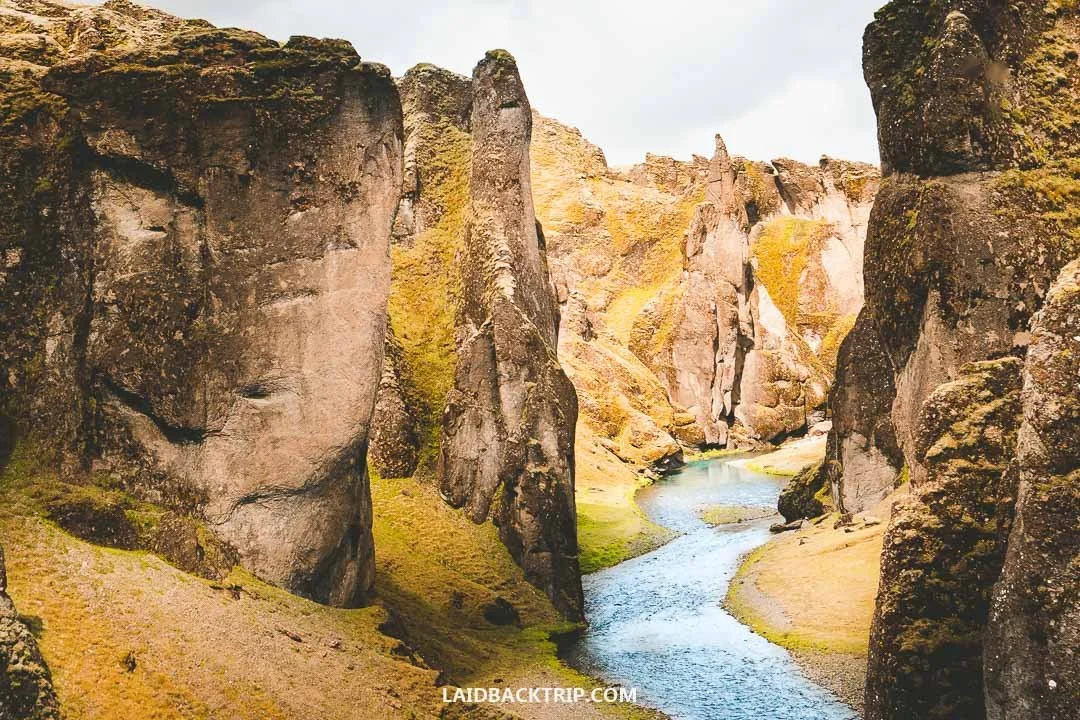
Hiking in the canyon is strictly prohibited, which helps Fjaðrárgljúfur stay preserved.
The only place we waded a river in Iceland was at Glymur Waterfall later in the trip, but that was a different case since it was part of the trail. Because we didn't hike inside the canyon, I can't say how much we missed, but I think Fjadrargljufur is best seen from above anyway.
What we did do, though, was walk onto the bridge over the Fjadra River to enjoy the view from there. The road continued on to nearby farmsteads, so we just stopped at the bridge for a moment.
Spending an Hour at Fjadrargljufur
Fjadrargljufur was one of the most accessible places we visited on the South Coast, and with the well‑maintained trail and easy difficulty, it really did take us just over an hour to do the whole hike. We walked slowly, soaked up the scenery, took tons of photos, and enjoyed the fact that it still hadn't started to rain even though the forecast warned us it would.
At the final viewpoint, the trail ended and didn't continue as it does at Latrabjarg Cliffs, so there was no way to extend the hike even if we wanted to. Since this was an out‑and‑back trail, we had to return the same way.
Fjadrargljufur in Summer Is Beautiful
Fjadrargljufur is open all year, even in winter. We happened to visit right at the start of Icelandic summer at the turn of June and July, and it was the classic Icelandic weather we had already experienced in Thingvellir National Park or at Bruarfoss Trail.
Dark, heavy clouds were rolling across the sky while the sun still managed to break through every now and then. Luckily, it didn't rain, at least not yet, even though the temperature was dropping.
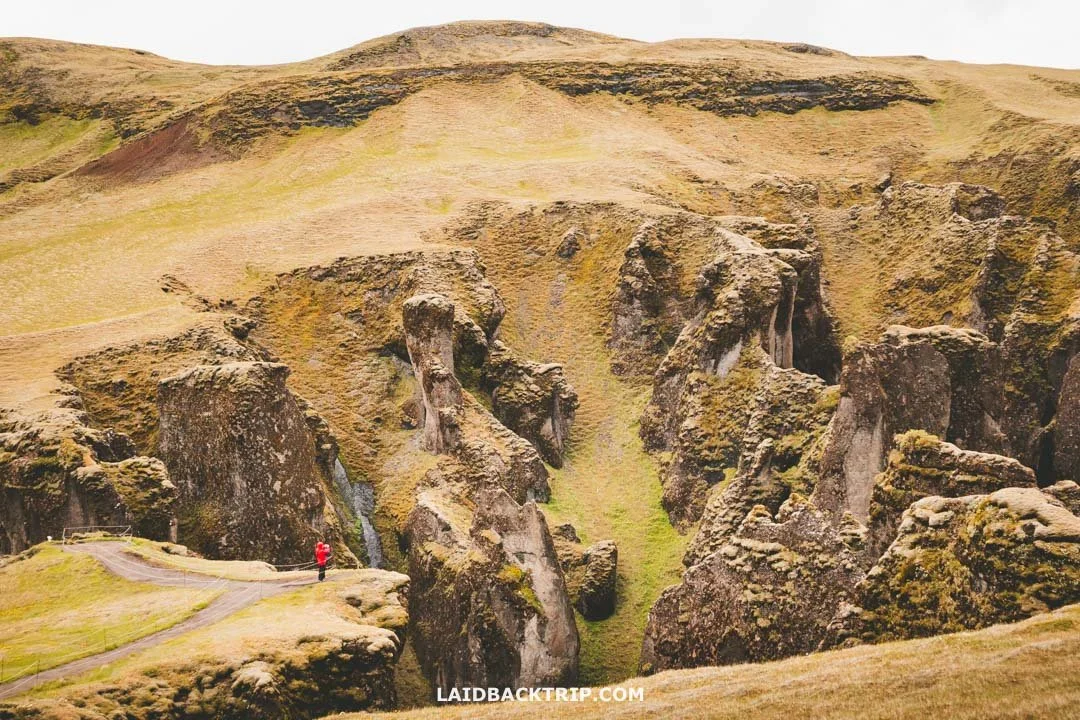
At the start of summer Fjaðrárgljúfur was gorgeous, and I'm sure it would look just as stunning in every season.
But while we were still at Fjadrargljufur, we didn't need our rain gear packed for Iceland. That didn't mean we weren't carrying our rain pants in our daypack, though. I know the canyon would look stunning even in bad weather, with mist lingering on the floor and hiding the steep moss‑covered walls, but I still preferred these conditions.
We arrived in the afternoon, and the canyon was fairly quiet since no bus tours showed up at the same time. The whole experience felt really relaxing, but I know we got lucky.
At other popular places like Reynisfjara and Gullfoss, we visited late in the evening to avoid the crowds, and I think the same strategy would work at Fjadrargljufur too, at least in summer when you can take advantage of the midnight sun. Like Reykjadalur Hot Springs, the canyon is technically open 24/7, so you can visit even after most people have left for the day.
Staying Near Fjadrargljufur
After Fjadrargljufur, we had to figure out where we would spend the night. Our first idea was to stay in nearby Kirkjubaejarklaustur, which has a basic but nice campground right next to two waterfalls. We really liked the thought of staying in such a charming spot, but the problem was that it was simply too early to call it a day.
Hotels in Kirkjubaejarklaustur
Another issue was the weather, since it was supposed to start raining within an hour or two, but we had our rain ponchos ready and didn't mind being outside even if the weather didn't cooperate. For us, that was still a better option than sitting in our small campervan for the rest of the day.
Besides the campground, the village also has Adventure Hotel Geirland and Hotel Laki, though the nicest place to stay in Kirkjubaejarklaustur would probably be the beautiful Hotel Klaustur. We also passed Hunkubakkar Guesthouse and Maddis while still on road 206, which are the closest places to stay near Fjadrargljufur.
Campgrounds in Skaftafell & Svinafell
In the end, we decided to drive about 80 kilometers to Vatnajokull National Park, so we could hike in Skaftafell, one of its most accessible entry points. Our plan was to do a short hike there and spend the night at the big campground in Skaftafell.
After the hike, though, we found a much smaller campground in nearby Svinafell, so we drove a bit farther and stayed there instead because we thought it would be less busy. And it was. Plus, it had a nice shared kitchen and a common room, something we always appreciated while camping in Iceland.
Hotels in Skaftafell & Vik i Myrdal
Skaftafell also has the cozy Hotel Skaftafell, and a bit farther down the road is the beautiful Fosshotel Glacier Lagoon if you don't want to camp as we did. And if you're driving in the opposite direction, your next stop would most likely be Vik i Myrdal, where we started this day. We stayed in the main campground there, but there are also a few hotels like Hotel Vik i Myrdal.

Discover Grjotagja, a tiny lava cave hiding a geothermal pool and the filming location of Jon and Ygritte's famous Game of Thrones scene.