A Guide to Geysir Geothermal Area

Interestingly, it's Strokkur, not Geysir, that erupts regularly in this geothermal area now.
There was no chance we'd come to Iceland and not visit the Geysir Geothermal Area to watch a geyser erupt.
As we were on our way to the Geysir Geothermal Area, we were so excited to finally see this place. We'd already seen a few geysers in the past and loved the experience every time, but it had been already a few years. Once again, it felt like one of those special moments we'd never forget. The scenery we'd seen so far was amazing, and the stops on the Golden Circle, where Geysir was located, were just as good.
And at the end of the day, it was places like the Geysir Geothermal Area in Haukadalur Valley that made our first day in Iceland so memorable. This site in particular was incredible and super easy to reach, which was exactly what we needed after a long travel day.
But let's start at the beginning. Since we landed at Keflavik Airport shortly after midnight and slept only a few hours in Hafnarfjörður, we knew this was going to be a long and tiring day. First we had to pick up our campervan, then stock up on food and camping essentials, and then hit the road.
Our plan was to explore Þingvellir National Park first, then hike to Brúarfoss Waterfall, and right after that head to the Geysir Geothermal Area. It was a solid plan. The first two stops needed a bit more time and some walking, but Geysir was basically right across the road from where we parked. It was one of those stops where there was nothing not to like.
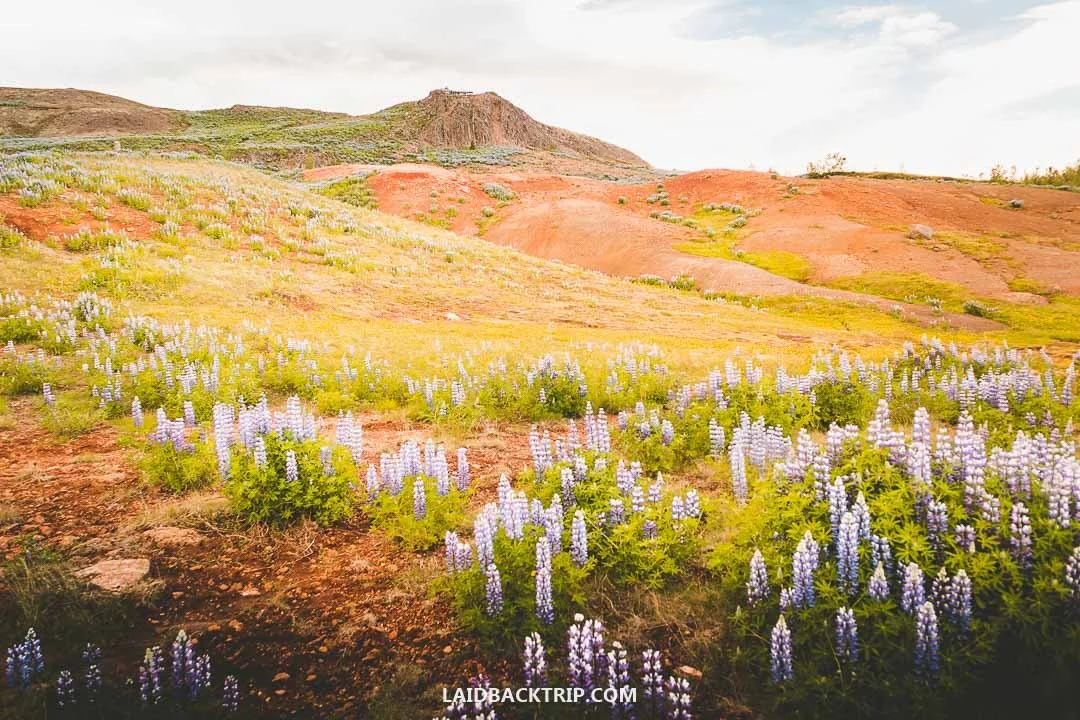
Geysir Geothermal Area is located in the beautiful Haukadalur Valley.
In the past, Geysir in the Haukadalur Geothermal Field was the main reason people even traveled to Iceland. This natural phenomenon was known around the world long before mass tourism, and visitors came from far away to see boiling water shoot 50 meters into the air, even if it meant waiting a day or two because the geyser's activity was so irregular.
This very Geysir gave its name to all other geysers around the world, and together with the ones in Yellowstone, it's one of the most famous sights of its kind. The funny part is that today it's mostly dormant, so we really came here to see Strokkur, another beautiful geyser. And this one is very much active. So let's dive into it.
Visiting Geysir Geothermal Area
Since this was our first day in Iceland, we were really glad that the Geysir Geothermal Area wasn't tucked away somewhere deep in Haukadalur Valley or as remote as Landmannalaugar (which is normally visited with a tour). Instead, it turned out to be the perfect place to explore after a long flight.
The entrance to the main geothermal area was just off Road 35 in a place simply called Geysir Geothermal Area. When we arrived, we quickly realized this wasn't a normal village like Vík í Mýrdal on the South Coast but more of a classic tourist hub with a few large parking lots, restaurants, and hotels. It was an ideal spot to grab lunch or stay overnight while enjoying some of Iceland's finest scenery, which was basically our plan (the scenery, not the food).
As we were leaving the parking lot, which was only a two‑minute stroll, we could already see Strokkur erupting in the distance. It wasn't the biggest one, but still pretty cool. And we couldn't wait to watch the whole show up close. But before we got to Strokkur, we walked past several hot streams, smaller pools with strikingly blue water, smoking vents, and we couldn't but notice how the ground here was colored by minerals creating a colorful scene.
Before we walked in, Lucie snapped a quick photo of the area map on her phone. It showed all the fumaroles, mud pools, and hot springs, so we knew what we were looking at, because some had names and some didn't.
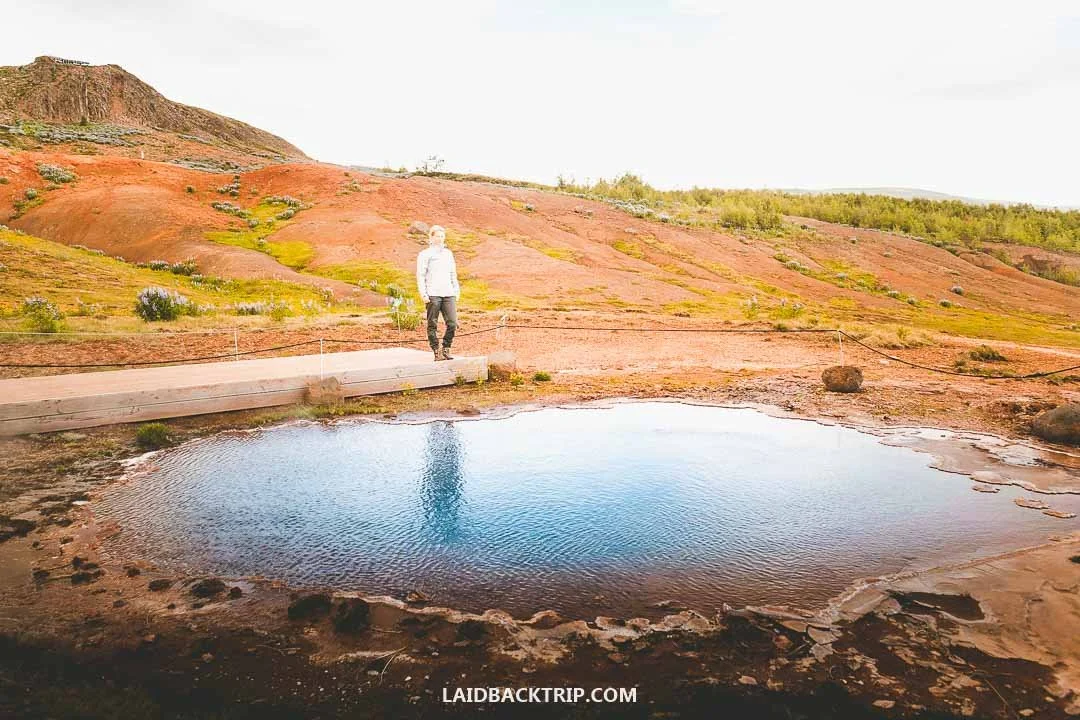
The trail was easy and paved all the way to Geysir.
The 1‑kilometer in‑and‑out trail through the Geysir Geothermal Area was paved, well maintained, and clearly marked, at least between the main entrance, Strokkur, and Geysir. Because of that, this was as easy a walk as it gets.
Strolling past hissing fumaroles, bright mineral deposits, and bubbling pools of boiling water with that classic sulfur smell (like rotten eggs) was pretty surreal, just like the moment we finally got close to Strokkur. But before that, we got to see another geyser called Litli Geysir, though we would’ve almost missed it if it hadn’t been for the sign. Compared to Strokkur ahead of us, it was tiny, more bubbling than spouting, but still pretty cool nevertheless.
Strokkur
Usually it's not easy to predict exactly when a geyser erupts. That wasn't the case with Strokkur, though. This geyser shoots water 15 to 20 meters high (sometimes up to 40 meters) every five to ten minutes, like clockwork. Some spouts were pretty small, but a much bigger eruption usually followed.
Unsurprisingly, it meant it was worth hanging around a little longer to catch the larger ones. Strokkur, and the whole landscape around it, reminded us of other geothermal areas we'd seen on past trips to Yellowstone or Rotorua, and as we waited for the next eruption, it brought back old memories, especially the time we went to see Old Faithful.
One of the most interesting things we learned about Strokkur was how both nature and humans shaped it. It's probably been active since the 13th century, though likely just as a hot spring. Back then, it was Geysir that dominated this area. In the 18th century, Strokkur became an active geyser after a major earthquake, sometimes erupting up to 60 meters. In 1920, after another big earthquake, it went quiet for a long time. More than 40 years later, in 1963, the local Geysir Committee drilled a 40‑meter hole to unclog the geyser's plumbing, and since then Strokkur has been erupting regularly again.

Watching Strokkur erupt was fascinating every single time, no matter how big the splash was.
And yes, we spent plenty of time around this geyser, waiting for just one more spout. "Could we see one more, Lucie?" "Yes, Martin." You probably know the feeling. Okay, we'd watch it one more time, and then we'd finally move on. Wow, that one was amazing. Maybe the next one would be even bigger. Then Strokkur sent a massive column of water into the sky and sprayed everything around. And because we're curious by nature, we wanted to see if the next eruption would top it. If it didn't, maybe the next one would. If we'd had more time, we could've stayed here the whole day.
Geysir
At the farthest end of the geothermal area, we finally found Geysir. Coming from the Icelandic word geysa, meaning "to erupt," this was the famous geyser that gave its name to all the others. It felt a bit ironic that at this moment it was dormant and no longer the main attraction in the area that carried its name.
Today, Geysir looked nothing like the powerhouse it once was. It was roped off and looked more like a calm water basin. Yet even from a distance, we could feel its sleeping power. And after what we'd just seen at Strokkur, it was easy to imagine how quickly nature could turn long dormancy into a raging beast.
Standing by its 18‑meter wide basin, it was wild to picture Geysir shooting water 60 meters high, with some eruptions reportedly reaching more than 100 meters. But all we could see now was a big pool of blue water.

Geysir, the most famous geyser in the world, is not active at the moment.
Many places we visited, like Hverir or Hengifoss, were shaped by volcanic activity or earthquakes. Geysir was a product of the latter. Records show it started erupting after a major earthquake at the end of the 13th century. Since then, it stopped several times and became active again, sometimes thanks to earthquakes, sometimes thanks to humans.
Like Strokkur, Geysir got its share of artificial help, whether it was digging a new channel, clearing its plumbing, or even adding a bit of soap to trigger eruptions. While its last eruption was in 2016 and it's considered practically inactive, it's not truly dead. And no one knows when it will erupt again.
From the edge of Geysir, we could climb a bit higher to see the whole geothermal area from above, but since it was getting late, we decided it was time to head back to the car. We thought about staying in Geysir because there was a campground just across the parking lot (the beautiful Hotel Geysir looked tempting after such a long day, but it was definitely out of our budget), but since we still had some energy left, we decided to continue to our next stop, the famous Gullfoss Waterfall. We eventually camped in Selfoss, where we arrived several hours later.
Staying Safe at Geysir
Since we were entering an active geothermal area, the info panels by the entrance greeted us with a few basic safety rules and warnings, like staying on the trail, never crossing into roped‑off areas, and not touching the hot water. We'd seen similar rules at places like Skaftafell or Fjaðrárgljúfur, but because Geysir's area added the geothermal element, we were definitely more careful while walking around.
Another thing we learned was that the water temperature in the hot pools usually stayed between 80 and 90 Celsius, while Geysir itself reached almost 95 Celsius. But that was just at the surface, because the base temperature of the whole area was around 250 Celsius.
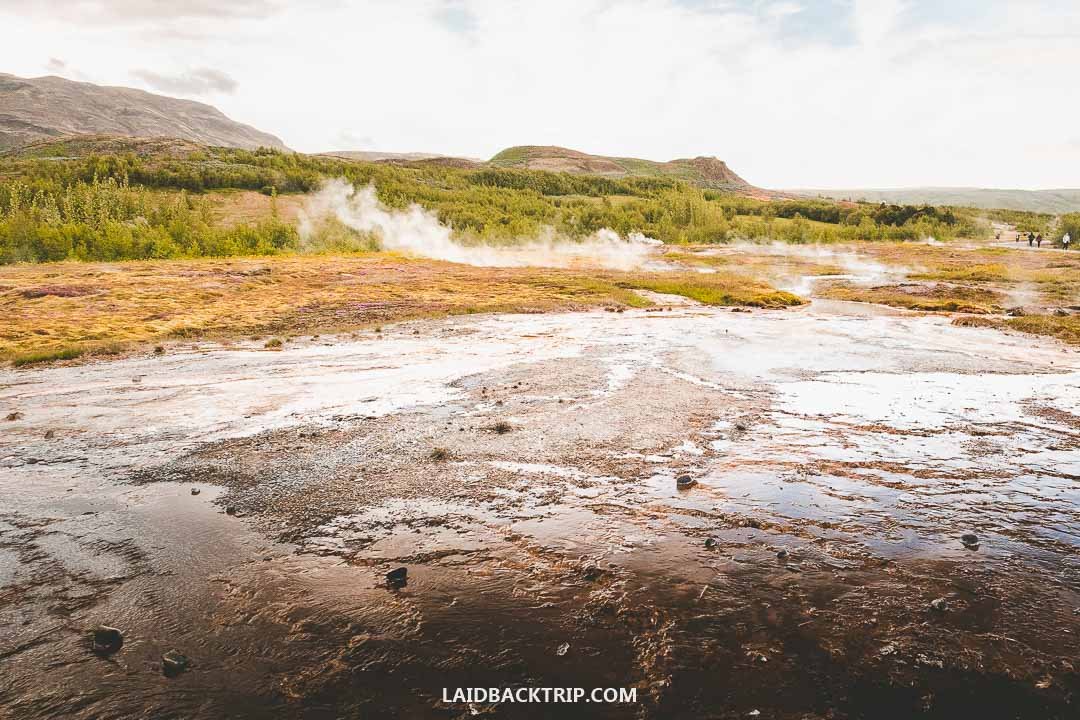
The boiling pools, the hissing earth, and the heavy sulfur scent attacked all our senses the moment we stepped into the Geysir Geothermal Area.
So unlike Reykjadalur or Mývatn, where we could actually take a dip, here we really understood why all the signs warned us not to touch the almost boiling water. One of the panels even mentioned that the nearest hospital was 62 kilometers away, which was a subtle reminder of how deceivingly dangerous this place could be.
World Nomads provides travel insurance for travelers to cover their trip essentials, including sports and adventure activities.
SafetyWing is affordable travel insurance for backpackers, long-term travelers, and digital nomads.
The last thing we had to watch out for was Strokkur's eruptions. Sure, we stayed in the "safe area" behind the ropes, but the spray from the geyser, which shot several meters into the air, was carried by the wind in all directions.
Luckily, the wind was steady that day, so the really wet spot where the water landed after each eruption was easy to see and easy to avoid. Since it was fairly cold even in summer, it wasn't so much about the heat of the water but more about not wanting to get soaked (we saved that for Kvernufoss) or smell like rotten eggs. Even though it wasn't raining, we kept our rain jackets on anyway, mainly to block the wind and the spray from Strokkur.
No Entry Fee to Geysir
Like most natural sites in Iceland, the Geysir Geothermal Area was free to visit. This was great news, and it wasn't just here, since we saw the same rule at places like Dettifoss or the Dyrhólaey Peninsula. The interesting part was that there had been attempts to turn this place into a paid attraction in the past, but luckily for us, none of them ever worked out.
That didn't mean the whole visit would be completely free nowadays, at least for those arriving by car like we were. What changed since our visit is that they started charging for parking.
Geysir Is Open 24/7
Since Geysir Geothermal Area was a natural site, it was technically open all day, so there was no rush to get there. We ended up arriving pretty late, around 8 PM. But because we were traveling in late June, there was still plenty of daylight thanks to the midnight sun, and it honestly looked like we'd arrived in the middle of the day. Sure, it was mostly cloudy with a few moments of sun breaking through, but that didn't change anything.
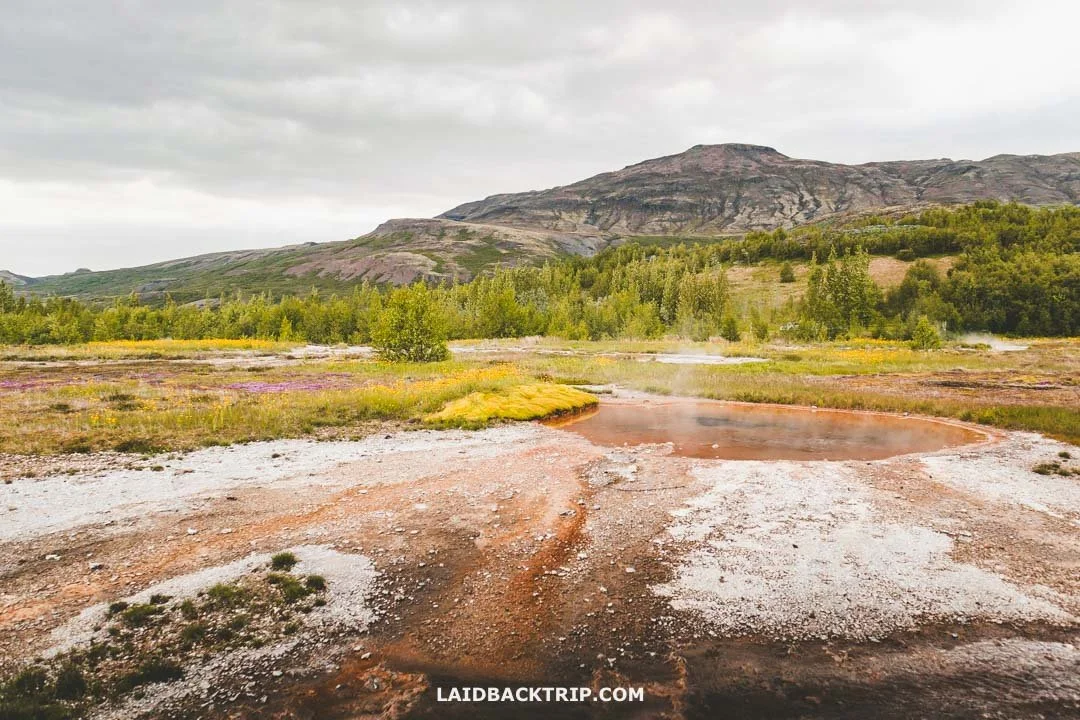
Since we visited the Geysir Geothermal Area in early summer, there was plenty of daylight even late in the evening.
As we learned in the following days, whether we were on a whale watching tour or standing on a black sand beach, this time of year let us visit places like Geysir even after midnight simply because it never got dark.
If we'd traveled in winter, or anytime with short days, we would've had to plan our timing much more carefully. Around that season, it gets dark fast in Iceland, so we'd have only a few hours to see Strokkur in daylight, since the trail obviously had no lights. But in summer, that wasn't an issue at all.
Another nice thing about our late arrival was that by the time we got there, all the big groups were already gone. And while we definitely didn't have Geysir to ourselves, the whole place felt pretty quiet compared to late morning or early afternoon. We'd heard that Geysir can get really busy during the day, so arriving this late gave us the chance to enjoy the whole area without the crowds.
We Spent Over an Hour at Geysir Geothermal Area
Since this area wasn't actually that large and the main entrance was basically right across the parking lot, the whole walk around the Geysir Geothermal Area took us roughly 30 to 40 minutes, but we spent at least another 30 minutes just watching the insane show that Strokkur put on every few minutes. So in the end, we spent over an hour at this site, and if we'd had more time, we probably would've stayed even longer.
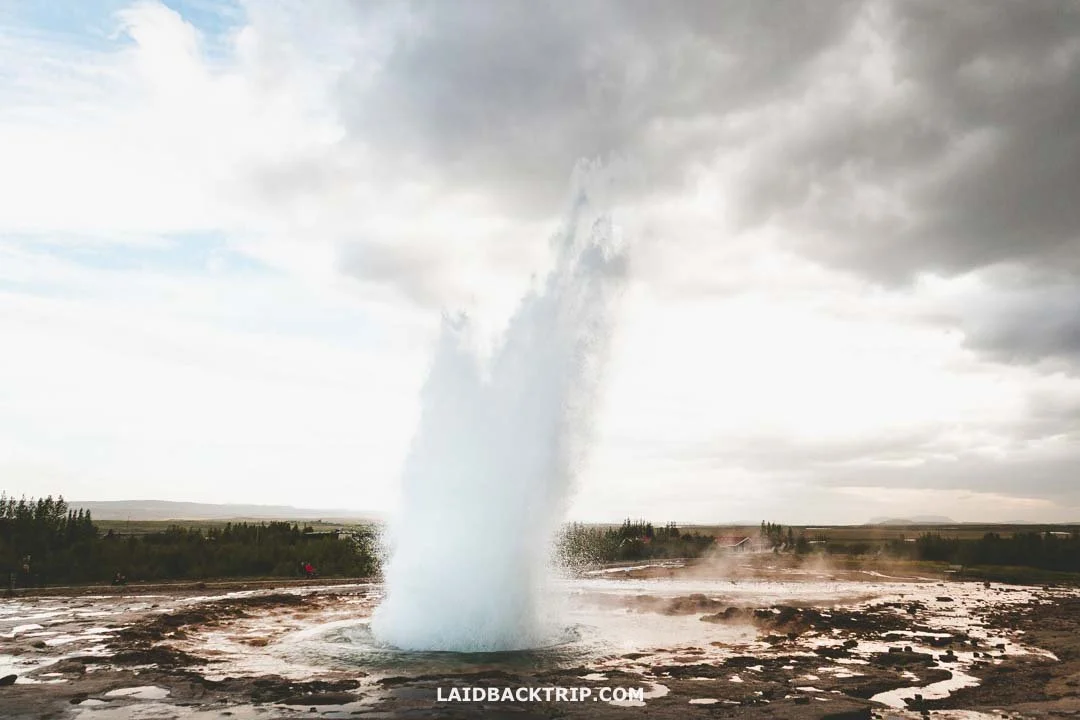
We could've stood there for hours watching Strokkur go off again and again.
If we'd been pressed for time, I'd say we could've seen the Geysir area in about half an hour. And because we didn't need that much time here, and when we combined that with the easy accessibility, we think this site was definitely worth a visit, even though our Ring Road itinerary was super packed.
Getting to Geysir Geothermal Area
Since we started our day in Reykjavik, or to be precise Hafnarfjörður, we were looking at a 110‑kilometer drive to the Geysir Geothermal Area. Because all the places we planned to see in between were basically along the way, we didn't add any extra mileage to that total. Brúarfoss, where we'd stopped earlier, was 15 kilometers away, and Gullfoss, which we were about to visit right after Geysir, was only 10 kilometers farther.
And because we also wanted to see Þingvellir National Park, we took Road 36, which eventually turned into Road 37. Driving the Ring Road to Geysir would've worked too, but because we planned to visit Reykjadalur Hot Springs (and also the whole Reykjanes Peninsula, where the famous Blue Lagoon was located) at the end of the trip, we chose the route we chose.
All these "main" roads were paved and easy to drive even with our small 2WD campervan, given that it was summer and there was no snow or ice. In winter, the road conditions would most likely be very different.

Being so close to Reykjavik, the Geysir Geothermal Area was one of the most accessible sites we visited on our Iceland trip.
Tours to Geysir Geothermal Area
Since Geysir is the most popular geothermal area in Iceland and sits so close to Reykjavik, it makes for one of the most popular day trips from the capital. Tons of tours come here every day, and had we not traveled on our own, we'd probably have gone with that option. We would've most likely picked a Golden Circle tour that includes not just Geysir but also the other must‑see places in this area. This would really be the best way to see Geysir without a car (and the other popular stops on this route), because there's no public transport here at all.
Parking at Geysir Geothermal Area
When we visited the Geysir Geothermal Area, the parking was free, but that's no longer the case. These days, a fee of 1000 ISK per car (the rate for a small car, valid for up to eight hours) has been introduced and has to be paid through the Parka app. The same thing happened not just at Geysir but at pretty much every major site like Seljalandsfoss or Skógafoss, so Geysir is definitely not an exception in this trend.
As we drove to Geysir from Brúarfoss, the parking lot was on our right side, almost immediately after entering the village. Despite how big it was, the road sign marking the lot was slightly past the entrance, so we almost missed it. The parking itself was paved and pretty spacious, and even though this was probably the busiest area we visited in those two weeks we were in Iceland, we found a spot right away. The trick was that we left our car a bit farther from the entrance (it added maybe 30 seconds of walking).
Another parking area sat right across from the entrance to the geothermal area beside the information center, but that one was packed. On the way out, we passed a couple of other lots, but those were private and only for guests of Hotel Geysir or Litli Geysir Hotel. We also noticed a self‑service N1 gas station (credit card only) next to the information center, which might be a good place to fill up depending on how much fuel you have left. It looked convenient, but since we'd filled up in Reykjavik, we didn't stop.
Travel Resources
Here you can find links to all the travel resources we use and which you might find helpful when planning your next holiday.
Accommodation: When looking for accommodation, we usually search hotels via Booking.com or Hostelworld.
Tours: Although we love to travel independently, some places are better to visit with a guided tour.
We prefer GetYourGuide for its easy-to-use interface and solid reputation. Another great alternative is Viator.
Rental Cars: When going on a road trip, we always use Rentalcars.com, a reliable site for booking a rental car in advance.
Flight Tickets: When looking for flight tickets, you can search Skyscanner to find the best price.
Travel Insurance: World Nomads and SafetyWing cover against risks of travel.

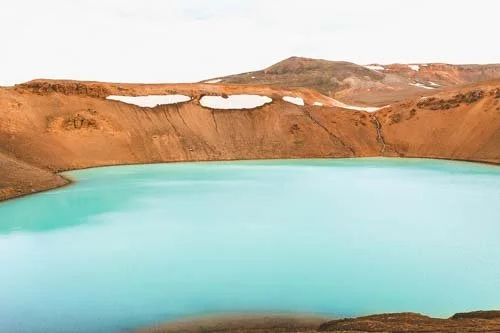
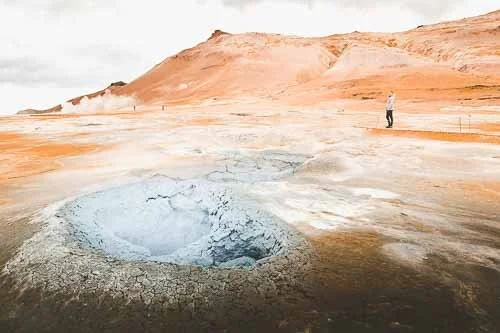

Read our travel guide on visiting Dettifoss in Iceland. It includes tips on how to get there, when to go, where to stay, whether the east or west side offers better views, and whether it's worth walking to nearby Selfoss.