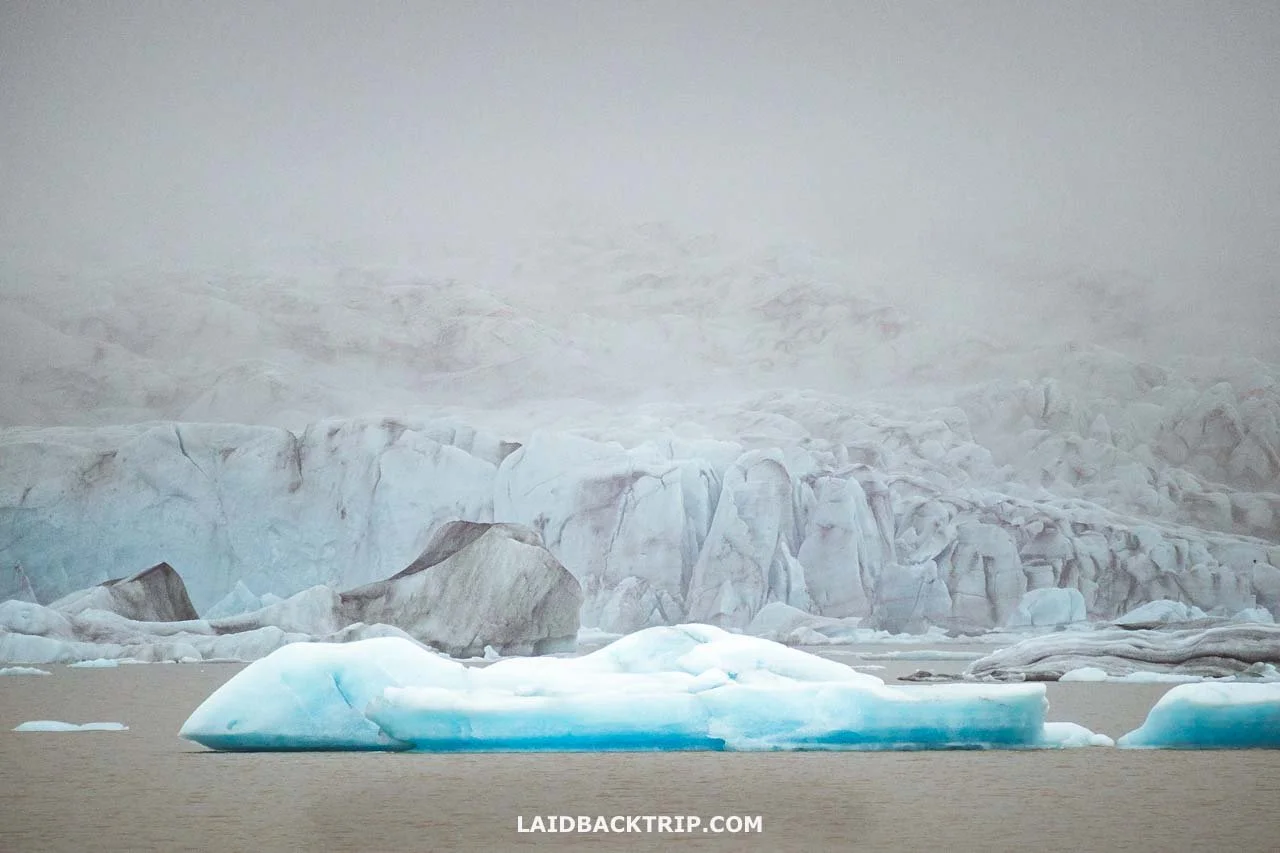
Seeing floating icebergs and massive glaciers was exactly why we wanted to see Fjallsárlón. This is how our visit went.
Fjallsarlon was one of the places we visited not because it was on our list of spots we wanted to see in Iceland since day one, but because we found out about it while planning our trip to another place, in this case the famous Jokulsarlon.
As I was looking at the map, I discovered that just a short drive away was another glacier lagoon. It was called Fjallsarlon, and unlike its much more popular counterpart, we'd never heard about it until the night before the visit, when we were making final decisions on when we would actually see Jokulsarlon. Knowing very little about it, it looked like Fjallsarlon was a great addition to our Iceland itinerary.
As this was our first trip to Iceland, we were all in to see the highlights like Geysir or Dettifoss, but we also wanted to see some less visited sites. Yesterday, we went to see Svinafellsjokull, for instance. This morning, it was time to explore Fjallsarlon. It wasn't that this was some unknown place, because even this lagoon got its fair share of tourists each day, but it was a lot less compared to Jokulsarlon.
The outlet glacier is Fjallsjokull, but like Jokulsarlon's Breidamerkurjokull, it originates from Vatnajokull, the largest ice cap in Europe. The glacier ends with Fjallsarlon, a big lagoon that has floating icebergs.
It was our second day in Vatnajokull National Park, and the scenery couldn't be more dramatic. We were surrounded by mountains, glaciers, and some of the finest views we saw in Iceland. The only downside on this little adventure was the dark clouds hanging over us.
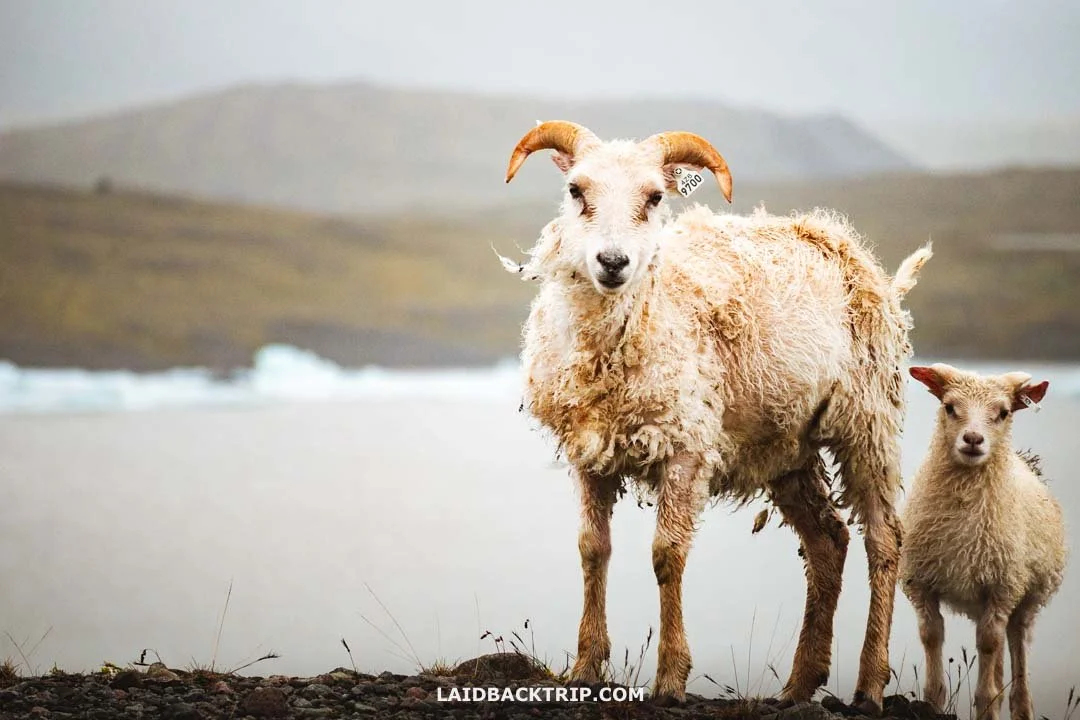
And except for a few sheep, we had Fjallsárlón completely to ourselves.
The day before, when we were hiking in Skaftafell, by late afternoon the rain arrived at Iceland's South Coast. The thing was that the weather forecast showed that it would stay with us for the whole next day. The first stop the next day was Jokulsarlon Lagoon, but we had to figure out when to visit.
The forecast showed the lowest chance of rain early in the morning, so we decided to try our luck. The small problem was that we had to be on the road by 5 AM and hope that the forecast would be somewhat accurate, but there was simply no other option because in the afternoon the forecast showed a lot of rain. Looking at the bright side, as Lucie noted, it looked like we would have Fjallsarlon to ourselves. She was dead on.
Getting to Fjallsarlon
Skaftafell was almost 50 kilometers from Fjallsarlon, but since we stayed at Tjaldsvaedid i Svinafelli a bit further down the road, it meant we could reach the glacier lagoon in about 30 minutes. Driving this stretch of the road was almost haunting because of the dark clouds, the mountains on our left, and practically no traffic at this hour.
The journey looked pretty straightforward, and we planned on just one quick stop. It was at Hofskirkja, a historic church with a turf roof, one of the few remaining in Iceland. The church was just 500 meters off the Ring Road, and since it was closed, the only thing we could do was read an info panel with its history and take some photos before continuing to Fjallsarlon.
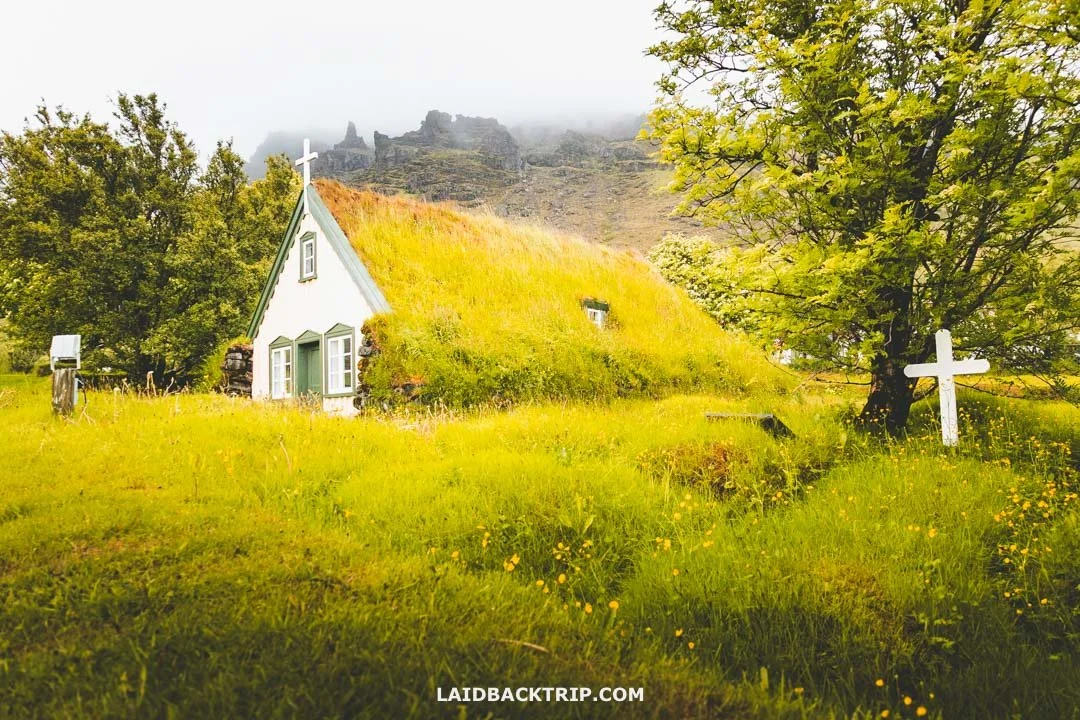
On the way to Fjallsárlón we made a quick stop at Hofskirkja, one of the last turf churches in Iceland.
On any other day, we would most likely have made a couple more stops on the way, but this morning we simply drove to the lagoon. Obviously, the Route 1 was fully paved, as was the access road. That was awesome as we didn't have to worry about driving there in our little 2WD rental campervan.
After we were done here, we continued to Jokulsarlon, which was just 11 kilometers southeast of Fjallsarlon. For your interest, we started in Reykjavik, and the 400‑kilometer route took us three days (there was the Golden Circle and South Coast to explore first).
This area is really popular for tours from Reykjavik, but they usually go to Jokulsarlon as it's simply way more famous, and while this makes for a very long day on the road, it would be the only option for those who don't drive, as the bus simply doesn't stop here. Here you can check out rental car prices.
Parking at Fjallsarlon
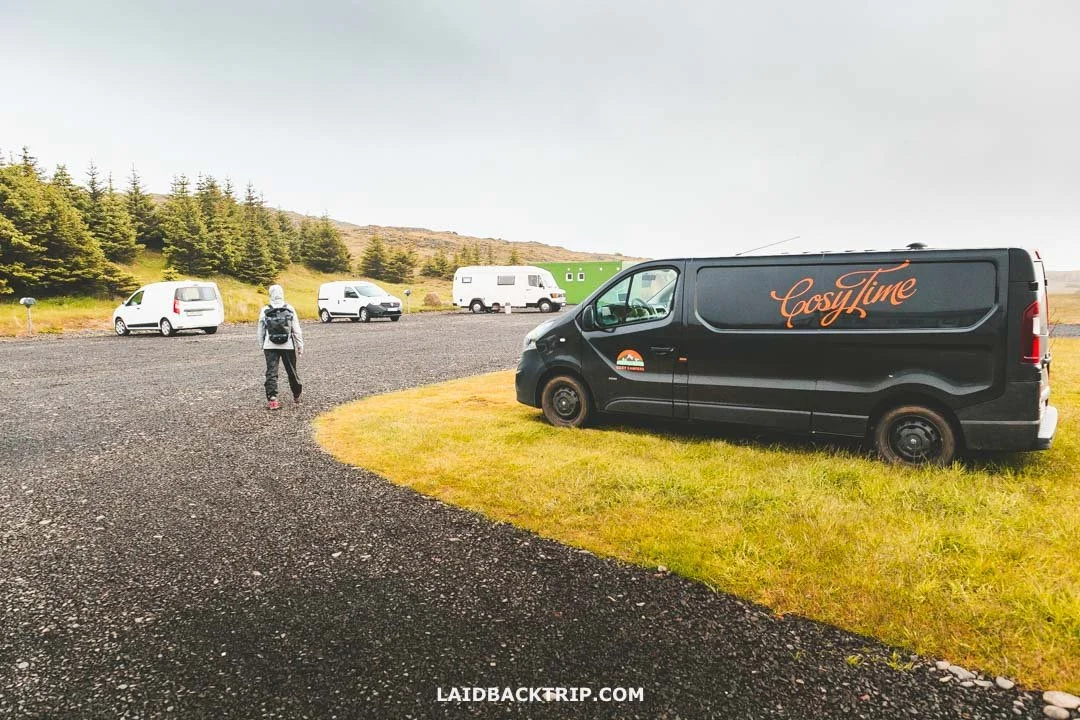
We headed to the main parking area that was called Fjallsarlon Glacier Parking (GPS coordinates: 64.01622, -16.36491). As we pulled into an empty parking lot, back then, parking at Fjallsarlon was free, and it still is!
Unlike Jokulsarlon (and tons of other sites on this coast like Seljalandsfoss or Reykjadalur) where they started charging for parking, Fjallsarlon remains without any entry fees. I'm not saying this would be the main reason to visit the lagoon, as it really isn't, but it's still nice when some things remain free (especially when we traveled around Iceland on a budget).
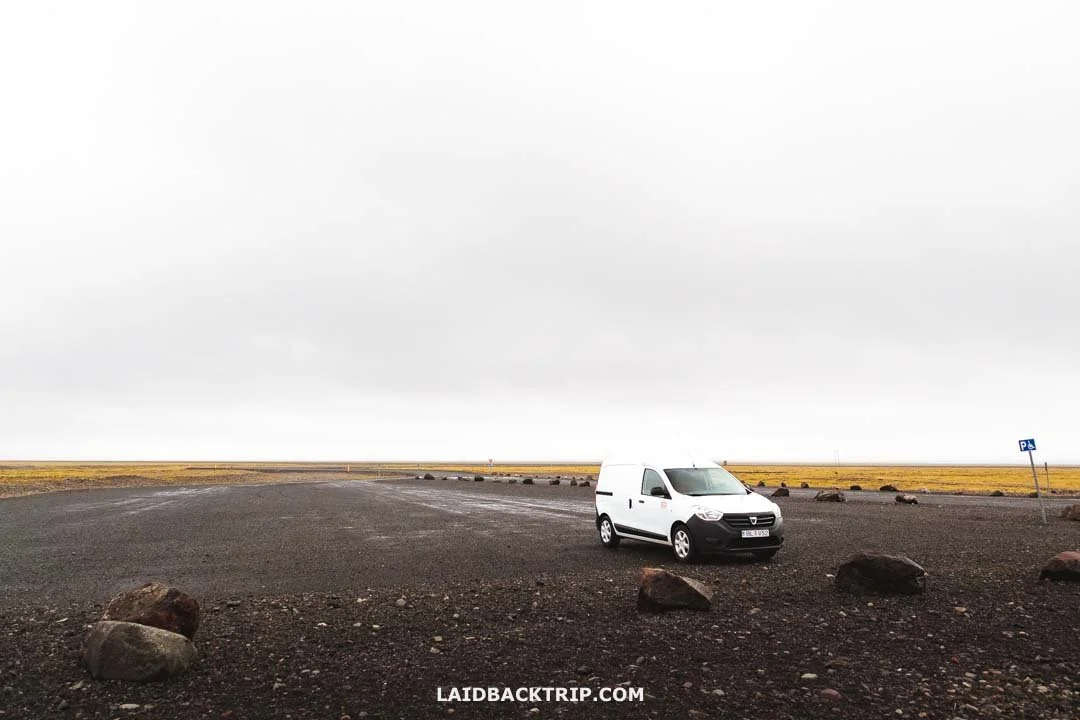
Even during summer, the parking at Fjallsárlón was completely empty early in the morning.
I later found that there was another small parking lot west of here (accessed by a different road), at these GPS coordinates: 64.01095, -16.38840. But since we didn't get a chance to explore it, I had no idea what the gravel road that led to it was like or whether it was even drivable in the 2WD campervan we had.
It looked like a nice option to avoid the crowds and reminded us of Gullfoss Waterfall with its parking on the other side, but as I said, there were no people around when we went, so we had no reason to look into this option. As usual, no overnight camping is allowed at Fjallsarlon.
Hiking to Fjallsarlon
Once we parked our car, we changed into our walking clothing, put on hiking boots, and set off. It was a cold morning, and it felt even colder as we were closer to the glacier. Lucie even put a rain jacket over her down jacket, while I just used more layers (here's our Iceland packing list). At least it wasn't as windy as it was on Diamond Beach later (not to mention the Westfjords).
We located the trailhead at the northwest corner of the parking lot and started hiking what was supposed to be an easy 1.3‑kilometer loop trail with little elevation gain (this was definitely no Glymur trail or Waterfall Way hike).
The path was clearly marked, very easy to follow, though hadn't it been for the glacier in front of us, not very exciting. But it was. So any of the morning sleepiness was long gone as we were just so excited to see another one. After a few minutes of walking, we reached the lagoon's shore.
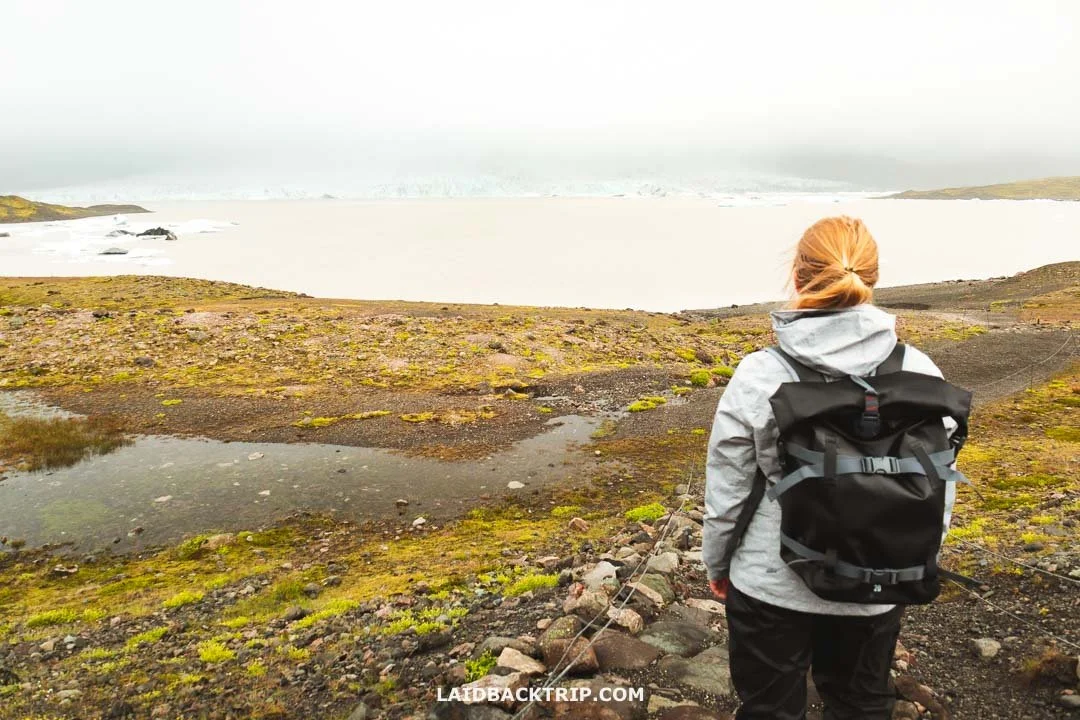
The walk from the parking lot to Fjallsárlón's lagoon was pretty easy.
In front of us was a big lagoon with floating glaciers, and behind it was the impressive Fjallsjokull. Because the weather was far from ideal, we could really only see the glacier's snout, as the rest of the ice mass was hidden in the low clouds or fog. From the shore, it looked almost tiny, but that was deceiving as the huge front wall of ice was about 20–30 meters high.
Another thing we noticed was that the glacier was farther than we thought it would be. We were visiting Iceland in summer and arrived at the Fjallsarlon at the turn of June and July, and it looked like Fjallsjokull had retreated by a lot.
The lagoon had a murky brownish color, very different from the bluish tint of Jokulsarlon we saw later (not to mention Bruarfoss Waterfall). I did see some photos of Fjallsarlon from winter, and it looked absolutely magical, and if you don't mind short days, this must be a great time to see the lagoon (just remember that the boat tours don't run).
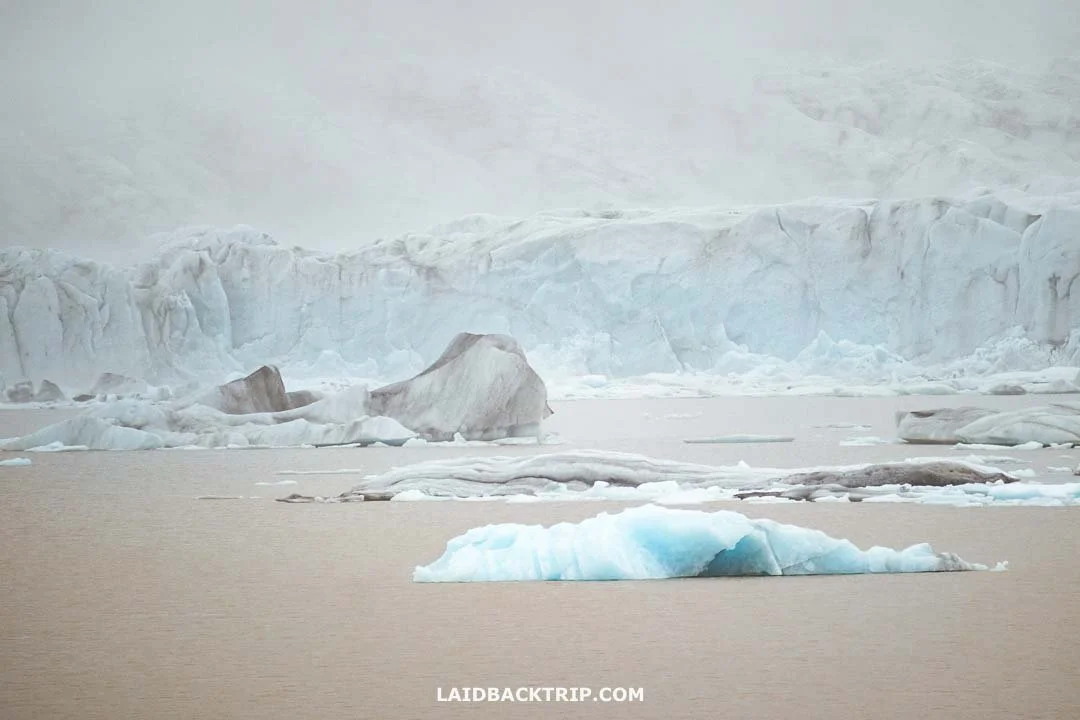
Seeing the Fjallsjökull glacier was pretty incredible.
We were standing by the lake, alone, taking in this eerie scene. It was completely quiet. And we were there completely alone the whole time we stayed. Okay, not completely, because we passed by some sheep on the way down to the lake, but for humans, it was just the two of us.
I have to admit that while I didn't enjoy the early wake‑up, it was so worth it just for this moment. I don't think it's needed to come as early as we did, but we'd still try to arrive outside 9:30 AM and 6:30 PM when the boat tours run to avoid the crowds (these hours are for summer months).
As we were watching the lagoon, we noticed a group of smaller icebergs on our left, with the big ice blocks farther out. I had my telephoto lens, so we could enjoy some closer looks even from a distance, but obviously it wasn't the same as if we'd taken the zodiac tour.
We could only imagine how huge the whole Vatnajökull must be because we could see only part of Fjallsjokull, and while it's technically considered one of the smaller glaciers, it sure didn't look like that.
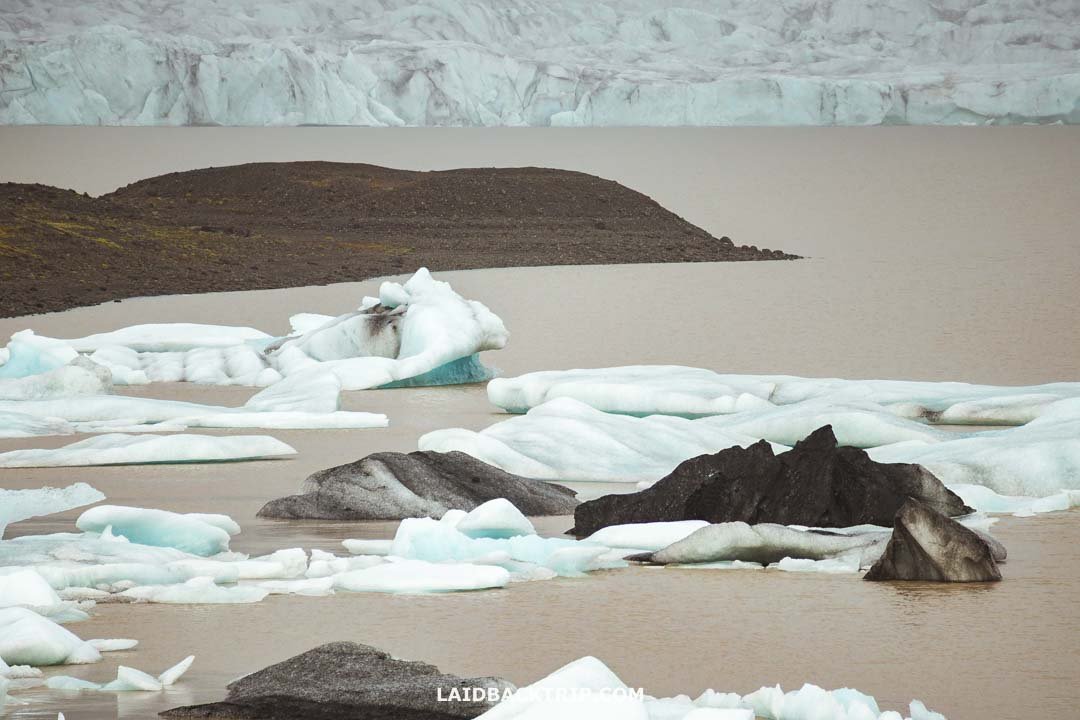
The floating icebergs at Fjallsárlón were noticeably farther from the shore.
Since it was so quiet and didn't rain, we could have spent hours taking in this whole scene. But it was the rain looming ahead that got us going. We still wanted to visit Jokulsarlon Lagoon, and ideally without getting drenched to the bone.
So we looped back to our car, still without anyone in sight. Overall, it took us less than 45 minutes to do the whole Fjallsarlon trail. We didn't do any of the tours, which would add about an hour for the zodiac trips and at least three more hours for ice cave exploration.
Things to Do at Fjallsarlon
Besides the obvious walking along the lagoon and seeing the glacier, which was completely free and which we did, there were a few more activities at Fjallsarlon. Since we arrived so early in the day, everything was closed apart from the trail.
We were eyeing the ice cave tours at Vatnajokull, but they run only in winter, so that one wasn't available (note that they usually depart from Jökulsárlón but some depart from Fjallsarlon too).
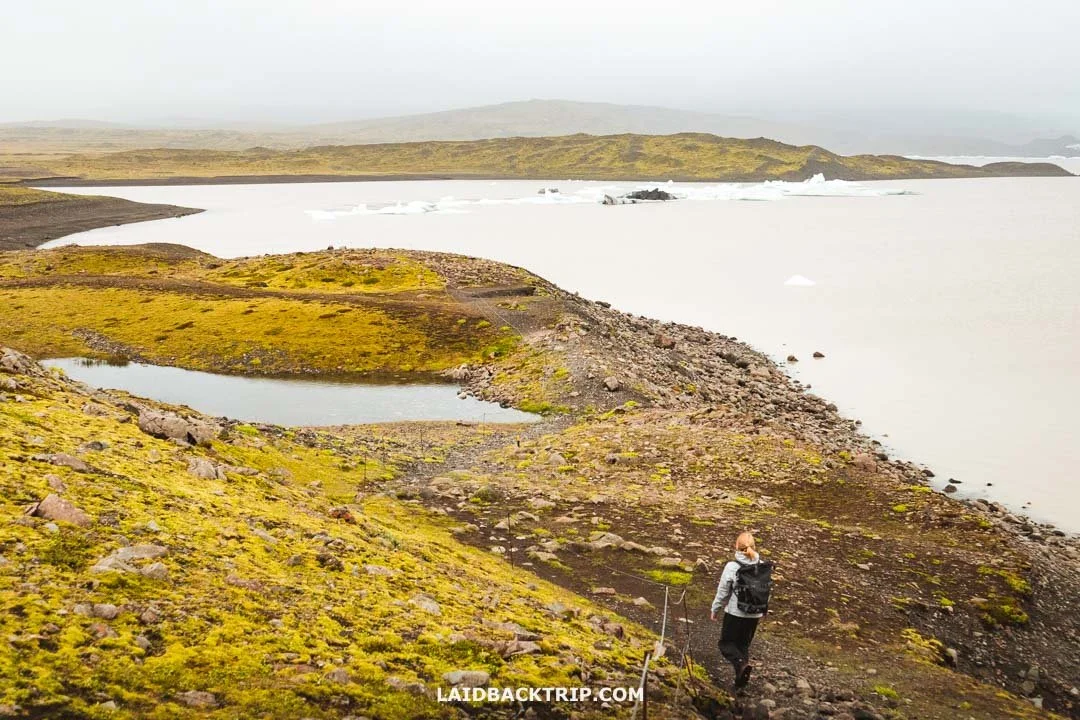
We came to Fjallsárlón only to see the floating icebergs from the shore, but boat tours and glacier hikes were available too, just not this early.
Then there were the boat tours on Fjallsarlon that would take us closer to the glacier and the floating icebergs, but first, it was still a few hours before they even started running, and because the weather just got really bad by that time, I'm not sure they were even running on this day.
They take you in a small zodiac boat so you get quite close to the glacier and icebergs, which is great, but they also offer kayaking tours which are definitely more adventurous. They also do the floating tours where they put you in something called an immersion suit so you can swim in the icy waters, but this wasn't something we wanted to try here.
Staying at Fjallsarlon Overnight
Another thing I want to mention is that you can actually stay in a floating hut overnight on the lagoon. They have just a couple of them, and if the weather is good, this must be an incredible experience, not just for you but also for your wallet, as the accommodation is very pricey.
We did a lot of camping in Iceland, and this was basically the same, as the huts were more like tents, just on water, and at a very premium price for a beautiful location. This is basically the only option to enjoy Fjallsarlon overnight, as there's no campground. We, as usual, tried to keep our Iceland budget in check, so we camped at Tjaldsvaedid i Svinafelli the night before and finished the day in Djupivogur's campground.
That adventure hut at Fjallsárlón was way beyond our budget, so we stuck with regular campgrounds, like the one at Djúpivogur where we ended our day.
There were some good accommodations within a short drive of Fjallsarlon, but the interesting part was that even the nice places like Fosshotel Glacier Lagoon or Hotel Jokulsarlon were a lot cheaper than the floating huts.
Fjallsarlon Is Worth Seeing
In the case of these glacier lagoons, the main difference between Fjallsarlon and Jokulsarlon was that the former was simply smaller and much more intimate, though I'm not sure that's the correct word, because the scenery was just as dramatic. We really enjoyed being much closer to Fjallsjokull glacier compared to Jokulsarlon, which, given the bigger distance and foggy conditions, we couldn't practically see.
Another thing that set these two apart was that the lagoon at Fjallsarlon was almost five kilometers away from the coast while Jokulsarlon was just a stone's throw from the sea. It wasn't just the color of the water that was different, but Jokulsarlon had lots of sea birds and also seals (which we didn't spot, though).
The situation with the floating icebergs was practically the same. They were a bit farther at Fjallsarlon, but the bigger issue was that there were a lot fewer icebergs than we expected.
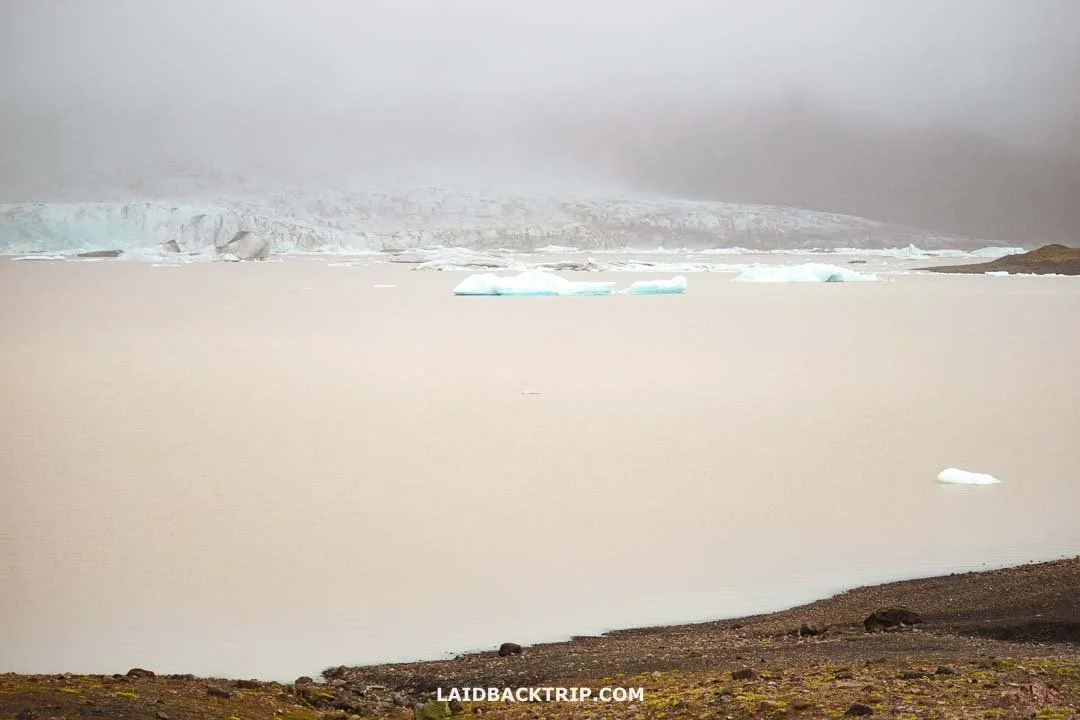
Fjallsárlón had a huge glacier, a quiet lagoon, and floating icebergs, and that alone was more than enough for us to enjoy the visit.
Looking back at Fjallsarlon, it was definitely one of the places that we thought might be a nice little stop, but weren't sure whether the detour was worth the time, given the poor weather, and especially since we knew the experience would be quite similar to Jokulsarlon.
But it turned out that each lagoon was fairly different. It was the same case as it was with the Iceland's waterfalls (for instance, Gofafoss and Kvernufoss couldn't be more different). And on the way out, we both agreed that we enjoyed our relatively short time at Fjallsarlon. The views were great (despite the weather), the walk was nice and easy, and overall the lagoon was beautiful and worth a visit.

Discover Grjotagja, a tiny lava cave hiding a geothermal pool and the filming location of Jon and Ygritte's famous Game of Thrones scene.