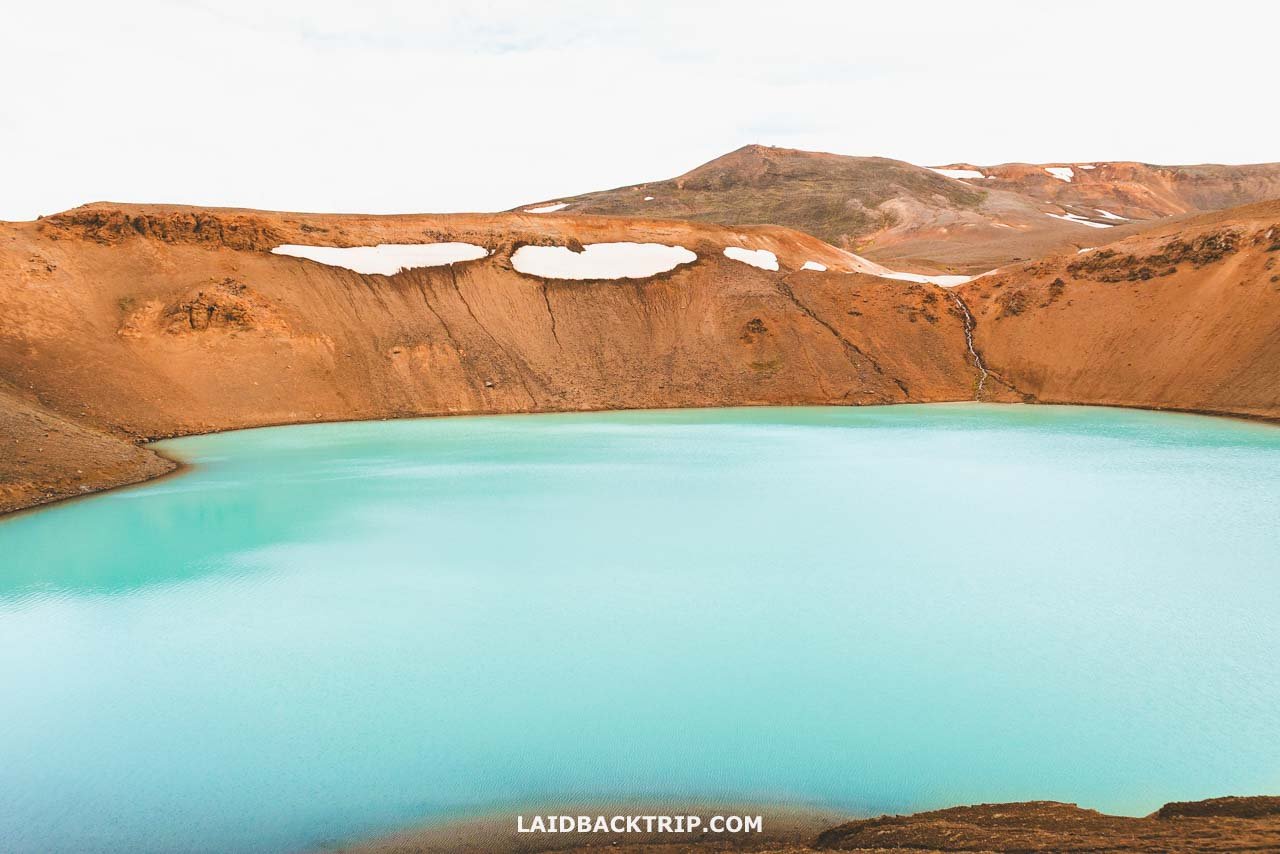
Surrounded by the incredible volcanic landscapes of the Krafla caldera, Víti ended up being one of our absolute favorite little detours on our North Iceland road trip.
Driving to hell wasn't exactly part of our Iceland itinerary. On that, both Lucie and I agreed. I mean, who would willingly want to travel to the realm of the damned? But the moment we learned about the Víti crater, whose name in Icelandic literally translates to "hell," we knew we couldn't skip it. And honestly, it wasn't because of the name, however cool it sounded, but because the explosion crater with its turquoise geothermal lake looked absolutely beautiful.
So when we finally reached North Iceland, we first stopped at the mighty Dettifoss Waterfall, because that one really is a must‑see, and then continued to Viti in Krafla, a volcanic caldera about 10 kilometers wide with a 90‑kilometer fissure zone. This whole area was easy to explore both by car and on foot, our favorite combination. Besides the crater lake, we had no idea what the rest of the place would be like, so we just kept plans flexible.

Even the drive to Víti was an experience on its own, passing through the surreal geothermal landscapes of Krafla.
One of my favorite things about the whole Iceland trip was how everything felt relative. Take Road 863, which connects Viti with the Ring Road. This 9‑kilometer stretch isn't on any list of famous scenic drives, but for me, sitting behind the wheel, it was unforgettable, even if it was short. We had already done some iconic drives, like the Golden Circle or the South Coast, but those are famous and much longer. Even this little adventure gave us scenery we hadn't seen yet.
It's not like we hadn't already seen volcanic plains, colorful hills, tectonic plates, steaming earth, erupting geysers, or volcanoes themselves, but this time we were also surrounded by geothermal power and modern engineering. The drive up to Víti was incredible. The road was paved the whole way, and since we visited in summer, with no ice or snow, driving it was as easy as it gets.
Contrary to what I would've expected, hell wasn't down. After the first flat stretch, the road actually took us uphill. Besides this funny little confusion on my part, it also meant that with every meter of elevation we gained, the views became even more spectacular. But the dramatic scenery wasn't the only thing that caught our attention. This area of Krafla was industrialized.
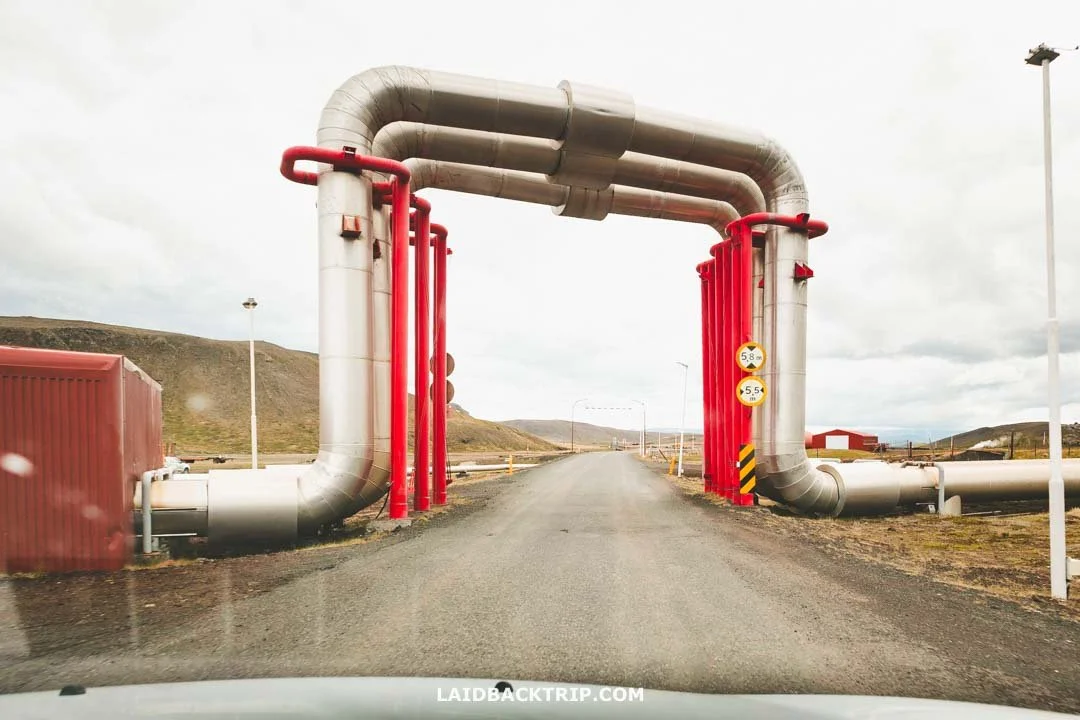
On the way to Víti, we actually had to drive under the huge steam pipes from the Krafla Power Plant, which felt pretty surreal.
We could already see big steam pipes on our left, and soon we passed Kroflustod, the Krafla Power Plant, a large geothermal facility with two turbine units generating 60 MW of renewable energy. The volcanic landscape mixed with steam rising not only from the earth but also from the industrial complex was incredibly interesting. At one point we even had to drive under those massive steam pipes as they crossed the road. There was plenty of space for our small rental campervan, and I'm sure even bigger RVs would pass without any trouble.
Exploring the Viti Crater
The whole journey from Route 1 up to the Viti parking lot took us no more than ten minutes. Our plan was to explore the crater lake first, so we drove straight up without stopping, saving any potential stops for the return trip. And as Lucie told me, there'd definitely be something to stop for, because this was Iceland after all. It was a quick, easy drive, and before we knew it, we were pulling into the parking lot.
Parking at Viti is Paid
Back when we visited Viti, parking was still free, but now they've added an 800 ISK fee per car. It's not a huge amount in the overall Iceland budget, but it's still a fee nonetheless. The trail around Víti is still free to access, so at least that part of the experience hasn't changed.
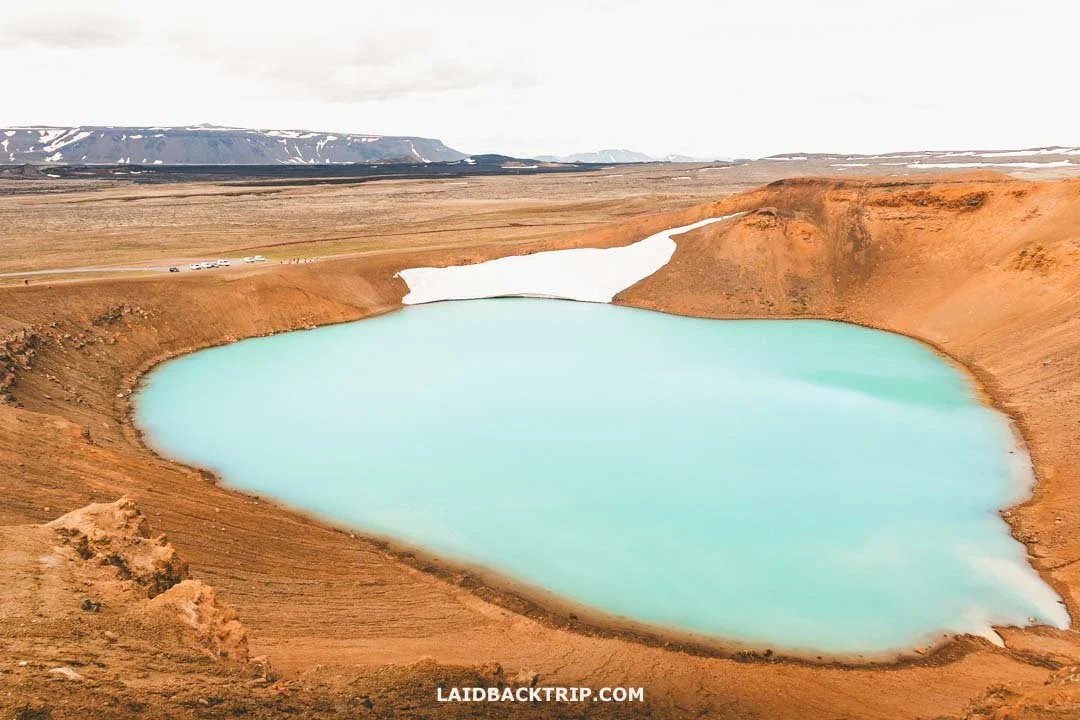
When we looked back from the trail's end, we could see that the parking lot was really sitting right on Víti's edge.
The parking lot was fairly small, at least compared to places like Gullfoss Waterfall or Blue Lagoon, but we found a spot without any issue. On a busy day it might fill up quickly, but I think most people don't spend that long here, so spots should open up pretty fast.
Visiting the Viti Crater in Summer
When we arrived at Viti, a few cars were already parked, but it didn't look like a busy day. We could see some people on the trail, and after grabbing the essentials, just our rain jackets and a dry bag, we quickly joined them.
The weather was changeable, but at that moment it was just cloudy and windy, and it seemed like we'd get to enjoy Viti without rain. When we stepped out of the car, it was definitely windier than we expected, and the further we walked, the stronger the gusts became.
We visited Viti at the end of June, and while the weather was still fairly good, the wind made the walk a bit more challenging. One interesting thing we learned from one of the panels was that this part of Krafla receives very little rain (unlike places like Skaftafell or Reynisfjara Beach).
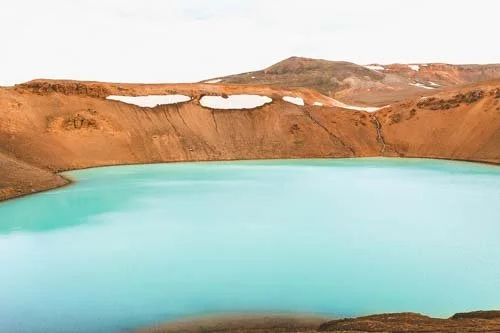
Because we were there at the start of summer, Víti had that beautiful turquoise color. I mention it because we'd seen winter photos where the lake was completely frozen. The scenery around Krafla still looked dramatic, but the blue color disappeared under a white blanket. And honestly, had we visited in winter, we'd probably have skipped Víti for something else, maybe Goafoss Waterfall or Trollaskagi Peninsula. I'm not saying Víti isn't worth visiting in winter, but we (probably) would've headed elsewhere.
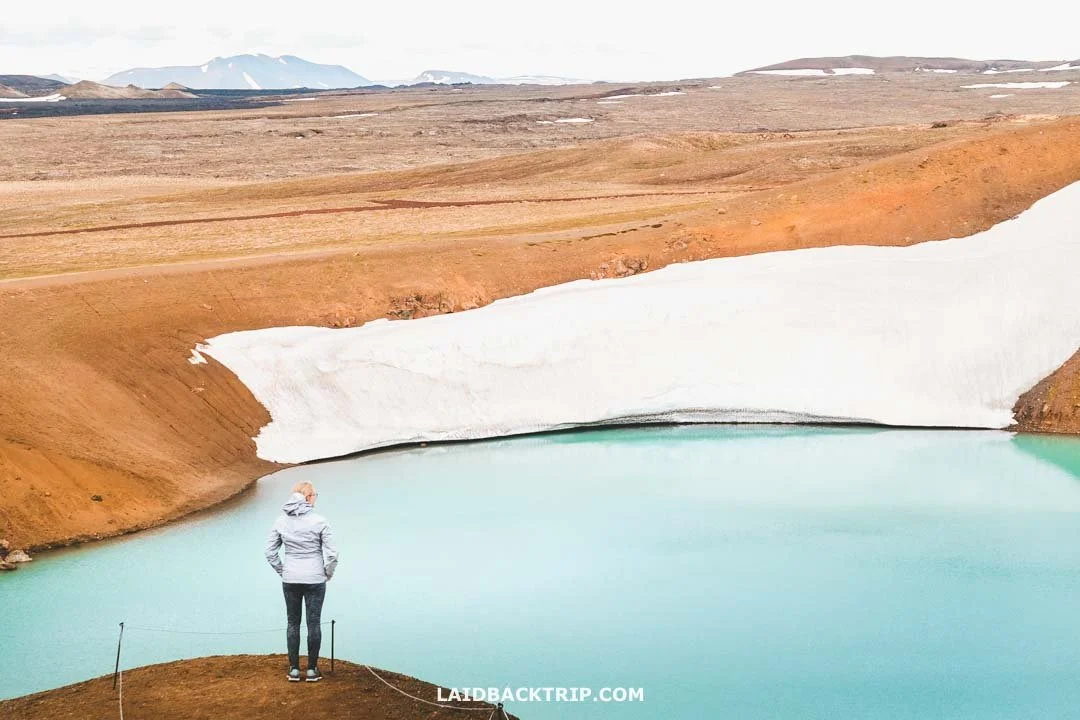
During summer, Víti had this gorgeous turquoise color, but the trail along the crater was windier than we expected.
In the afternoon, as I said, there were some people, but not that many, so the whole experience was very enjoyable. Because Viti is open 24/7, coming here late in the day in summer, with the midnight sun lighting everything up, would most likely mean seeing the crater completely alone. We actually used the same strategy at Reykjadalur Thermal River and it worked like a charm.
Walking the Viti Crater Trail
From the parking lot, the crater was only a stone's throw away. By this point we were used to it, because the same thing happened at Jokulsarlon Glacier Lagoon or Dyrholaey Peninsula, where the main viewpoint was basically twenty meters from the car. From up here, Víti looked incredible.
From the first viewing platform, we followed the trail to the right. The path was easy, with a gradual incline. It clearly hadn't rained for days, because there was no mud at all, which was great. That volcanic dirt looked like it would turn into mushy, sticky mud in no time. Sure, we passed that hot shower on the drive up (a natural shower using water from a hot spring at these GPS coordinates: 65.68123, -16.77481), but I was still glad we didn't have to deal with dirty boots like after the Bruarfoss Trail.

The trail led us straight along Víti's edge, giving us those perfect close‑up views of the crater as we walked.
Even though the trail was easy, it was also pretty windy. Walking on the exposed ridge was harder than it would normally be, but still nothing compared to the Westfjords. The upside was that we had uninterrupted views of the Víti crater the entire time.
Despite the cloudy weather, the lake's blue color was magnificent, and its turquoise surface stood in striking contrast to the barren landscape around it. There was no path leading down into the crater, so we stayed on the rim the whole way.
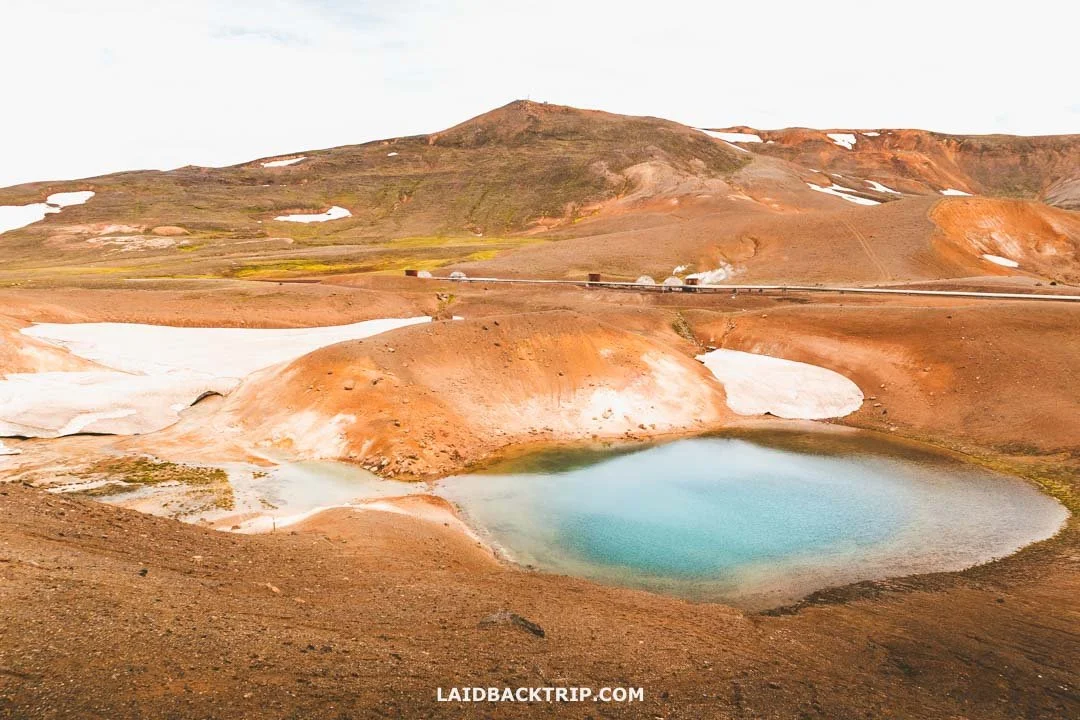
Behind us, looking away from Víti, we could see the highest point of the whole Krafla caldera.
The cool part was that while Víti was beautiful, the trail also gave us views of a much bigger part of the Krafla caldera, which was just as interesting. The landscape around us had that typical geothermal look and was absolutely incredible. Right next to Víti was a tiny crater filled with blue water, and when we looked farther, we could see Krafla's highest peak at 818 meters.
Viti History
Víti was formed in the 18th century when hot magma encountered groundwater, which instantly turned into superheated steam and exploded, creating a 300‑meter‑wide explosion crater. For decades after the eruption, the lake looked like a giant boiling bowl of geothermal mud, producing steam, ash, and sulfur. That's the main reason locals named it Víti, because it really looked like hell.
Over time, the mud cooled and settled, and the basin filled with a mix of rainwater and groundwater. Its stunning turquoise color comes from silica minerals and sulfur compounds rising from the active geothermal plumbing system deep beneath the crater floor.
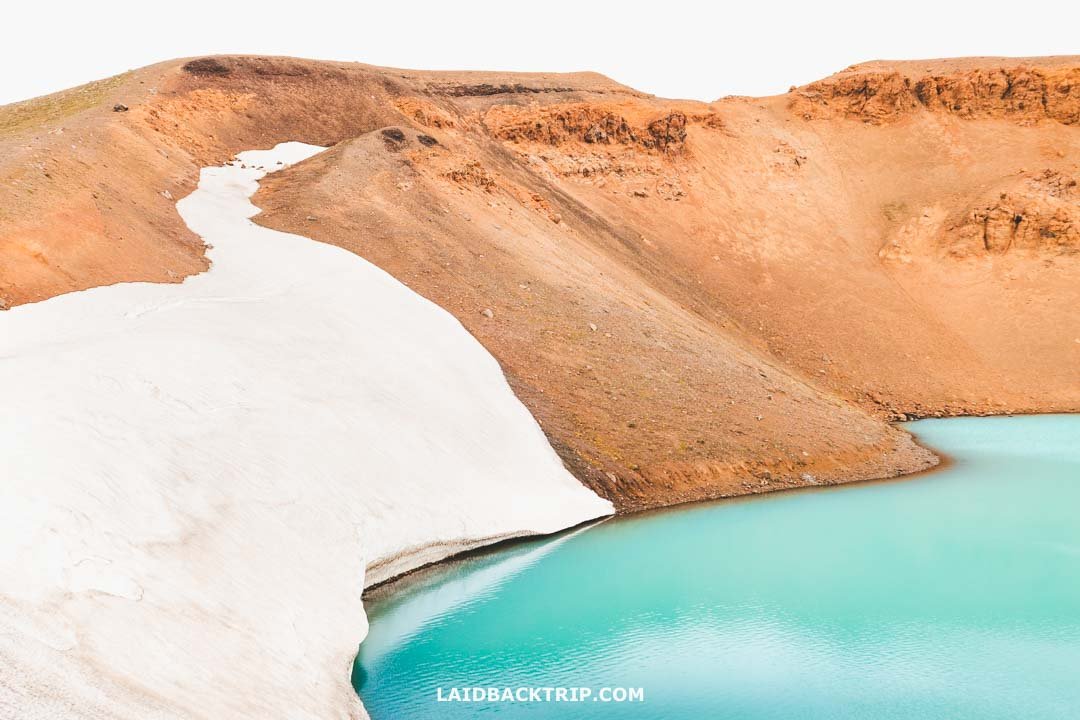
Víti is an explosion crater formed during the Mývatn Fires, one of the major volcanic events that shaped this part of North Iceland.
Another thing we learned later was that Viti isn't the only crater lake with this name in Iceland. This one is Viti in Krafla, but there's also Viti in Askja, located in the Central Highlands. Unlike the one in Krafla, the Askja Viti is much harder to reach and requires one of the big 4x4 off‑road vehicles. I'm honestly glad our rental contract forbade driving in that region, so we didn't have to worry about tackling such an adventurous route.
After a few minutes of hiking, we discovered there was no way to walk around Viti. The trail ended abruptly after about 350 meters at a roped‑off viewpoint and didn't continue any further. Since walking beyond that point wasn't allowed, we had to return the same way. We didn't mind, but it was definitely different from Kerid, which we visited on our first day and had a full circular trail along its rim.
Leirhnjukur Trail
After we were done with Viti, it was time to head back. About a kilometer down the road, there was a viewpoint on the left where we stopped to enjoy the views of the valley and the Krafla Power Plant, and to read a bit more about the area from the info panels. It was just a quick stop, but we liked the views. A couple hundred meters further, on the right, was the parking lot for the Leirhnjukur lava field.
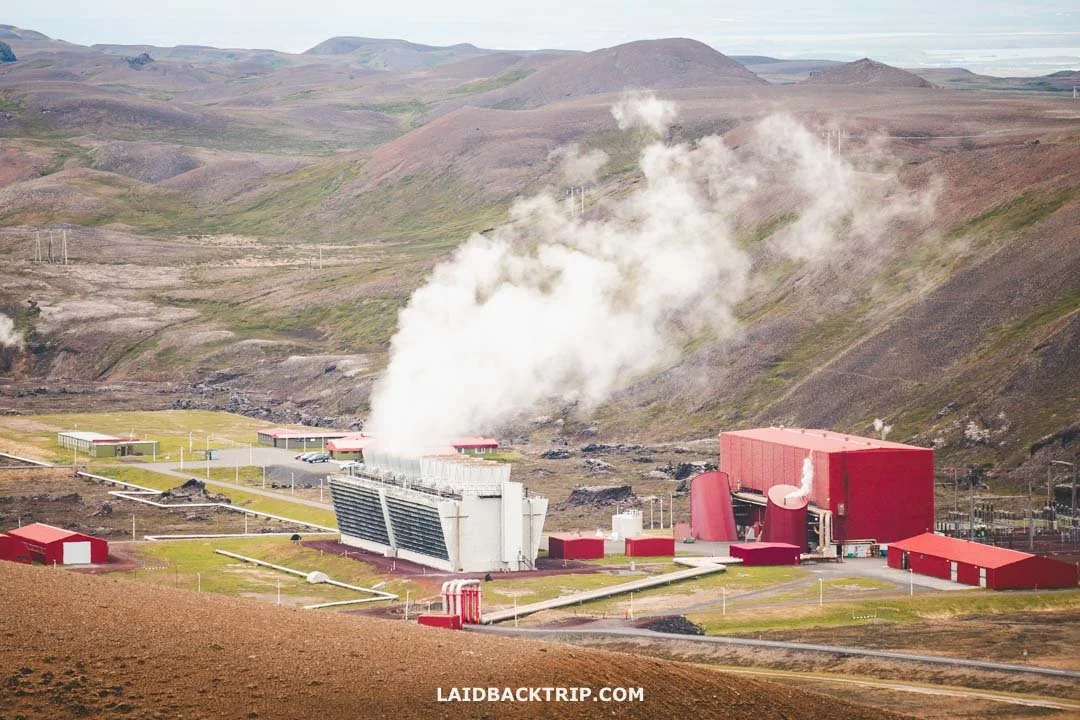
On the way back, we stopped at a viewpoint with an incredible view of the Krafla Power Plant.
This geothermal area, with steaming vents, boiling mud pools, and a strong sulfur smell, has an easy 3.5‑kilometer trail that can be extended to a 4.5‑kilometer walk. We considered it, but since we were ultimately heading to our whale watching trip in Husavik and didn't have much time to spare, and because we had already seen a big lava field at Gonguleid um Eldhraun trail earlier, we decide to visit the Hverir geothermal area instead. We had time for just one, and simply picked this one. Honestly, it was basically a coin toss.
Because we went whale watching, we didn't spend the evening around Viti and Myvatn. Instead, we camped on the north coast. When we returned the next day, we discovered that Lake Myvatn was stunning and also had some great campgrounds and hotels like Sel Hotel Mývatn or Fosshotel Myvatn.
Getting to Viti
Reaching Viti from the East Fjords, where we started our day, was really straightforward. We woke up in Borgarfjordur eystri, drove to Egilsstadir, and from there it was about 170 kilometers to Viti, plus a 40‑kilometer detour to Dettifoss.
By Car
It was an easy drive through incredible scenery, and it took us way more time than navigation suggested. We didn't mind, though, because this was exactly how we imagined our first trip to Iceland.
From Viti, it was about 70 kilometers to Husavik. First we made a very short detour to Hverir, then passed through Reykjahlid, a small tourist town on the shores of Lake Myvatn. Akureyri, which we visited afterward, was roughly 100 kilometers away. You can check rental car prices here.
Viti Tours
If you don't have a car, getting to Viti becomes pretty complicated. No bus goes there, and tours aren't great either. You'd likely need a private tour from Akureyri or join one of the private multi‑day trips that leave from Reykjavik.
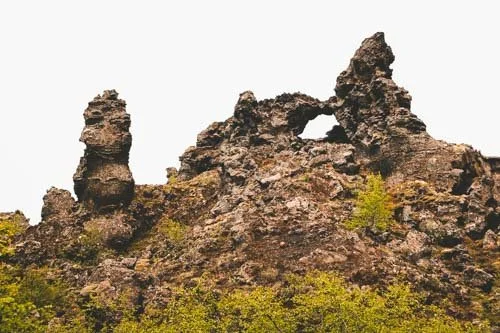

Discover Grjotagja, a tiny lava cave hiding a geothermal pool and the filming location of Jon and Ygritte's famous Game of Thrones scene.