How to Visit Gullfoss Waterfall
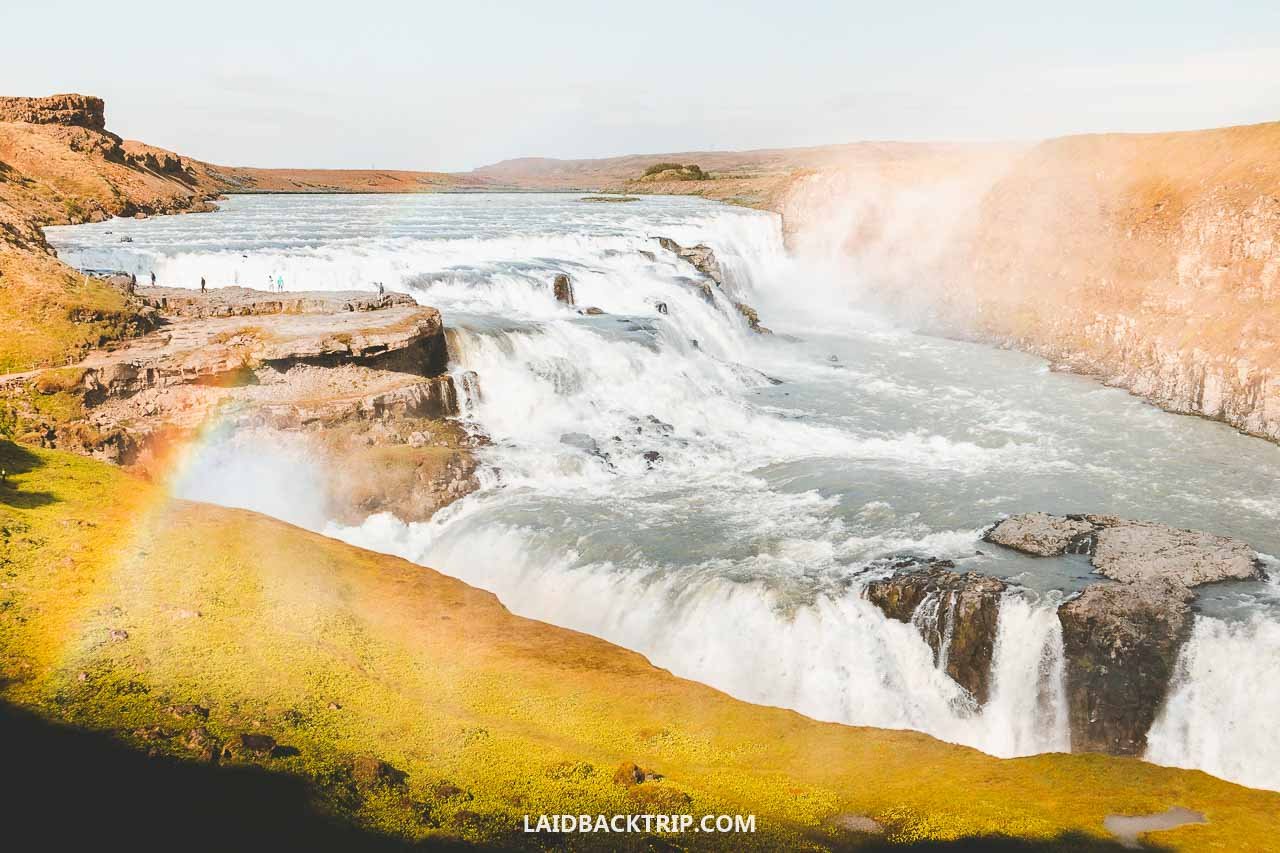
Was it worth it to drive all the way to Gullfoss to see one of Iceland's most famous waterfalls? Let's find out!
It was a beautiful evening, it was getting late, and we were on our way to Gullfoss, one of Iceland's most famous waterfalls. It was our first day in Iceland, and even in such a short time we'd already learned that the country was home to tons of amazing waterfalls. Obviously, we didn't come here from Mars (we flew to Keflavík from Prague, in fact), so we knew we'd see a lot of them on this trip, but the surprising thing was that we were still just under two hours from Reykjavík. It was mindblowing. And we were still about to visit the mighty Gullfoss.
We naively thought nothing could surprise us after seeing the dramatic Geysir Geothermal Area and Þingvellir National Park that day, but we couldn't have been more wrong. We also thought we'd seen enough waterfalls for one day after Öxarárfoss and hiking to Brúarfoss. As we learned during our two‑week road trip, no matter how many waterfalls we saw each day, we never had enough, especially when they were as huge as Gullfoss.
Located in the southwest of Iceland in the canyon of the Hvítá River, Gullfoss was one of those top attractions we simply couldn't miss. Interestingly, at 32 meters, Gullfoss wasn't the highest waterfall we'd ever seen, but it was really wide and unbelievably powerful. At its widest point, the canyon stretched for over 200 meters, and after plunging over two steps, the water forced its way into a narrow gorge that was only about 20 meters across. But these were just numbers, and seeing all that power in real life was on a whole different level.
Getting to Gullfoss (West Side)
The best part was how incredibly easy it was to reach Gullfoss because it sat right on the famous Golden Circle, which started in Reykjavík and which we planned to tour as soon as we left the capital. Since we decided to travel this scenic loop clockwise, Gullfoss was the last "big" stop on our itinerary that day. Had we driven to Gullfoss from Reykjavík directly, we would've tackled the 115‑kilometer drive in under two hours.
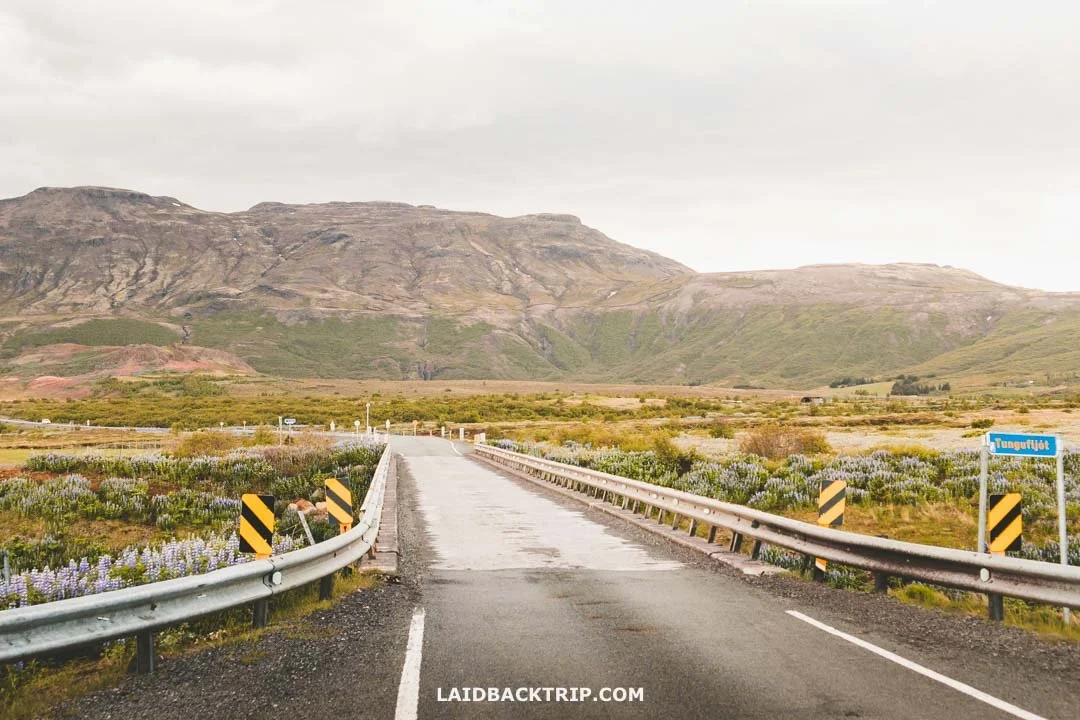
The road was paved all the way to Gullfoss.
The road was paved all the way to Gullfoss and super easy to drive, at least to its west side (the one where pretty much everyone stops). But because we made several stops along the way, it took us more than eight hours to cover this distance.
After we were done with Gullfoss, we continued to Selfoss, which was about 70 kilometers south of here. Navigation showed the journey would take about an hour, but since we stopped at Skálholt Cathedral and Kerið Crater, it took longer. This was a common thing for us, whether we drove to Gullfoss or other parts of Iceland like the Snæfellsnes Peninsula or the Westfjords. It always took way more time than we expected.
By the way, Gullfoss was as far as we could drive on Road 35. Not because the road ended there, but because of our rental agreement (and because our plan was to reach the north via the Ring Road and see the South Coast and East Fjords along the way).
Back then, the road past the waterfall turned into the mountain road F‑35. This route connected the south with the north across Iceland's Highlands, and even though it had bridged river crossings, it was really only for 4x4 cars. And while the road condition has improved a lot in recent years and it no longer has the F rating (so it's now just Road 35), we still couldn't drive it in our small 2WD campervan. And like I said, we had other plans.
Had we not rented a car, reaching Gullfoss wouldn't have been difficult despite the fact that there was no public transport connecting the waterfall with the capital or any other town. But just because a bus didn't go there didn't mean tours didn't. Quite the opposite.
Gullfoss Tours
Since it was one of the main stops on the Golden Circle, pretty much every tour doing this scenic drive from Reykjavík also stopped at the waterfall. Our only advice would be to check whether the tour focuses just on the Golden Circle or includes something extra, like the ones that also visit the famous Blue Lagoon, which we visited later in the trip and really enjoyed.

Gullfoss is located on Iceland's Golden Circle.
Parking at Gullfoss
About 500 meters before we reached Gullfoss, the road split. If we'd stayed on Road 35, it would've taken us to the upper parking area. This was the main lot with tons of spaces, a visitor center, a restaurant, a gift shop, and toilets. And because it had all the facilities, most people parked there.
But we turned right instead and headed toward the lower parking, which was just a simple lot with no facilities, but way less busy. It was slightly closer to the waterfall (it saved us about 200 meters of walking), but since we planned to explore all the trails anyway, it didn't really matter where we left the car.
Parking at Gullfoss was free when we visited. The interesting part is that since then, lots of other sites started charging for parking, like Fjaðrárgljúfur Canyon or the Hverir Geothermal Area, but so far, Gullfoss parking remains free.
While we were at Gullfoss, we noticed a couple people on the other side of the canyon. We had no idea at the time that Gullfoss also had a parking area on its east side, at least not until we saw them. We later discovered that it was accessible from Tungufell via a 2.2‑kilometer in‑and‑out trail, which honestly sounded like a fun little adventure, especially since it looked so quiet over there. But we didn't have a 4x4, and Road 349, which also passed by Tungufellskirkja, wasn't paved, so I'm not sure we'd even be able to reach it. Not to mention that we simply didn't have time for that detour.
Another interesting thing we learned about Gullfoss parking was that it served as a starting point for guided tours to Langjökull Glacier. These were done with the massive glacier monster trucks, the huge beasts that reminded us of our trip to Athabasca Glacier a few years back.
Visiting Gullfoss Waterfall
The trail at Gullfoss was basically split into two, with both being very easy walks. The lower branch was about 350 meters one way, and the upper path was about 500 meters one way. When we were there, the far ends weren't connected, so we couldn't loop back but instead had to walk to the lower viewpoints first, retrace our steps, climb the stairs, do the upper trail, and once again return the same way.
So the whole walk was about 1.7 kilometers, and had we started in the upper parking, it would've been just over 2 kilometers. The entire path we walked was well maintained, clearly marked, and roped off so all visitors stayed on the trail.
Since we parked at the lower lot, we started with the lower trail because it just made sense. This was the path that eventually brought us right to the very edge of the waterfall. The whole time we had Gullfoss right in front of us, and with a favorable wind, we could enjoy all the spray coming our way. It wasn't as intense as Seljalandsfoss or Kvernufoss, but we were still glad we had our rain jackets on (and rain pants worked here pretty well too).

The lower trail at Gullfoss led us to an incredible viewpoint sitting right beside the roaring falls.
It was a fairly quiet evening, which let us enjoy Gullfoss's majestic aura without worrying about crowds. That calm was deceiving though, because the closer we got, the more we could feel and hear the thunder of the waterfall. The walk ended on a big rock with a viewing area that brought us right next to the falls. And I mean really right at its edge.
World Nomads provides travel insurance for travelers to cover their trip essentials, including sports and adventure activities.
SafetyWing is affordable travel insurance for backpackers, long-term travelers, and digital nomads.
We'd been in Iceland for less than 24 hours, and by now we could understand what made this country so special. The view from here felt like something from another planet. From this point, we could've watched the Hvítá River carving its way down the canyon for hours. In the next days, we visited Skógafoss and Dettifoss, two other major Icelandic waterfalls, and they had the same effect on us. Each time, the scene was hypnotizing.
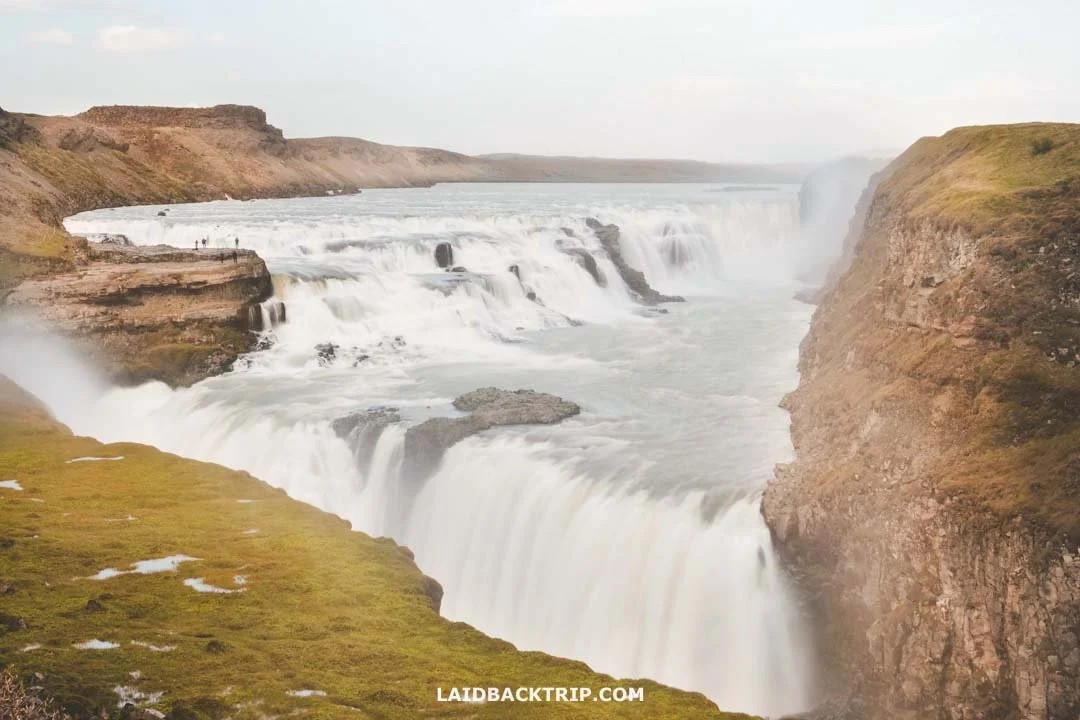
From the parking lot, it was an easy walk to Gullfoss.
After we were done here, we walked back to the staircase, climbed up (nothing serious), and explored the upper trail. Its main upside was that it had a boardwalk (great for strollers and people with mobility issues) and a lot less spray.
And while the trail was nice, I think the views just weren't as good as the ones from below, at least beyond that first main viewpoint. From there, the view of the whole Gullfoss was breathtaking. And don't get me wrong. The rest of the trail was worth doing too. I just enjoyed being closer to the waterfall because the whole experience felt much more intense. And that's something the upper trail couldn't match.
The Golden Waterfall
Gullfoss means "Golden Waterfall" in Icelandic, but no one knows for sure where the name comes from. There are a few theories, though. The one I found most plausible was the simplest one. In the evening, the soft sunlight makes the glacial water look golden. It was really as simple as that. The info panel also mentioned a rainbow from the spray, but that didn't quite fit the golden narrative, so we moved on to the last theory, which was much more interesting.

As we reached Gullfoss before sunset, the waterfall really appeared golden thanks to the soft evening light.
It came from Sveinn Pálsson's travel journal and the story of a farmer named Gýgur who lived at Gýgjarhóll. He had a lot of gold but was so worried about what would happen to it after his death that he put all of it in a coffer and threw it into the waterfall, changing its color forever. Pretty much every place we visited in Iceland had a story like that, whether it was Reynisfjara or Ásbyrgi Canyon, and Gullfoss was no exception. And each time, we really enjoyed these little tidbits, whether they were pieces of history or made‑up legends.
Sigríður Trail
At the start of the trail, we found a panel with some interesting bits about the history of Gullfoss. The first panel covered only the basics (the next one had geology and a few extras), and it mentioned that more signs would appear along the trail. But it did explain why the path from the lower parking lot to the waterfall was named the Sigríður Trail.
It honored Sigríður Tómasdóttir from Brattholt and her efforts to save Gullfoss. She grew up on one of the nearby sheep farms, and in the early 1900s she fought against a plan to build a hydroelectric dam across the Hvítá River that would've flooded the whole area, including the waterfall. The fight wasn't easy, but in the end the dam was never constructed, and the site was eventually protected.
Gullfoss in Summer
We arrived at Gullfoss in early summer, and since we got there in the late evening (it was open 24/7 like most other sites), the trail was really quiet, even though we obviously didn't have it to ourselves. By the time we showed up, all the big groups were gone, and we could enjoy the scenery without crowds. It felt pretty awesome to see such a major attraction in such a relaxed atmosphere.
Thanks to the midnight sun, there was tons of daylight even at night, and we really took advantage of that. And not just at Gullfoss, but also when hiking in Skaftafell or on whale watching tour. When we arrived, the soft light really made the waterfall look golden, but by the time we were leaving, the sun had dropped pretty low and the falls were already in shade. So we ended up visiting at the best time possible, even if it was mostly luck.

At the start of summer, Gullfoss was at its full strength, and the spray was everywhere.
I'm sure we would've enjoyed Gullfoss even in the middle of the day with lots of people around, but we definitely didn't complain that things worked out the way they did (especially since we had no idea what time we'd get there).
Another great thing about being at Gullfoss at the turn of June and July was that around this time the waterfall has its biggest flow thanks to melting glaciers. To be fair, I've seen photos of Gullfoss in winter, and it didn't look like the Hvítá River ever struggles with water volume in other seasons either. Speaking of this period, Gullfoss is accessible all year long, even in winter. Sure, the trail would most likely be icy or snowy, but still doable.
Gullfoss Is Free to Visit
Visiting Gullfoss was completely free when we were there, and that was true for most of Iceland's attractions. What made it a bit different was that parking was also free. And it still is, which unfortunately isn't the case at many other sites like Dynjandi, Kirkjufell, or Dyrhólaey. The only thing that wasn't free were the toilets, which cost 200 ISK and could be paid by credit card.
Staying Near Gullfoss
After we were done with Gullfoss, we had to figure out what our next step should be. It was getting late, and we still hadn't decided where we'd stay. Unlike some other sites, there was no campground (or hotel) right at Gullfoss, though a few options were only a few minutes away. The first one that made sense to us was Skjól Campground, which was just six kilometers away, and since it sat right at the intersection of Roads 30 and 35, we'd drive past it either way.
About three kilometers from the waterfall was Hotel Gullfoss, but since we were all about camping, we didn't really consider staying there. We also saw a campground at Geysir (and Hotel Geysir), which sounded like a great idea since we'd be staying right by the geothermal area, but there was one small problem. We still had some energy left. And there was still plenty of daylight. So we decided to drive all the way down to the Ring Road, which meant heading to Selfoss, where we finally called it a day. The town had a campground where we stayed, along with accommodations like Hotel Selfoss and Hotel South Coast.

Our travel guide to Grjótagjá Cave covers everything you need to know before visiting this famous lava cave in North Iceland, including how to get there, parking information, what to expect inside, why it became so popular, and the best times to visit.