How to Visit Dynjandi Waterfall
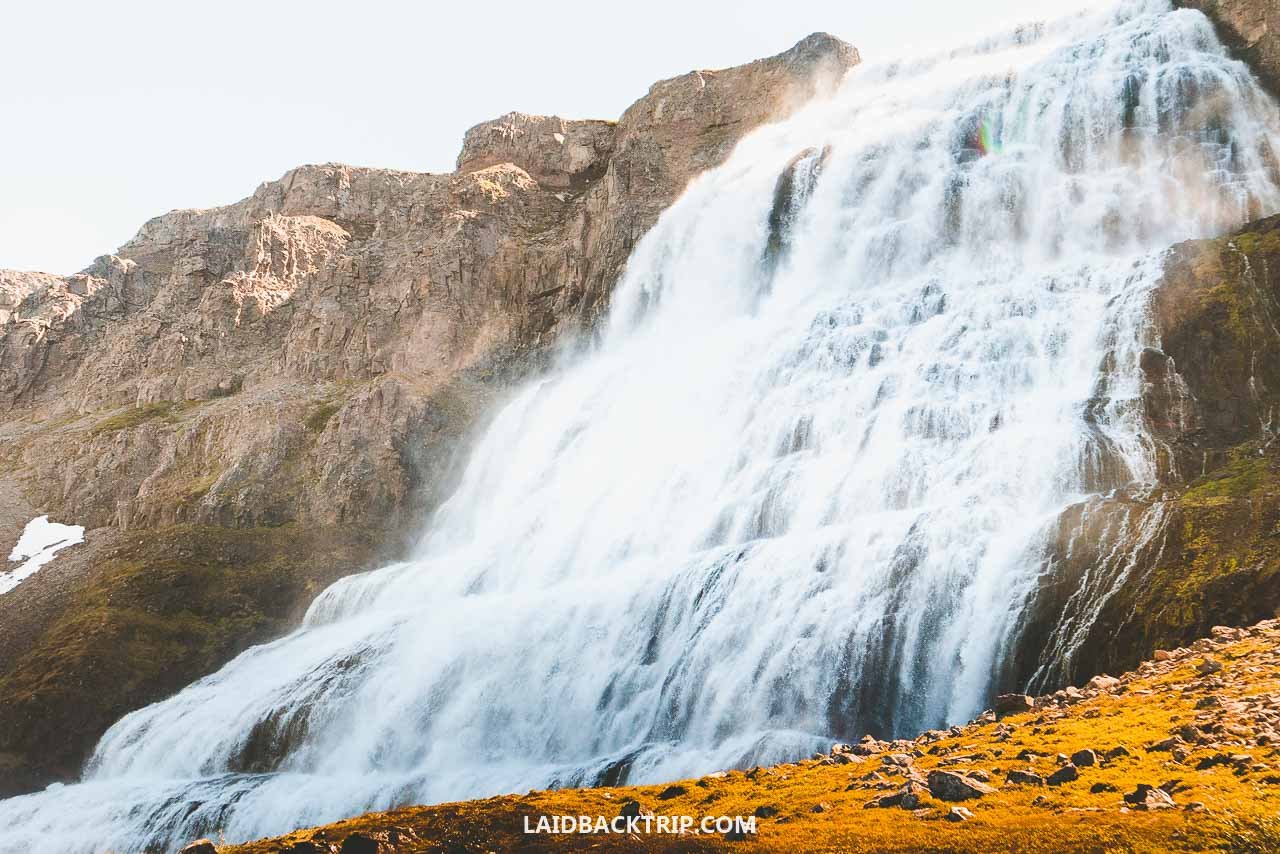
We couldn't wait to explore Dynjandi. This is how our visit went!
Local people who live in the remote Westfjords often say that Dynjandi is the most beautiful waterfall in Iceland. And honestly, if we had such a gem on our home turf, we'd probably say the same. So even if their view might be a little biased, nothing changes the fact that Dynjandi is just stunning.
After seeing tons of beautiful waterfalls in the previous ten days or so while driving around Iceland, we stopped comparing them simply because there was no point anymore. One thing was certain, though. Dynjandi was one of the stops we were most excited about the moment we added it to our Westfjords itinerary. Because it really looked amazing.
The best part about visiting Dynjandi was that it was another place that was incredibly easy to access. Well, I'm not counting the long drive to the Westfjords (that would be a whole different topic), but the waterfall itself was practically right beside the road. Even better, we lucked out with the weather and got to enjoy the whole spectacle on a beautiful, sunny, albeit windy, day.
The series of waterfalls, with Dynjandi resembling a bridal veil, was breathtaking even from a distance, but for us, it was also a perfect stop to stretch our legs during a long day on the road. And as we pulled into the almost empty parking lot, Lucie was already putting her hiking boots on. We were definitely ready to get a closer look!
About Dynjandi Waterfall
Before we hit the trail, we took a moment to read more about Dynjandi first. Some basic facts we picked up from the info panels by the parking lot were that Dynjandi is 99 meters high, it's 30 meters wide at the top, and as the water plunges into the pool at its base, the waterfall widens.
When the huge water mass finally hits the bottom, it's already around 60 meters wide. But that's not all. As we've already mentioned, Dynjandi is actually a series of waterfalls, so the whole place feels completely different from the classic ones we'd seen in the previous days, like Seljalandsfoss or Dettifoss.
It means the water takes a more challenging route and drops over another six cascades before reaching the bottom of the valley. Because of that, the whole waterfall is much higher. In total, it's roughly 200 meters high, making Dynjandi the biggest waterfall in the Westfjords.

The beautiful trail along the cascades eventually brought us really close to Dynjandi.
Dynjandi literally means "thunderous" because of the sound you hear when standing close to it. And the closer we got to the main fall, the louder it became. Dynjandi also has another name, Fjallfoss, which means Mountain Waterfall, though that version is used far less often.
When we looked around, it felt like we were in the middle of nowhere. And honestly, we were. So it surprised me to learn that there had been a farmstead at Dynjandi since the Middle Ages, specifically since the 15th century. The farm was inhabited until 1951, and the remains are still there. How difficult life must have been here was one of the questions that stayed with me as we found the trailhead to Dynjandi and started making our way up.
Visiting Dynjandi Waterfall
The second day of our trip around the Westfjords was supposed to be very scenic, but honestly, we could say the same about every single day we'd spent in Iceland so far. Another thing we knew for sure was that this was going to be another long day of driving.
And while that normally wouldn't be how we'd want to spend the day, in Iceland it felt different, because the breathtaking nature everywhere around us made the whole journey unforgettable. As did the dirt road. As did the majestic Arnarfjordur. And as did Dynjandi, one of the absolute must‑sees in the Westfjords.
We traveled to Dynjandi from Patreksfjordur, and as we got closer, we actually drove almost directly above the waterfall as we crossed the small bridge over the Dynjandisa River that feeds it. If we hadn't known the waterfall was somewhere further down the valley, we would have unknowingly driven past the water that creates it without realizing this stunning place was practically right below us.
And I have to admit that at this point Dynjandisa still looked pretty tame, so we focused more on the views of the bay, which were just incredible. My favorite part is that while crossing this little bridge, right below is Kalfeyrarfoss, which unfortunately stayed hidden from our eyes the whole time, but it's actually another beautiful waterfall.
So we didn't really get the views until we started descending to Dynjandisvogur, which is part of the bigger Arnarfjordur. But since we were still roughly a couple of kilometers away, the waterfall looked like a small white stripe on a dark gray rock cliff. Once we finally had the waterfall in sight, though, it stayed with us all the way until we parked.
Parking
As of now, there is a 750 ISK fee for parking at Dynjandi Waterfall. When we visited, it was still free, but that's no longer the case. From what I've found, the parking lot now has blue signs with a QR code that you can simply scan and pay on the spot.
Entry Fee
There is no entry fee to Dynjandi Waterfall itself, but as I mentioned above, you do have to pay for the parking. So for people like us, who arrived to see the waterfall by car, it basically means it's one of those places in Iceland that are no longer free to visit.
Hiking the Dynjandi Trail
The walking path to the Dynjandi Waterfall was well-maintained and clearly marked, but to reach the biggest waterfall here, we had to walk up. The whole hike was about 750 meters one way with an elevation gain of just over 100 meters. It was a pretty easy climb, especially since we walked along a series of smaller waterfalls, so we stopped practically every other minute.
Even though the trail only went uphill, thanks to the other waterfalls, and also because it was such a short climb, the next 20 or 30 minutes we spent on the way up were actually quite fun. The hike was a bit steep, but fairly short, and didn't give us any problems, so we think any moderately fit person should be able to reach Dynjandi without too much effort. Simply, it was much easier than when we hiked to Glymur or Reykjadalur Hot Springs.
Gradually, we passed Haestahjallafoss, Strompgljufrafoss, Gongumannafoss, Hrisvadsfoss‑Kvislarfoss, Hundafoss, and Baejarfoss, which kept us entertained until we reached Dynjandi. These smaller falls created a charming cascade that made the climb easier as we made tons of stops on the way up. Obviously, each stop added some time, and it definitely took us longer to get to the top than usual. And while these little falls and cascades were beautiful on their own, it was really Dynjandi that stole the show.

On the way to Dynjandi, the trail took us close to all the other waterfalls formed by the Dynjandisa River.
The closer we got, the more spray we felt. We hiked light, as usual, but since it wasn't that warm because of the cold wind, we had our rain jackets on from the start, which came in handy once we reached Dynjandi's base. As we got close to the waterfall, we could feel the spray hitting us. It wasn't as intense as at Skogafoss, but still, it wasn't like we'd stay completely dry, either. We were glad it was a sunny day, so everything dried quickly. Seeing the sheer amount of water falling from that huge basalt wall was incredible, and it also made us keep a safe distance.
World Nomads provides travel insurance for travelers to cover their trip essentials, including sports and adventure activities.
SafetyWing is affordable travel insurance for backpackers, long-term travelers, and digital nomads.

This view of thundering Dynjandi, with mist all around us, was totally worth the hike.
Once we finished admiring Dynjandi, it was time to head back. Since this was an out‑and‑back trail, we just retraced our steps, but now we were facing the fjord, and the breathtaking views almost made us forget we'd just visited one of the Westfjords' most stunning waterfalls.
We turned around a few times on the way up, but it wasn't the same as now, with constant views of the whole Dynjandisvogur. It's home to abundant birdlife, with 35 species recorded here (knots, arctic terns, and harlequin ducks among them), and also seals. But from up here, the whole bay looked still and quiet, nothing like the Látrabjarg Cliffs we visited the day before.

Once we were heading back from Dynjandi, we could enjoy these amazing views of Arnarfjordur.
As we headed down, Lucie pointed out how quiet it was. While Dynjandi was really thundering, the trail was almost empty. There were just a few cars parked there, and since the hike wasn't long, the few other tourists spread out along the trail, so we walked mostly alone.
I knew the Westfjords weren't as busy as the South Coast or the Golden Circle, but since Dynjandi is one of the most famous sights here, I expected a bigger crowd. She also said that if Dynjandi were on the famous Ring Road, it would be one of the most visited sites in the country, no doubt.
That said, times change, and the increasing number of big cruises arriving in Isafjordur means the chance of coming here when cruisers make a day trip to Dynjandi is definitely higher than when we visited.
I remember something similar happening to us in Denmark's Skagen, which has a beach with the country's northernmost point, and it was basically empty when we were there, but on another day, it could have been overrun by cruisers. Luckily, that wasn't the case when we visited. And it wasn't the case here at Dynjandi either. Once back in our car, we continued north. Our next stops were Thingeyri (Þingeyri), then Flateyri, and eventually Isafjordur (Ísafjörður).
Getting to Dynjandi
Dynjandi lies on Road 60 between Patreksfjordur and Isafjordur, the biggest town in the Westfjords. And while the whole stretch was incredibly scenic, it took us longer than we expected because the road wasn't fully paved.
The part of the drive from Patreksfjordur to Dynjandi was especially memorable, and we loved the moment when we finally got the first glimpse of Arnarfjordur Fjord, and only minutes later, when we made that big U‑turn by the cascade itself. As we continued toward Isafjordur, we had to pull over after a while to enjoy one last look at Dynjandi in the distance across the fjord before it finally disappeared.
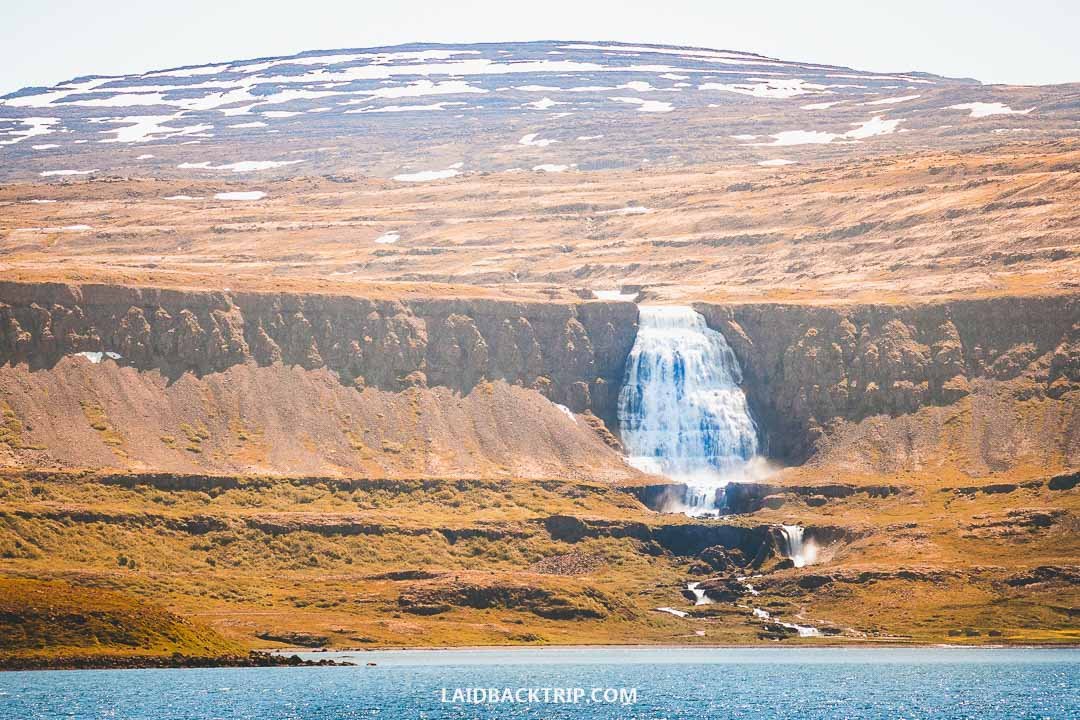
As we were driving to Isafjordur, this was one of the last views we got of Dynjandi from across the fjord.
For us, driving was easily the best way to reach Dynjandi, since we had rented a campervan for the whole trip. Because we were here at the beginning of the summer, we drove to Dynjandi (and around the whole Westfjords) in our 2WD campervan, and everything was totally fine. I can imagine that a four‑wheel drive would be necessary in this part of Iceland once the snow arrives. And just for reference, getting to Dynjandi from Reykjavik by car would take at least six to seven hours, and that's without stops.
Without a car, traveling to Dynjandi is more difficult, but unlike in some other areas of Iceland, it's not impossible. Westfjords Adventures runs a bus between Patreksfjordur and Isafjordur between June and August that also stops for 30 minutes at Dynjandi. I'll talk about whether that's enough time for the waterfall in a moment, but I think I can give a small spoiler by saying it's definitely doable. This bus runs only on Mondays, Wednesdays, and Thursdays, and must be booked in advance!
Dynjandi Tours
As I said earlier, big cruise ships come almost daily to Isafjordur, which means getting to Dynjandi on a tour is incredibly easy nowadays. If it were me, I'd book early because I have a feeling plenty of fellow cruisers would have the same idea. Besides this option that would realistically be mostly for these day‑trippers, there's also the option to join a sightseeing tour that takes you all over Iceland, including the Westfjords and Dynjandi.
Accommodation Near Dynjandi
On the day we visited Dynjandi, we started early in the morning in Patreksfjordur and continued via Isafjordur all the way to Budardalur. Throughout this trip, we stayed in campgrounds, and the Westfjords were no exception. The night before, we stayed at the campground right in Patreksfjordur, and after that, it was the one in Budardalur. Both campgrounds were totally fine, and we got a good rest after a long day on the road, at least as good as it gets when you're sleeping in a campervan.
Dynjandi Waterfall is pretty much in the middle of nowhere, so there are no hotels nearby. But every town we passed had at least one place to stay if camping isn't your thing. Patreksfjordur had the beautiful Fosshotel Westfjords, Isafjordur had a place simply called Hotel Isafjordur, Budardalur had the guesthouse Castle, and Holmavik had Gistihus Holmavikur.
How Long Does It Take to See Dynjandi
I've already mentioned this earlier, but since we had to stop at a car shop first thing in the morning and then spent a couple of hours driving on a bumpy road, we were really excited to enjoy Dynjandi at a slow pace. We soaked up the somewhat warm sun, Lucie read every info panel, I took tons of photos, we stopped at every single fall on the way up, didn't rush because there was no reason to, and on the way back, we just took in all the views of the fjord. And because of that, we spent over an hour at Dynjandi.

We made tons of stops, so the walk to Dynjandi took us just over an hour.
If we assumed we just parked the car, walked quickly along the cascades to Dynjandi Waterfall, snapped a few photos, and headed back to our campervan, we'd need roughly thirty minutes for the whole visit. But that would really be the bare minimum, and unless we'd arrived on an incredibly cold and rainy day or with that seasonal bus I mentioned earlier, we would have wanted to stay longer. Because it wasn't just Dynjandi that was worth seeing here, but the whole fjord was absolutely spectacular.
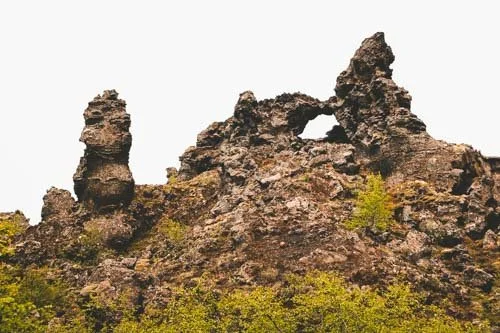

Our travel guide to Grjótagjá Cave covers everything you need to know before visiting this famous lava cave in North Iceland, including how to get there, parking information, what to expect inside, why it became so popular, and the best times to visit.