How to Visit Reykjadalur Hot Springs
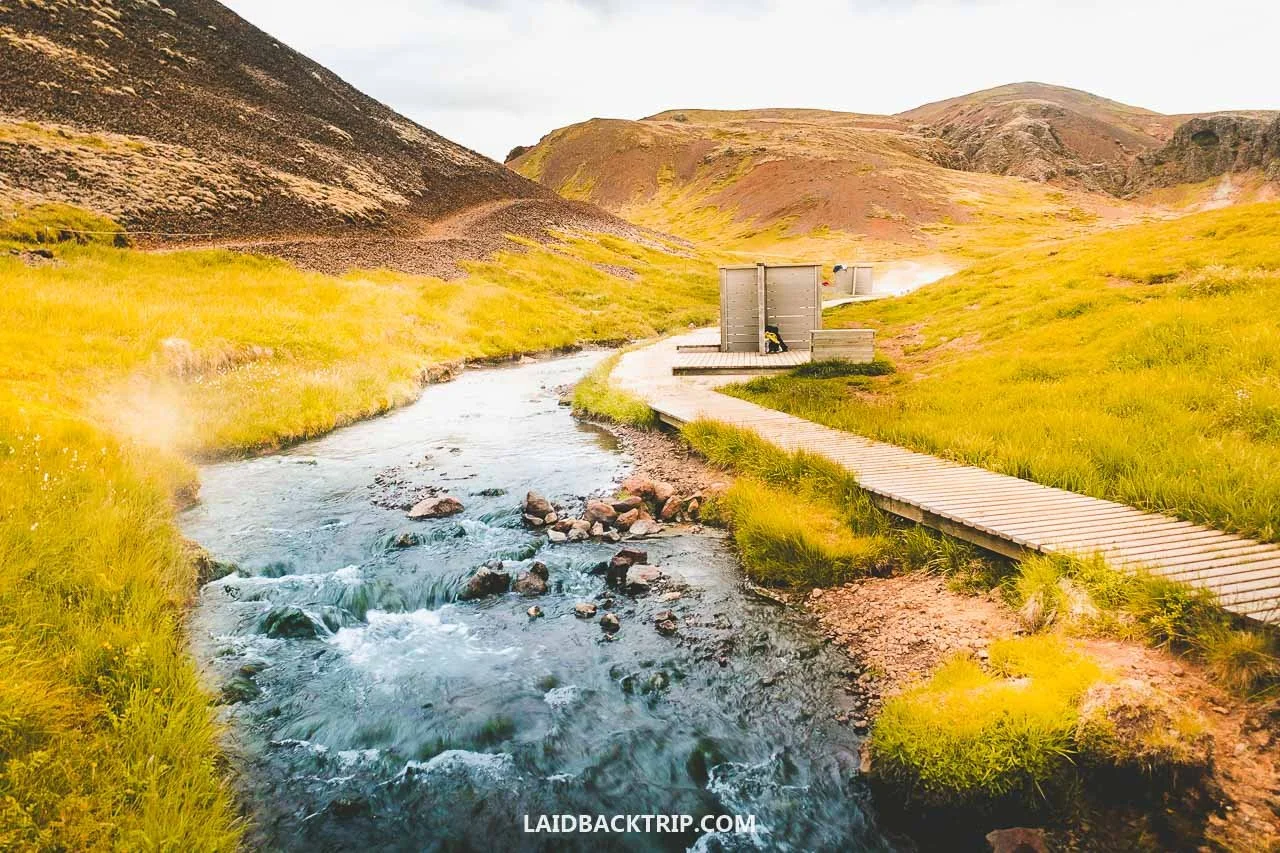
We loved Reykjadalur because it's one of the best places in Iceland to enjoy free hot springs.
After a long day on the road, we finally reached Reykjadalur Valley to soak in the hot springs. Was the experience really worth the 8‑kilometer hike?
As our road trip through Iceland was nearing its end, we still had one more place on our itinerary we were really excited to visit. It was Reykjadalur Hot Springs, a thermal river flowing through beautiful, untouched scenery. And even though this place wasn't some hidden gem anymore but a super popular spot, it kept its basic feel that made it so different from its more developed counterparts.
And because there were practically no facilities apart from a wooden platform that made getting into the river easier and a few wooden screens where we could change into swimwear, the whole experience was meant to be as simple and natural as it could get.
And because everything was so minimal at Reykjadalur, which literally meant "smoky valley," it also meant we could enjoy these hot springs for free. Tickets to Blue Lagoon or Mývatn Baths were pretty pricey, so the idea that we didn't need them for Reykjadalur was awesome.
But both Lucie's and my favorite part about this whole site was that it wasn't right by a parking lot. We actually had to hike almost four kilometers to reach the bathing spot. Yes, those four kilometers were only one way. Then we had to walk the same trail back. This made Reykjadalur almost the ideal attraction in our eyes. Like Lucie. said: "A little walking, a little bathing, and a little leaving of everything behind."
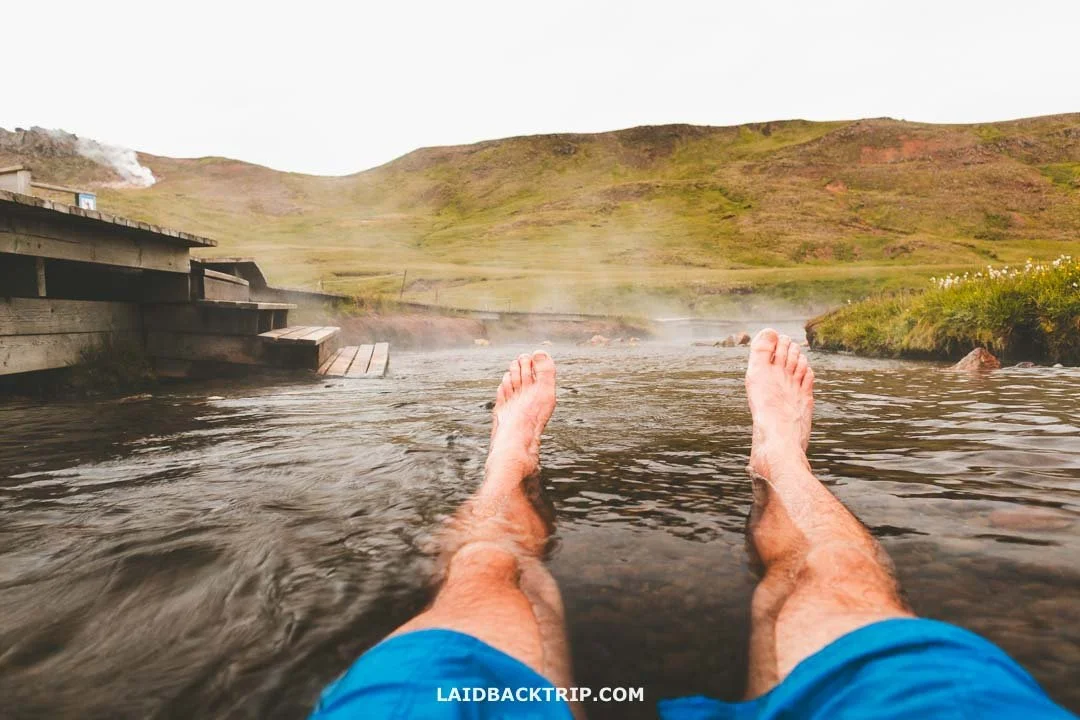
Bathing in Iceland's hot springs was always an amazing experience, and Reykjadalur was no exception.
We drove the Ring Road counterclockwise, and while we could've visited Reykjadalur at the very start of the trip, we skipped it and headed straight for the Golden Circle. It just worked better for our plans. A big part of it was hearing that the thermal river at Reykjadalur gets super busy during the day, especially in summer when we were there. And with how our first day was planned, we would've arrived in the middle of the day, like all other people.
So instead, we decided to focus on the Golden Circle and its highlights like Þingvellir National Park and Gullfoss, and return to Reykjadalur at the very end of our road trip. We wanted to avoid the crowds, so we planned to come late in the evening. And we did. It was already 9 PM when we reached the parking lot at the beginning of July. However, the parking wasn't empty at all, and some people arrived even after us. So we still weren't sure if our plan would work. So let's find out!
Getting to Reykjadalur Hot Springs
The Reykjadalur Valley where the thermal river flows is less than 50 kilometers from Reykjavík. The nearest town to the trailhead is Hveragerði. The town has a grocery store, gas station, and also some restaurants, hotels, and a campground. Since we were driving, getting to the Reykjadalur Hot Springs trailhead was as easy as possible.
We drove there from Reykjanes, with our last stop being Seltún Geothermal Area, so the whole drive took about an hour or so. A lot of people travel to Reykjadalur directly from Reykjavík, with the journey taking a bit less than an hour, though you could stop at Hveradalir Geothermal Area, which would add some extra time to the trip.
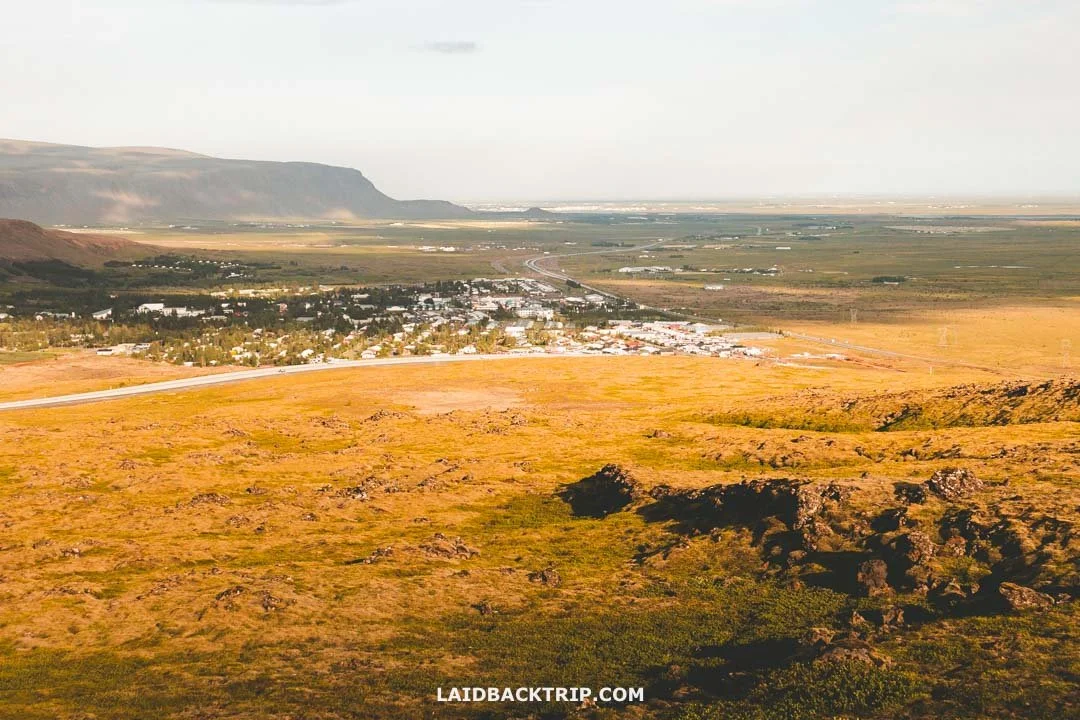
We were almost in Hveragerði, and from there it was another four kilometers to the Reykjadalur trailhead.
Anyway, we eventually ended up back on Route 1 as "someone" from our group made a small navigational mistake, but at least we could enjoy a bit more beautiful Icelandic scenery. Obviously, this road was fully paved, as was the final 4‑kilometer stretch between Hveragerði and the Reykjadalur Hot Springs parking lot.
We'd rented a small 2WD campervan, so it was great that we didn't have to worry about dirt paths or potholes (unlike at Látrabjarg or Borgarfjörður eystri, for instance). By the way, since we were driving to Hveragerði via Route 1, we could enjoy the scenic descent just before the town.
Without a car, we would probably just take a tour to Reykjadalur Hot Springs, assuming we started in Reykjavík. The reason was that taking a bus would require first getting to Reykjavík's Mjodd Bus Station (to get there, take bus 3, 11, 12, or 17 from centrally located Hlemmur Station), then hopping on bus 51 or 52 to Hveragerði.
My biggest problem with this option was that the bus stops only in the town, about four kilometers away. So just to get to the trailhead, we'd have to cover that stretch on foot, and do the same after the hike to get back to the town. So instead of an eight‑kilometer hike, we'd be looking at a 16‑kilometer one, with half of the trail being a regular road for cars.
Parking at Reykjadalur Hot Springs
These days, the parking at Reykjadalur Hot Springs is paid and costs 1000 ISK per car for up to five hours. It can be paid online through the Parka app. When we were there, it was still free, but that changed like at so many places all over Iceland. In this case, and in my opinion, the parking fee is pretty negligible since the thermal river remains free.
The parking was pretty huge, and because we arrived in the evening, it was relatively quiet as most day trippers were already gone. I noticed that when the parking lot gets full, people leave their cars on each side of the access road. The parking area also had restrooms and a café.
No Entry Fee to Reykjadalur Hot Springs
As mentioned earlier, there is still no entry fee to Reykjadalur Hot Springs. That stayed the same, unlike the parking. Being able to see one of Iceland's most famous thermal rivers for free was definitely a big reason why we even went there. Because don't get me wrong, the Blue Lagoon experience was amazing but quite pricey, and we really welcomed that there were also free options to help our budget stay within reasonable bounds.
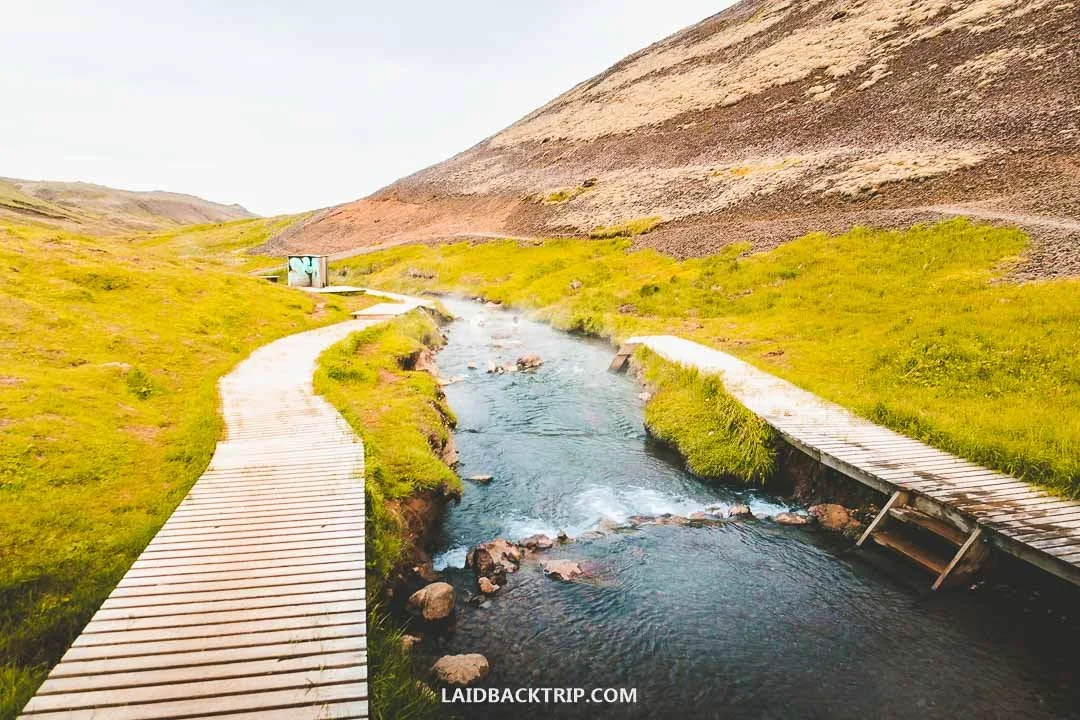
It's pretty amazing that Reykjadalur hot springs still don't have an entry fee!
Now that they charge for parking, I don't think it would change our opinion, and we'd still want to go, because even with that small fee, we'd consider the Reykjadalur experience worth it. If you don't share the same sentiment, then we visited other hot springs in places like the East Fjords or Westfjords, which remain completely free, including parking. Obviously, their main downside was that they were much farther from the capital than this place.
Reykjadalur Hot Springs Trail
The Reykjadalur Hot Springs is an out‑and‑back trail about 3.8 kilometers long with an elevation gain of 200 meters, at least that's what my watch showed me once we reached the bathing spot. The interesting part was that one of the signs at the start of the trail indicated that the hot springs were just three kilometers away, but as I said, it was almost four kilometers.
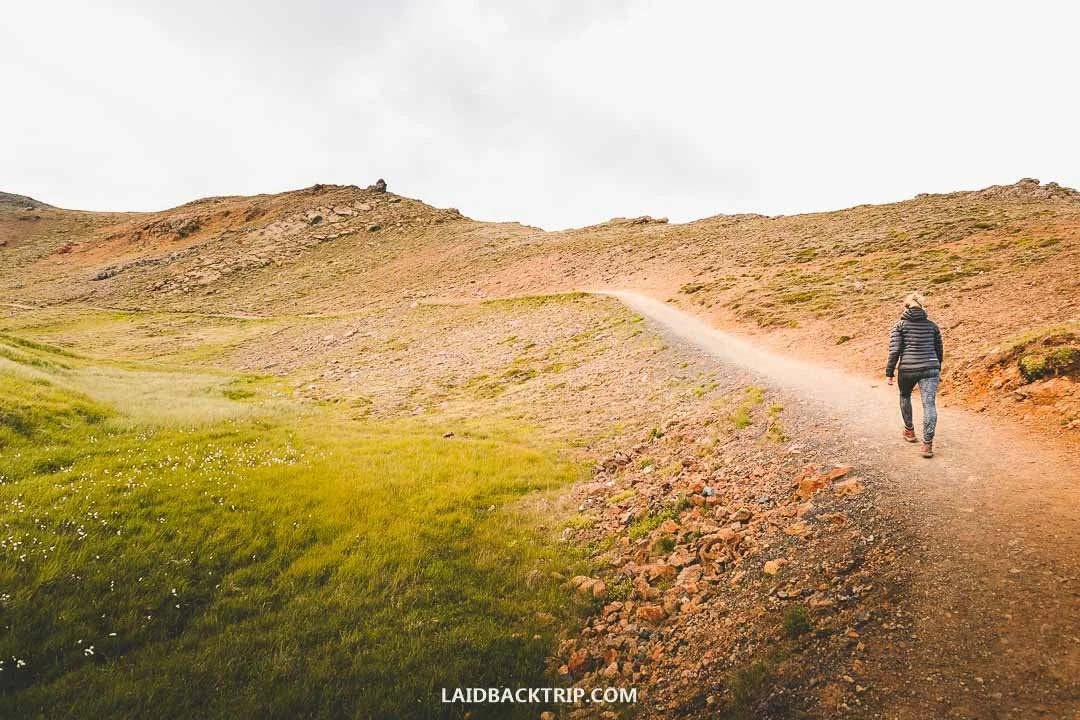
To enjoy the Reykjadalur hot springs and return, we had to walk for almost eight kilometers.
Given that we were doing the hike in summer and the path was the whole time fairly wide and well‑maintained, it was as easy as a hike with these figures could be. The walk there was mostly uphill and took us definitely under an hour (I think it was like 50 minutes including photo stops), and obviously we walked back faster as it was only downhill. The Reykjadalur Valley had more trails, but we didn't have time to venture beyond the bathing area.
What We Packed for Bathing at Reykjadalur
As I mentioned, when we arrived at the parking lot, it was after 9 PM. It was quite late, but we really didn't mind. What was worrying was that we sort of skipped dinner, and now was the time to put that right. So I rummaged through the last of the food we had and found out that we'd have beans with bread for our late dinner.
Afterward, we put our swimsuit and a quick‑drying towel in our dry bag, and by the time we were done and ready to start the hike, it was almost 10 PM. Had this been one of our other road trips like the one in Jutland or Wild Atlantic Way, we'd be almost ready for bed. But Iceland was very different in this regard.
Most noticeably, there was still so much daylight that we didn't even need to use our trusty headlamps. Had this been our first day in Iceland, we would've been definitely surprised by this, as even though we knew about the midnight sun phenomenon, it still took us a few days for our brains to fully adjust to it, but at this point, we just counted on it.
Other than that, we wore hiking boots as we did for other hikes like Brúarfoss or Glymur Waterfall, and didn't regret leaving our sneakers in the car. As it was relatively cold, we both put on our down jackets and removed them no sooner than when we reached the bathing area. By the way, we saw some people who brought beer with them to make the atmosphere even more relaxing. Just make sure to leave no trace and bring back what you brought in.
Hiking to the Reykjadalur Hot Springs
We did several hikes during the trip, but I don't think we were excited for any of them as much as we were for this one with the promise of taking a dip in the thermal river. But first, we needed to reach the hot springs, which were almost four kilometers up in the valley. So, with a full stomach, we hit the trail.
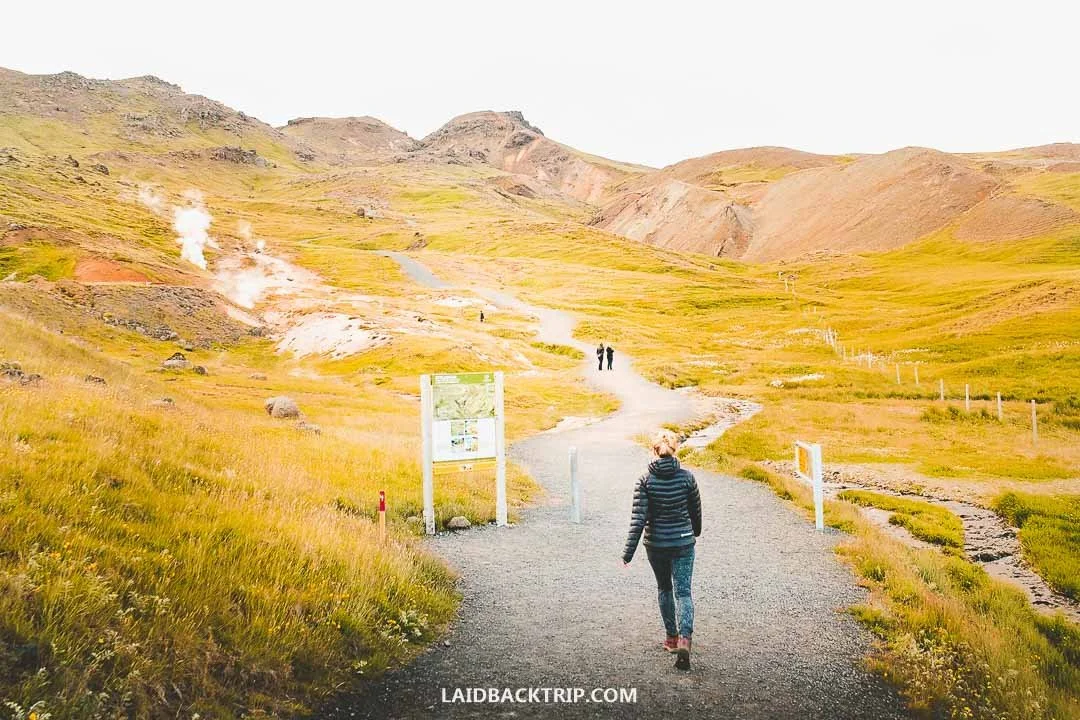
The first part of the trail was wide, climbed uphill, and passed a few steaming fumaroles.
The only thing we weren't sure about was how difficult the hike would be. Because on paper, it looked like a fairly easy walk. But we learned many times that this can be deceiving, like on Tongariro where the muddy trail made us walk much slower than we normally would. Anyway, this wasn't any problem at Reykjadalur because it didn't rain in this part of Iceland for at least a few days and the trail was in excellent condition the whole time.
The trail that took us through the Reykjadalur Valley was basically an old sheep path used by locals. And while it hasn't changed, even though the hike has recently gained popularity, it also meant that it was fairly wide for the most part.
We started walking up and could see some hissing fumaroles, hot streams, and bubbling mud pools right from the start. The beginning of the trail was probably the steepest, but the incline wasn't really that dramatic. The steam coming out of the ground reminded us of Geysir and Hverir we visited earlier on the trip and also showed us where the area's name comes from.
Even after those weeks, we were still easily amazed by Iceland's incredible beauty and its geothermal power. My favorite part about this lovely hike was that it wasn't just about the thermal river but also the scenery along the way. While we enjoyed even the monotonous walk along the volcanic plain to the Sólheimasandur plane wreck, this valley with moss‑covered hillsides was definitely more scenic.
We took photos of the surrounding hills, watched the sheep grazing on green pastures, and just enjoyed the quiet moments we found on this trail. It was a quiet evening, and we didn't meet many other hikers on the trail. Overall, it was a very enjoyable hike, as we didn't have any reason to rush. The trail wasn't really marked, but it was clearly visible and well‑maintained the whole time, and there wasn't any place where we could get lost.
We couldn't get enough of the Icelandic landscape, but other than that, the walk was almost uneventful. The trail through the Reykjadalur Valley that eventually brought us to the thermal river was really not difficult. There were no strenuous sections, no steep climbs. For us, it was more like a pleasant walk.
Djúpagilsfoss Waterfall
Well, uneventful. It wouldn't have been Iceland if we hadn't seen at least one waterfall that day, right? After about two kilometers, we spotted Djúpagilsfoss. It was formed by the rivers flowing down the valley, merging into Reykjadalsá. and while it was a bit in the distance, it was as gorgeous as an Icelandic waterfall could be. At the top of the waterfall, two streams joined and created this beautiful cascade.
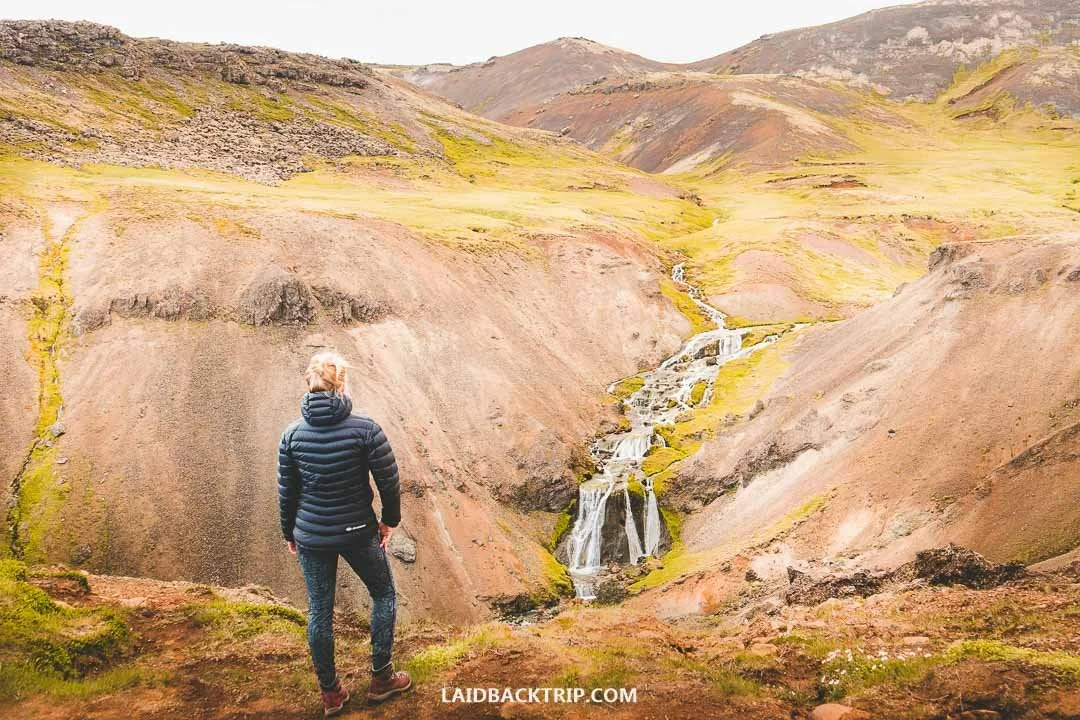
We reached Djúpagilsfoss roughly 30 minutes into the hike.
As Lucie said, it was like Fjaðrárgljúfur combined with Dynjandi's lower falls. Even after seeing so many waterfalls in Iceland, we were still amazed by these smaller ones, not just because they were beautiful but also because we simply don't have that many of them back home. We spent a few moments enjoying the views before we continued.
No Changing Rooms at Reykjadalur
When Lucie started wondering how much further the bathing area was, we finally spotted the boardwalk that marked it. Before we went, we wondered what it would be like, because during the trip we experienced everything from places with great facilities like Hofsós to some natural pools in the Westfjords or a hot tub in the East Fjords. The steaming river looked beautiful, as did the scenery around it.

When we reached the bathing spot at Reykjadalur, we realized it was just this wooden platform with a few changing screens.
As we did the hike wearing all our hiking clothes, we started looking for where we would change into swimwear. We quickly looked around to find out that Reykjadalur Hot Springs had no changing rooms, except for some wooden changing screens. They were just screens, normally open, so they really didn't do much, but we didn't really care about that. Public nudity is a common thing at Iceland's hot springs.
Water Temperature of Reykjadalur Thermal River
It was finally time to test the water. Without thinking too much about it, we simply found a spot that had the least people around. It wasn't that difficult at this point of the evening, as at 11 PM most people were already gone. The river was pretty shallow, so no cliff jumping this time, but this wasn't really the place, right? So from the wooden platform, we took the steps and very slowly dipped into the water. After the entire day on the road and this almost hour‑long walk, this felt like stepping into heaven. The water was amazing.
Really, we had a great time not only because there weren't that many people that evening, but the water seemed warm enough for our taste. The water temperature of the Reykjadalur thermal river typically ranges from 36° C to 40° C, which is ideal for bathing. We didn't bring our own thermometer to check that, but judging by other hot springs we visited, I think the river really had a temperature within those numbers.
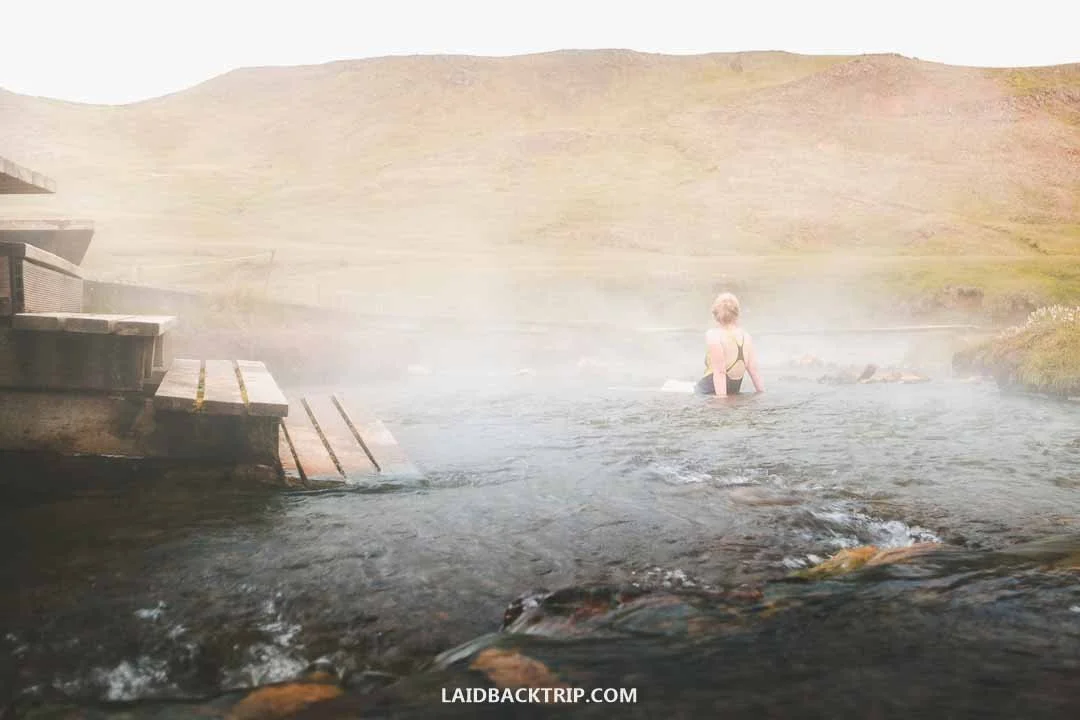
The further upstream we moved, the hotter the thermal river was.
Apparently, the water was supposed to be warmer further upstream. Which got us curious. We were just sitting in the water, only halfway submerged, and since it was getting colder outside, after some time we moved a few meters upstream and found that definitely true. In fact, we enjoyed this spot with much warmer water for just a few minutes and then slowly returned to our previous spot as the water temperature wasn't comfortable there anymore. It was simply too hot.
I read that the water stays warm throughout the year, which makes Reykjadalur a great place to visit even in winter, though the temperature could drop by a few degrees during this season, as it could drop after heavy rain.
When to Visit Reykjadalur Hot Springs
We hiked to Reykjadalur Hot Springs at the turn of June and July. Since we were there at the beginning of the Icelandic summer, we could take advantage of the super long days, which, thanks to the midnight sun, practically allowed us to start hiking not sooner than 10 PM and stay at the hot springs even after midnight.
During the day, the whole area would be packed as this would be peak season, but since we did the hike that late in the day, we arrived at Reykjadalur when day trippers and big groups were gone. We counted on that as we had a similar strategy at places like Reynisfjara or Dyrhólaey where it worked, so we hoped this time would be the same. And it was. Sure, it was a long and tiring day for us, and we got to bed pretty late, but it was definitely worth it so we could enjoy Reykjadalur Hot Springs without crowds.

The whole Reykjadalur valley was just gorgeous at the beginning of the summer.
Just earlier I mentioned that bathing at Reykjadalur Hot Springs is a year‑round activity, but while the water remains warm enough for bathing in off‑season, the same can't be said about the trail. I already talked about how easy the trail was, but that was obviously in summer.
During the winter, we would really be more worried about the trail's condition than the water temperature. At the beginning of July, we found the trail really safe. However, we could imagine this would be a different story in the winter, when the trail would be muddy, icy, and slippery, not to mention that there would be a very short window of daylight during December and January (this is the time when a headlamp is a must‑have).
World Nomads provides travel insurance for travelers to cover their trip essentials, including sports and adventure activities.
SafetyWing is affordable travel insurance for backpackers, long-term travelers, and digital nomads.
We Spent Over Three Hours at Reykjadalur Hot Springs
After a delightful experience, we changed into dry clothes, and it was time to walk back to our car. I thought that the walk back would be tedious, but it wasn't. We felt really relaxed, and I'd say even well‑rested, given it was after midnight. The trail was even quieter at this time, though we met a few people heading for the bath even at this hour. In about 45 minutes, we were back at the parking lot.
All in all, it took us over three hours to enjoy the Reykjadalur Hot Springs, including the walk there and back. We spent almost another hour at the parking lot having dinner and taking a break before the hike. We could have brought some snacks up to the river, but we were really hungry, and it didn't make sense to wait that long. I'm mentioning it because I do think that anything three to four hours sounds about right for Reykjadalur Hot Springs.
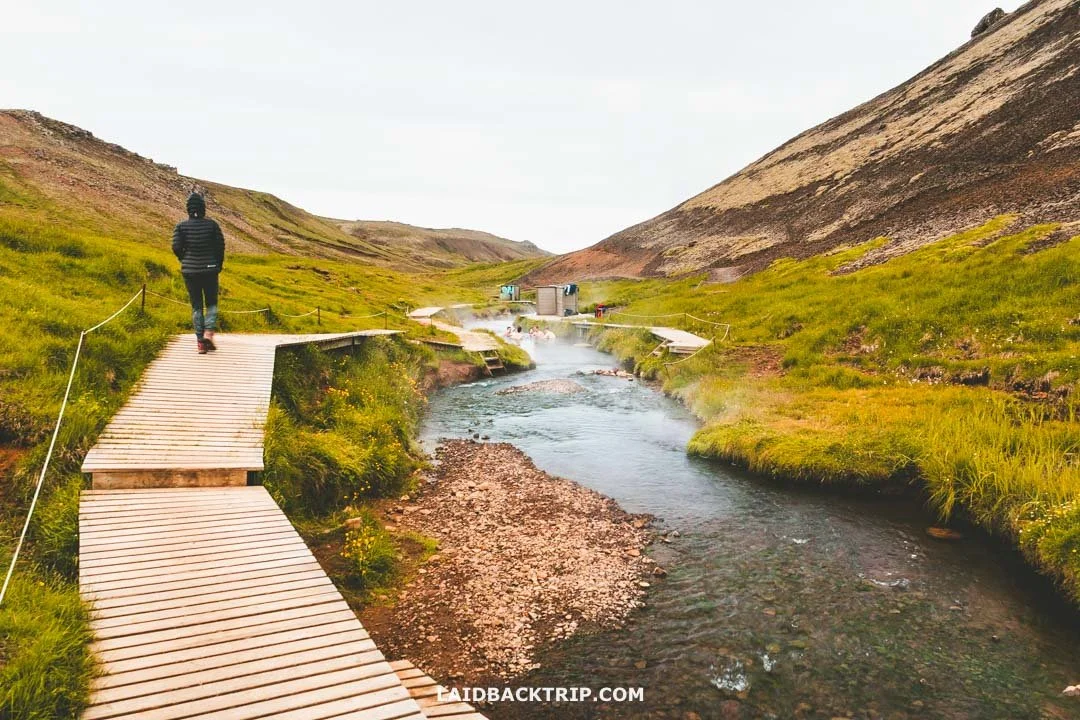
It was already after midnight (just look at how much daylight there still was) when we finally started walking back to our car.
I thought we would spend more than an hour bathing, but I'd say that in the end it was more than enough for us. After all, there wasn't much else to do (obviously) besides sitting in that river, and we both felt, after this time, more than soaked enough. Of course, it's possible to walk further and explore the valley more extensively because the trail doesn't end at the bathing spot, but since it was so late, we were already thinking about being camped somewhere. Obviously, if you want to do more hiking in the area, you'll need more time than those three hours.
Where We Stayed Near Reykjadalur Hot Springs
As our idea was to make Reykjadalur Hot Springs our final stop of the day, we obviously had to figure out where we would stay afterward. Since this was our penultimate evening in Iceland before flying from Keflavík back home, we kept our plans fairly loose at this point and hadn't booked anything, and quite honestly, hadn't put too much thought into this.
I had saved a few places within a short driving distance from Reykjadalur. The first choice we had was just to drive four kilometers back to Hveragerði, which had a campground and a few nice places to stay like Hotel Örk or The Greenhouse Hotel. It was a sensible choice as it would be nearby Selfoss. In our case, because we wanted to visit the Blue Lagoon the next morning, the option that would make even more sense was Reykjavík's outskirts, or Hafnarfjörður.
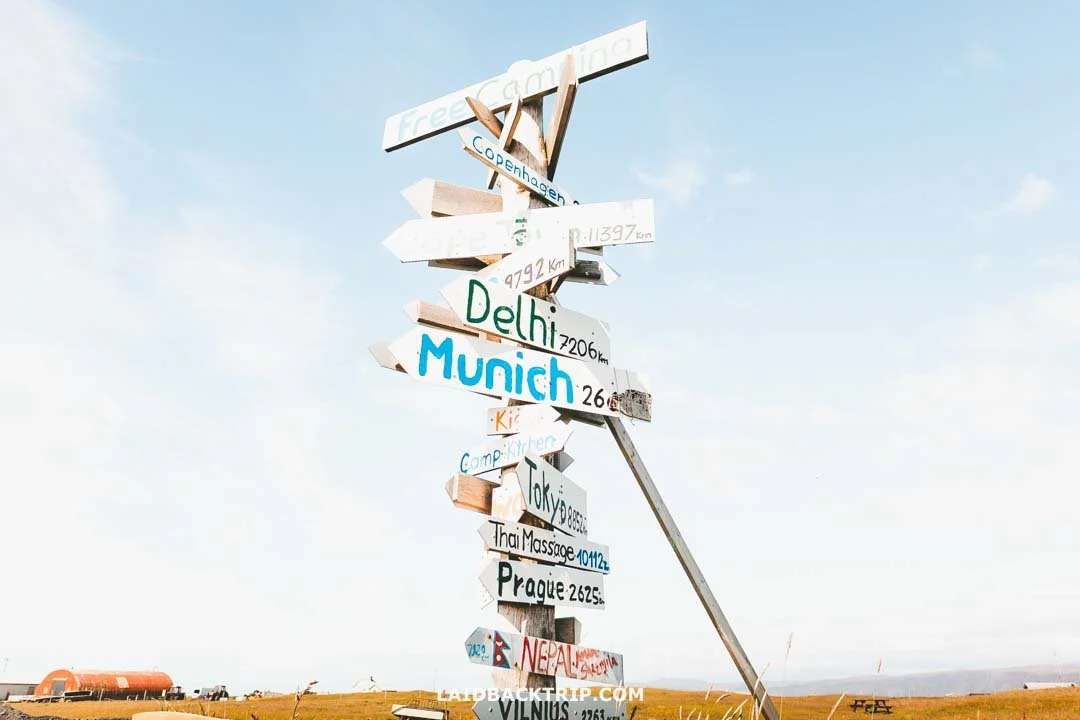
After visiting Reykjadalur, we stayed at Gata Campground, and it was free.
But then Lucie said that it was a beautiful night, and it would be a shame to stay in some town. So I looked in my notes, looked once again at Reykjanes's southern coast, and found a place called Gata Campground (sometimes referred to as Strandakirkja). It looked perfect. It was the only free campground we stayed in during the whole trip, and while it was super basic, it had everything we needed that night (flat terrain, a WC, and that was all we needed). And a beautiful church.
Travel Resources
Here you can find links to all the travel resources we use and which you might find helpful when planning your next holiday.
Accommodation: When looking for accommodation, we usually search hotels via Booking.com or Hostelworld.
Tours: Although we love to travel independently, some places are better to visit with a guided tour.
We prefer GetYourGuide for its easy-to-use interface and solid reputation. Another great alternative is Viator.
Rental Cars: When going on a road trip, we always use Rentalcars.com, a reliable site for booking a rental car in advance.
Flight Tickets: When looking for flight tickets, you can search Skyscanner to find the best price.
Travel Insurance: World Nomads and SafetyWing cover against risks of travel.


Read our travel guide on visiting Dettifoss in Iceland. It includes tips on how to get there, when to go, where to stay, whether the east or west side offers better views, and whether it's worth walking to nearby Selfoss.