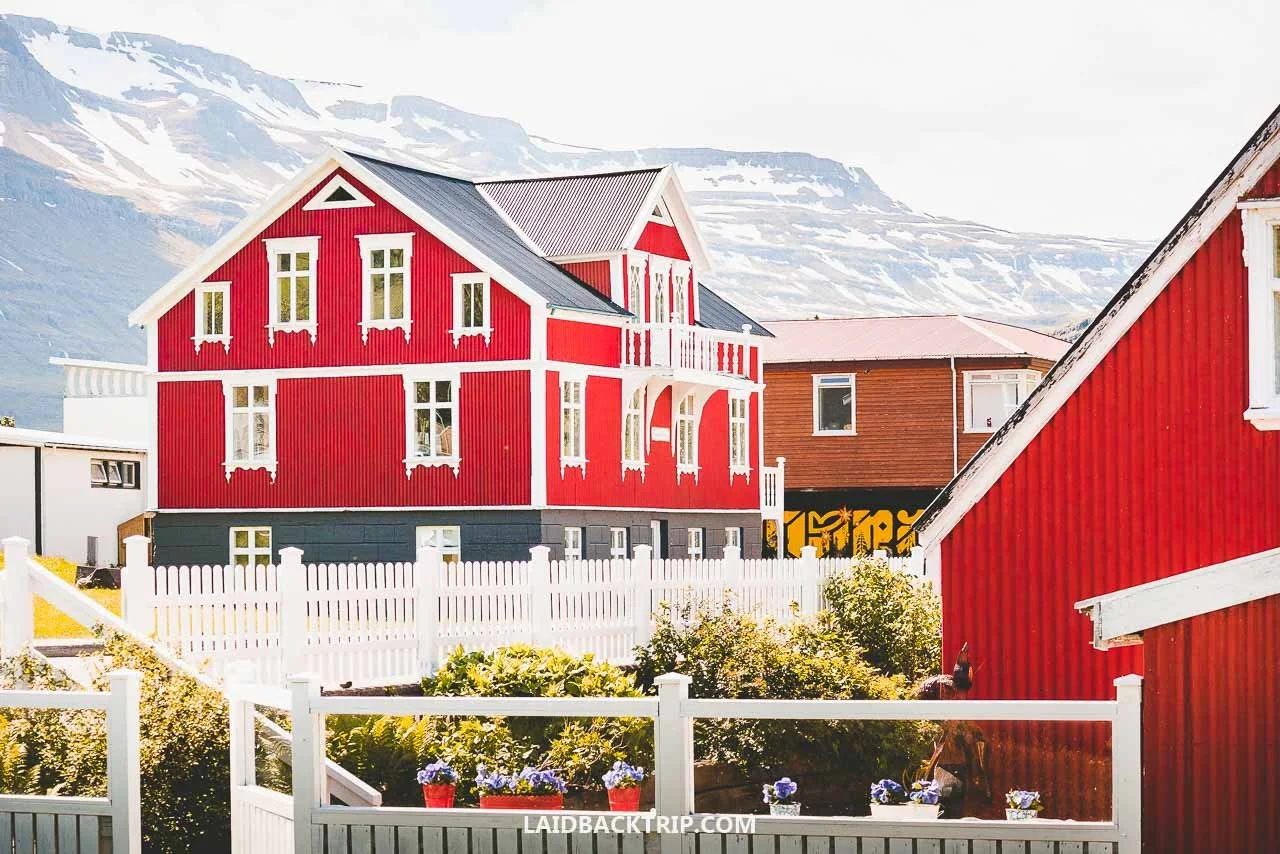
Seyðisfjörður was one of those places we loved right from the start. Here's how our visit went.
The idea behind visiting Seydisfjordur was that we were about to see one of those charming Icelandic seaside towns, and this one fit that description perfectly. Up to this point, we had practically just focused on nature. And while all those amazing waterfalls, endless black sand beaches, and iceberg lagoons with glaciers were incredible, we felt like we needed a short break from all of that.
We were still in Iceland, which meant we'd need to drive yet another scenic road just to reach the town, and the fact that Seyðisfjörður was located in a fjord meant we'd still enjoy dramatic scenery here too. Only the destination of this short detour was different this time.
The only small problem was that we had no idea whether we'd actually make it to Seydisfjordur. It was one of the places we had marked as optional in our Iceland itinerary, and we planned to decide whether we'd visit once we reached Egilsstadir, the departing point for this town. That was when we were still back home.
As we were traveling toward Egilsstadir through the South Coast, where we were caught in a two‑day spell of heavy rain, the chances looked pretty dim. When we finally reached Djúpivogur the evening before, it looked like the weather was turning in our favor.
The next morning we woke up to a beautiful sunny day. We spent it exploring the East Fjords, and when we finally arrived in Egilsstadir, we had to make that decision about Seyðisfjörður. With weather that good, we didn't need much convincing to drive there.
Taking a Scenic Drive from Egilsstadir to Seydisfjordur
As I said, we started our day in Djupivogur and spent the morning driving around the East Fjords. The scenery was mesmerizing, and we wished the drive would never end. When we finally reached Egilsstaðir, we simply had to take a moment to process what we'd just seen.
The reason I'm repeating myself is that at this point, we thought nothing could take us by surprise. We'd been exploring Iceland for a few days already, and we were still kind of naive, because it felt like Iceland's scenery ignored simple logic.

The scenery in Seyðisfjörður was simply breathtaking.
So once we reached Egilsstadir, we had almost 30 kilometers of yet another scenic drive ahead of us. It was Road 93. We read that it was supposed to be scenic, but honestly, that same description applied to pretty much every route we'd taken so far, whether it was Golden Circle or Eldhraun Lava Field.
Our excitement after seeing the East Fjords wasn't as high as the road deserved. We still thought the main highlight would be Seydisfjordur and that along the way we'd see some nice scenery. As I said, we were proven wrong again, because on the way we had to cross the Fjardarheidi mountain pass.
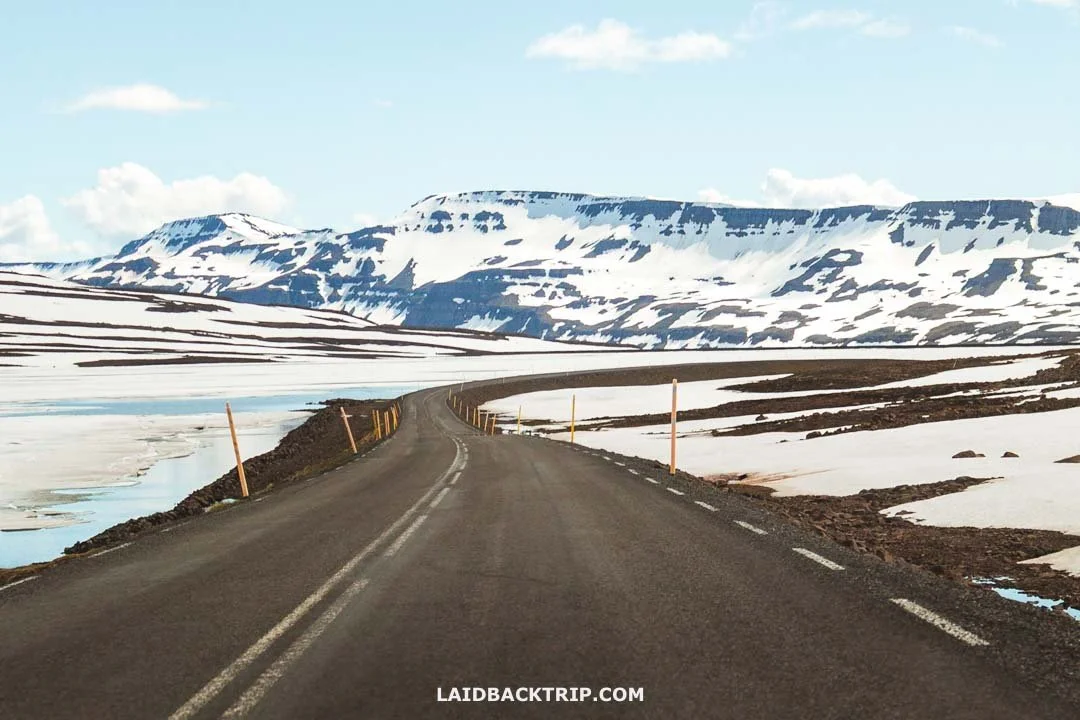
The scenic Road 93 between Egilsstaðir and Seyðisfjörður was one of the most beautiful drives we did in Iceland.
As soon as the Ring Road brought us to Egilsstaðir, we turned right onto Route 93. We crossed the Eyvindara river and soon turned right again to stay on the route. After a minute or two, we started climbing the hill. And because Egilsstadir sits at a very low elevation, under 50 meters above sea level, and we had to climb above 600 meters, it was a pretty interesting drive.
The road was paved the whole time, and in the first section, it had several sweeping curves and switchbacks. It was fun to drive uphill, especially since the whole area around the town opened up the higher we traveled. At the very top, we stopped at a small pull-off to enjoy the view and take some photos.
From here, we continued driving uphill to reach the mountain pass, though the incline wasn't as steep after that. After a short time, we emerged into a snowy wonderland we hadn't expected to find here. We traveled to Iceland at the turn of June and July, the start of the summer season.

Driving over Fjarðarheiði pass felt more like a winter crossing than a summer one.
At this time of year, we didn't think we'd find much snow, especially after the Jokulsarlon experience. But once we climbed high enough, the scenery suddenly changed, and it looked like we were visiting Iceland in winter.
The road led across snowy plains with vast ice patches and icy lakes formed by melted snow. In the backdrop, we could see white mountaintops in the distance. The road itself was clear of snow, so driving was as easy as on the coastal roads of Reykjanes Peninsula or the inland drive of the Diamond Circle. We were speechless. And the longer we drove, the more we wished the drive would never end.
Not long after, we saw a modern art installation on our left. We didn't expect snow, and we definitely didn't expect this. So we pulled over to take a closer look. It consisted of colorful blocks with old TVs mounted on top, made by local artist David fra Davidsstadir. The contrast of the bright blocks on the icy plateau was really cool.
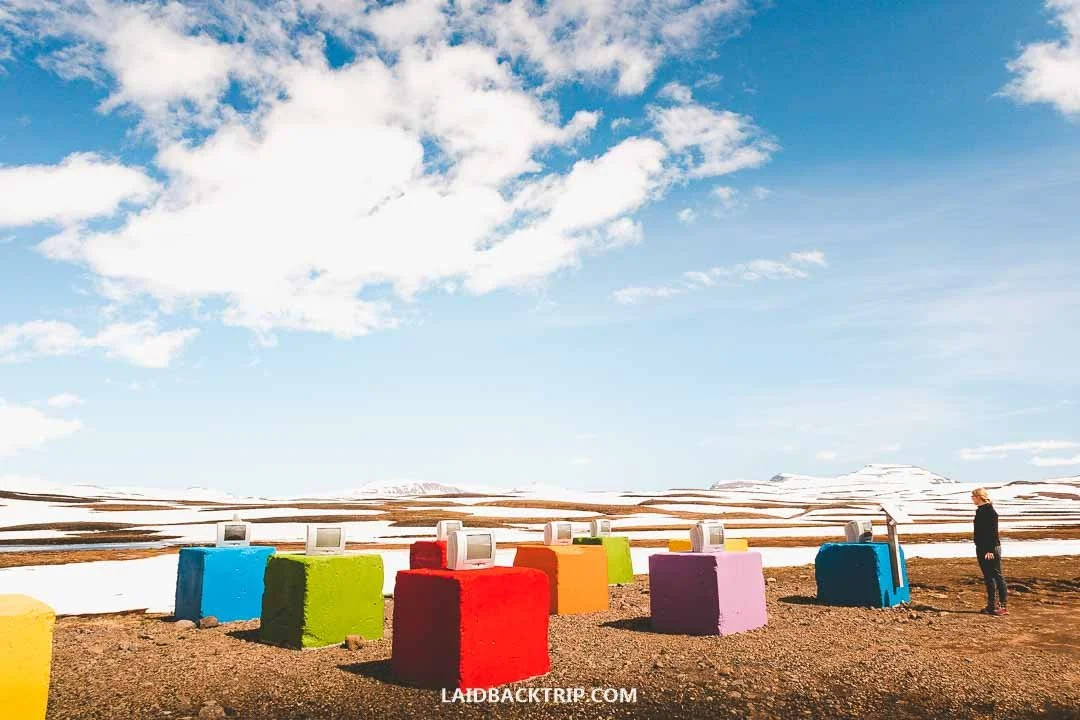
With all its colors, the outdoor exhibition Heavier Mountain was in striking contrast to the barren, snow-covered plains around us.
Another interesting place we passed was Stafdalur, a small ski resort with three ski lifts and a Nordic ski track. It's tiny and local, operating only in winter, usually between December and April. It was obviously closed at the end of June, but the idea of skiing in Iceland stuck with us, so maybe one day (and if you want proper European skiing, see our ski trip to Zermatt and 4 Vallees).
Once we crossed the pass and started descending to the other side of the valley, we pulled over at a small parking lot and went for a short walk (known as the viewpoint from The Secret Life of Walter Mitty). We couldn't get enough of the views. After a while, we returned to the car and continued the descent along the Fjardara river. Gufufoss was on our right, but since we stopped there too, I'll talk about it in a minute.
After touring Road 93 on the way to Seydisfjordur, we can say that the journey was the destination. We drove around the whole island and explored several memorable drives, whether in the Westfjords or on the Trollaskagi Peninsula.
For me, Road 93 was the one I'll never forget, and Lucie, even though she wasn't behind the wheel, felt the same. It was simply our favorite drive in all of Iceland. And because this is the only road connecting Egilsstadir with Seydisfjordur, we got to drive it twice in the same day.
Getting to Seydisfjordur by Bus
Besides driving, your only other option is taking a bus or joining a tour. Bus 93 between Egilsstadir and Seydisfjordur runs twice a day during summer, in the morning and afternoon, giving you about five hours in the town, which is enough for a day trip. We passed the bus stop Seydisfjordur - Herdubreid, and it was just a two‑minute walk from Seydisfjardarkirkja, which looked super convenient.
Taking a Cruise to Seydisfjordur
As for tours, I think Seydisfjordur is mostly visited through multi‑day trips, because I haven't found any day tours that go there (Reykjavik is too far). My guess is that people who reach Egilsstadir do so either by car (like we did) or by bus, and that's the same way they visit Seydisfjordur.
The interesting part is that because the town gets so many cruises these days, they offer tons of day tours not to, but from Seydisfjordur. And since I mentioned cruises, Seydisfjordur is also the port town for ferries from Denmark and the Faroe Islands, run by Smyril Line.
Parking in Seydisfjordur
When we finally arrived, we found that parking in Seydisfjordur was plentiful and free of charge. There wasn't an official main parking lot, just several smaller ones scattered around the town.
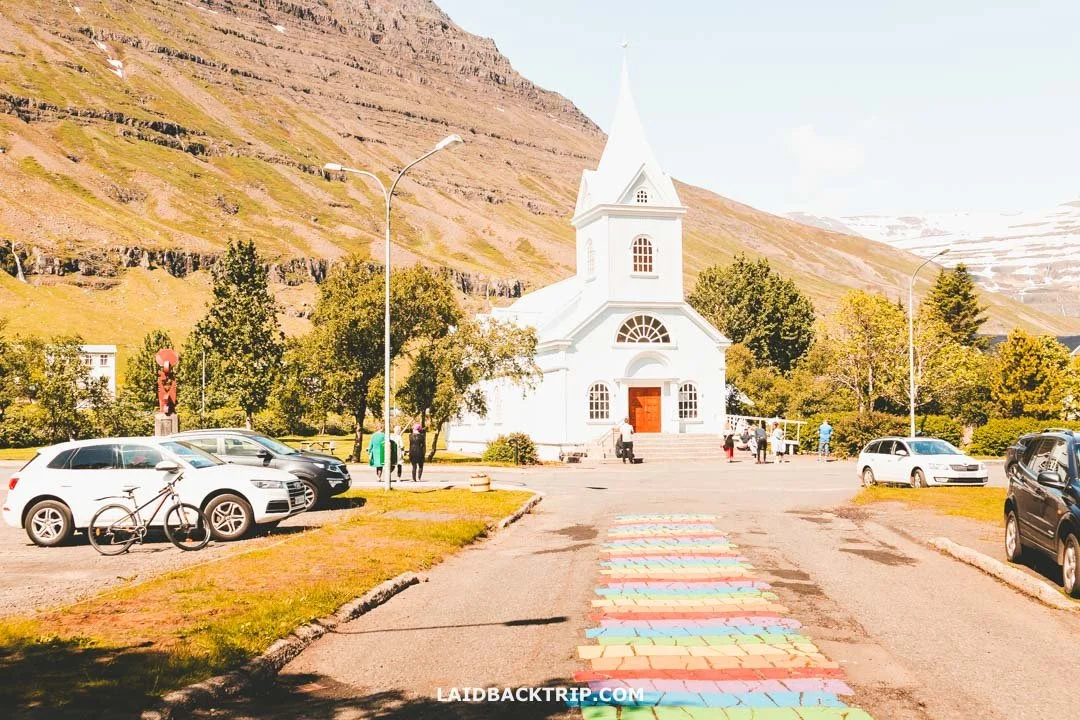
We parked our car in the small lot to the left of Seyðisfjörður's Blue Church.
We parked between the campground and the Blue Church on a small lot at these GPS coordinates: 65.26090, -14.01040, because it was right in the town center and fairly empty. About 20 meters farther was another parking area by the water, and we saw the next one by the ferry terminal and another next to the Herdubreid Arts & Community Center.
Best Things to See and Do in Seydisfjordur
As I mentioned earlier, Seydisfjordur was a remote fishing town at the end of the road, so we didn't expect there to be many things to do. Besides the scenic drive I already talked about, we figured we'd find colorful houses with traditional Icelandic architecture, all wrapped in a peaceful atmosphere with a fjord and snow‑capped mountains around us. And maybe a bit of tacky tourist stuff.
The town was small and easy to explore on foot (it was really just a small village than a town). So here's a closer look at what we did in Seydisfjordur.
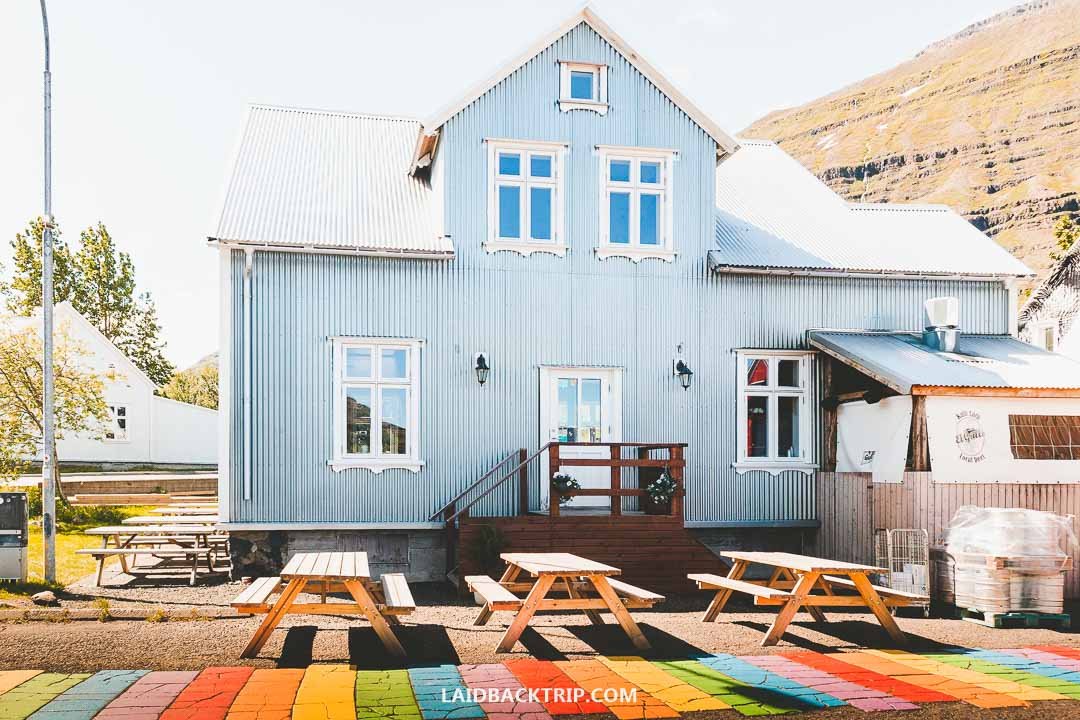
Seyðisfjörður practically had just one tourist street, and that was pretty much.
Visiting Seydisfjordur's Blue Church
Since we parked just a stone's throw from Seydisfjardarkirkja, starting there first felt like the obvious choice. We grabbed our daypack and headed out. Ten seconds later, we were already standing in front of the church. Lucie laughed and said, "Well, that wasn't much of a hike, was it?" We knew the town was small, but it was really that small.
The church was supposed to be open in summer, but when we visited, it was closed. We didn't expect anything grand like St. Peter's Basilica, but it was still a bit disappointing that we couldn't go inside.
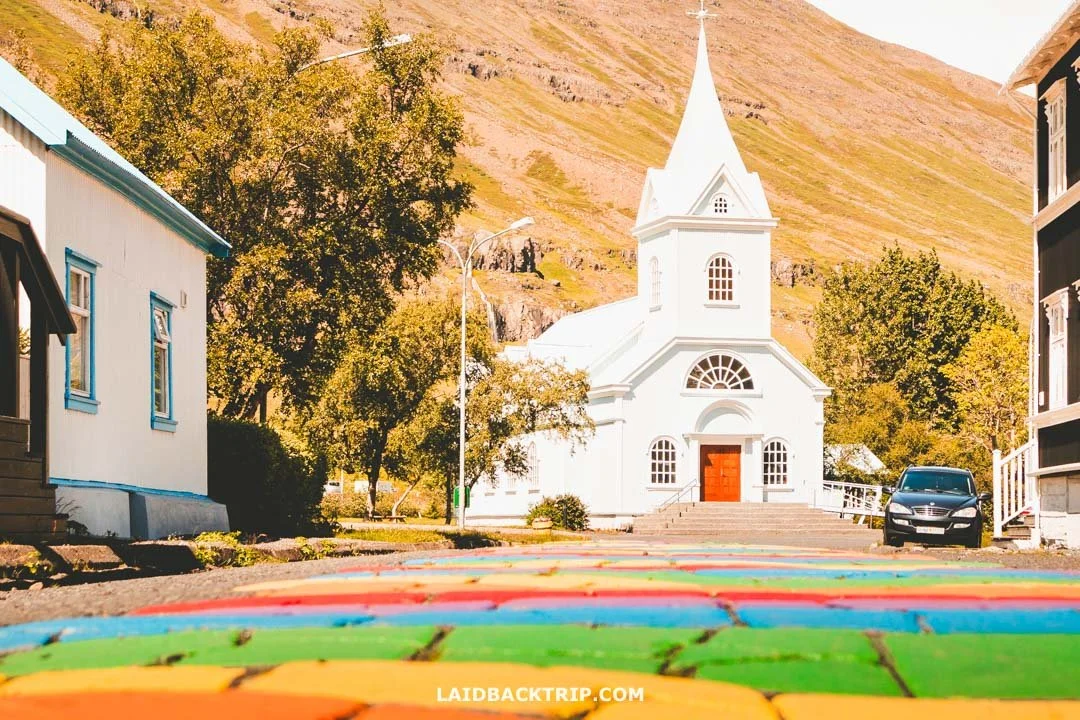
The Blue Church is Seyðisfjörður's most famous attraction.
With its pastel blue color, the Seydisfjordur Church has been one of Iceland's most recognizable landmarks for years, and ever since they added the rainbow walkway in front of it, it's become even more famous. The church itself was adorable, but its history was even more interesting.
It originally stood at Dvergasteinn farm (further down the fjord on Road 951) before being moved to Vestdalseyri (same road, but a bit closer to modern-day Seydisfjordur) at the end of the 19th century, where it stood on a hill until a major storm damaged it. It was then rebuilt lower down, where it stayed until 1920, when the entire structure was moved to Seydisfjordur.
Taking a Photo of Rainbow Walkway
From the church, we turned around and walked down Norðurgata with the already mentioned rainbow walk. This was the main tourist street in all of Seydisfjordur, but because there were no cruises in the town that day, it was fairly quiet.
Sure, Seydisfjordur wasn't the only place where we saw a rainbow street, since towns like Akureyri and Reykjavik had one too, but we found this one probably the most photogenic, especially with the blue church and steep rock walls in the backdrop. It was only about 100 meters long and very easy to explore.
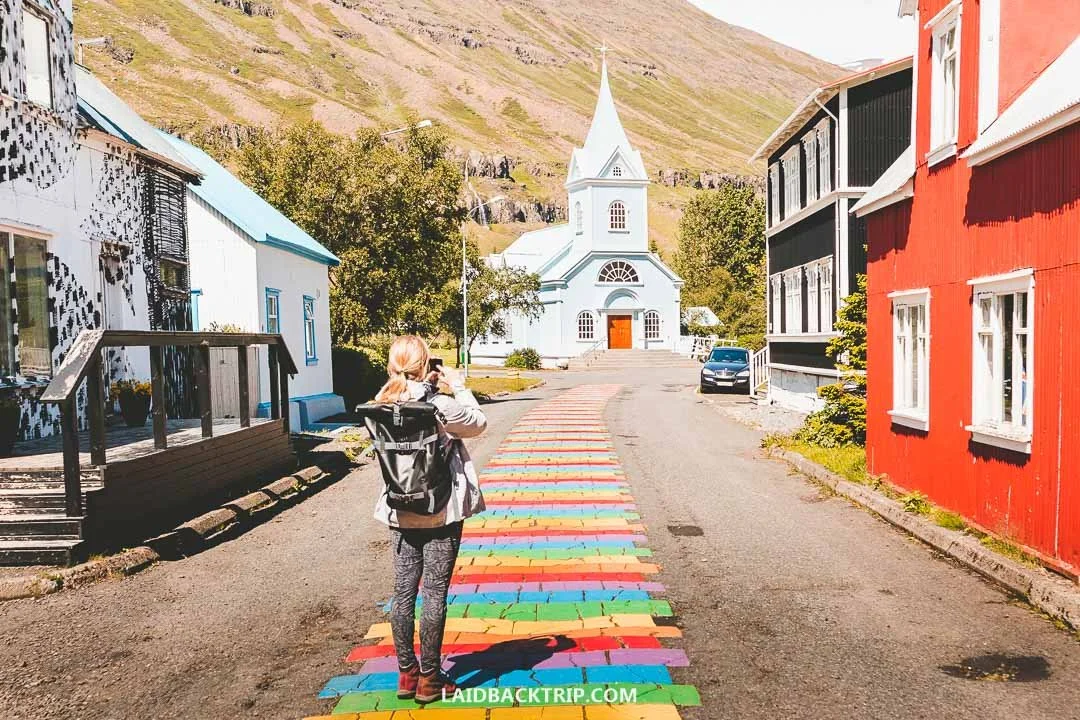
The rainbow walkway stretched along Seyðisfjörður's main tourist street.
Because this really was the main tourist street, it had a few places to eat or grab a coffee. We'd already had our lunch in a small parking lot just before the Faskrudsfjardargong road tunnel, so we didn't try any of the restaurants in Seydisfjordur.
Even if we'd arrived hungry, we would've just grabbed our own food and eaten it in some quiet spot with a fjord view. It wasn't that we didn't want to try the local food, but eating out was simply too expensive, not just here but throughout the whole country. Since food can take up a significant part of your Iceland budget, avoiding restaurants was one of the easiest ways to save money in Iceland and keep our overall expenses down.
As we walked through this narrow street, we also passed a couple of places with local arts and handicrafts. The town is known for that, and because of it, it's probably a good place to get an Icelandic souvenir for your family or friends. But for us, traveling on a shoestring and as light as possible, we skipped all the wool sweaters and pottery.
Despite being quite remote, Seydisfjordur is also one of Iceland's cultural centers, and the annual culture festival LungA used to take place here every July until it was canceled in 2024.
Exploring Seydisfjordur
Once we saw both main attractions in Seydisfjordur, we were ready to walk a bit more around the town. It was a quiet day with beautiful weather, so we could enjoy a really pleasant walk.
We headed toward the port along the shallow lagoon where the Fjardara river, after tumbling down from the mountains, finally met the sea. Around us were the colorful houses so typical for Iceland, making the whole scene even more picturesque.
In the old days of Iceland's settlement, it was Bjolfur who made his home in Seydisfjordur. But the modern history didn't start until the middle of the 19th century. Like the church, it was an interesting one. It began with Norwegian fishermen who set up a fishing post and rapidly developed with increasing herring fishing.
The town had an industrialized whaling station, the first telegraph cable connection between Iceland and Europe, a power plant, and even a base for Allied forces during World War II. With the decline of the fishing industry, the town now focuses on tourism.

We could only imagine how tough life must've been for the first people who settled in Seyðisfjörður back in the 19th century.
It was pretty incredible that such a tiny town, nowadays with only about 700 inhabitants, had such an interesting history. It was relatively warm, but once we stood by the sea, we could feel the cold wind blowing across the fjord.
Beyond a single fishing ship, a small reminder of the old days, the port was quiet, so we just focused on the scenery. My favorite part was that without the presence of big ships, Seydisfjordur still felt incredibly secluded.
The atmosphere in the town nestled between Mt. Bjolfur (1,085 m) to the west and Mt. Strandartindur (1,010 m) to the east was calm. Maybe a bit too calm. I wondered what it would be like to visit Seydisfjordur in winter. Coming here on one of those foggy, dark days with just a couple of hours of daylight would be a very different experience.
And when we looked above, we thought two things: that these mountains would be amazing for hiking, and at the same time, we saw the avalanche barriers silently protecting the town, reminding us that the steep sides presented a real danger, not just in winter, since landslides happen even outside the season.
Hiking in Seydisfjordur
The only thing we regretted during our two‑week trip around Iceland was that we didn't have enough time for hiking. As we looked at the high mountains around us, we wondered what it would be like to hike there. Seydisfjordur simply looked like a hiking paradise.
The Strandartindur side of the fjord had a few shorter trails, like the one to Tvisongur, a set of concrete bubbles that each resonate differently when the wind blows, paying tribute to Iceland's unique tradition of five‑tone harmony.
But that 2‑kilometer trail (one way) led mostly along Road 952 with a short climb to the modern installation. It was possible to climb a bit higher since the trail followed the hillside, but we simply didn't find it that interesting. And Strandartindur itself didn't have a trail that would take you to the top.
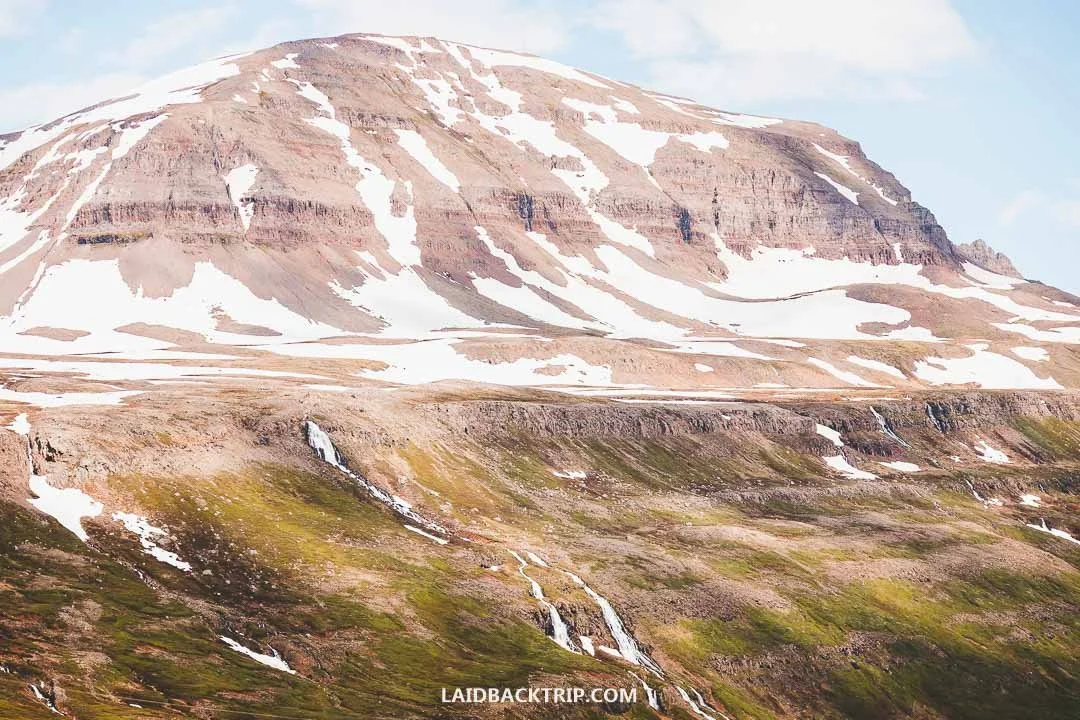
There was a trail on Mt. Bjólfur offering great views of the fjord, but we didn't have enough time to hike it.
A very similar situation was on Mt. Bjolfur, the mountain just across the fjord. The 1,085‑meter peak overlooking Seydisfjordur, with steep sides and avalanche hazards, had a path leading from the town along the avalanche barriers, but no trail that reached the summit. The only way to enjoy Mt. Bjolfur would be to drive back toward Fjardarheidi and turn right at these GPS coordinates (65.23447, -14.09619) onto a gravel road.
The issue was that the 5‑kilometer road was only for 4WD cars, which we didn't have, meaning we'd have to leave the car at the small parking lot right after the turnoff and walk the entire stretch. At the very end, there were more avalanche barriers and a viewing platform that should offer amazing views of the fjord, but we decided it wasn't worth a 10‑kilometer hike along a gravel road.
Waterfalls in Seydisfjordur's Town
There were a few more waterfalls around Seydisfjordur, some we could see along the way and some right from the town. A few, like Budararfoss, were right in town, while others, like Vestdalsfossar, were within walking or driving distance.
We briefly considered visiting Vestdalsfossar because it was only four kilometers outside the town, but eventually decided against it. We could've walked there along the gravel road (Road 951) leading to the trailhead, but that alone would've taken at least 90 minutes. And that was without walking to the waterfall(s).
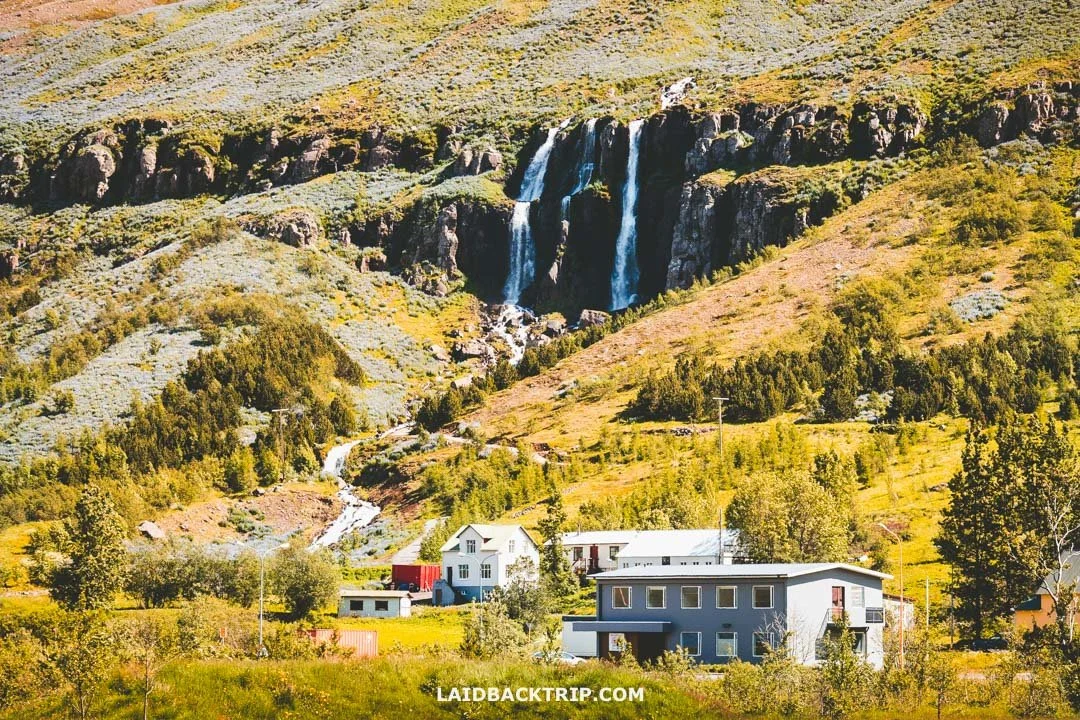
Búðareyrarfoss was right in the northeast corner of Seyðisfjörður.
We could've driven there, but again, we knew we'd be tempted to hike beyond Vestdalsfossar, just like we were on the Waterfall Way Trail, and that would've taken too much time. Plus, we still had to see Gufufoss, and after finishing the Seyðisfjörður area, we planned to hike to Hengifoss. And we simply couldn't see all of Iceland's waterfalls. So this time, we gave it a pass. But we do have a list of places we'd like to see on our next visit, if that ever happens.
Then there was the trail to Gufufoss from Seydisfjordur, but for us it made more sense to visit by car. This trail would most likely make sense for cruisers, since it's a nice 4‑kilometer one‑way walk along the Fjardara river, or a 3.5‑kilometer bike ride thanks to the new cycling path built there.
Gufufoss Waterfall
Once we started descending to Seydisfjordur, we drove through a few sharp hairpins. After passing them, we knew Gufufoss Waterfall should be somewhere on our right. We thought the view from the car would be enough, but when we saw it, we made a spontaneous decision to pull over.
There was just a tiny pull‑off, and it took me a second longer to process that new information, so by the time it clicked, it was too late and I missed the parking. It wasn't the end of the world, though, because we knew we'd be coming back via the same road. And this time, we knew exactly where it was.
We'd been in Iceland for a few days already, and each day we saw a stunning waterfall. Whether it was mighty Gullfoss or famous Seljalandsfoss, they were all incredible.
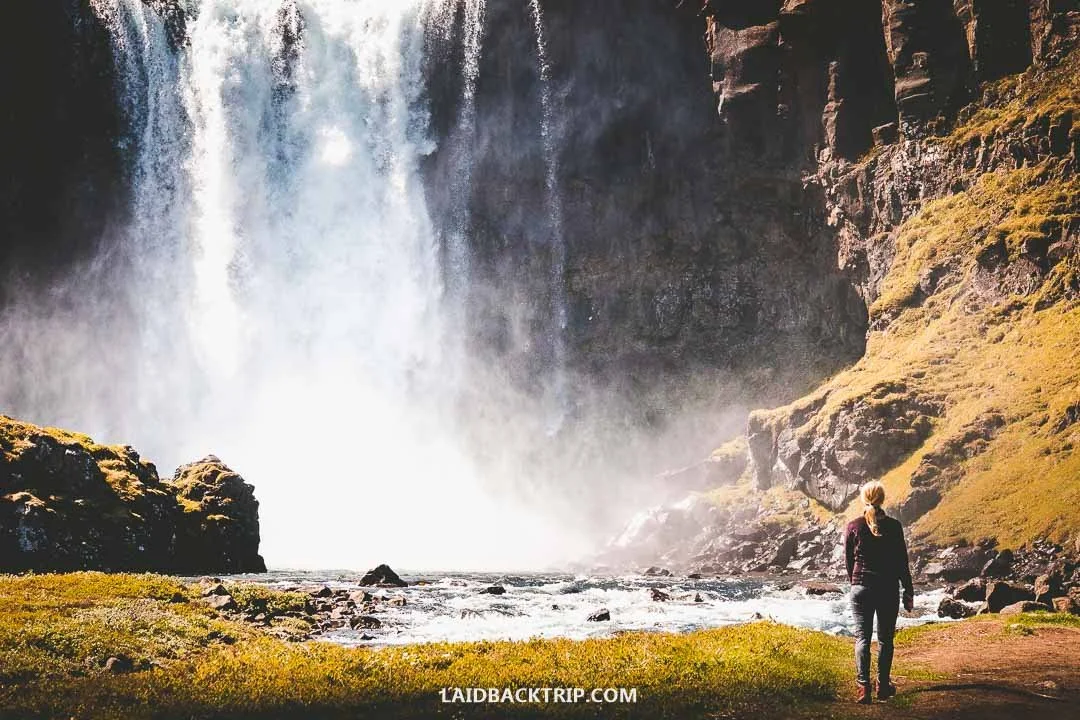
Gufufoss was our favorite waterfall in the Seyðisfjörður area.
Gufufoss was one of the lesser‑known waterfalls (like Bruarfoss or Kvernufoss), so we had no idea whether it would be worth a stop, but as I said, one look was enough to convince us. We just had to wait until we were done with Seydisfjordur. And once we were, we were ready to see Gufufoss up close.
After leaving the town behind, we drove to Gufufoss and easily parked this time. From there, it was just about two minutes to the end of the trail, where we got the most beautiful views of the waterfall. We kept our rain jackets in the car, which was a bold move since "gufa" means steam. But because we didn't get that close to the waterfall, and this wasn't Dynjandi, we were fine without rain gear.
From that viewpoint, the waterfall was stunning, as were the views down the valley with the Fjarðará river and the whole fjord. Because Seydisfjordur sits in a glacial valley, when it rains, many new waterfalls appear and flow down its steep walls. We didn't get to see that since we were there on a sunny day, but it could've been another reason to visit even if the weather wasn't on our side.
Tours from Seydisfjordur
As we were wandering around Seydisfjordur, I asked Lucie what we would've wanted to see and do if we'd arrived on one of the cruises instead of by car. If it had been just a short stop on a longer journey, she said we'd probably have gone to see the same things we saw ourselves. And because the drive along Road 93 was so incredibly scenic, she'd want us to take a puffins tour just to experience that road.
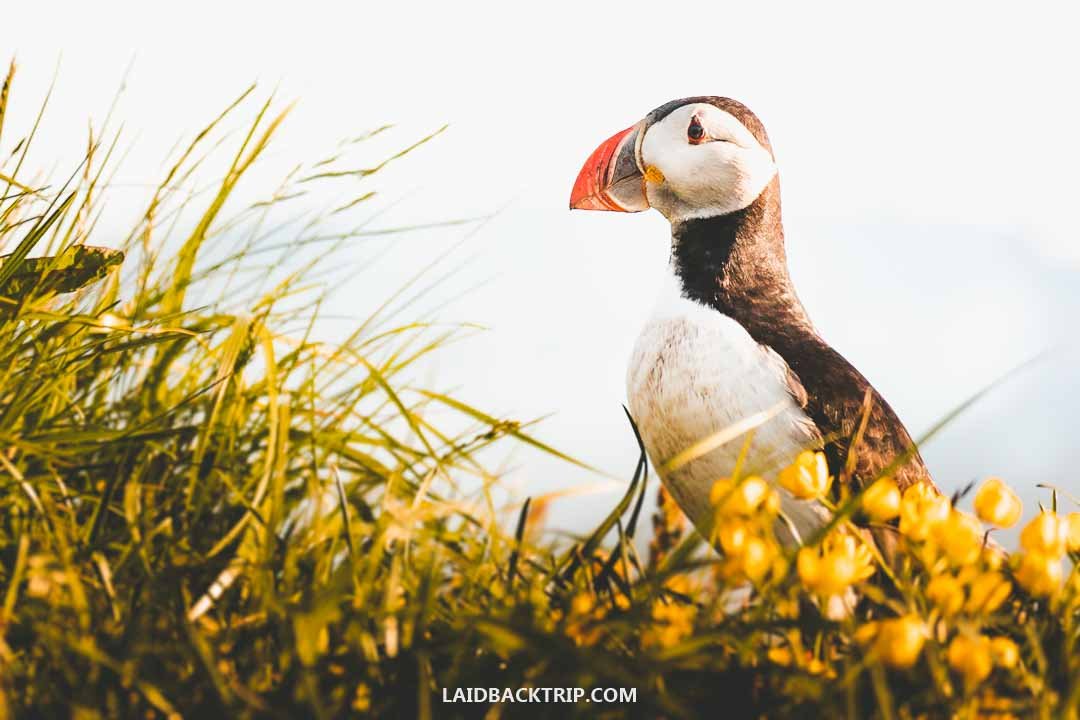
Puffin watching is one of the most popular trips for cruisers coming to Seyðisfjörður.
We argued a bit about whether it would be better to see puffins or Studlagil, that canyon with basalt columns, but that really depended on what we'd already seen before coming here. I was thinking about staying within Seydisfjordur and exploring the fjord a bit more, but in the end, no matter what we'd choose, I think we'd enjoy this place.
Where to Stay in Seydisfjordur
As we were heading back to our car, we kind of wished we could stay in Seydisfjordur overnight. The weather was great, the town was as quiet as it could be, and there were still some trails with waterfalls to explore. Not to mention that the sunset must've been gorgeous in Seydisfjordur that day.
But it was still just afternoon, and with such great weather, we wanted to see some other places we had in our itinerary. Plus, this trip was already beyond our main plans, and we didn't want to fall too far behind schedule. A small consolation was that we eventually spent a beautiful evening in Borgarfjordur eystri, though the fjords there were a bit more open.
We stayed mostly in campgrounds in Iceland, and the cool part about Seydisfjordur being a tiny town was that its campground sat right beside the Blue Church and just a short walk from the sea. It didn't look that big, but that probably becomes an issue only on peak summer days. It had hot showers, a shared kitchen, basically everything a proper campground should have, not like the one we stayed before our Blue Lagoon visit.
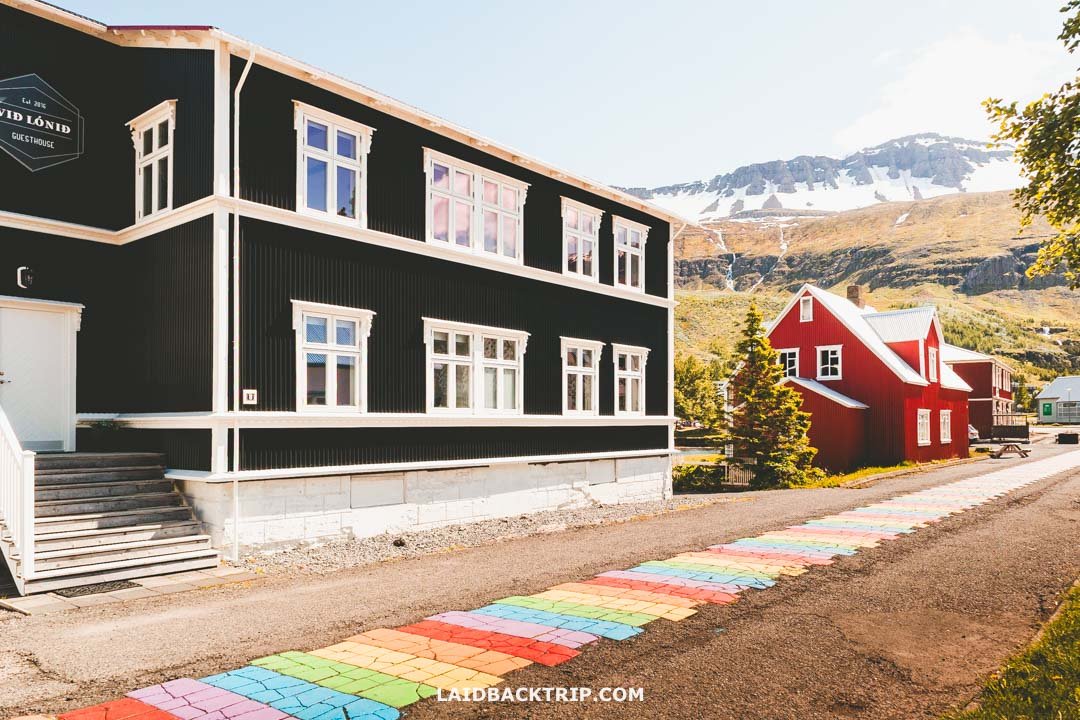
One of the guesthouses that was located right in Seyðisfjörður's center.
Another thing we noticed was that despite Seyðisfjörður often getting busy and crowded during the day, it didn't have any big hotels. I guess day‑trippers visit the town as we did, and cruise passengers just stay on their ships.
On our walk through town, we passed a couple of hotels, Snaefell and Bankinn, and among the cheaper options there were a couple of hostels, one in a harbor building and the other in an old hospital. There were also some guesthouses like Media Luna and Vid Lonid, but that was about it.
Since we didn't stay overnight, we also avoided the high accommodation prices Seyðisfjörður had during this period, though to be fair, we would've been camping anyway.
When to Visit Seydisfjordur
We arrived in Seydisfjordur in summer, and since we lucked out with the weather, the whole experience was as simple as it could be. Road 93 was easily passable and, more importantly, free of snow and ice.
Our next stop was Gufufoss, which was quite powerful at this time of year. And the town itself was a joy to explore on a relatively windless, sunny day. We arrived around noon, with the sun high above the fjord, making the whole place feel incredibly welcoming.
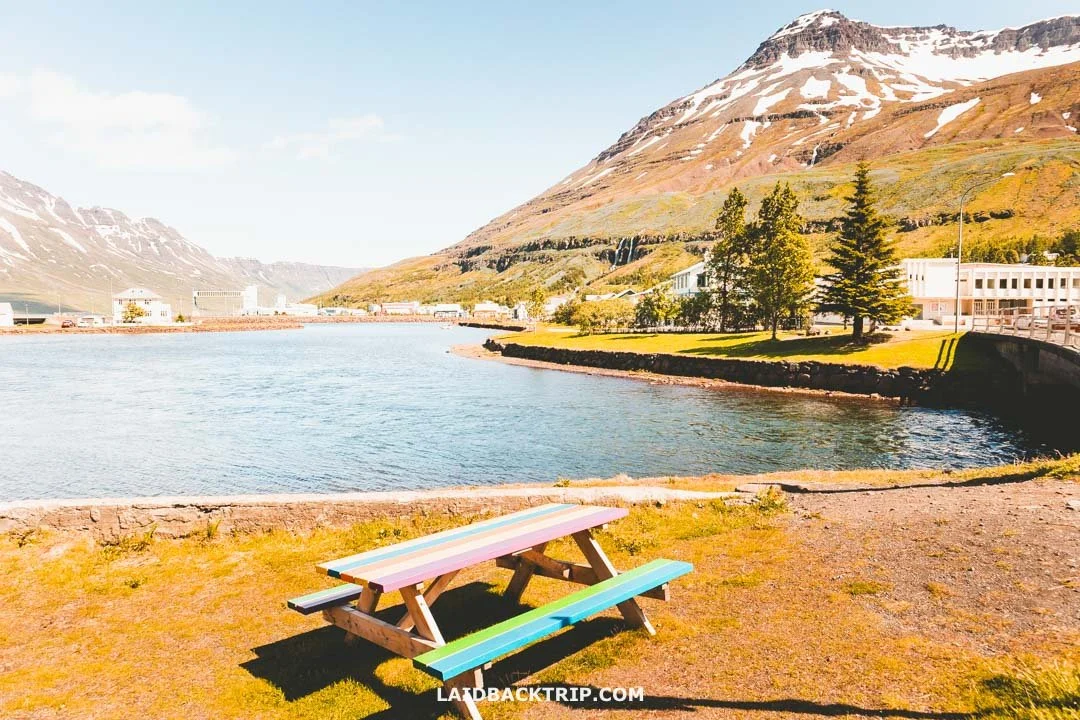
We couldn't have asked for better weather for our Seyðisfjörður visit.
While all of that was true, Seydisfjordur is one of Iceland's port towns popular with cruises (for instance, another one is Isafjordur). When we were there, no cruise ship was docked, and since it was the beginning of the tourist season, the town was still surprisingly quiet.
I have to admit that we checked the Ports of Mulathing schedule to see if any big ships were coming. Luckily, none were. And since the port has become significantly busier since our visit, it's something we'd definitely check again if we ever return.
Even though we would've been tempted to see the town either way, I think knowing what to expect helps set the right expectations. The funny paradox we noticed in Seydisfjordur was that on a quiet day like ours, the town felt like a tranquil oasis in a hectic world, the kind of place that's rare to find these days.
It looked like time had stopped there. But had we arrived while a cruise ship was docked, it would've been the complete opposite. The hectic world would've come right into the fjord.
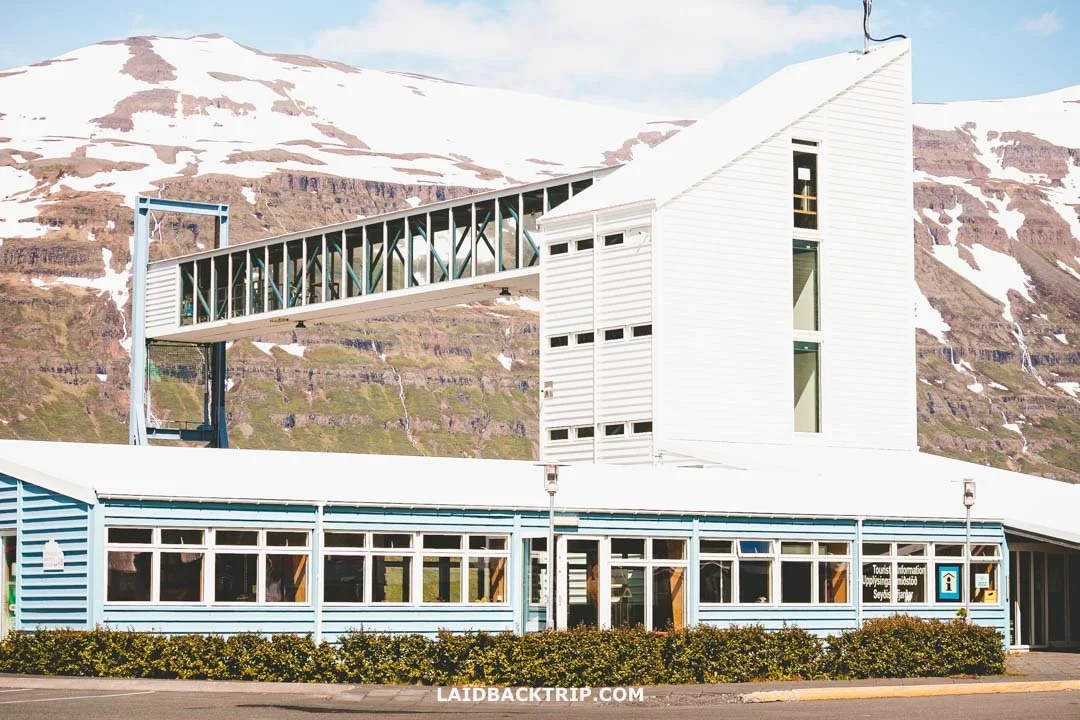
With no cruise ship docked, the port terminal was just as quiet as the rest of Seyðisfjörður.
While it's true that Seydisfjordur can be visited any time of year, I could clearly see that getting there would be more challenging outside summer. Even in summer, I can imagine that driving on a foggy, rainy day like the one we had on the coast the previous day would've made the journey through the mountains not that easy.
Because summer was just beginning, we drove a small 2WD campervan rental, but outside this season, we'd definitely go for a 4WD. To be fair, we'd do that not just for Seydisfjordur but for driving around Iceland in general. On this road, I guess that in winter, snow chains should be in the boot, because the road could be potentially dangerous when conditions get icy (and can be closed).
How Much Time to Set Aside for Seydisfjordur
Because we made several stops along the way, it took us a bit over an hour to reach Seydisfjordur instead of the 30 minutes our GPS promised. Once we arrived, we spent about 45 minutes exploring the town, another 20 minutes at Gufufoss, and roughly 45 minutes driving back to Egilsstadir (with a few scenic stops again).

It didn't take much time to explore Seyðisfjörður, since the town was super tiny.
Altogether, the trip to Seydisfjordur took us around three hours. We didn't rush, but if we'd had more time, I think we could've easily spent another hour or two there. We'd probably have checked out Vestdalsfossar, though the viewpoint on Mt. Bjolfur looked just as tempting.
Is Seydisfjordur Worth Visiting?
At first, we weren't sure whether it was worth visiting Seydisfjordur because we came mainly to Iceland to see the scenery, and these little "charming" towns were further down our list. So as we were driving back to Egilsstadir and had to cross the Fjardarheidi mountain pass once again, we had time to reflect on the whole trip. Obviously, the drive was incredible, and we thought Seydisfjordur was worth seeing just because of it.
I already said this was one of our favorite scenic drives in all of Iceland, but at the same time, I need to add that the weather was great. Had it been like the day we hiked in Skaftafell, when everything was covered in fog and battered by rain, I don't think our experience would've been so positive.
But for us, the weather wouldn't be the main issue when deciding whether to visit Seydisfjordur. I could argue that bad weather would add a lot of atmosphere to the mountain road, the waterfalls, and the whole fjord.
The bigger issue was the question of cruise ships, which we'd probably consider even more important when deciding whether to give the town a chance or skip it. I remember when we were in Rio de Janeiro, and one of those behemoths arrived, releasing thousands of tourists into the city.
But Rio was huge, with millions of inhabitants, while Seyðisfjörður was still just a tiny town of 700. And I can only imagine how different, and probably not in a positive way, the town would've felt had we arrived at the same time as one of the cruises.
Lastly, I need to add that Seydisfjordur was simply a detour off the Ring Road. We had just two weeks in Iceland, and all these side trips, while incredibly beautiful, were also really time-consuming, so we had to be picky about them. And unlike Snaefellsnes, where we drove around the peninsula until we joined the Ring Road again, this time we had to drive the same way back.
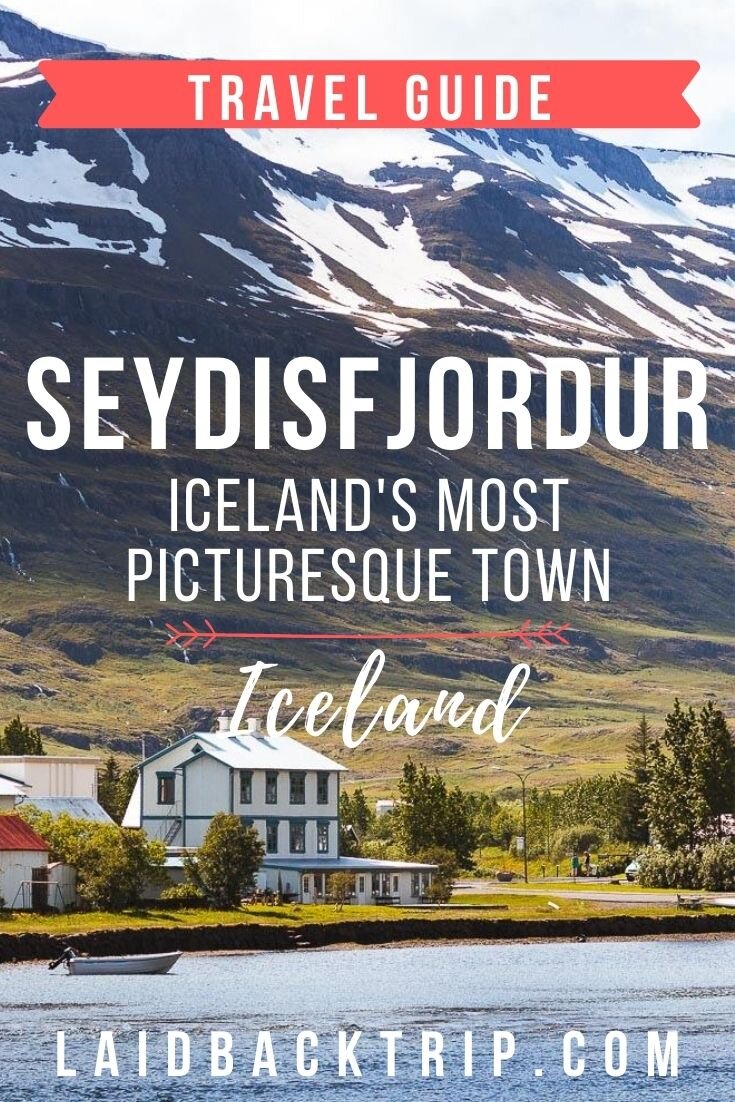
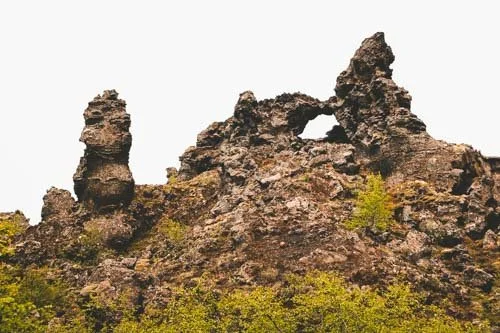

Discover Grjotagja, a tiny lava cave hiding a geothermal pool and the filming location of Jon and Ygritte's famous Game of Thrones scene.