Today, we'll take you on a guided walk through Vyšehrad, one of our absolute favorite places in all of Prague!
It does not happen to us often that we write about a place we know so well, a place that is so close to where we live, a place we love visiting in our free time, a place we know like locals, not tourists. It is surprisingly rare that we share tips on a destination we are so deeply attached to, a destination we know by heart, and yet one that still keeps a few secrets we have not uncovered. This guide on Vyšehrad will definitely be one of those places and one of those times.
We do not know how it happened, but in the past few years, we moved a few times within Prague, and we always ended up living near Vysehrad. Even now, after returning from our another long‑term travels, we can walk there in about twenty minutes, which means it is our go‑to place when we do not plan on doing anything in particular, when we simply want to go out and see some greenery, and we often go there jogging before or after work.
We are not saying Vysehrad is some hidden spot that only we locals know about. It is definitely not, now more than ever. But even though we meet a lot of people here, including many foreign visitors on warm days, it will still never be as many as you would see in the historic center.
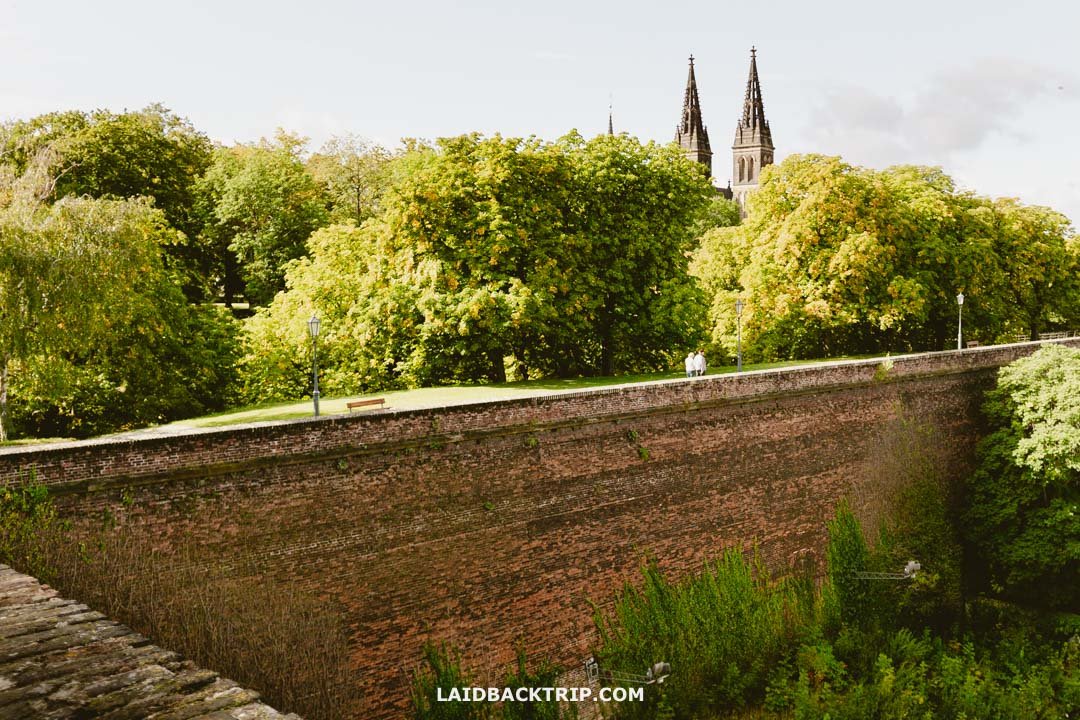
While Vyšehrad used to be an impenetrable fortress, today it's basically a beautiful park we use to escape the city for a bit.
Speaking of history, Vysehrad is full of it, as it was one of the first settlements in Prague. It is also full of legends and has a deep connection to our national history. It still has the old fortifications, beautiful sculptures, the Basilica of St. Peter and St. Paul, amazing views over Prague, the most famous cemetery in the Czech Republic, and a green park with charming walking paths.
Both Lucie and I think that Vysehrad is one of Prague's must-sees. There's absolutely no debate about that, no matter if you want to spend three days in Prague or just a single day. Yes, we love this place so much that I even managed to fit it into our 1-day Prague itinerary which works great for those who have only a little time to explore the city.
It really says quite a lot about how much I like this place, because that is really not a common thing to do with such limited time. While it is technically a bit farther from the historic center, it is still super easy to reach. And as you have probably already guessed, it is absolutely gorgeous in every season.
Legends of Vysehrad
Czechia is sometimes nicknamed the land of stories, and it is really because of places like Vysehrad. And since it explains a lot about this place, it is why I want to start with it. An old legend says that it was the mythical ruler Krok who founded Vysehrad in the 7th century as he was seeking a better place to live, but so far, it is mostly just a legend.
Another one says that his daughter, Libuse, from this very place, prophesied the glory of the future city of Prague. She said, "I see a great city whose glory will touch the stars," and ordered a castle built on that site. She was right on the money, if she ever existed. This is not the last myth tied to Vysehrad, of course. There are also tales about Bivoj, who caught a wild boar and married Kazi (the sister of Libuse), and Premysl, a farmer who married Libuse and started the Premyslid dynasty.
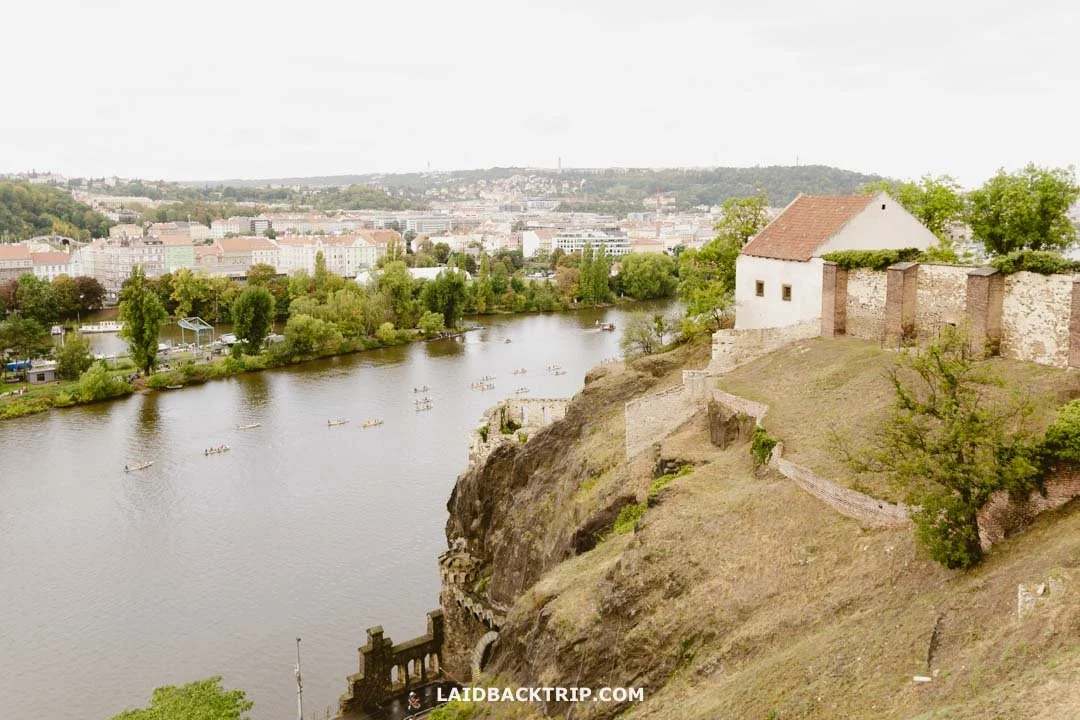
Here are the ruins of Libuše's Bath, plus the place where Šemík supposedly jumped over the walls.
Another popular Czech legend tells the heroic story of Horymir and his faithful horse, Semik. Sentenced to death at Vysehrad for opposing Prince Kresomysl's mining plans over farming, Horymir's final wish was a last ride, during which Semik leaped over the castle's high ramparts, plunging into the Vltava River to save his master. Although Kresomysl eventually pardoned Horymir, the leap mortally wounded Semik, who is still honored today for his loyalty and courage. The whole escape must have been really cool (the jump, not the death), though some pessimists say that Horymír might not have even existed.
History of Vysehrad
Nowadays, the evidence shows that it was not Vysehrad but Prague Castle that is actually the oldest place in Prague, as it was built around 870 CE. The historic fort of Vyšehrad (which means Upper Castle in English) was built on a hill above the Vltava River in the 10th century, making it one of the first settlements in this area.
A century later, Vratislaus II of Bohemia, the first Czech king, made Vysehrad his seat as he built a Romanesque castle here. He founded a chapter and had the Capitular Church of St. Peter and St. Paul built for it, along with the Basilica of St. Lawrence and the Romanesque cemetery Rotunda of St. Martin, which still stands today.
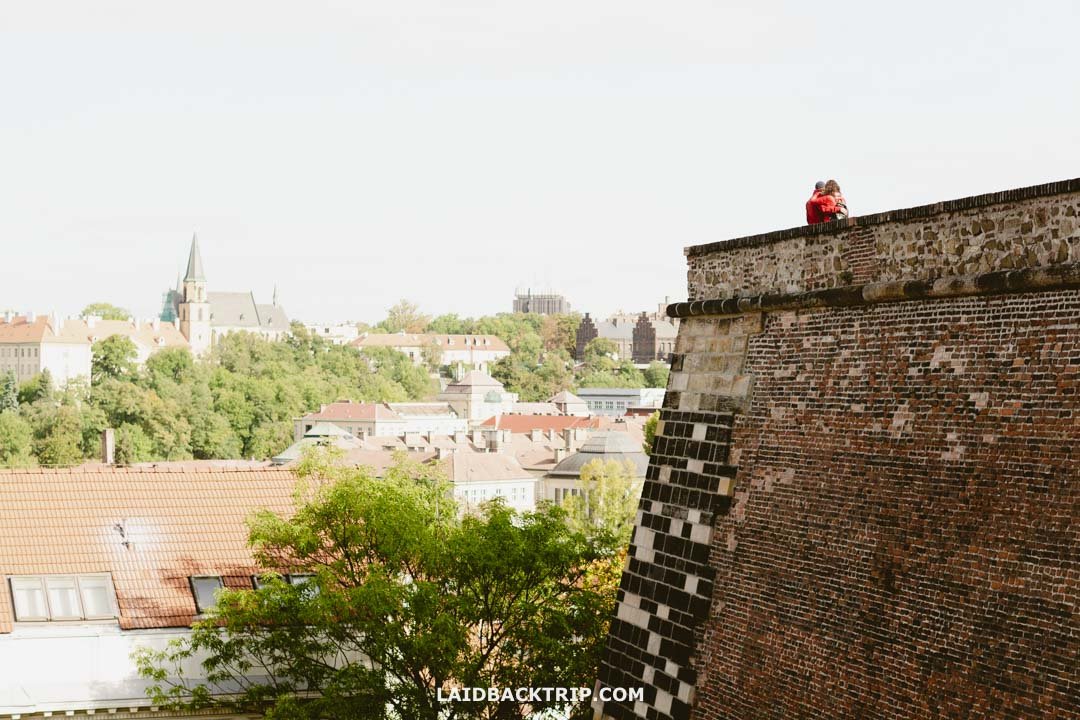
Vyšehrad's history is a mix of myth, medieval power, and centuries of dramatic fortification that shaped the hill into what it is today.
It remained that way until 1170, when Vladislaus II moved the center of power to Prague Castle. Vysehrad's significance declined, and it was not until our most famous ruler, Charles IV, decided to renew the fortifications, build a castle, and restore the church in the 14th century that it regained its importance. This lasted until 1420, when the Hussites besieged Vyšehrad and, after defeating the Crusader armies, reduced the site to ruins.
In the following years, Vysehrad turned into a small town settled by poor craftsmen and did not regain its importance until the mid‑17th century, when the local community was moved, and the whole place was rebuilt into a Baroque fortress by Habsburgs, forming part of Prague's fortification system.
In the 19th century, the fortress was decommissioned, Vysehrad became part of Prague, and the entire area became the property of the Chapter. The Vysehrad Cemetery became a national burial ground, and the Capitular and Parish Church of St. Peter and St. Paul was rebuilt in the Neo‑Gothic style (with the facade and towers added at the beginning of the 20th century).
How to Get to Vysehrad
Vysehrad is about 2.5 kilometers south of Prague's historic center, whether you start at Charles Bridge or Wenceslaus Square. Getting to Vysehrad is really easy, no matter whether you walk or take public transport (mostly tram or metro, though there is also a bus).

To reach Vyšehrad, take the Metro C line and then a short five-minute walk.
But since the fortress has three main entrances (though technically it is just two outer gates because of the fortress's layout, as I will explain in a second) and a few smaller gates, and all of them are closely tied to how you actually get there, I think I will start with that first to avoid any confusion and to help explain my suggested route of visit. I would also add that we like to enter Vysehrad through one gate and leave through another, which we would recommend to you as well.
Tábor Gate (Best for Metro C Line)
Located on the east side, Tabor Gate (Táborská brána) is typically the first gate you encounter when arriving from the Pankrác and Nusle districts, and it is the one we use to enter Vysehrad almost every time we go there, as it is simply the closest to where we live. It was built around 1655 and served as the first line of defense for the Baroque fortress, so it features a simple, sturdy design with two stories and a central passage that leads you into the inner area.
If it were up to me, I would personally use this gate to enter Vysehrad, no matter how I got there. I know that those arriving from the Vltava waterfront might not think it is a good idea, because if you look at the map, you will see it adds an extra 1.2 kilometers, and I understand that. But this is Vysehrad's main entrance, and if you are not careful, there is a chance you might miss this area completely.
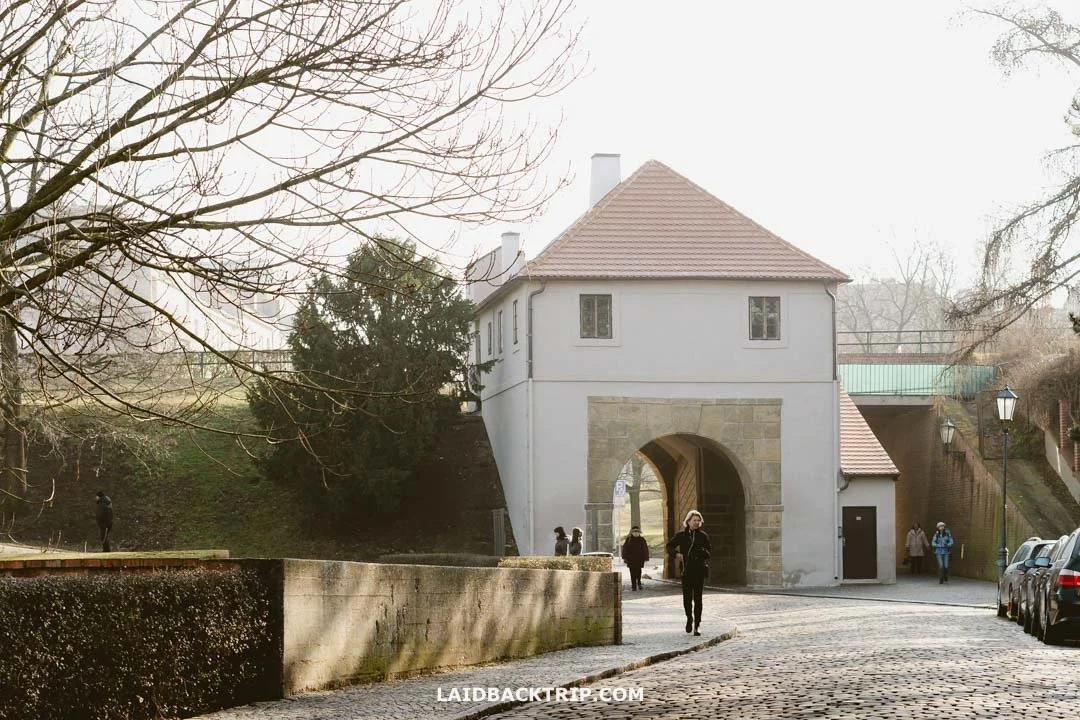
Tábor Gate serves as the main entrance to Vyšehrad.
Tábor Gate is about 500 meters from Vysehrad metro station (C Line Red). Once you get off the metro, you will see the large Prague Congress Center in front of you on your left, and the tall Prague Towers Hotel behind you. You should also notice a small brownish sign saying Vysehrad in front of you. Follow the arrow and walk straight for about 500 meters until you reach Tabor Gate.
Roughly the same distance away is Ostrcilovo namesti, which is easily reached by tram. From this square, use the small underpass to Lumirova Street, then follow the street all the way up. Tabor Gate will be about 100 meters farther on your right.
Or, as I said, it is about a 15‑minute walk from Vyton, which is a tram stop on the waterfront. You would take Vnislavova Street all the way until it ends, then turn right onto Lumirova Street and walk up the same way we described a moment ago. There is also a bus stop (Vysehrad) about 500 meters down Na Pankraci Street, but I do not think many tourists will choose that option.
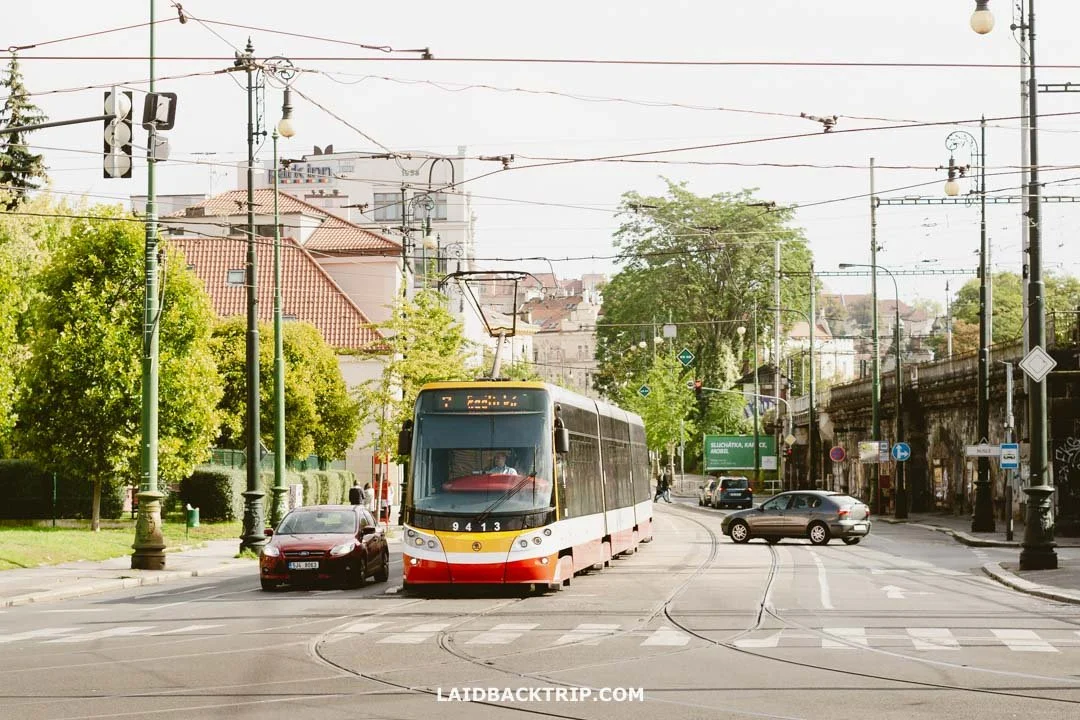
Výtoň is really well connected to the historic center by tram.
Leopold Gate
Leopold Gate (Leopoldova brána) marks the entrance into the inner fortress area and is often considered the most beautiful. The important part is that it is technically inside the complex. So if you choose to enter Vysehrad through Tabor Gate as I suggested, you will also pass through Leopold Gate after about 250 meters.
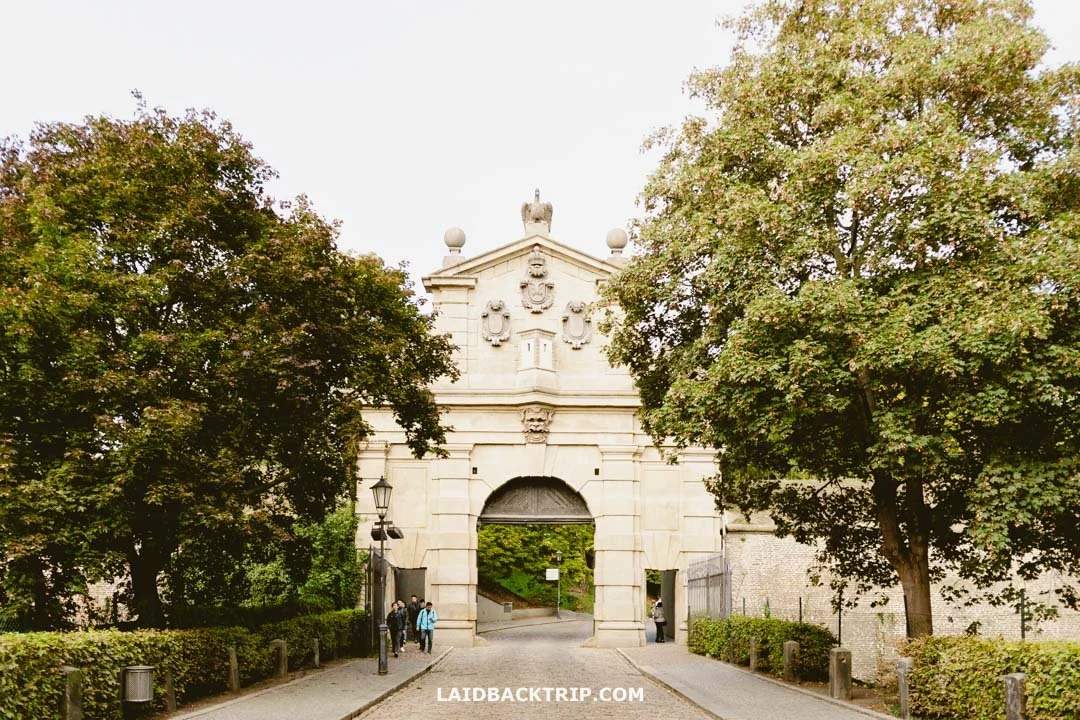
Leopold Gate is the inner gate you come to once you've walked through Tábor Gate.
When I said earlier that there are really just two entrances, now you know why. This gate was built between 1670 and 1672 by the architect Carlo Lurago and is a prime example of Baroque military architecture, decorated with pilasters and a pediment featuring a coat of arms.
Brick Gate (Best for Trams to Vyton and Albertov)
Located on the north side is Brick Gate (Cihelná brána), the last of the main gates. Built in 1841 under the direction of Karel Chlum, this gate is designed in an Empire (Neo‑Classical) style. It currently houses an exhibition on the history of the Vysehrad fortress and serves as the entrance to the casemates and Gorlice, a big underground hall containing several of the original Baroque statues from Charles Bridge.
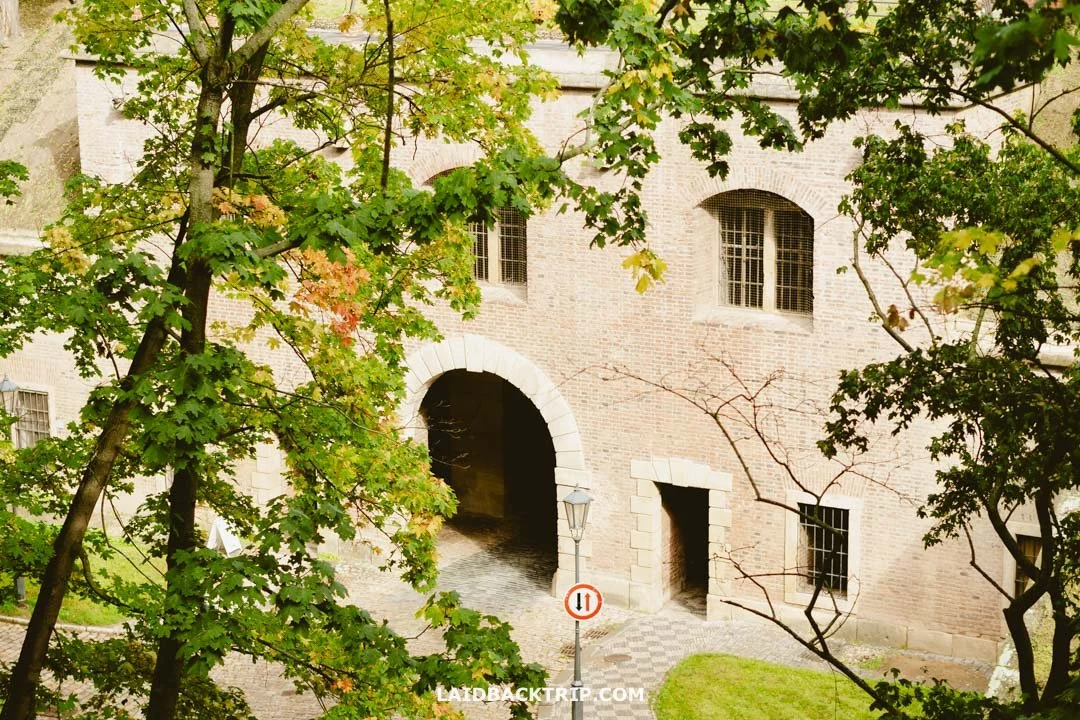
Brick Gate is the other entrance to Vyšehrad, but for us it's the less convenient one, so we don't use it as often.
Brick Gate is easily reached by walking from Vyton or Albertov, both of which are well connected by trams (lines 3, 17, 24, etc.). Vyton is about 500 meters from the gate, while Albertov is slightly closer. No matter which route you choose, the walk to this gate via Vratislavova Street (or partly Premyslova) is uphill (nothing too strenuous, though).
We usually enter Vysehrad through Brick Gate only during our runs, but it works perfectly well even if you come here for sightseeing. While I said earlier that I prefer Tabor Gate, I have to admit that using Brick Gate and then leaving through a small unmarked gate I will mention in a moment probably makes slightly more sense, at least for those coming from the waterfront.
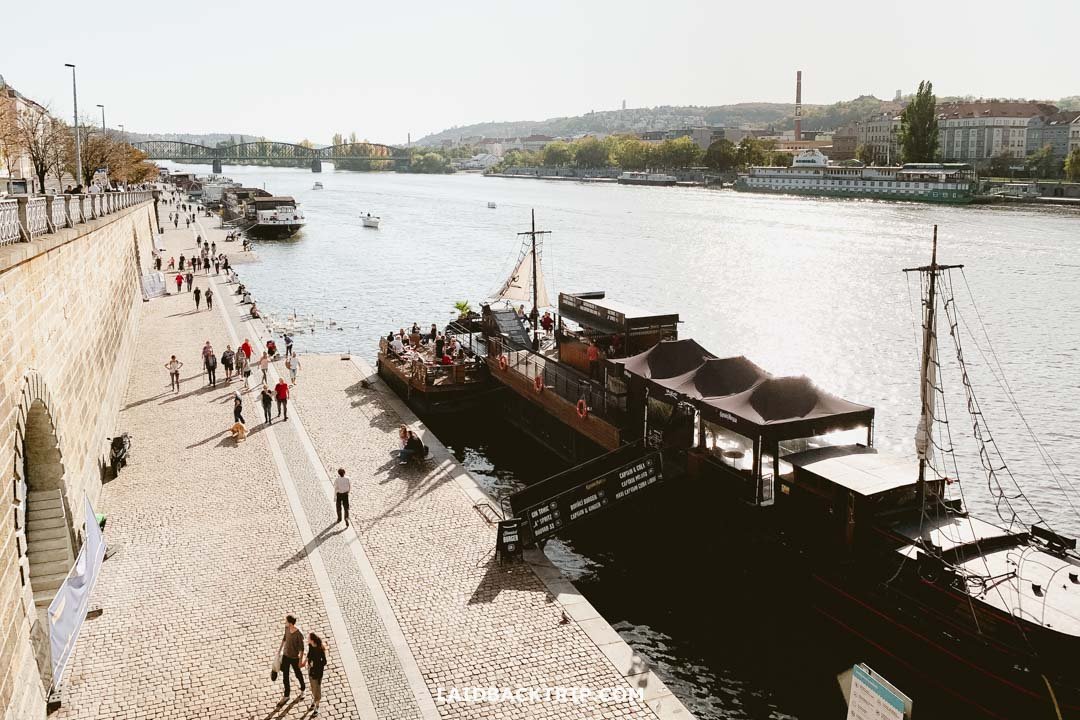
Walking to Vyšehrad from the city center along the Vltava is really worth it.
Since we love the whole riverside walk from the city center to Vyton, we do recommend covering the 2.5‑kilometer stretch on foot, as it is really scenic. The buildings along the waterfront are beautiful, as are the views of the Vltava, and you get to see some Prague must‑sees like the National Theater and Dancing House.
Stairs from the Vltava River (Best for Tram to Vyton or Riverside Walk)
Besides the main gates, Vyšehrad also has a sort of hidden entry point on its western side. These days, it is quite popular because it allows you to get from the waterfront directly to the basilica and cemetery, which is very convenient. The stairs to this gate start at these GPS coordinates: 50.06604, 14.41608, and after a short climb, you will appear here: 50.06487, 14.41679. This entrance is best reached from Vyton, as the stairs are only 200 meters from both the tram stop and the waterfront.
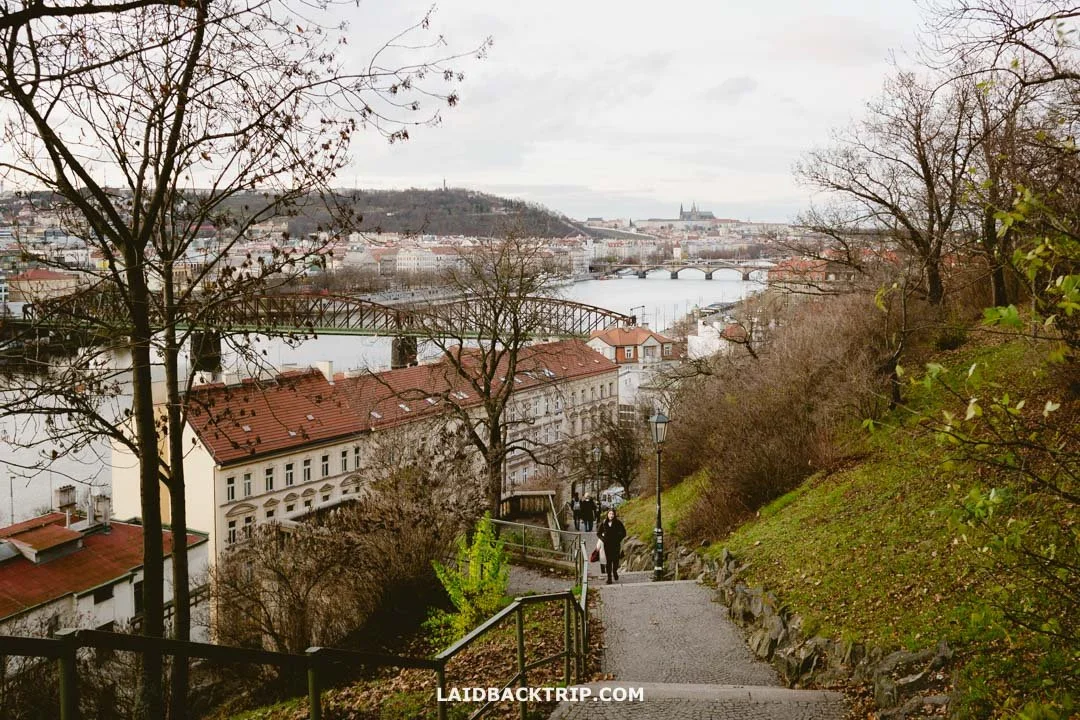
These are the stairs we usually take when we're walking from Vyšehrad to the riverfront.
As I said, it does not make sense for us to use this entrance given its farther location, but as I mentioned earlier when talking about entering through Brick Gate, this is the gate I would use on the way out. I have to admit that we sometimes do that ourselves when we want to continue from Vysehrad to the waterfront.
This entrance can also be reached from Vratislavova, as the whole northwestern hillside outside the fortress has walking paths, but unless you have been to Vyšehrad a few times, I do not see a point in going there from this street.
Pedestrian Tunnel between Nusle and Podoli
There is also a tunnel that connects Nusle with Podoli via Lumirova Street and U Podolskeho sanatoria Street, with stairs that take you to just a few steps past Tabor Gate, but unless you really like short tunnels, there is no real reason to use that entrance, at least if you are a first‑time visitor. Letni scena Vysehrad also has a gate, but that one is normally closed.
No Entry Fee to Vysehrad
One of my favorite things about Vysehrad is that it is free to explore. As a local, I always appreciate having such a beautiful spot that I can visit whenever I want, not only because I like it, but also because I do not have to worry about entry fees. I hope it stays that way in the future, because while I understand that it is a major tourist attraction today, for both of us, it's still mainly a public park, which we visit frequently in our free time.
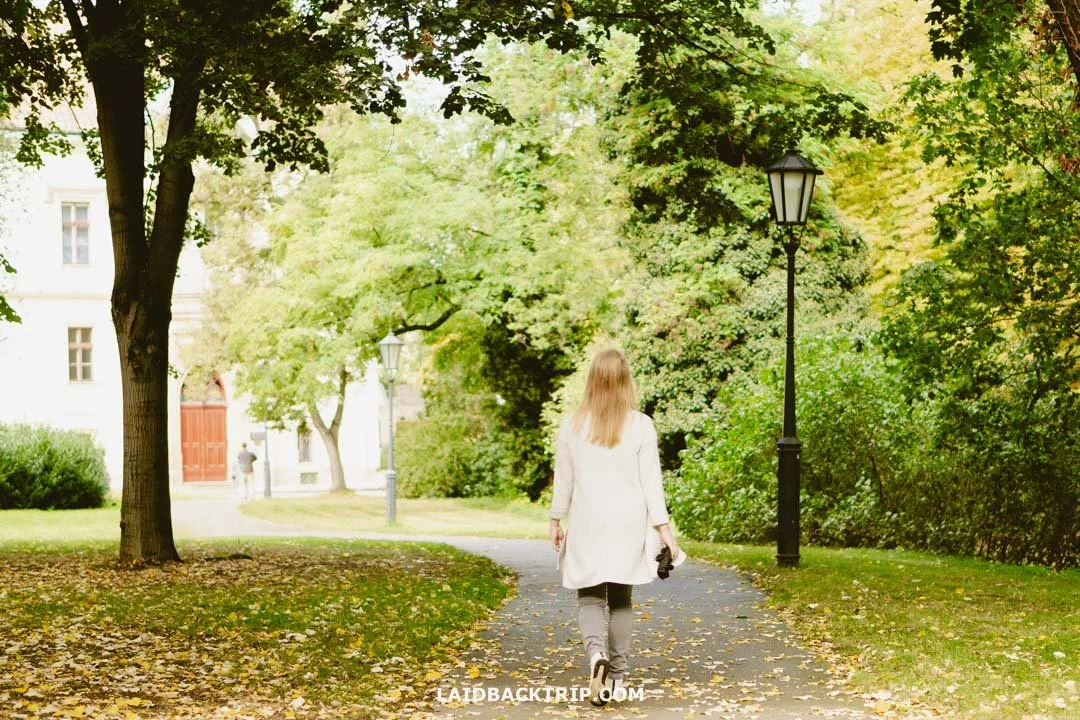
Vyšehrad is free to visit, and honestly, that's a big part of why we come here so often.
Vysehrad works in a similar way to the Prague Castle complex, where the grounds are free to walk around, while some sites require a ticket. And Vysehrad is the same. You can walk around Vysehrad's grounds as much as you like, but if you want to see the basilica or the casemates, you need to buy a ticket.
I know from our previous travels to places like Rome and Paris that entry fees take up a big part of our budget, and finding these entrance‑free sights in otherwise expensive European cities is always something we really appreciate. And while the sites with an entry fee are a nice addition to the whole Vysehrad experience, it is entirely up to you whether you want to go inside or not. If not, here are more ideas on Prague's free attractions.
Vysehrad is Open All Day
Another thing I love about Vysehrad is that since it's technically a public park, it's accessible 24/7. That's why we come whenever we want, whether it is for an early morning run, an afternoon stroll, or to catch a sunset.
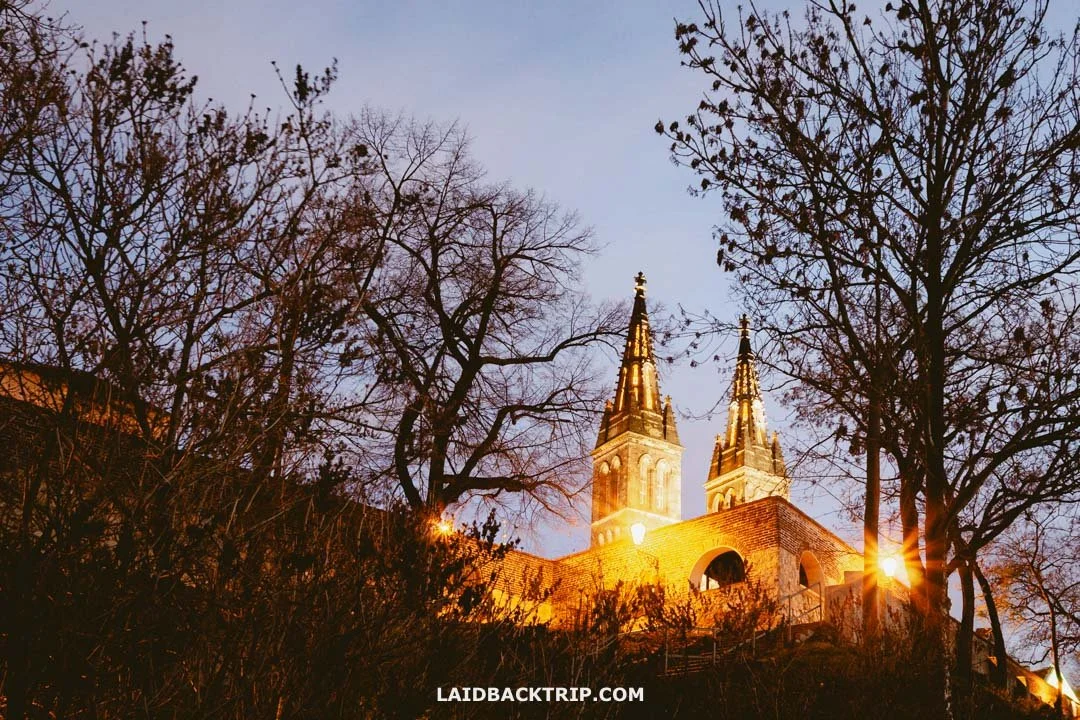
Vyšehrad is stunning even after dark, but a few places inside may be closed then.
With that said, the basilica, cemetery, and casemates obviously do have opening hours, which is why we recommend coming here between 10 AM and 5 PM. If we wanted to avoid the crowds, we would arrive, for example, around 9 AM, walk around the ramparts and the gardens, and then go to see the basilica interiors or the cemetery.
Vysehrad Is Beautiful Any Time of Year
No matter the time of year, we prefer to visit Vysehrad early in the morning when it's quiet, though that is mostly in our normal daily life, usually for our runs. In the summer (basically from June to August), like most other locals, we come here later in the afternoon after work to relax, but the whole place is obviously much busier by then. We don't mind, though, because we do not come here for sightseeing, so we stick to the less crowded spots. If it is a weekend, we bring a picnic blanket so we can take a short nap and work on our tan.
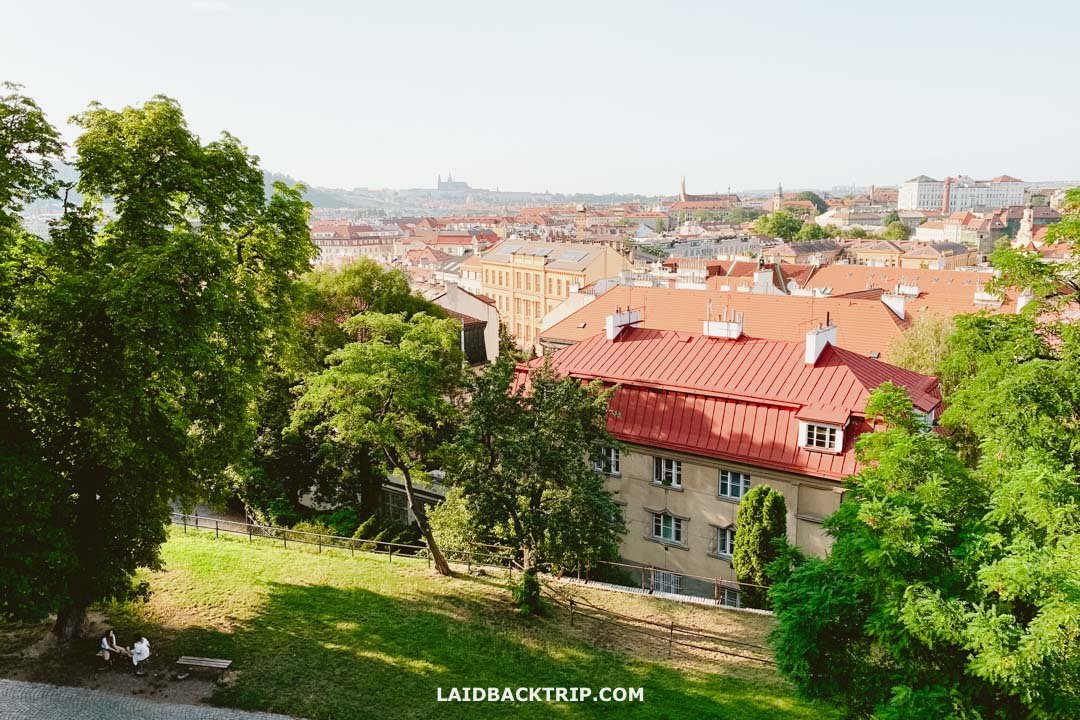
Summer brings not only great weather but also some of the most beautiful views from Vyšehrad.
When we come here just for a walk, our favorite time of year to visit Vysehrad is definitely autumn. Once the leaves start changing color, the whole place becomes almost magical. It also gets quieter since the cooler temperatures start to discourage picnickers. But that is something we could also say about Petrin or Letna, especially if you get lucky with the weather, because all of Prague is gorgeous.
Also, for the past few years, when we are home, Lucie and I have had a holiday tradition of walking to Vysehrad on Christmas Day to soak up the festive atmosphere while avoiding the unpleasantly busy Old Town Square, which hosts the Christmas Markets. Winter usually brings gray, gloomy days to Vyšehrad, but when the weather clears and the air turns crisp, it becomes one of my favorite times to enjoy the views and, in my case, usually take sunset photos here.
Places to Stay Near Vysehrad
Before we dive into Vysehrad's attractions, I want to point out that this area is actually really nice, and staying near the fortress is not a bad idea at all. It's still within walking distance of the city center, the public transport connection is great (metro C and plenty of tram lines), and the neighborhood around the fortress is pretty and far less touristy.
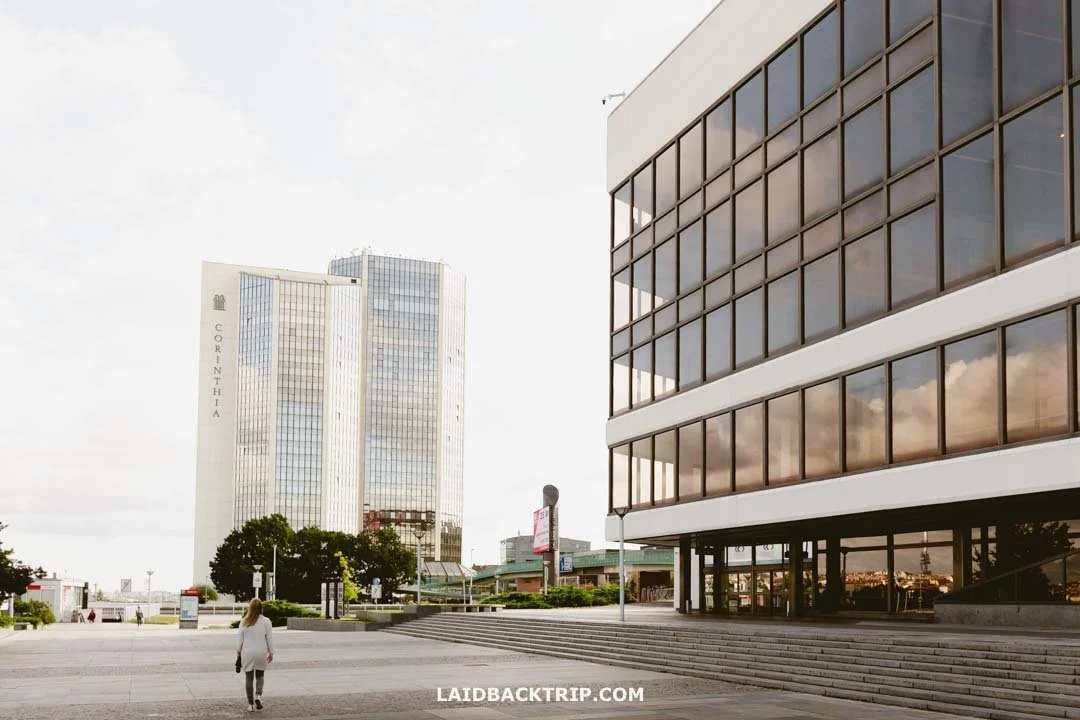
Hotel Prague Towers is basically next to the metro station and only about a 5‑minute walk to Vyšehrad.
Na Výtoni has the beautiful Art Deco Hotel Hermitage, Nusle has the traditional Union Hotel, and just steps from Tabor Gate is the affordable Holiday Inn Prague, while the 5‑star Prague Towers sits right by the Vysehrad metro station. I know it's tempting to stay in the historic center to have all the sights right under your nose, but if you're someone who prefers a less touristy area, this might be a good place to look.
What to See and Do in Vysehrad
Now that we've finally reached Vysehrad and know that we can enjoy it for free, it is time to look at what there is to see and do. And as I said above, for us it is mostly a beautiful park with fantastic views. While the rotunda, basilica, cemetery, and gates are all very interesting, we find the biggest magic of Vyšehrad in simply walking around the whole place (or running, as we often do here). And this is how I want to show you Vysehrad. As a place you can simply enjoy by walking.
I really gave some thought to how I would want to walk around Vysehrad if it were my first visit, and the plan I came up with was to walk the ramparts clockwise, because I like having the main views toward the city center in front of me. But that is just my personal preference, as it does not matter much in the end. I would also like to point out that we find Vysehrad easy to explore without a guide. That said, there is definitely the option to take a Vysehrad Tour, which obviously makes everything much easier.
Vysehrad Gates
It wouldn't really be a fortress without gates, right? Vysehrad has three of them. Tabor Gate and Brick Gate were part of the outer wall defensive system, while Leopold Gate served as a second line of defense in case Tábor Gate was breached. From Vysehrad metro station, we follow Na Bucance Street until we reach the easternmost walls of Vysehrad. Then it's just a short walk to Tabor Gate. Before we enter, you can take a look at the walls, which on this side aren't as high as on the others but are still massive.
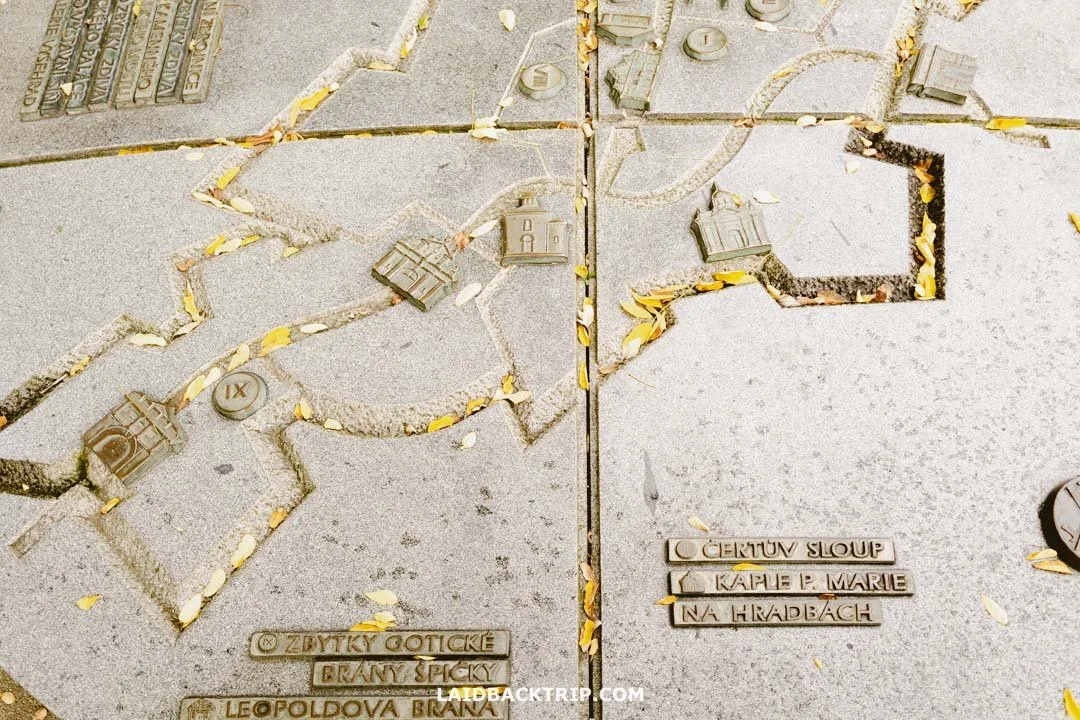
This relief map of Vyšehrad has all three main gates, so you can quickly get a sense of how the place is organized.
After passing through this gate, we arrive in an outer ward of the fortress. This relatively narrow corridor acted as a buffer between the outer walls and the inner citadel, and there are only a few things of interest here.
When walking through this area, there's one early hidden gem of Vysehrad, and that's Spicka Gate, which was built around 1350 during the reign of Emperor Charles IV. I didn't mention it earlier because only a small fragment of this Gothic structure remains today, and if you didn't know about it, you'd most likely walk past without ever noticing it. Its remains can be seen just 100 meters after Tabor Gate on the right, now forming part of the white‑painted building that houses Infocentrum Spicka.
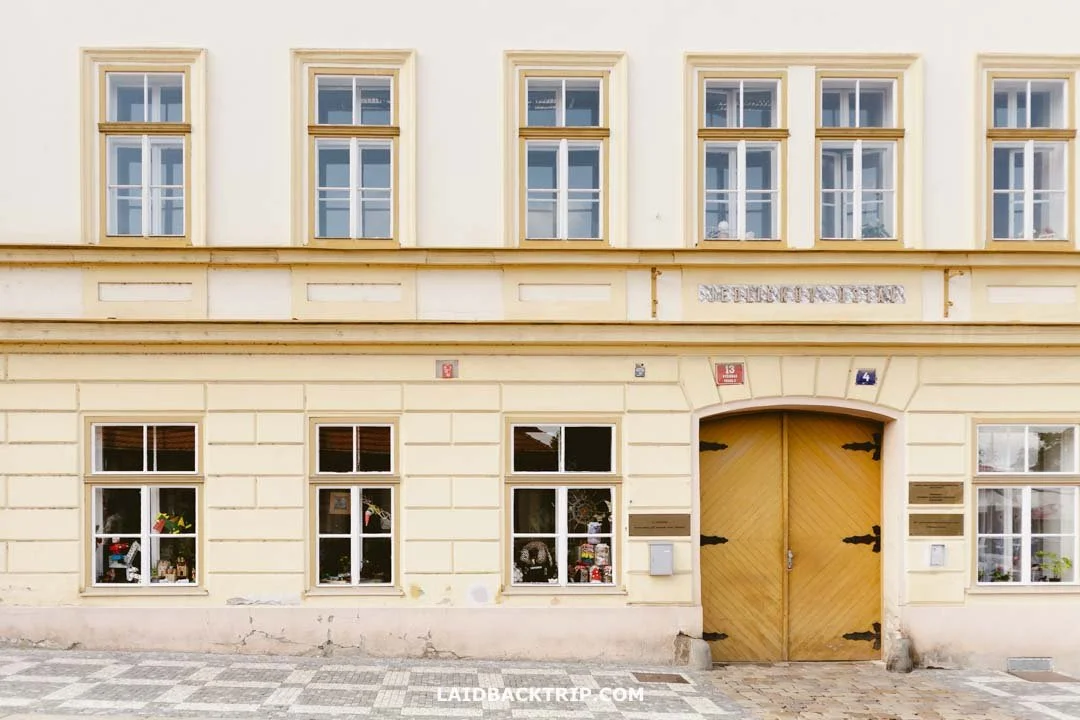
One of the buildings in Vyšehrad's outer ward is the Jedlička Institute.
A few meters further down the cobblestone road is a building of the Jedlicka Institute, Czechia's most famous school and facility for children and adults with physical disabilities (a much larger part of the institute is actually outside the fortress). They have a small shop here called Boruvka (Blueberry), where you can buy products made by their handicapped artists.
They offer some lovely items that make great souvenirs if you want to bring something meaningful to your loved ones from Czechia. And of course, the money helps support the entire organization. At the end of this area stands Leopold Gate, which is where we're heading next.
Rotunda of St. Martin
After passing through Tabor Gate and Leopold Gate, we finally reach the inner area of the complex. The fortress of Vysehrad is full of small gems like various sculptures and foundations of old structures, but our favorite is the Rotunda of St. Martin, which stands slightly to the right in front of us. This small structure is quite picturesque, but many people pass by without realizing it's Prague's oldest surviving Romanesque building, dating back to the late 11th century during the reign of King Vratislav II.
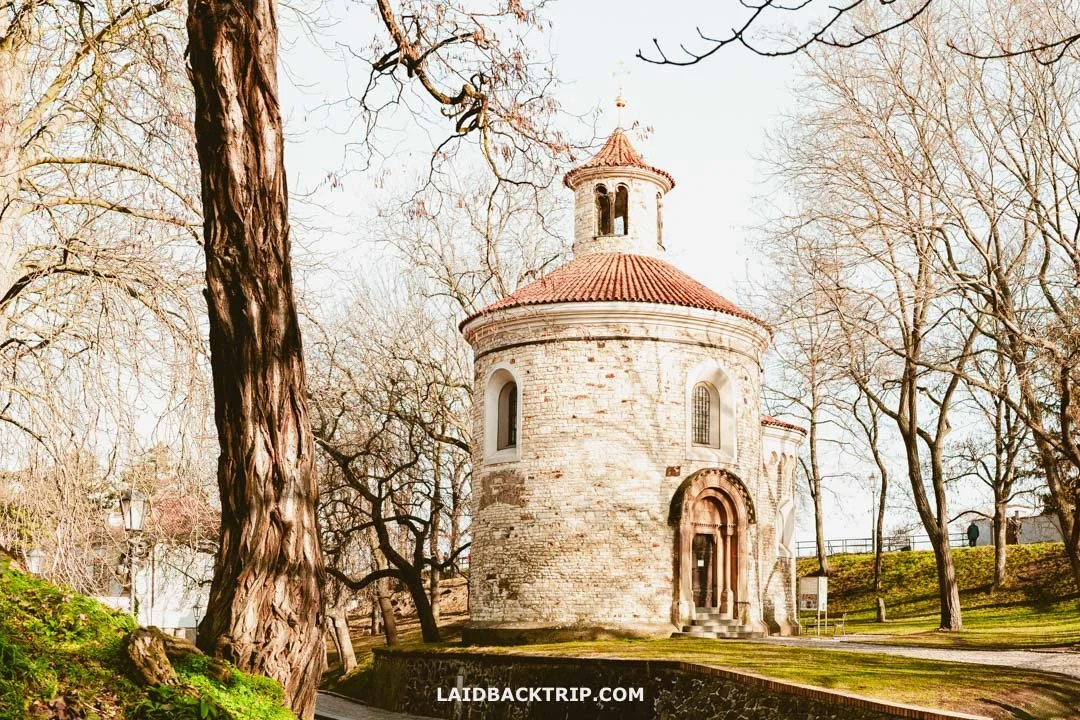
The Rotunda of St. Martin is an eleventh‑century chapel right inside Vyšehrad.
What's even more impressive is that it's one of the last remnants of the medieval settlement, since it survived all the Baroque changes, its conversion into a gunpowder storage, and even centuries of conflicts, including the Hussite Wars and the Prussian siege of 1757 (a cannonball in its facade commemorates this event).
Normally, it's not possible to go inside, as the rotunda is open only during services, but I have to say that admiring the architecture from the outside is more than enough, because the small structure is very charming and photogenic.
Vysehrad Ramparts Walk
Now comes the big decision on how to see the whole complex, but as I said, there are no wrong choices here. But because I know that if it were my first time here, I'd want to walk along the ramparts, that's where we head next. So once past Leopold Gate, we take the first left and walk toward the southernmost bastion. If you actually walked all the way to the Rotunda of St. Martin, then you'd have to retrace your steps slightly (and turn right, obviously).
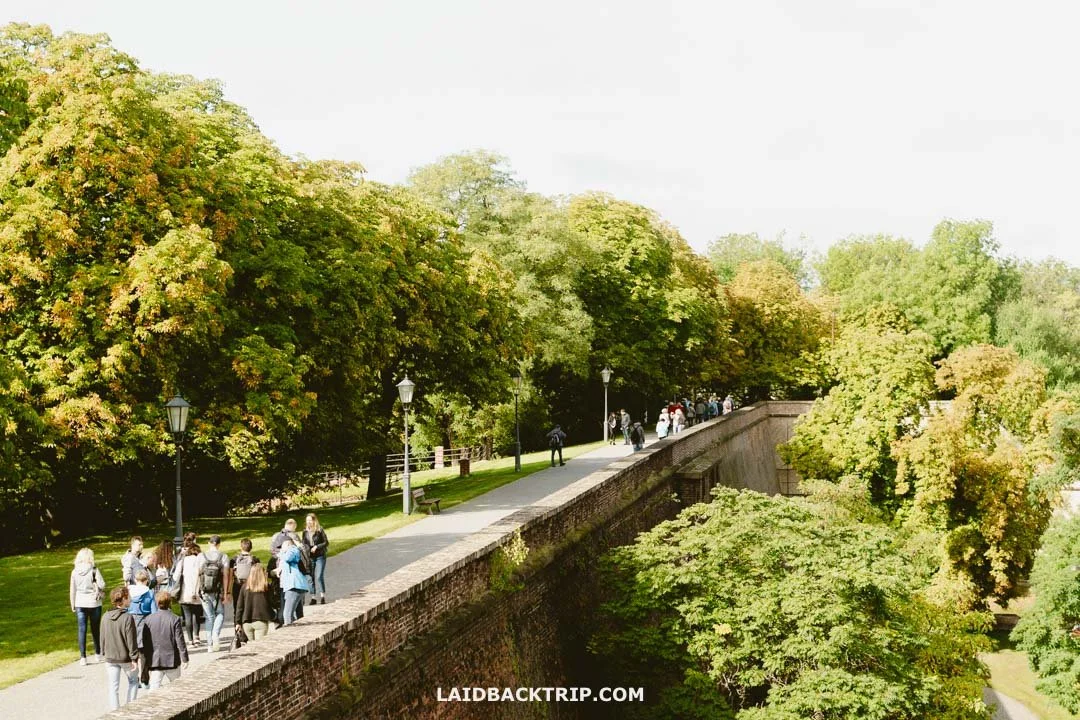
We just love the walk around the whole ring of Vyšehrad's fortifications.
The way to tell you're going in the right direction is that you should have a children's playground (inspired by the Old Czech Legends) on your right. At the first fork past the playground, we turn left again and in 50 meters reach the ramparts. From now on, the route is very straightforward.
All we need to do is follow the outline of the fortifications. The whole walk around Vysehrad's fortifications is 1.7 kilometers, and since I find it the most interesting thing to do here, I'd try to walk the whole thing if time allows. Both Lucie and I love the walk because it's not only relaxing, but the unobstructed views from the fortress are amazing.
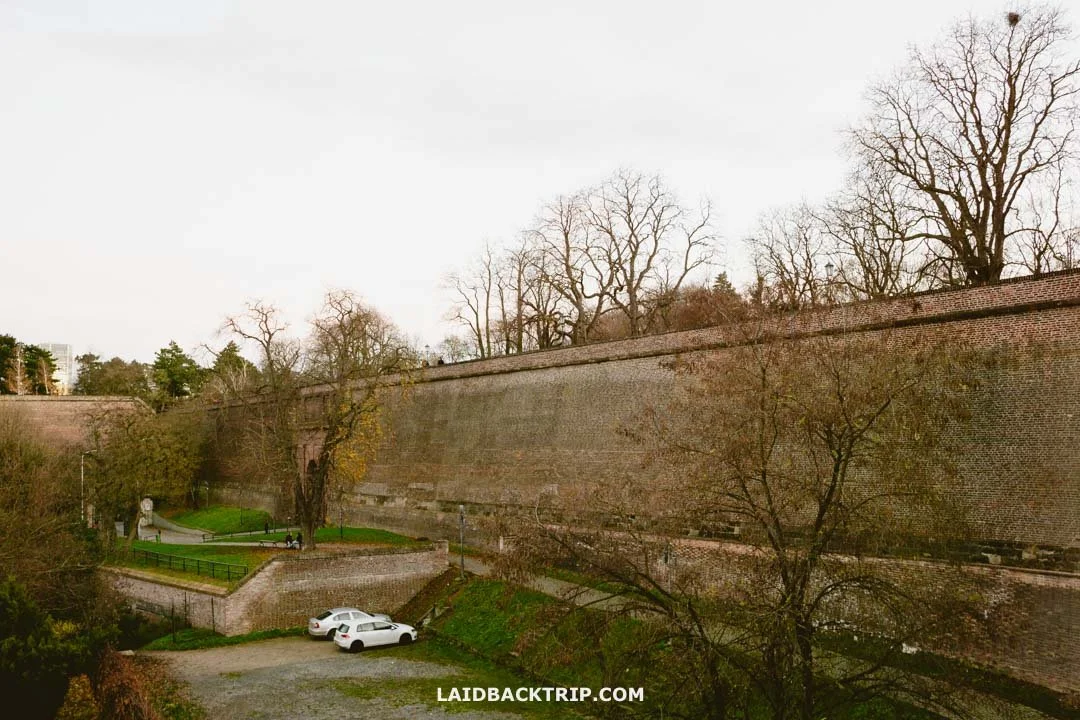
The fortifications were built when Vyšehrad was transformed into a Baroque fortress.
Vysehrad's fortifications were transformed from a 10th‑century wooden hillfort into a castle with massive Gothic stone walls in the 15th century, but the most significant changes came after the Thirty Years' War, when the Habsburgs, between 1653 and 1727, rebuilt Vysehrad into a modern Baroque fortress.
The medieval walls were replaced with thick, brick‑faced ramparts and star‑shaped bastions designed to withstand artillery. The new citadel served as a military base and a last line of defense for Prague.
Today, the massive walls and brickwork remain the most visible layer of its military past. It's really the system of bastions that lets you see the walls even from inside the former fortress, but I also love the view from that little area around Brick Gate, where the walls are high and really impressive, not to mention that there's a walkway that takes you to the western side with that gate accessed from the Vltava waterfront, which I talked about earlier.
To reach both gates from either Albertov or the Vltava waterfront, you have to walk uphill, which also gives you a rough idea of how difficult it would've been for intruders to get inside from this side.
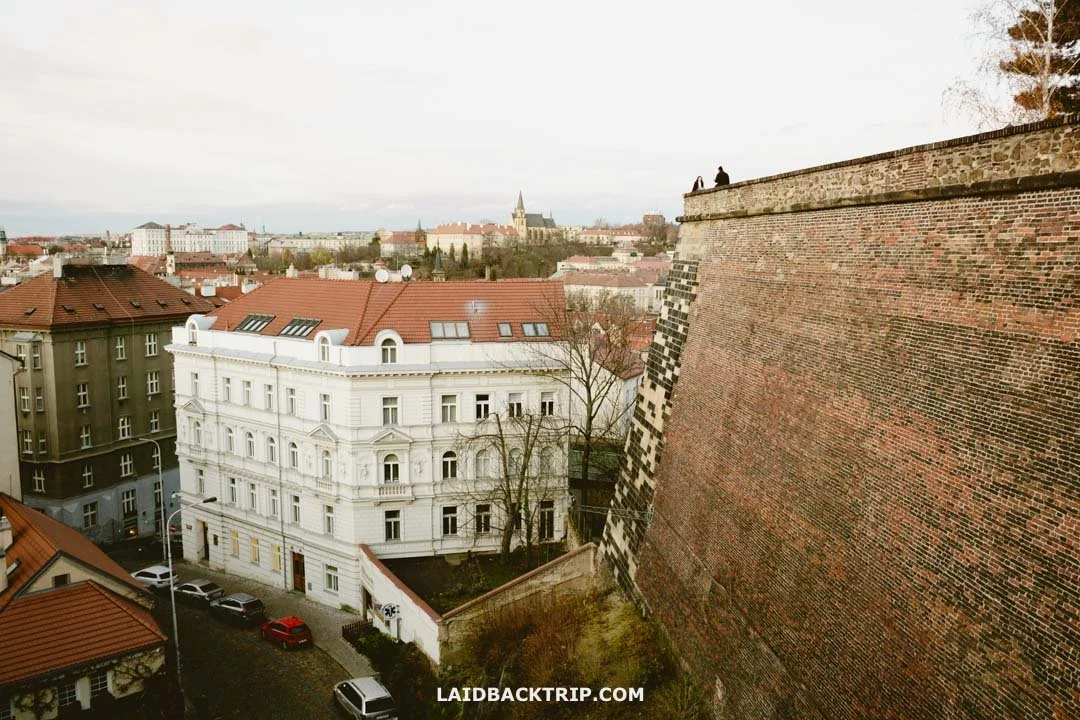
In some sections, the high walls of Vyšehrad are just incredibly impressive.
Roughly halfway through the walk, we'll reach the basilica and the cemetery, and it's really up to you whether you want to see them now or continue walking around the whole fortress. If you decide to finish the walk, then the way I planned it will bring you to both sites again at the end of the visit, so you can go inside then.
I'd continue walking, but if you want to see both sites first and then finish the walk, that's totally fine too. And if you complete the whole loop, you'll reappear at the Rotunda of St. Martin by Leopold Gate.
From here, you can either take Sobeslavova Street or K Rotunde Street. At this moment, I prefer the latter because it's lined with historic buildings managed by the Royal Collegiate Chapter of St. Peter and Paul. These are the religious and cultural administration of the entire complex.
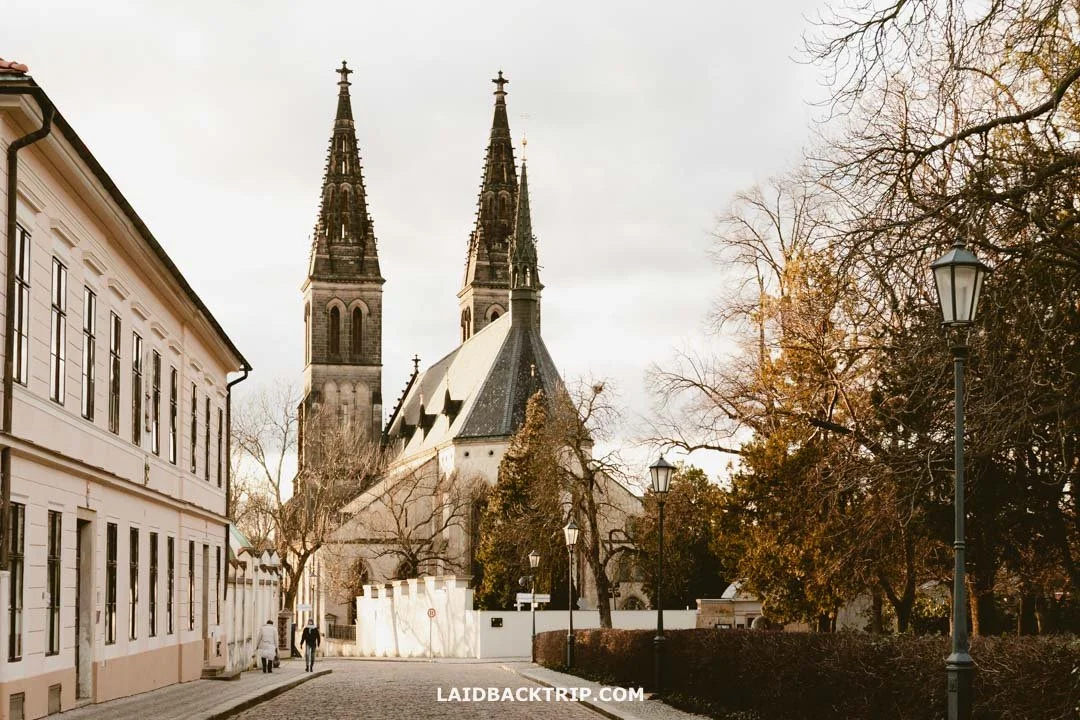
Finally, we walk up to the Basilica of St. Peter and St. Paul from behind.
The most important of them is the New Deanery, a large administrative building serving as the Chapter's modern headquarters and archive. There are also several Canonry Houses that served as residences for high‑ranking priests. What I really like about this street is that the towers of the Basilica of St. Peter and St. Paul are right in front of us the whole time.
My Favorite Views from Vysehrad
During this whole walk, you can enjoy some pretty amazing views of Prague. From the southern side of Vyšehrad, you can see the entire district of Podoli with the neoclassical Podoli Waterworks building, Podoli Swimming Stadium, the marina (Podolský přístav), and the Maternity Hospital. Above Podoli is Pankrac, which is easy to recognize by a few skyscrapers, most notably the V Tower, thanks to its distinctive shape resembling the letter.
Once we reach the western side, we get stunning views of the Vltava River, the ruins of Libuse's Bath (probably a 14th‑century watchtower where, according to legend, Libuse bathed with her lovers), the long Cisarska louka Island, and the Smichov district on the opposite bank. The best view of this whole scene is from the southwestern corner of the fortress (GPS coordinates: 50.06284, 14.41714).
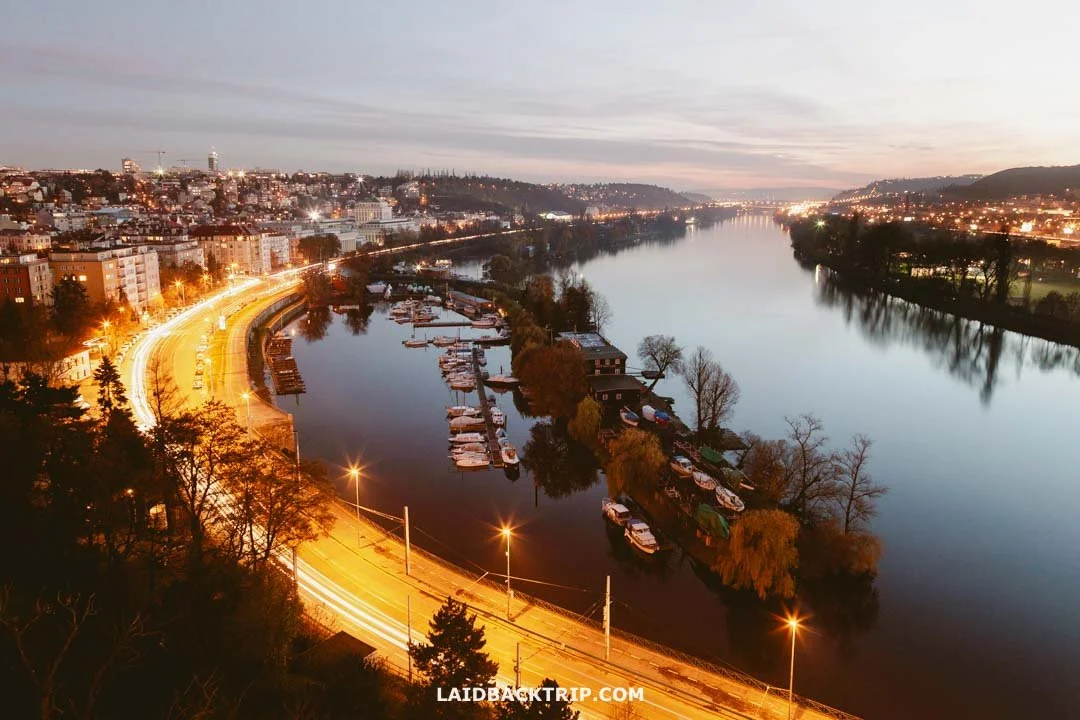
One of my favorite views of Prague is right here, in the southwest corner of Vyšehrad.
Only a short walk north of there, right next to the Vysehrad Gallery, is another amazing viewpoint (GPS coordinates: 50.06365, 14.41646), which includes Vyšehrad Railway Bridge and even Prague Castle.
From the northern side, there are beautiful views of New Town, but my favorite spot doesn't come until we reach the northeastern corner, which includes views of Albertov and Nusle with the (in)famous Nusle Bridge that spans above this part of the district. The eastern side shows the same view from a different angle, though the interesting part is that there are also tennis courts right below the high walls on this side.
Basilica of St. Peter and St. Paul
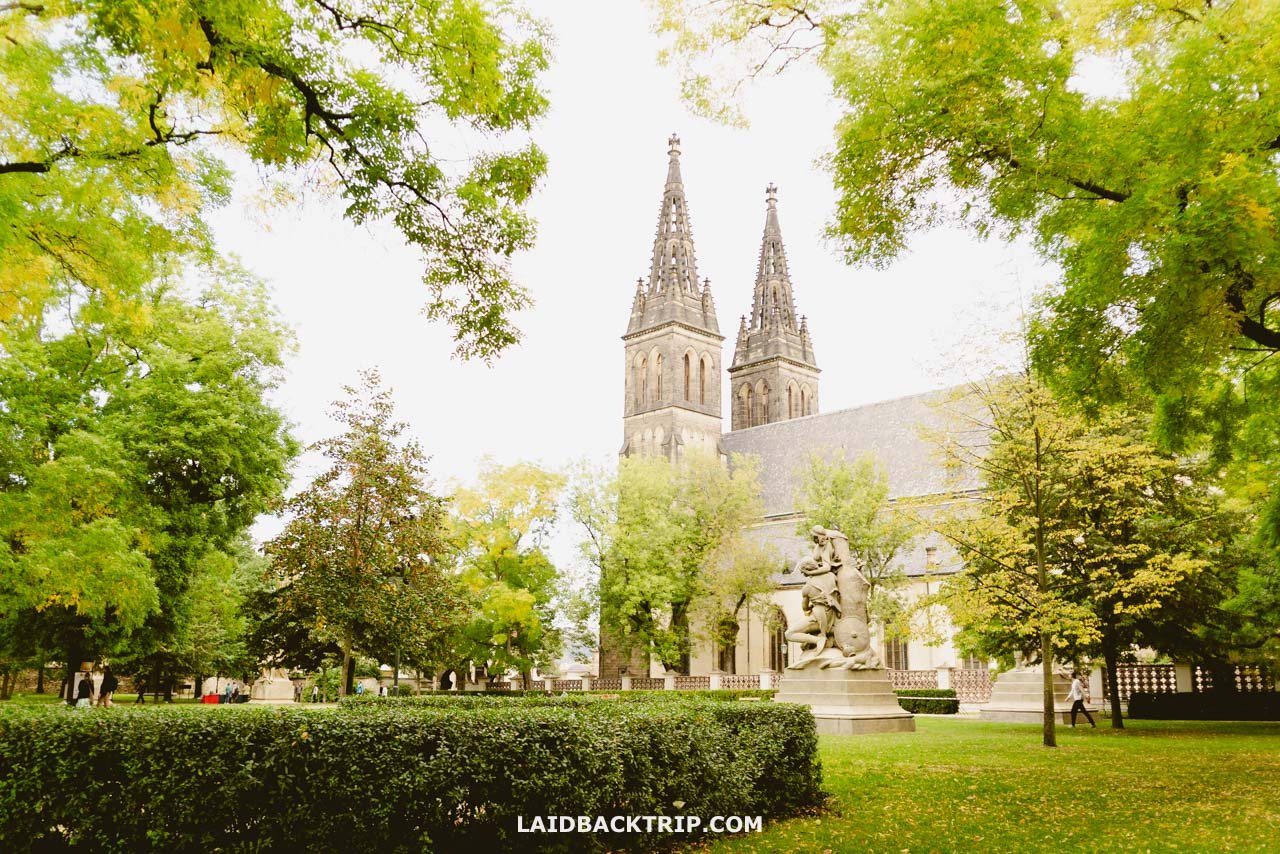
After 300 meters or so, we appear right in front of the Basilica of St. Peter and Paul, the architectural centerpiece of the Vysehrad complex. I love this moment because the square in front of it is really small and really lets it stand out, especially the twin 58-meter towers, nicknamed Adam and Eve.
The church was originally a Romanesque structure built around 1070 by King Vratislav II. Over the centuries, it underwent Gothic and Baroque transformations before architect Josef Mocker gave it its current Neo-Gothic appearance in the late 19th century.
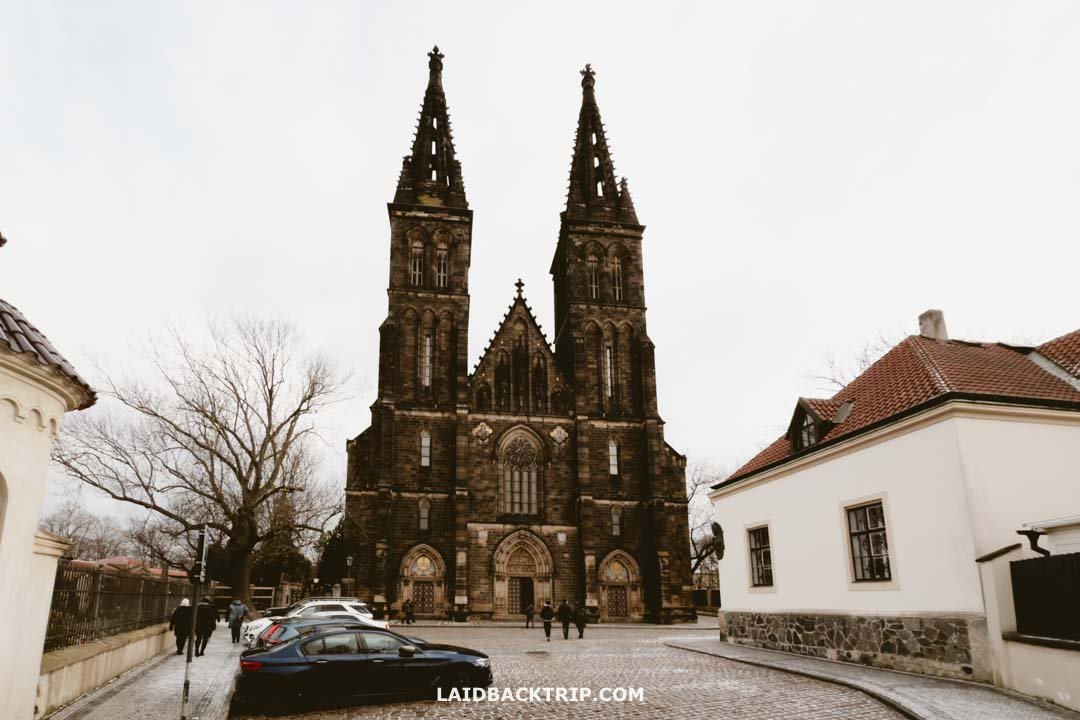
The Basilica of St. Peter and St. Paul dominates the whole Vyšehrad complex with its tall twin towers.
If you've paid attention while exploring Prague's city center, you already know him. He was responsible for the construction and restoration of many Bohemian monuments in Prague, like the Cathedral of Saint Vitus in Prague Castle, and even beyond, like Karlstejn Castle or Krivoklat.
Speaking of St. Vitus, Vysehrad's basilica isn't as impressive, yet we still think it's one of the most beautiful religious structures in Prague. Besides the towers, the basilica also has stunning facade and front doors, especially the two on the sides that have a pinkish tint and colorful stone mosaics.
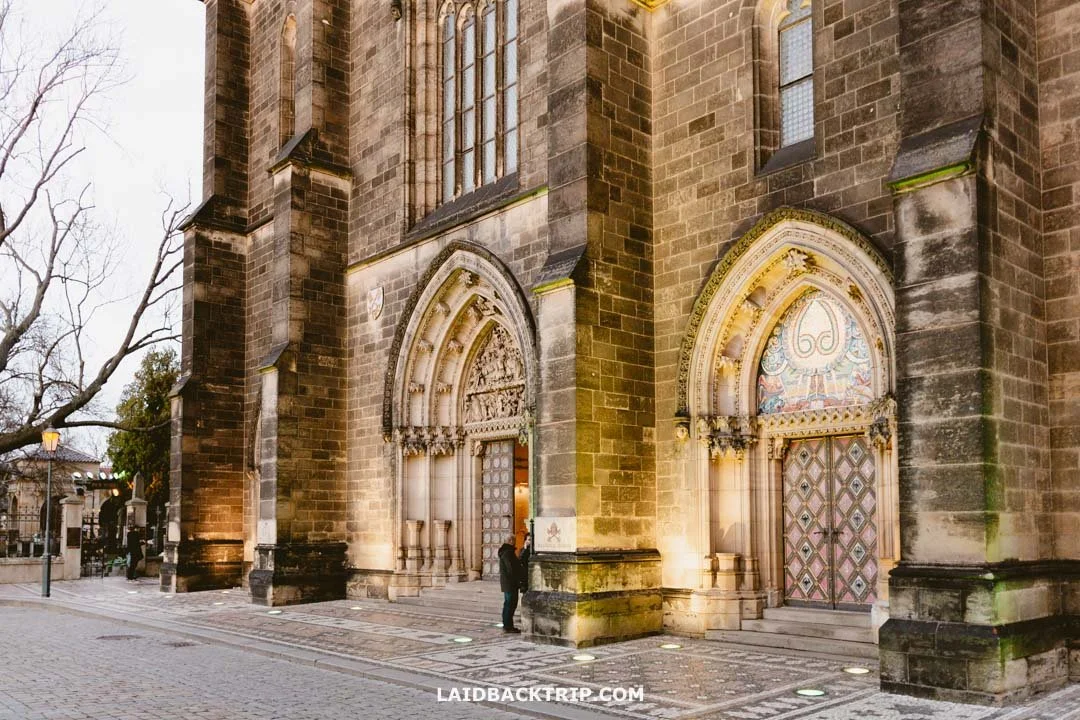
The basilica is stunning even from the outside, especially the colorful mosaics on the side doors.
The Basilica of St. Peter and Paul has an entry fee of 130 CZK, which isn't a lot, but it's also not free. But when I said the exterior is impressive, the interior is really beautiful too. It's basically a display of Art Nouveau design, as every surface is covered in vibrant frescoes and intricate floral motifs (for more of Art Nouveau, visit Municipal House).
There's also a 14th-century panel painting of the Vysehrad Madonna and a Romanesque stone sarcophagus. I really do think it's worth the money to go inside if you have time, but it's completely up to you.
Our tip: About 30 meters from the basilica (in the western wall) is a public bathroom. It used to work on a donation basis, but nowadays it costs €1/20 CZK, and it's cash only.
Vysehrad Cemetery
When facing the Basilica of St. Peter and St. Paul, you'll see the entrance to the most famous Czech cemetery on your left, basically at the corner next to the basilica. And that's where we're headed next. Enter and walk quietly through narrow pathways, hiding the final resting place of some of the most famous people our nation has had. You'll find several large tombs, interesting statues, neo-Renaissance arcades, beautifully decorated stone coffins, and also old graves you might pass without noticing.
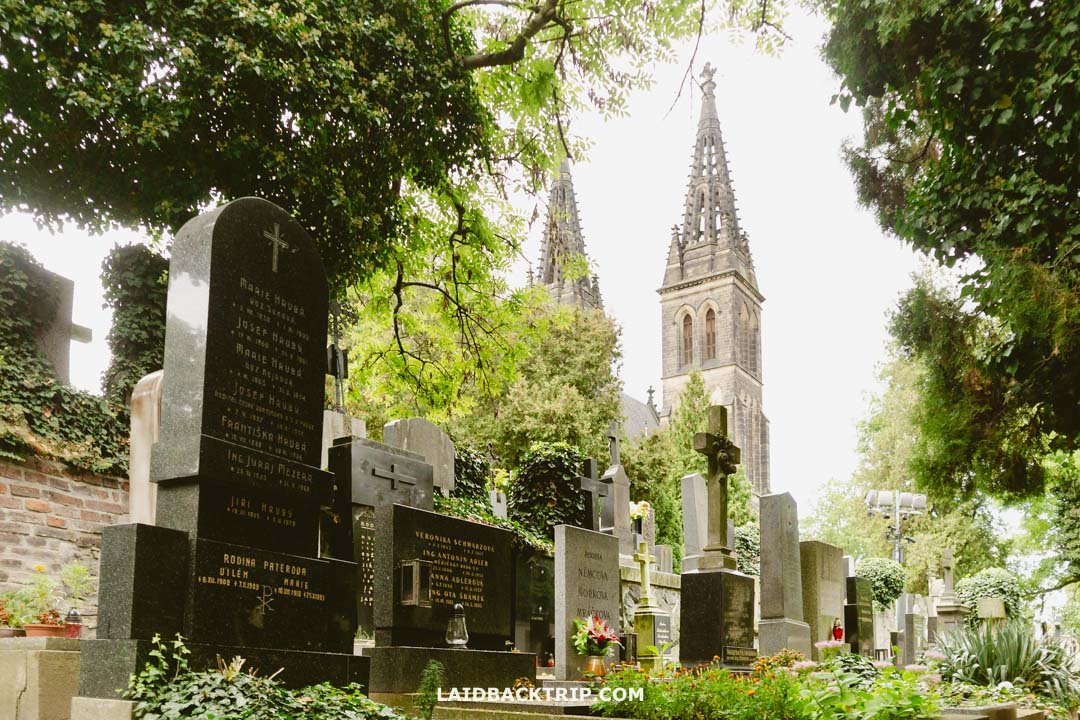
Vyšehrad has the most famous cemetery in all of Czechia.
Even though it sounds a bit strange to call a cemetery beautiful, Vysehrad Cemetery really is, and every time we come here, we lose track of time, looking for new details we missed last time. The cemetery isn't huge by any means and is tiny compared to places like Pere Lachaise Cemetery we visited in Paris, but it still takes quite a while to explore, especially once you start focusing on the little details, not just the names on the tombstones.
There was a cemetery in this same place as early as the 11th century, but by the mid-19th century, it was used by the local parish. In 1869, it was rebuilt and designated as the national burial ground.
While strolling here, you can find the graves of famous composers Antonn Dvorak and Bedrich Smetana, but also scientists like Jaroslav Heyrovsky and Frantisek Krizik, writers like Josef Capek, Bozena Nemcova, Jan Neruda, Karel Hynek Macha, painters like Mikolas Ales, and many other well-known people, including athletes, singers, and politicians.
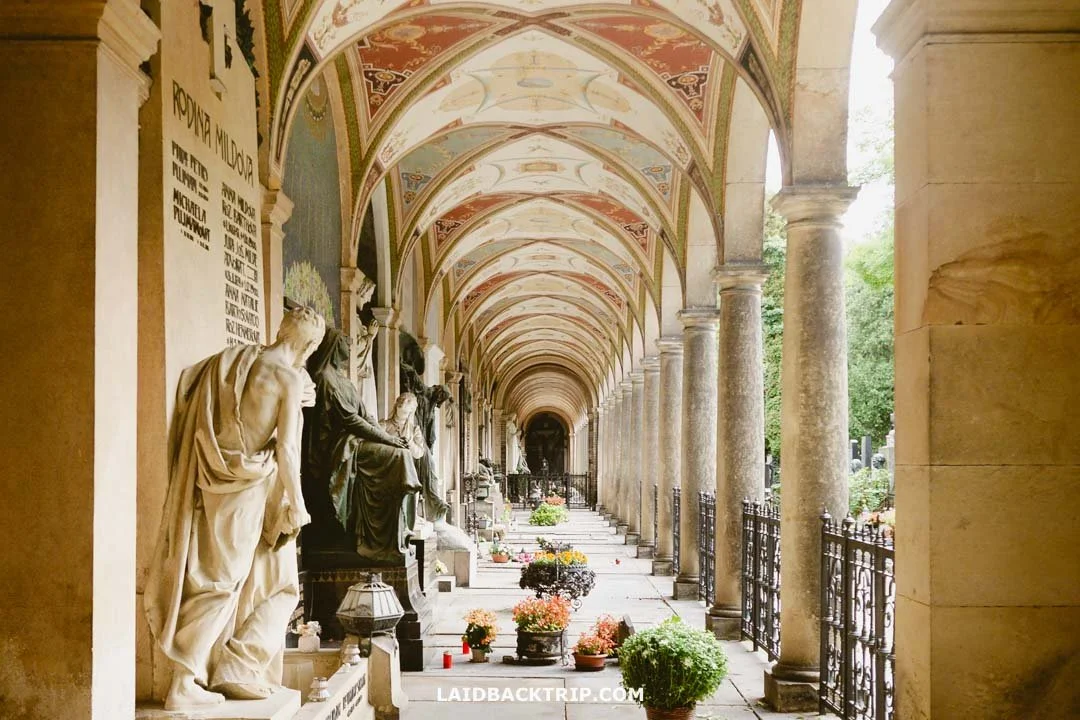
Vyšehrad also has this beautiful arcade.
A symbolic grave has also been placed here for Milada Horakova (killed by communists) and Josef Capek (killed by nazis). And that's just the most famous ones I picked, but there are definitely many more laid to rest here.
On the east side of the cemetery, you'll notice the biggest tomb with a large allegorical winged figure of the Genius of the Fatherland on top. It's called Slavin, and this massive monument serves as a collective crypt for the finest Czech personalities. Buried here are Alfons Mucha and more than 50 others.
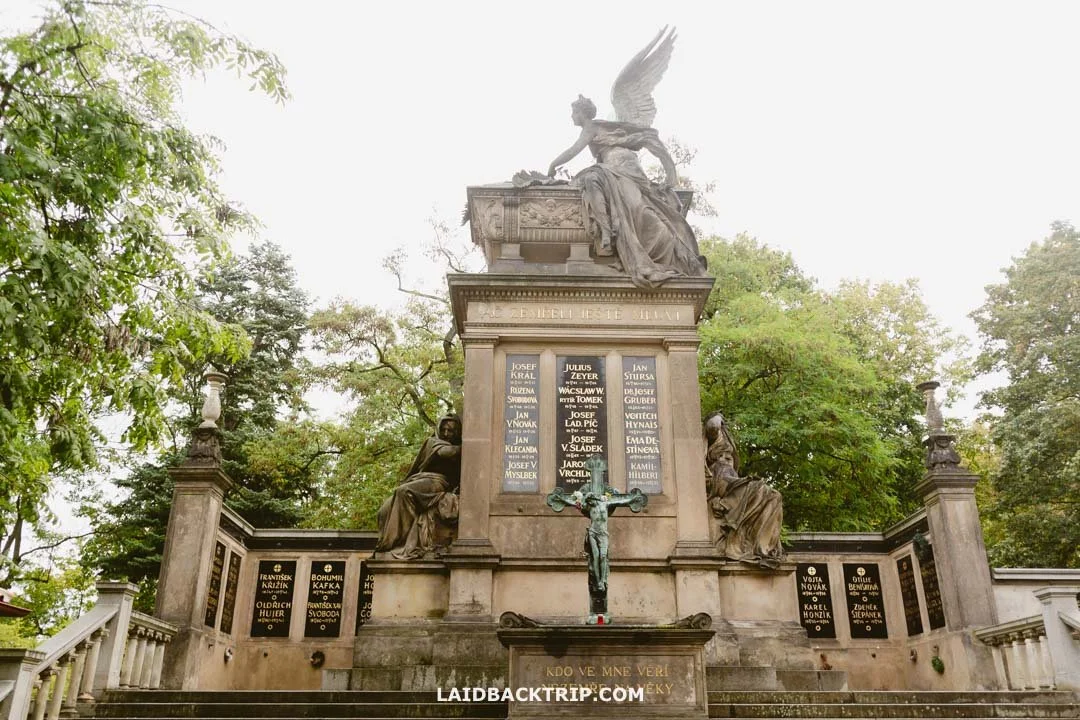
More than fifty famous Czechs are buried in the Slavín crypt.
Once you inspect this tomb and the rest of the cemetery, you can let us know in the comments below how many famous Czech people you know. By the way, the cemetery is normally open between 8 AM and 5 PM, so make sure you visit when it's not closed.
Vysehrad Gardens
At this point, I've walked you through all of Vysehrad's must-sees, and depending on how much time you have, you can either head back to the city center through Brick Gate or the gate that takes you directly to the waterfront. But if time allows, I really think you should stay a bit longer.
Because Vysehrad is mostly for us and all the other locals who come here often, it's just a park. And as such, it's really worth staying a bit longer. Prague has quite a few green areas in the city center, but Vyšehrad is one of the most popular ones, so you'll meet many people jogging, walking their dogs, picnicking, and simply enjoying their time outside.
I really do think that after you've seen the basilica and cemetery, it's better to stop thinking about this place as a tourist attraction and instead see it as a nice, laid-back patch of greenery, benches, statues, and great views. The Premyslids' history and legends, as well as the fortress transformation, are really interesting, but we come here mostly to take a break from hectic city life and enjoy some quiet moments.
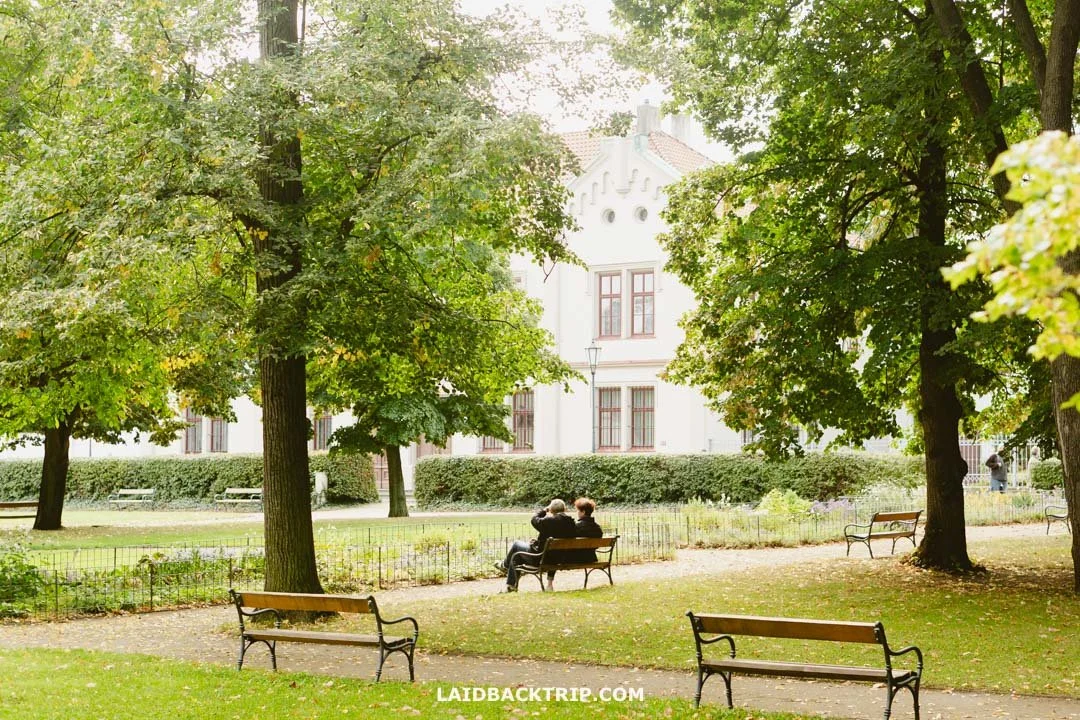
Vyšehrad is the ideal place to just sit, relax, and enjoy the moment.
That's not that easy on warm days when the park is busy, but I'd say the situation here is always better than in the upper parts of Grebovka, another one of our favorite parks. So if you're tired from a whole day of walking around the cobblestone streets of the historic center, Vysehrad is a great place to rest in the shade of the trees and maybe even wait for the sunset, because they're spectacular from here.
There are three sections, Vysehradské sady, Karlachovy sady, and Stulcovy sady, that are like gardens within the park. They're slightly more landscaped, with sculptures, but that doesn't mean the rest of the park isn't well-maintained. We love coming here when it's warm, and everything is green, as the park is really beautiful at this time of year, though we can say the same once the foliage turns to its autumn palette.
Casemates and the Gorlice Hall
If you still have some energy left, then we do have one more tip for you, and that's Vysehrad Casemates. They can be accessed by guided tour only, which takes about 45–60 minutes and is available not just in Czech but also in English. The ticket costs 330 CZK, which isn't exactly cheap, but to be fair, it also includes access to the Brick Gate itself, where you can learn about the architectural development of the citadel and its fortifications, and the Powder House that holds the exhibition The Rise and Fall of Vysehrad.
The entrance to the casemates (and Gorlice) is from the Brick Gate, but the Powder House is in the southwest corner of the fortress. We still haven't done that one, which is a bit of a shame (and slightly embarrassing) because we visited casemates in Kronborg on our trip to Denmark, and they were really interesting, and I have a feeling this one will be too, so it's definitely on our list.
The casemates are a system of narrow, vaulted underground corridors built during the 17th and 18th centuries as part of the Baroque transformation of Vysehrad into a military stronghold. These passages were designed for the rapid and hidden movement of troops, storage of ammunition, and defensive maneuvering.
The corridors are roughly 2 meters high and 1.5 meters wide. They lead to a massive underground hall known as Gorlice, which was a gathering point for soldiers and a storage site for food and military supplies. Today, it's a small gallery that houses six of the original stone statues from Charles Bridge.
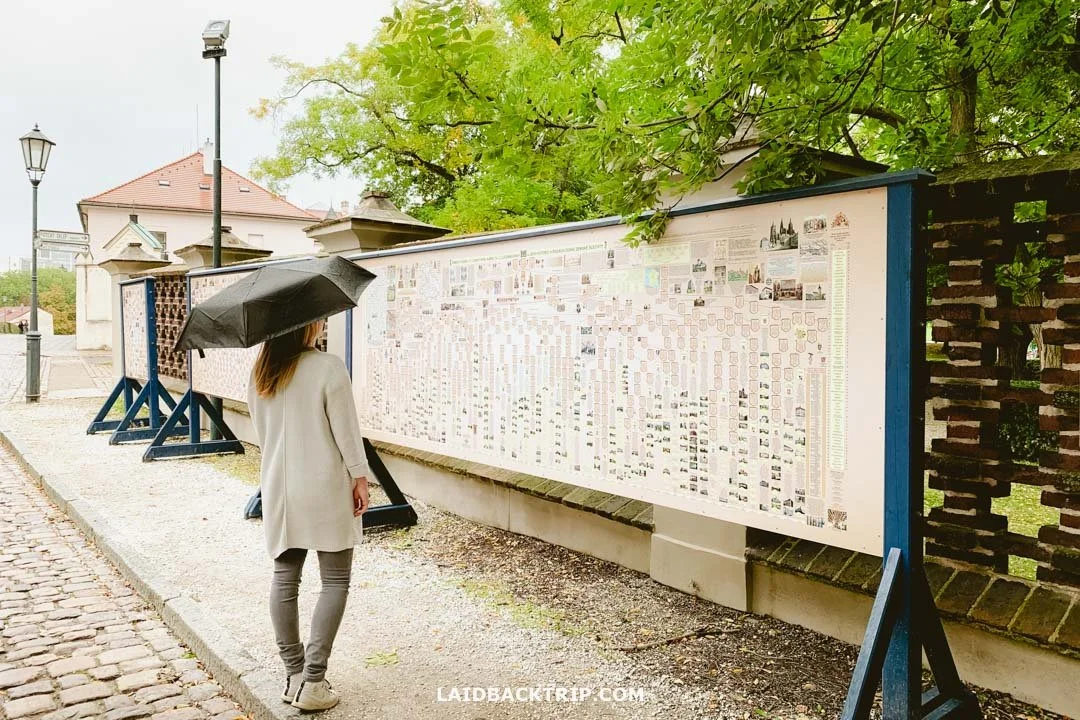
One of the free exhibits within the Vyšehrad gardens.
If you don't have time or just don't want to buy another ticket, there are also free exhibitions in the park from time to time. Last time we visited Vysehrad, we saw some info panels with Charles IV's lineage here for the first time, so the exhibitions change occasionally. And my last tip is that right next to the Powder House is the Gothic Cellar, a remnant of one of the palace buildings constructed here during the reign of Charles IV in the second half of the 14th century.
Vysehrad Sculptures
Throughout the whole Vysehrad, you'll encounter several interesting sculptures, though the most famous ones are the four massive stone groups located in Vysehradske sady. When facing the basilica's main entrance, they'll be in the park on your right, though if you did the walk along the ramparts first, you might have already seen them if you were curious enough.
These sculptures were created by Josef Vaclav Myslbek and depict famous pairs from Czech mythology: Libuse and Premysl, Sarka and Ctirad, Lumir and Pisen, and Zaboj and Slavoj. They were originally located on Palackeho most but were moved to the park after being damaged during World War II.
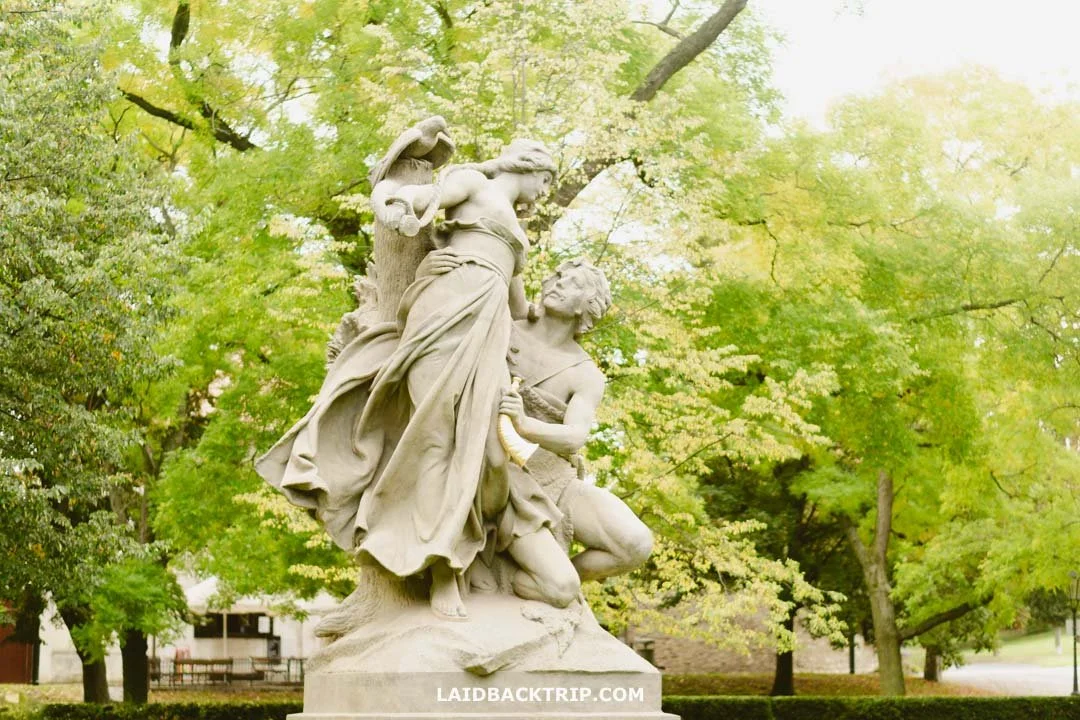
Ctirad and Šárka from The Maidens' War is another myth connected to Vyšehrad.
There are definitely more sculptures around, like my favorite equestrian statue of Saint Wenceslas in Stulcovy sady (in the northwest corner). Another notable feature is the Certuv sloup (Devil's Column) in Karlachovy sady, consisting of three stone pillars. While not a traditional sculpture, it's an interesting historical curiosity linked to many local legends. And I can't forget to mention that some of the most interesting sculptures and decorative headstones are in the cemetery.
Chapter Vineyard
The sunny areas and steep slopes of Vysehrad are perfect for growing wine, and believe it or not, a small vineyard has been in this complex since the 11th century. A legend says that Czech lands will thrive when wine is cultivated in its vineyards, and although there were some darker times when the wine disappeared after the complex was turned into a fortress, the vineyard tradition was reestablished here in the 1990s. Today, you can still find small plots with grape varieties like Muller-Thurgau, Blauer Portugieser, and Pinot Noir.
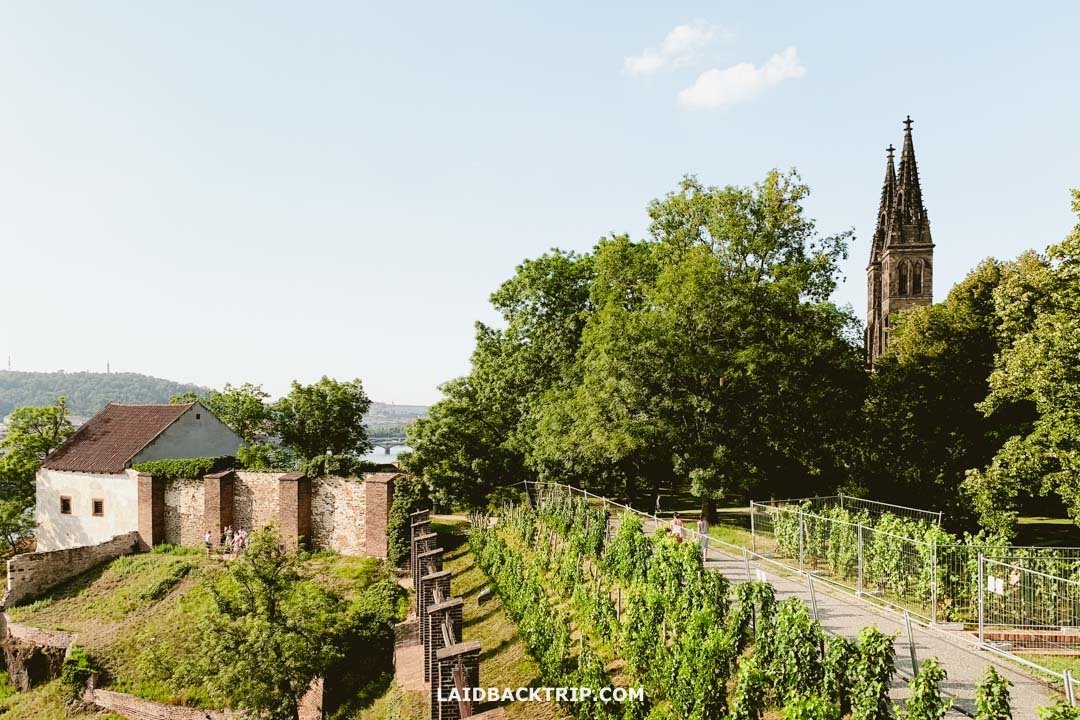
Vyšehrad even has a small vineyard with a tradition dating back to the 11th century.
Unfortunately, you'll most likely not be able to taste it, because the number of bottles is very limited and the wine isn't sold commercially, as it's used for representative purposes only. The easiest way to see part of the vineyard is while doing the rampart walk, and there's a small plot beside the Old Burgrave's Office in the southwest corner of the complex. It's impossible to miss, as you'll walk literally right through it.
Cafes and Restaurants
Vysehrad has a few places to eat or grab a coffee, but we hardly ever eat or drink here. If we come for a picnic, then we bring our own food. The only exception we make from time to time is having a Pilsner in the beer garden in the northeast corner, which has some really beautiful views, but that's about it.
In case your schedule is tight and you arrive at Vysehrad around lunch or dinner time, you won't leave hungry. To be fair, some of the cafes here look fairly nice, like the ones located in the Chapter's buildings, but every time we see that place by the cathedral's main entrance, I have no idea how it's still there.
Summer Theater
Another interesting spot you might have noticed while walking the ramparts is the small open-air amphitheater in the northwest corner. It's called Letni Scena Na Vysehrade and is actually located in the part of the fortifications that was once known as the redan, originally built for artillery.
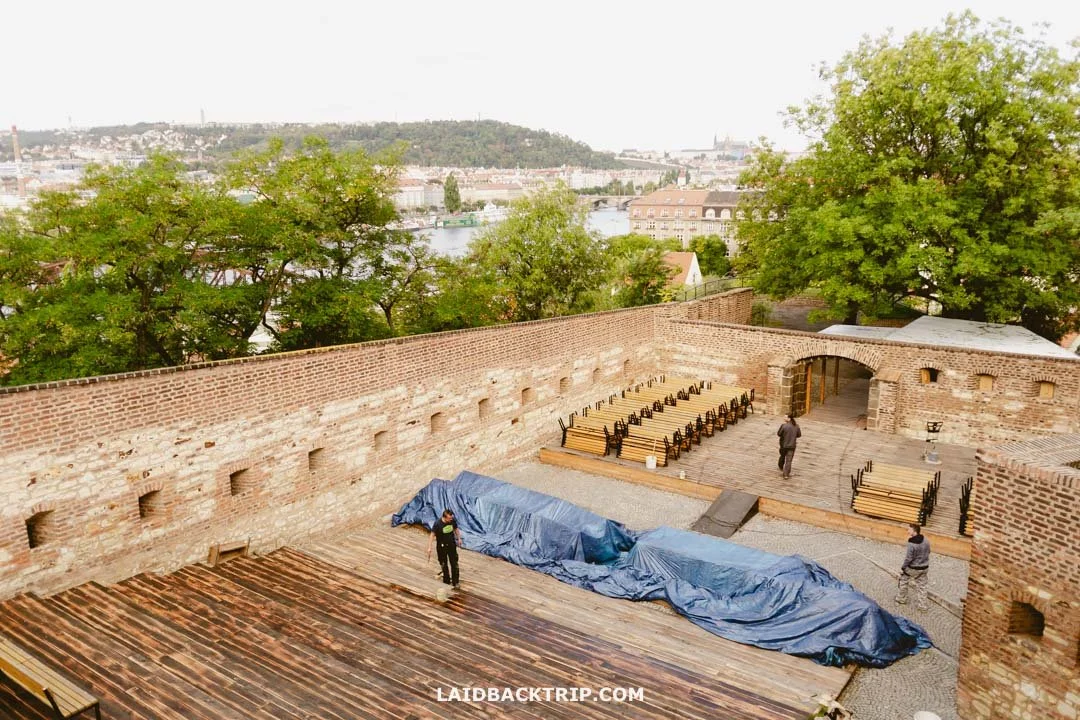
Vyšehrad also has a small summer theater, tucked into the old fortifications.
If you happen to be in the city when a play takes place, usually between June and August, you can check online to see if there are tickets available and enjoy a cultural experience in a very unique location. The only downside is that the plays are usually only in Czech, but that can be part of the unusual experience, or you might catch a concert instead, since they appear on the calendar from time to time, too.
How Long Does It Take to See Vysehrad
Now that one is, as usual, really hard to answer because I'd really like to tell you that you'd need at least a few hours to get a sense of Vysehrad, but I also know that's often not realistic. I know that just the walk around the whole fortress takes at least 30-40 minutes, but a more realistic estimate is about an hour because the views are really stunning, and there's always something new to see.
I also know that we've repeatedly spent more than an hour just at the cemetery, and when we went to see the basilica's interiors, it wasn't a five-minute visit either. And then there are the casemates, the museums, and the galleries. While they're not really that big, they'll add anywhere between an hour and two to your visit. Another big factor is the weather, because when it's a warm summer day, Vysehrad is one of those places we don't want to leave.
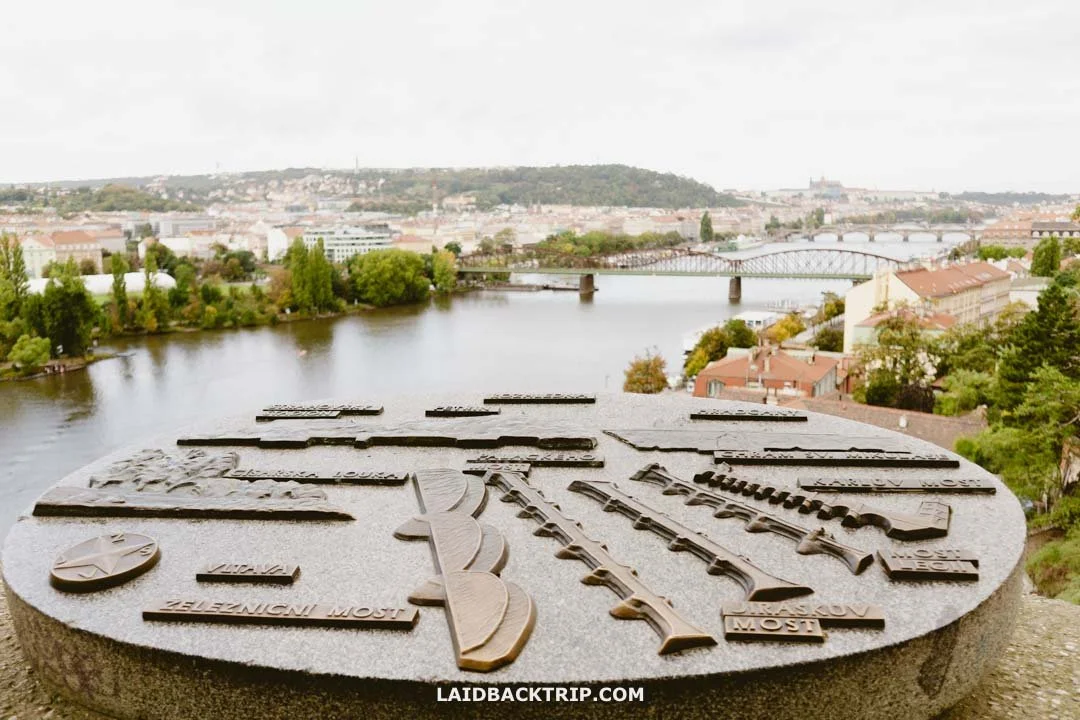
We could spend hours up at Vyšehrad just enjoying the views.
Even if you're in a hurry, you'll need at least an hour to see Vysehrad's highlights, but we're still talking only about the outside areas, with maybe a visit to the basilica. With the intention of seeing the museums, you'll definitely spend about two to three hours here.
And beyond the traditional sightseeing, we really do recommend that you should, if the weather allows, spend another hour here just doing, well, nothing. Just enjoy the views from the walls, sit on one of the benches in the park, look at the big trees, admire the sculptures, or just take a quick nap.