Visiting Prague Castle Like a Local
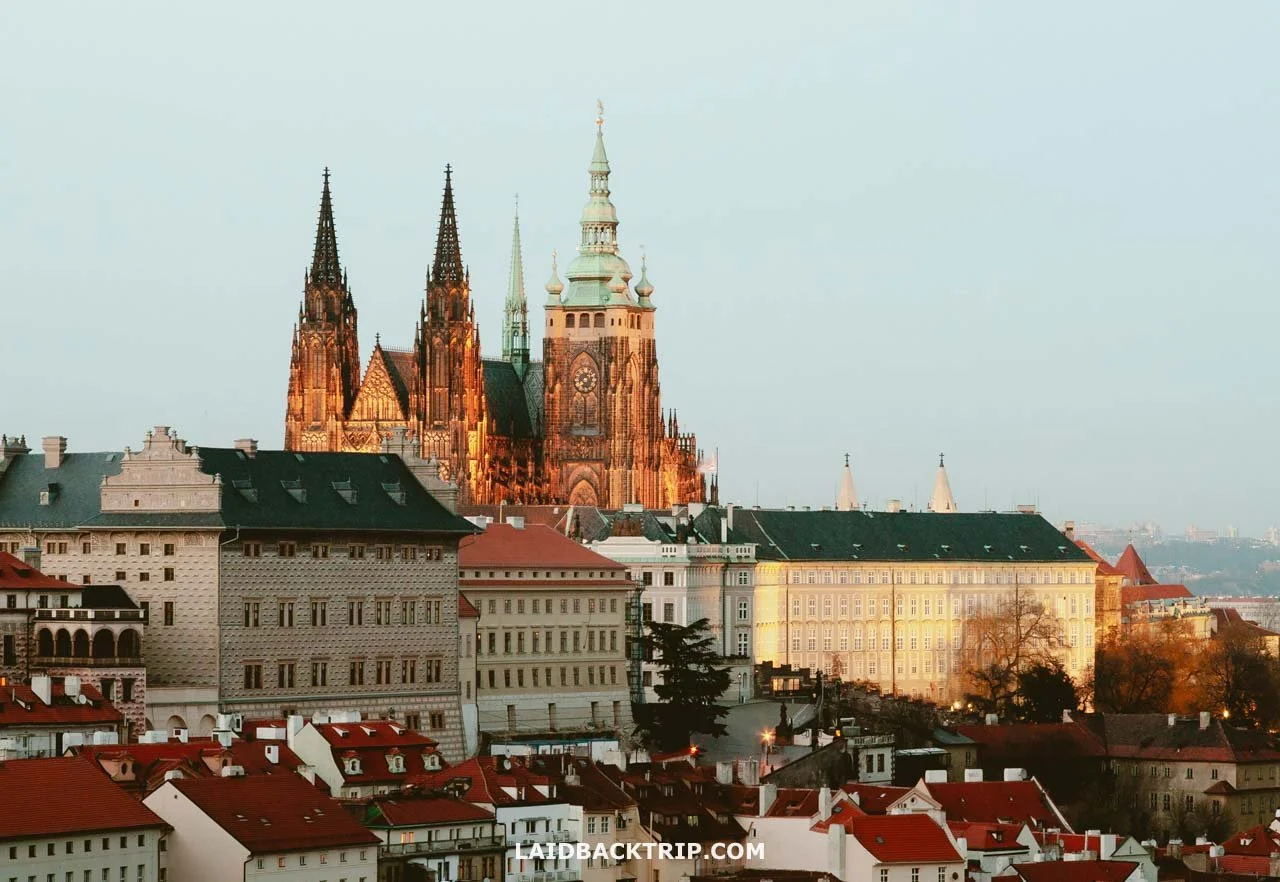
A visit to Prague Castle is definitely one of the highlights of any trip to the Czech Republic.
As locals, we've put together this guide with everything you need to know before visiting Prague Castle!
For us Czechs, Prague Castle is a very special place, because it's not just one of the top attractions in Prague, but also the most famous spot in the whole country. It's the seat of our presidents, a home to centuries of Bohemian history, and one of the main symbols of the Czech Republic. Since we were kids, we had visited it so many times that we had stopped counting, and for sure, far more often than our fellow Praguers, since it's still for us a place we love to visit in our free time.
I'm really not exaggerating here. Whenever we don't have any specific plans, a walk through the historic center to Prague Castle is still our favorite leisure stroll on lazy Sundays (or Saturdays, of course), as well as for sunrise or sunset photo walks. And the older we get, the more we enjoy our visits to the castle complex, though the early wake-ups to catch a sunrise from there are harder and harder with each year.
Prague Castle sits high above the Vltava River, Charles Bridge, and the Lesser and Old Towns, and since it's the world's largest castle complex, it is the true dominant of Prague, shaping its iconic panorama. A big part of it is that the Prague Castle is not just huge and really beautiful, but the grounds are free to explore. So being able to enjoy all the architecture, the views, and the atmosphere without paying a single dime is definitely a big reason for us to come here so often.
We both remember visiting Prague Castle as kids, whether it was with our parents or on compulsory school trips. But since then, we actually never bought a ticket again to see the castle's interiors, the cathedral, or the museums. Until just recently, when Lucie said that we should also see the Prague Castle like tourists, not just locals. And I have to admit that I was quite intrigued, because while we do come here quite often, I sort of never took it from the tourist's point of view.
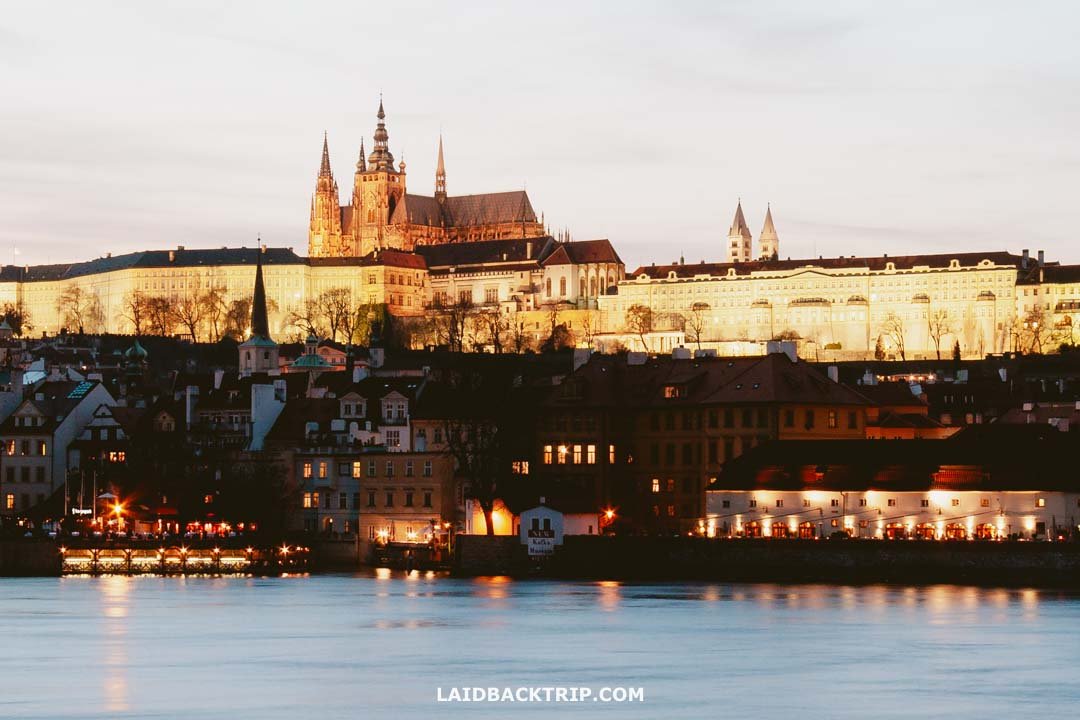
Prague Castle isn't just a historical landmark, but it's also one of the biggest symbols of our country.
This experience was great, it actually exceeded our expectations, and we loved for a moment to be tourists in the city where we live and that we know so well. We relearned so much about the architecture and history of the complex, and this visit only reassured us that Prague Castle is really one of its kind. And it really is, because it's also inscribed as a UNESCO World Heritage Site as being part of the Historic Center of Prague since 1992.
It does not matter if you are enjoying Prague for three days or if you kind of have to rush around the city's top attractions in only one day, pretty much every visitor to the capital heads to Prague Castle. Had we come here as tourists, we would definitely do the same, as it's simply a place one cannot miss. We also know very well from our many travels that visiting a place like this requires at least some basic planning to have a stress-free time there. Hopefully, this guide Lucie and I created for you will have all the answers to achieve just that. Let's dive into it!
Prague Castle History Started in 880 CE
Even though archaeological evidence shows that the area of Prague Castle was inhabited thousands of years ago, the history of the castle complex as we know it begins in the 9th century. Prague Castle was founded around 880 by Prince Bořivoj of the Přemyslid dynasty. At that time, the site consisted mainly of fortifications and the first stone building, the Church of the Virgin Mary.
From the 10th century onward, the importance of the castle grew. New churches were added, including the Basilica of St. George and the first church dedicated to St. Vitus. The original St. Vitus structure was a small rotunda, later replaced by a basilica. The cathedral we know today began to take shape in the 14th century, when Charles IV initiated the construction of a grand Gothic cathedral. This period marked Prague's golden age: under Charles IV, Prague became the seat of the Holy Roman Empire, and the castle served as the center of imperial power.
Prague Castle dates back to the 9th century, but it has been rebuilt, expanded, and transformed many times over the centuries.
After the death of Charles IV in 1378, Prague Castle entered a long and dramatic period marked by political instability, religious conflict, and shifting dynasties. Under his son Wenceslas IV, the castle lost much of its earlier prestige, and the Hussite Wars in the early 15th century brought significant turmoil. The castle was attacked several times, and parts of the complex were damaged or abandoned.
A revival came under the Jagiellonian dynasty in the late 15th and early 16th centuries, when major Renaissance-style rebuilding began. Vladislaus II commissioned the impressive Vladislav Hall, one of the earliest and largest Renaissance halls north of the Alps. Still, the castle's fortunes fluctuated. After 1526, the Habsburgs took over, and although they ruled from Prague at times, the castle often stood empty as the court moved between Vienna and other residences.
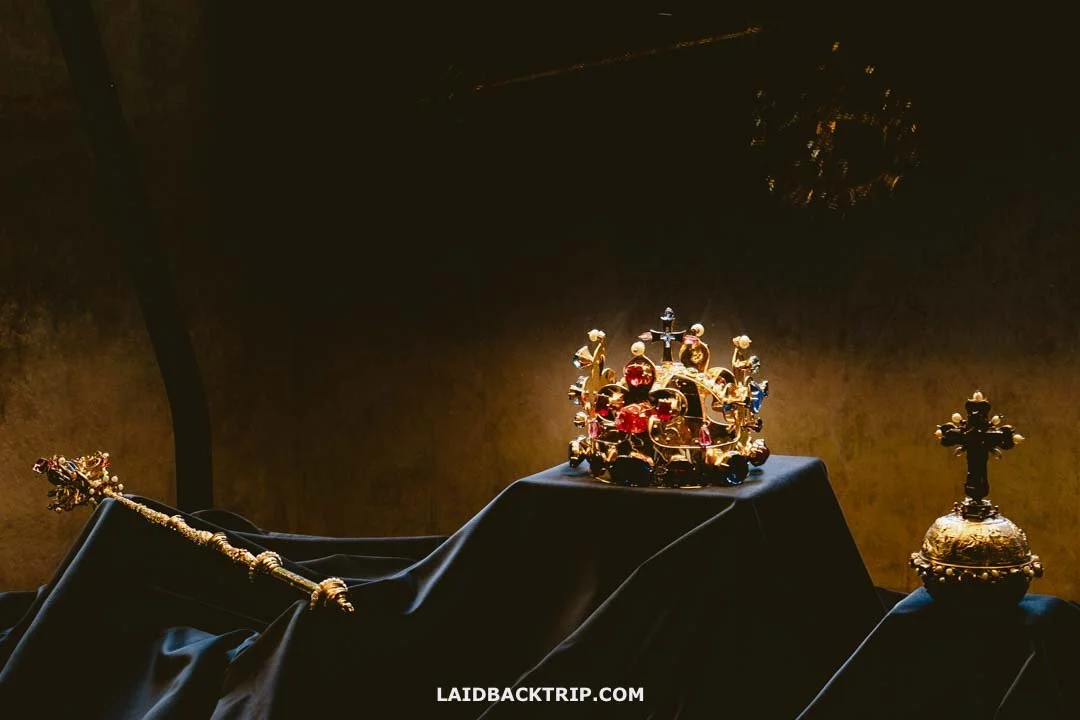
Czech kings were crowned inside St. Vitus Cathedral, where the Bohemian Crown Jewels were brought out for the ceremony.
The 1618 Defenestration of Prague, which helped spark the Thirty Years' War, took place within the castle walls. The conflict devastated the city and the complex. Only in the 18th century, especially under Empress Maria Theresa, did the castle undergo major Baroque reconstruction, giving it much of the appearance it has today.
In 1918, with the creation of an independent Czechoslovakia, Prague Castle became the seat of the country's president and underwent major renovations led by architect Josip Plečnik, who reshaped it into a modern seat of democratic power. During the communist era after 1948, the castle served as the symbolic center of the regime, hosting state ceremonies, foreign delegations, and tightly controlled political life. Since 1993, it has served as the official residence of the presidents of the Czech Republic. Today, Prague Castle is not only the political heart of the country but also the most visited monument in the Czech Republic.
How to Buy Prague Castle Tickets
When I said earlier that we go to the Prague Castle so often because it's free to visit, what I meant by that was that we stick to the castle grounds, which are really accessible without any ticket. Just by walking through the complex, we get to see pretty much all the main sights like St. Vitus Cathedral, St. George's Basilica, or the change of guards. This is a fantastic way to see the Prague Castle, not just for us locals but also for every tourist who comes to our city for a quick visit or travels, as we do ourselves so often, on a budget.
Buying Your Prague Tickets on the Spot
With that said, no matter how impressive the cathedral's exterior is, if this is your first time in Prague, we would really recommend getting a ticket and going inside, as the interiors are definitely worth seeing. Now the easiest way to get a ticket to the Prague Castle is to buy it on the spot.
There are three ticket offices within the castle right now. Since we know that the ticket office in the Second Courtyard is always without a line, we decided to get them there. Most tourists buy them at the ticket office in the Third Courtyard by the St. Vitus Cathedral, but this one is the busiest, so expect to spend some time queuing. The last one is by the Golden Lane, which is also quieter.
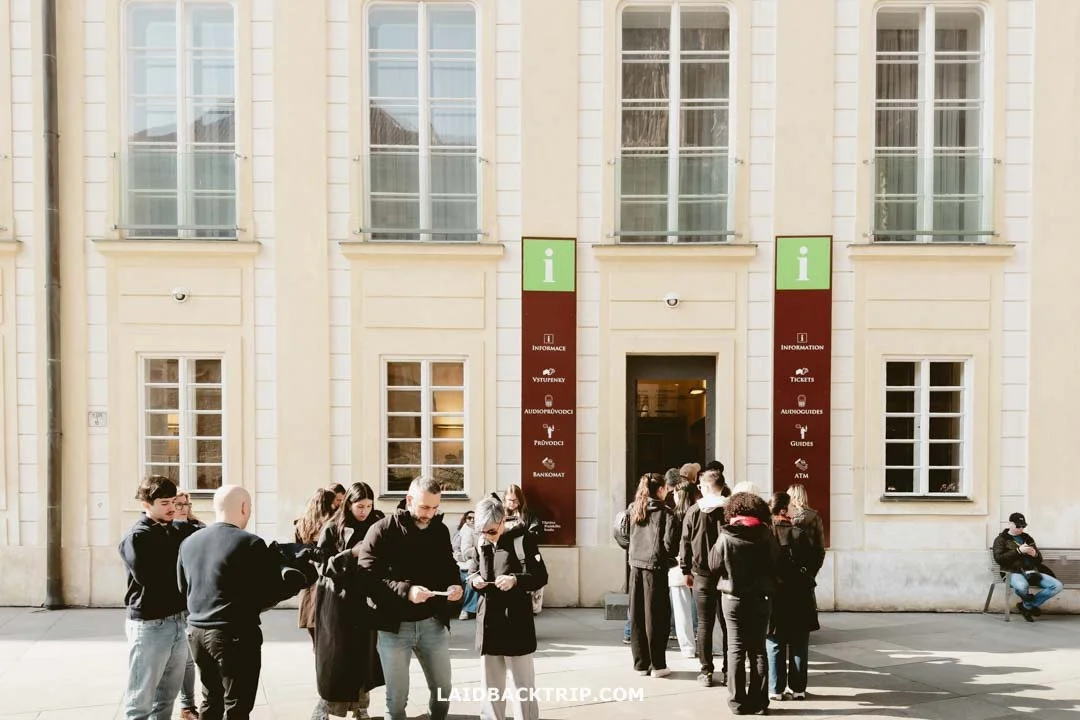
The ticket office in the Second Courtyard is always the busiest, so be prepared for a bit of a wait.
Buying Your Prague Tickets Online
As I'm writing this (in 2026), the only official way to get Prague Castle tickets online was through either GetYourGuide or Ticketportal, but there was no option to buy them directly at the official site (yes, I found that one strange too). All tickets to Prague Castle are valid for two days, so you do not have to rush in case you cannot see everything you wanted in only one day. Don't forget to mention if you're a student, over 65, or visiting with kids to take advantage of the discounted ticket rates.
You might also find some sites, often carrying a very official name, reselling the tickets, but I would avoid them since they're always overpriced. And if you see the Skip the Line Tickets, then Prague Castle actually doesn't have them. It just means that you don't have to wait in line at the ticket office, nothing else.
Main Circuit Ticket
As of now, Prague Castle has four types of tickets. The main one is called the Main Circuit. It costs 450 CZK and includes, as the name indicates, all the highlights: Old Royal Palace, St. George's Basilica, Golden Lane, and St. Vitus Cathedral. This was the ticket we got, as we wanted to focus on what most people come here to see.
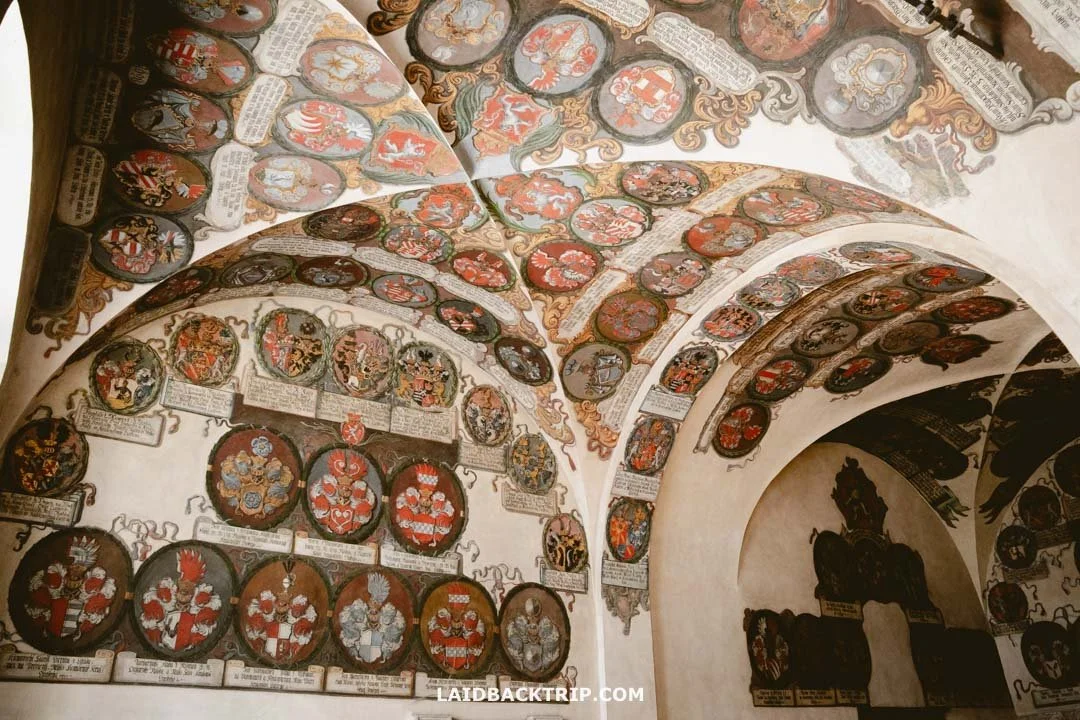
These beautifully detailed coat‑of‑arms paintings are located inside the Old Royal Palace.
Permanent Exhibitions
The next one is called Permanent Exhibitions, costs 300 CZK, and includes the Story of Prague Castle, Castle Guard Exhibition, Prague Castle Picture Gallery, and Rosenberg Palace. It's definitely more niche, and from my experience, the majority of tourists skip it, so if you're in the city for a few more days, this is a nice way to enjoy some parts of the Prague Castle without crowds.
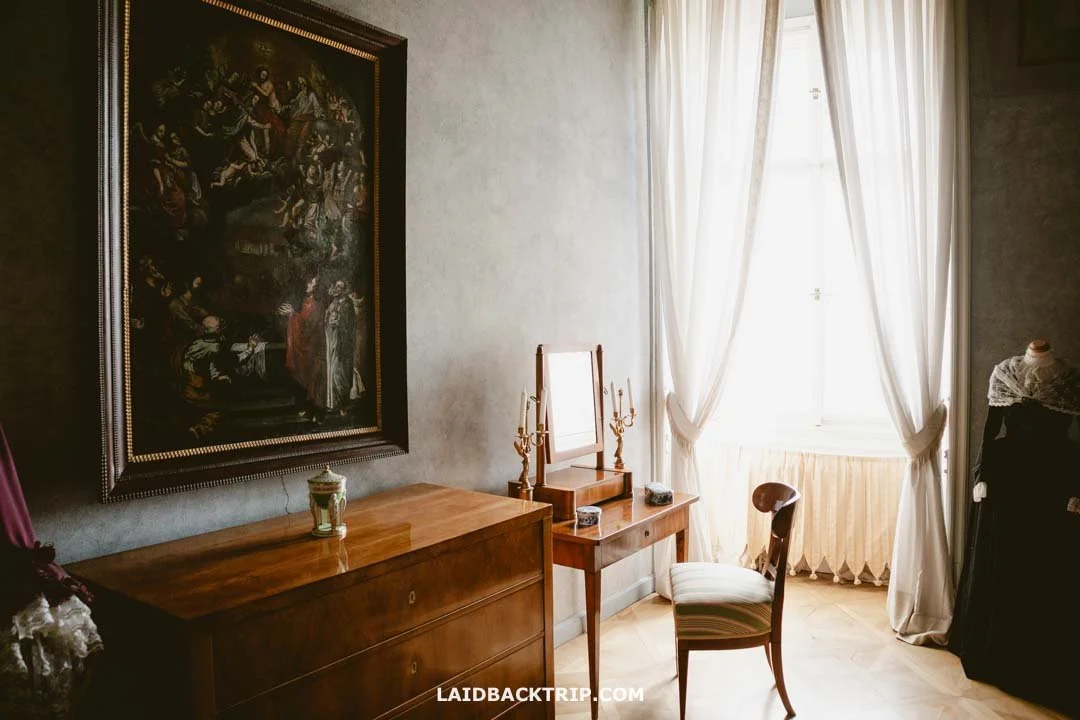
The Permanent Exhibitions ticket gives you access to a few lesser‑known spots like Rosenberg Palace.
Prague Castle Picture Gallery
Similarly, there's the Prague Castle Picture Gallery ticket for 200 CZK, which has a collection of the emperor Rudolph's paintings.
Tower of the Cathedral with a View Gallery
Finally, there's the Tower of the Cathedral with a View Gallery ticket for 200 CZK, which is needed to climb that tall tower at St. Vitus Cathedral. While the cathedral itself is included in the Main Circuit, the tower is not, and if you want to enjoy some stunning views of Prague from there, you have to pay extra. We love climbing old towers, so we think that one's really worth it too.
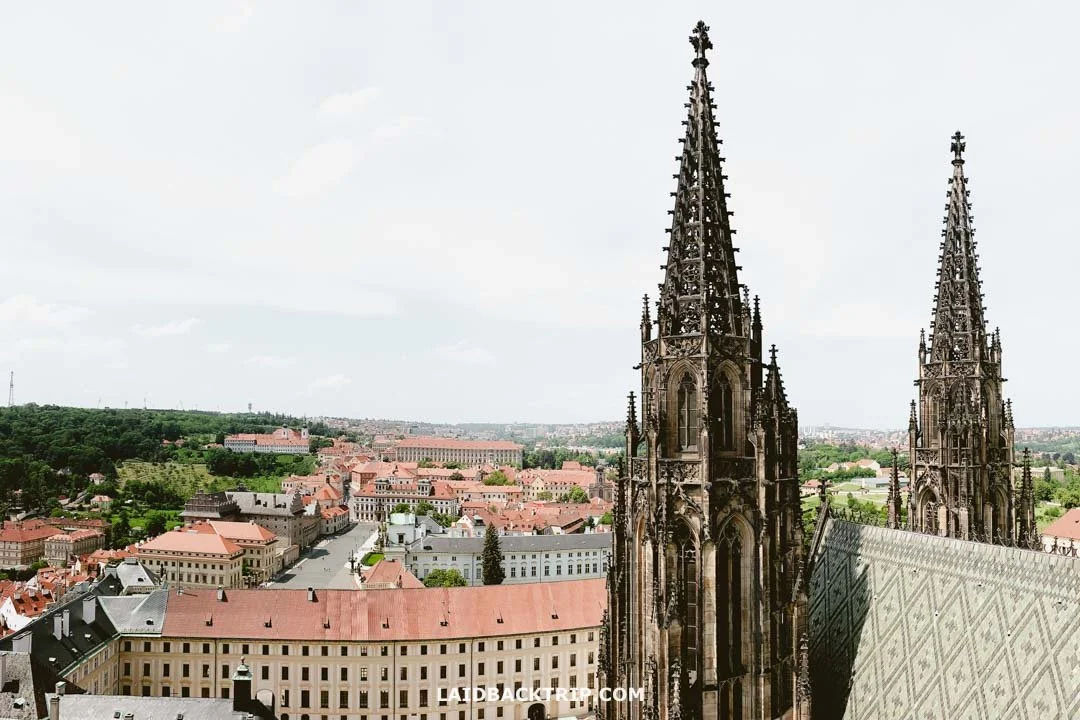
Climbing to the top of St. Vitus Cathedral is definitely worth it for the views.
What You Can See at Prague Castle for Free
Now, if we didn't convince you that the main ticket is worth it, we have two tips for you, which will at least give you a small peek of what you're missing out on. First, it's possible to go inside the St. Vitus Cathedral and see its main section for free. You cannot walk around and admire all the details, but you can look at how it looks inside from the front door. You won't get any further as there are tourniquets.
Another place which you can see for free is the Golden Lane, but only after the official opening hours, which are 5 PM in the summer, and 4 PM in the winter. The shops will be closed, but I actually prefer it that way. And like I said, the whole castle complex is free to enter, so you can wander through all the courtyards and gardens without buying a ticket.
Visiting Prague Castle Independently or With a Guided Tour?
We prefer to wander around Prague Castle on our own, mostly because we've already been there so many times and explored most of its areas that we really don't need to go with a guide. But if we were you, coming to see the castle for the first time, we would definitely consider the option of taking a guided tour. I'd argue that the whole complex is pretty big, and these tours make everything much easier for you.
If you book through the official channels (like on the spot), the standard guided tour takes about an hour, costs 250 CZK, is available in multiple languages (English, German, Spanish, French, etc.), and the guide will show you St. Vitus Cathedral and the Old Royal Palace. They also offer other, more specific, tours, but I'd go with the standard one if I were visiting for the first time.
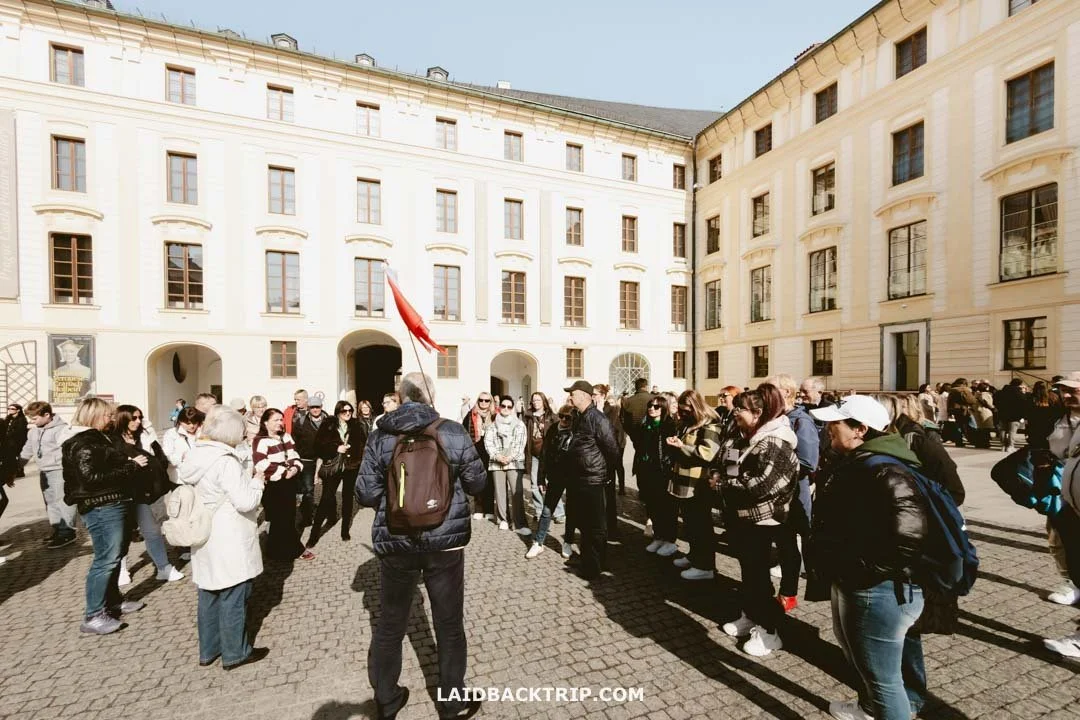
Exploring Prague Castle with a guide is definitely easier than doing it on your own.
There's also an option to explore Prague Castle with a private guide. I think this option is the best for visitors who want the smoothest experience, because you usually meet your guide outside the complex, so the only thing you really need to do is reach the meeting point on time. Another advantage is that you can go with a small-group tour, which is something we prefer ourselves.
If you prefer to learn about the complex history, but guided tours are not exactly what you want, you can rent an audioguide for 350 CZK in the Third Courtyard. Remember that there's also a deposit for each device you rent, so carry some extra cash. It includes a total of 96 stops, which cover all the Prague Castle highlights and history in about three hours.
Our tip: There's also an app called Archaeology of Prague Castle that is completely free. It has tons of information on the archaeological findings of the past 150 years, offers a unique look under the castle to areas which are not accessible to the public, and also shows nicely how the whole castle complex changed over time.
Opening Hours of Prague Castle Are Seasonal
The grounds of Prague Castle are open every day between 6 AM and 10 PM, and during this time, you can walk around the whole complex freely, and as we already said, even without a ticket. We've been there right after the complex opened and just before it closed, and the early mornings are especially great to enjoy this area when it's quietest.
If you plan on getting the ticket and visiting the historic buildings like the royal palace, the cathedral, or the museums, then note that the Prague Castle has seasonal hours. The summer season is from April 1 to October 31, and the winter season is from November 1 to March 31.
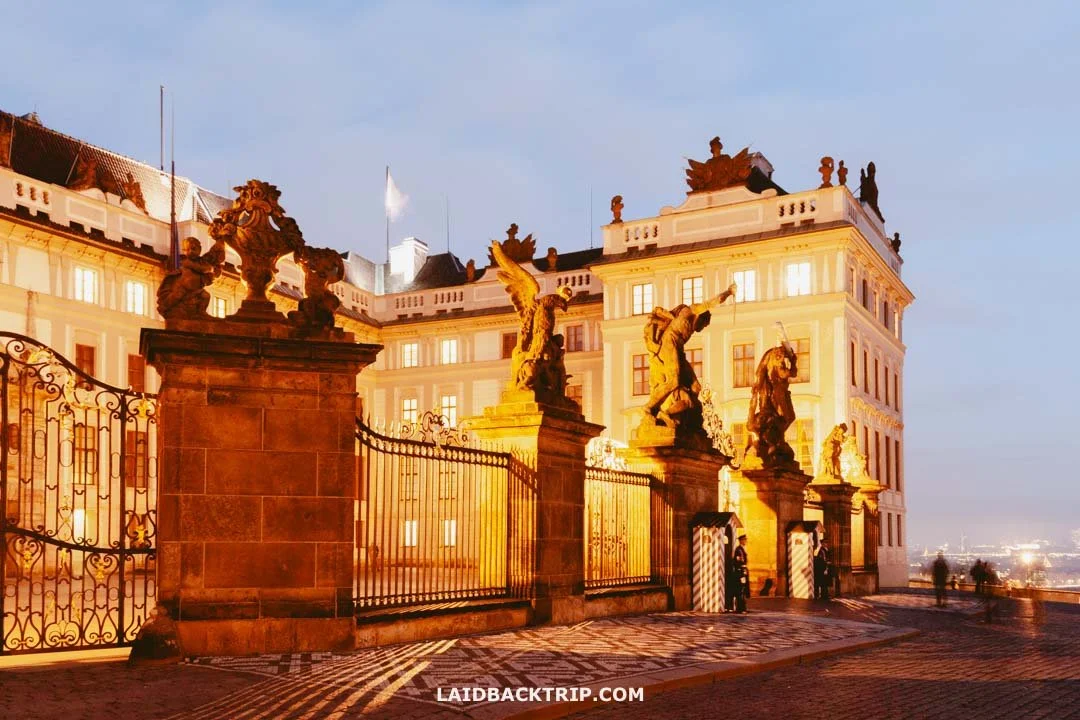
Prague Castle is beautiful at night, but the grounds close at 10 pm.
Summer Season
In the summer season, historical buildings are open from 9 AM to 5 PM (exhibition halls still open until 6 PM) from Monday to Sunday. The only exception is St. Vitus Cathedral, which has opening hours from 12 PM to 6 PM on Sundays. The last entrance is usually twenty or thirty minutes before closing time, so make sure you arrive on time. As St. Vitus Cathedral is a church in use, regular services and special ceremonies take place here. To make sure your visit won't be affected by these ceremonies, check out the official website below, where you can find up-to-date information. Castle Gardens are open from 10 AM to 8 PM in the peak season (and close a bit earlier outside July and August).
Winter Season
During the wintertime, historical buildings and St. Vitus Cathedral are open from 9 AM until 4 PM. Again, on Sundays, St. Vitus Cathedral opens at noon. Great South Tower is open from 10 AM to 5 PM. The exhibition halls are open from 10 AM to 6 PM. Prague Castle Gardens are closed from the start of November to the end of February.
How Long Does It Take to See Prague Castle?
Probably the hardest part of deciding how much time to set aside for Prague Castle is figuring out what you actually want to see there. As we can come here any time we want, we really don't think about it, but you will most likely be in a very different situation. From my experience, I'd say that three to four hours should be enough to see the very best of Prague Castle for most visitors, but let's take a closer look at it.
Now, even our most brief visits to Prague Castle took at least an hour, and that was basically just a simple walk around the complex, without any visit to the historical buildings or museums. In this case, it was really just about walking around the grounds, seeing the courtyards, the cathedral, the main viewpoints, changing the guards, and the gardens. I'd say that another hour would definitely make it a much more relaxed experience, especially if you want to see the changing of the guards, as this one requires a bit more careful timing (if you miss it by a few minutes, you'll need to wait for another hour).
When we went to see the main sights included in the Main Circuit Ticket, it took us about four hours to see it all, including the climb to the cathedral tower. There were no lines that day as we went in the off-season, so if you come here in May or June, you might need to add some extra time. We didn't rush, but we did not take the slowest pace either. But as I said, three to four hours are enough to see the Royal Palace, St. Vitus Cathedral, and walk around the whole place.
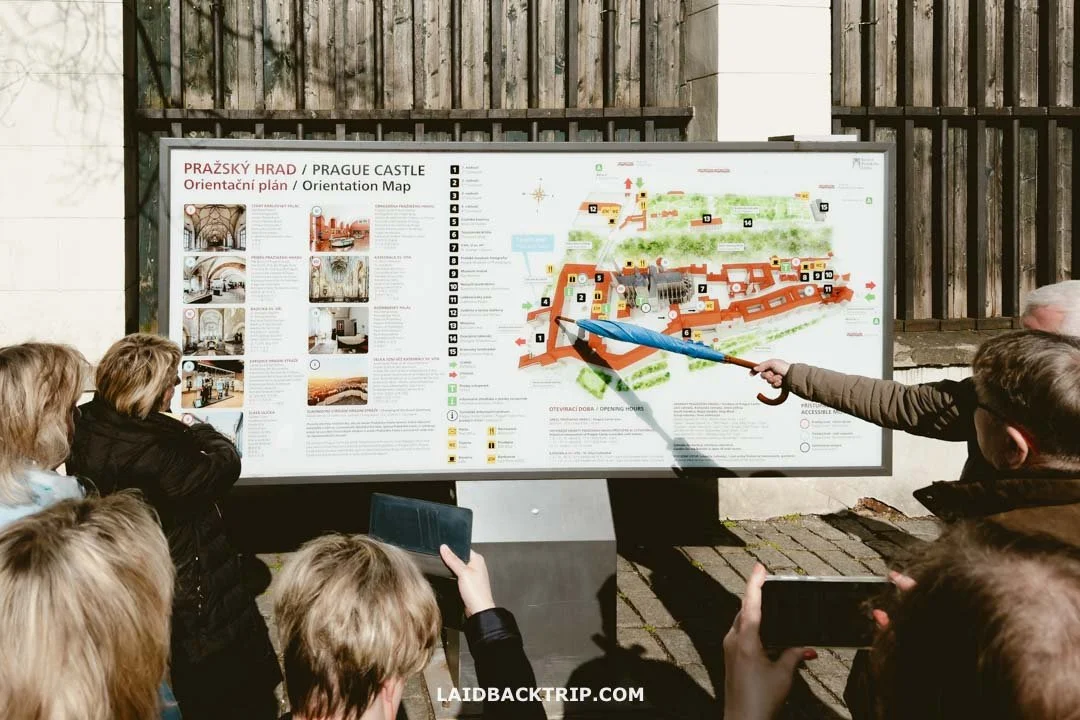
The Prague Castle complex is huge, and we always end up staying for a few hours.
There's definitely more than enough to see at Prague Castle for those interested in it, so it's easy to spend a full day here. We've never been here that long simply because it just doesn't make sense to us, and quite honestly, it would be a very long and tiring day just to focus on this particular site.
The most typical situation where you would need a large part of the day is if you plan to do the Main Circuit and Permanent Exhibitions in one go. Even then, we would probably split it into two days if we were you, which works well since the tickets are valid for that time frame, allowing you to visit everything in any order you like. We're speaking from experience, because this is exactly how we explored Prague Castle ourselves, though instead of coming back the next day, we ended up taking a few months' break between the two circuits.
Prague Castle Has Three Entrances
I'll get into it in more detail in the next section, but just so it's all clear, I want to quickly list all the points where you can enter the Prague Castle complex. The main one is from Hradčanské Square in the west. Here's the famous Gate of Giants with the statues of wrestling Titans, but nowadays it's used as an exit only, with the entrance being just a few steps left of here through the Fourth Courtyard. This one is reached either by walking up from Charles Bridge and continuing to Nerudova Street or New Castle Stairs, or by taking a tram to Pohořelec and walking from there.
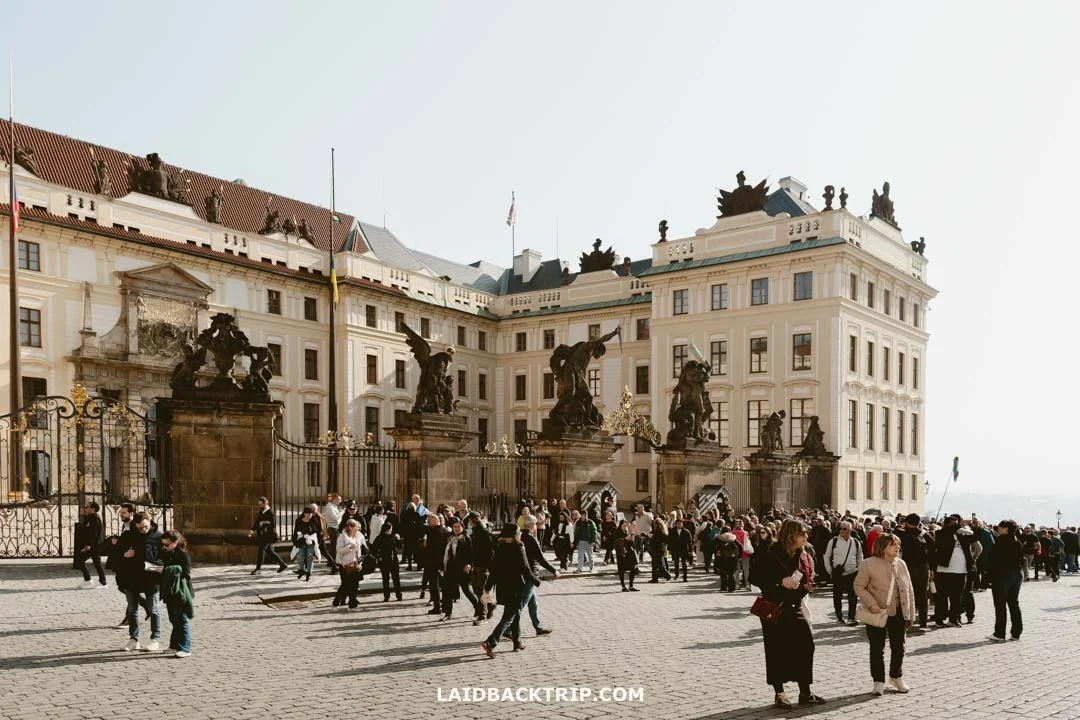
We usually just enter Prague Castle from Hradčanské Square.
The north entrance is a short walk across the Powder Bridge and through the Second Courtyard, reached either by taking a tram to Pražský hrad or a hop-on, hop-off bus. Na Opyši Gate is the east entrance, which you'll reach via Old Castle Stairs from the Malostranská metro station.
Lastly, there are two seasonal entrances. In the northeast, there's an entrance to Royal Gardens, which you can reach by taking a tram to Královský letohrádek or walking here from Letná Park through Chotkovy sady. The Stag Moat can also be entered through its western gate from U Brusnice Street. However, these are open only from March to October. Now that I have hopefully made all this clear, let's take a closer look at it.
The Best Way to Get to Prague Castle Is on Foot
While there are three main entry points and several ways to get to the Prague Castle, we pretty much always just walk there. Since we live southeast of the castle, it means that we have to get there from Lesser Town, which is actually the hardest route. Our favorite option is to go to Charles Bridge first, then cross the Vltava River, walk to Malostranské náměstí, and then climb through Nerudova and Ke Hradu Streets all the way to the castle. Sometimes, we take Thunovská Street followed by the New Castle Stairs instead.
For me, this is the most scenic route, and I also prefer to explore the Prague Castle this way, as it has the most ceremonial feeling. Sometimes, we take a tram or metro to Malostranská, and then walk to the castle via Old Castle Stairs, but as I said, this is the way that doesn't feel that natural to me. And if you ever read that the climb to the castle from Lesser Town is challenging, then it really isn't, unless you have limited mobility. Our favorite part is that we pretty much never leave the same way we got to Prague Castle, which is great, as you can really combine all the options.
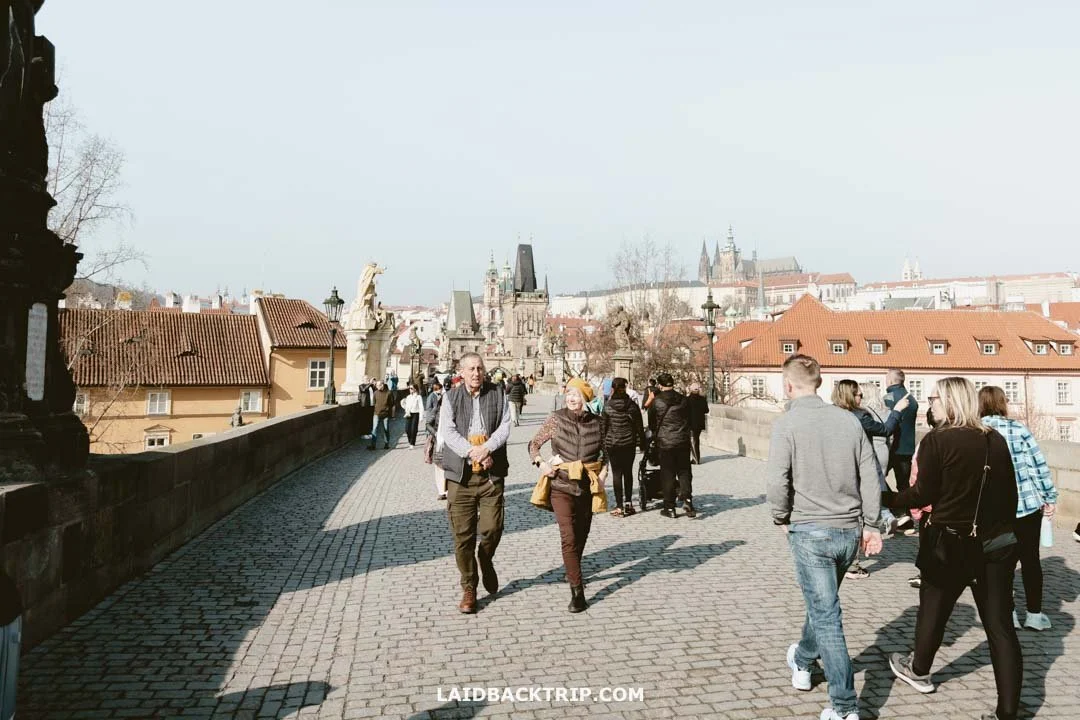
Our favorite way to get to Prague Castle is on foot, following the classic Royal Route that leads you across Charles Bridge.
The easiest way to get to Prague Castle is by tram 22, as it stops within walking distance from all three entrances, either at Malostranská, Pohořelec, or Pražský hrad, with the last being the most popular as it practically stops right beside the castle and you avoid the walk uphill.
Lucie also loves to get to Prague Castle via Petřín Hill during spring, as the whole park is just stunning during this time of the year. We get to Újezd first (either by tram or on foot), and from here, we walk up through the park in the direction of Petřín Tower (or just take the funicular). From the top, it is about a 20-minute walk to Prague Castle.
Prague Castle can also be reached by metro (Green A Line), either from Malostranská (closer, but you need to walk uphill from here) or Dejvická (at least a 15-minute walk).
There's Really a Lot to See and Do at Prague Castle
I'm not really sure what you imagine under the words Czech castle, but if it's the classic medieval fortress like Karlštejn or Zvíkov, Prague Castle is nothing like it. We admit that calling it a castle can be a bit misleading and really doesn't do this place any justice. The whole complex is really huge, which isn't surprising as, depending on the definition, it is actually the largest in the world. And after almost 12 centuries since it was founded, it has gone through so many transformations that the mix of buildings, alleys, museums, galleries, and gardens creates a visual like no other.
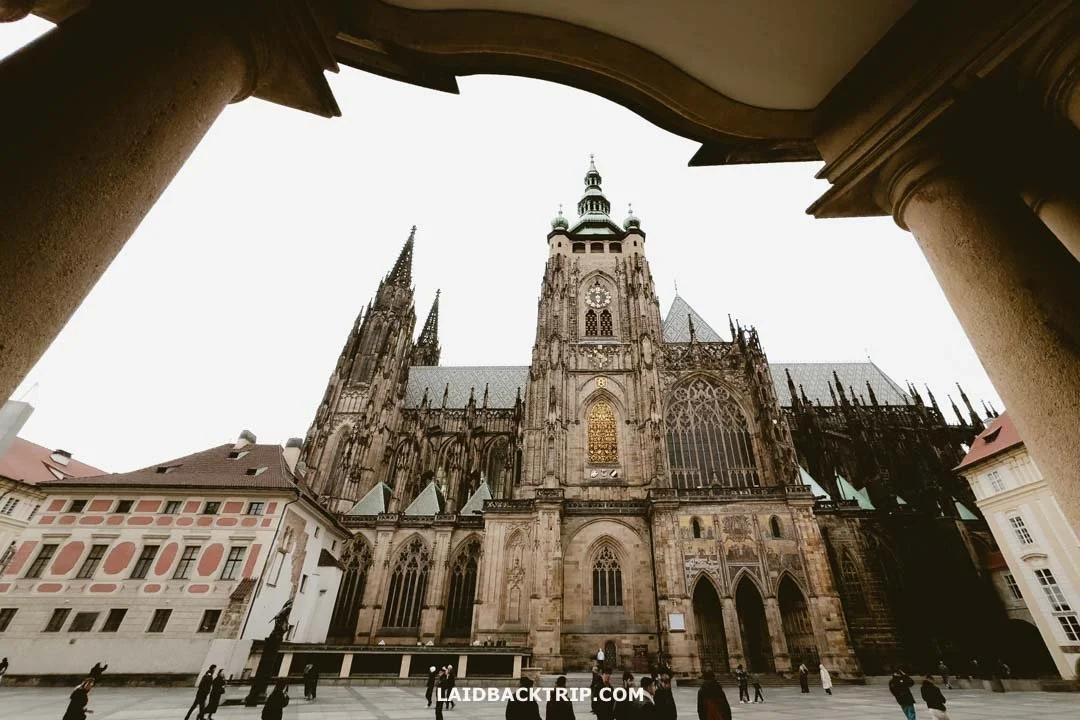
St. Vitus Cathedral is one of the absolute highlights of Prague Castle.
There's really so much to see and do at Prague Castle because, and that's the best part, most areas are accessible to the public, whether in the form of open courtyards, green gardens, historical sites like the old palace or cathedral, or spaces turned into museums and galleries. I'm going to mostly focus on the areas included in the Main Circuit ticket (Old Royal Palace, St. George's Basilica, Golden Lane, and St. Vitus Cathedral), because that's what I think most visitors plan to see here, but I'll also take you up to the highest tower of the whole complex, see the guard change, walk through the Royal Garden, and share my favorite viewpoints.
Hradčanské Square
As I said, we pretty much always start exploring the Prague Castle from Hradčanské Square, so we'll not change it here either and follow in our usual footsteps. Out of all the entrances, this is the one that feels the most official to me, and I'm definitely not in the minority because it's always the busiest one. And it doesn't matter whether we take the New Castle Stairs or follow Nerudova and Ke Hradu Streets, because they all meet at the same place.
No matter how many times we've been here, we never rush through this area, as this is where the whole experience begins. We always stop by the wall, which has some of the best views of Prague, full of red roofs, towers, and the Petřín Hill. Only a few steps from here is the main gate, where we stop to admire the sculptures of Wrestling Titans, check whether the Presidential flag is hoisted, which means that our president is in his office right now, and if we arrive here on the hour, watch the change of guards who stand on each side of the gate.
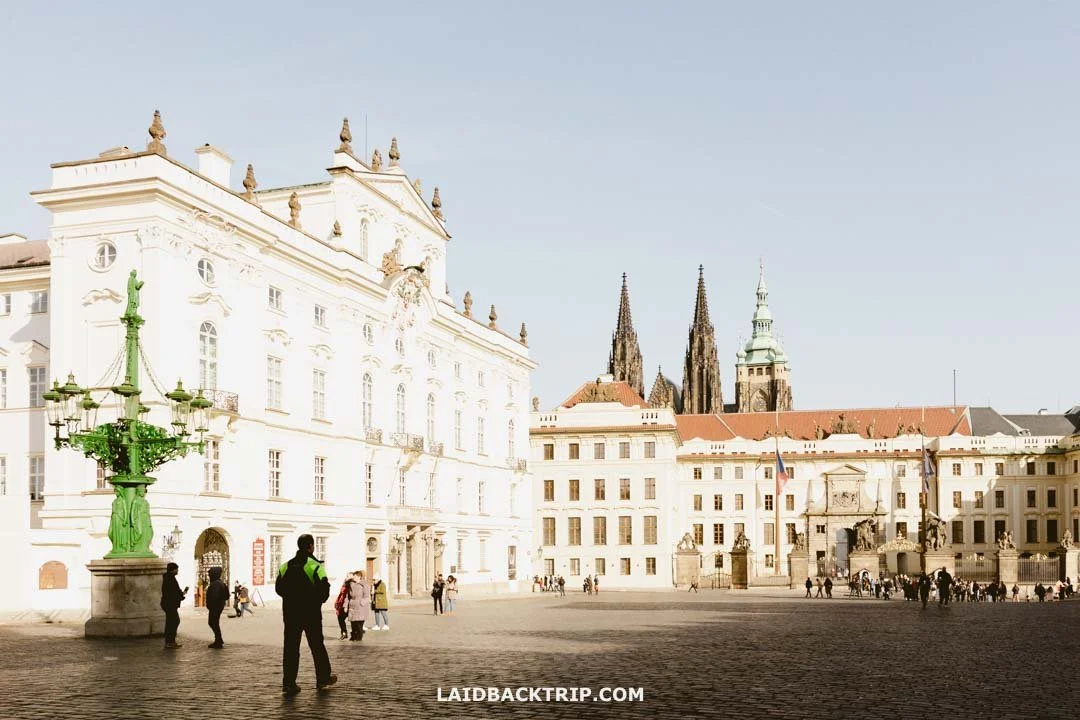
We start most of our visits to Prague Castle from Hradčanské Square.
The actual visitor entrance is now on the left side, about 50 meters from the Giant's Gate, which is now used only by those leaving the complex. Before we head there next, it's worth taking a peek behind the gate at the First Courtyard and the beautiful baroque Matthias Gate, built by Matthias, Holy Roman Emperor, in 1614. This is a ceremonial space connecting the first two courtyards, wrapped in centuries of Czech history. If you want to walk through this area, you can easily enter it from the Second Courtyard (you will most likely have to exit and reenter the complex the same way you arrived here).
It's also worth exploring the Hradčanské Square beyond this area, as it is lined with charming palaces and historical buildings, many of which now house museums and exhibitions. The most beautiful building is easily the Schwarzenberg Palace, which has an amazing Renaissance sgraffito facade. Besides the buildings, there's the Statue of Tomáš Garrigue Masaryk (opposite the Giant's Gate) and the Marian Plague Column (that one sits in the middle of the square).
Changing of the Guards at 12 PM
Before we leave Hradčanské Square, we can stay here a bit longer and enjoy the famous changing of the guards. It's one of those small rituals that gives the Prague Castle a bit of a ceremonial feel (and definitely adds it to your visit). The guards belong to the Castle Guard, an elite unit that protects the president, and you'll see them rotate every hour at the main gates.
However, the main change happens at noon in the First Courtyard, and what makes it worth catching is that it's slightly more formal, with a brief fanfare and a flag exchange. The whole ceremony only lasts a few minutes, but it's definitely worth seeing, even if you don't come here at noon. If you're following in our footsteps, you'll probably be here much sooner anyway. But since you can roam freely around the complex, you can always come back here.
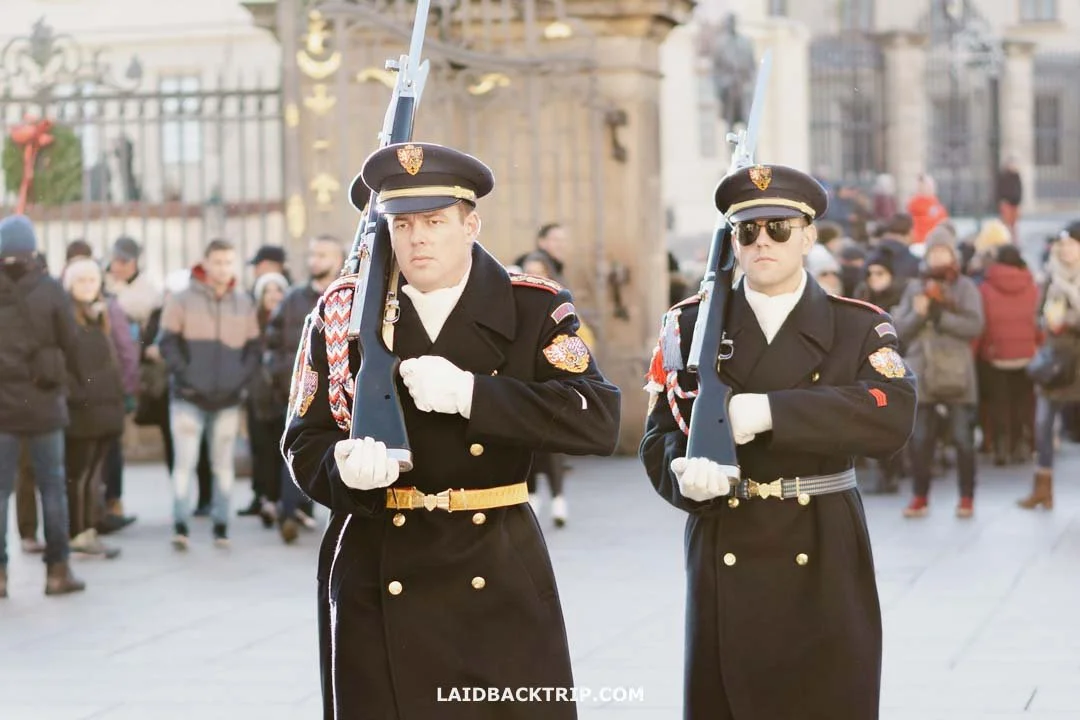
The guards at Prague Castle change every hour, so it's easy to catch the ceremony as you explore the grounds.
Second Courtyard and Prague Castle Picture Gallery
From the Fourth Courtyard, we continue to the Second Courtyard. At first it might seem like there's not much to see or do, but I really like this spot. Most people just walk through without spending much time, though almost everyone snaps a photo of Kohl's Fountain, which is fed by the nearby Brusnice. I love this place after sunset when it's beautifully lit and has a really stately atmosphere. As I mentioned earlier, this is a good place to get your tickets. You'll need them, because if you choose the Permanent Exhibitions option, the first stop is right here.
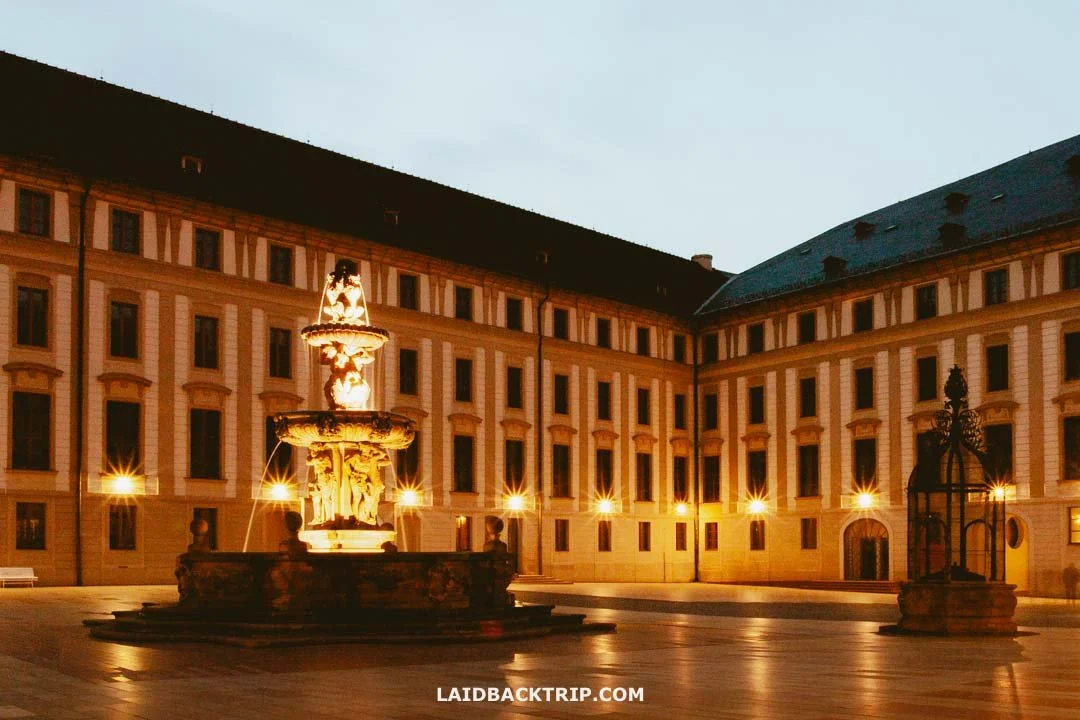
The Second Courtyard with Kohl's Fountain is especially beautiful after dark.
The Prague Castle Picture Gallery houses the castle's historic art collection, including works by Titian, Rubens, Veronese, Cranach, and Hans von Aachen. With roots in the late 16th century, it's the oldest continuously preserved painting collection in Czechia. It's a small gallery, and with the way we're exploring the whole complex, I'd probably continue straight to the Third Courtyard, where the main highlights are, and save this one for later if time allows. Don't forget that before continuing to the Third Courtyard, you can also see the First Courtyard from here, the one we saw from Hradčanské Square through the gate.
The State Rooms
I know you're tempted to finally head straight into St. Vitus Cathedral, but I have one more tip before you do. Since we're standing between the First and Second Courtyard, it's the perfect moment to take a closer look at Matthias Gate. I already mentioned that it was built in the 17th century, so I'll just add that it was designed by the Italian architect Giovanni Maria Filippi and is one of the oldest examples of secular Baroque architecture in Prague.
But the main reason why I'm telling you this is that it also serves not just as a passage between two courtyards but also as an entrance to the New Palace that encompasses the whole Second Courtyard. That's where, on the first floor, the ceremonial halls and rooms used for the President's official duties are located. This is the place where our President receives state visits and appoints ministers, judges, or generals. While some of these spaces date back to the 16th century, the South Wing salons were given their current look during the 18th‑century Empress Maria Theresa renovations.
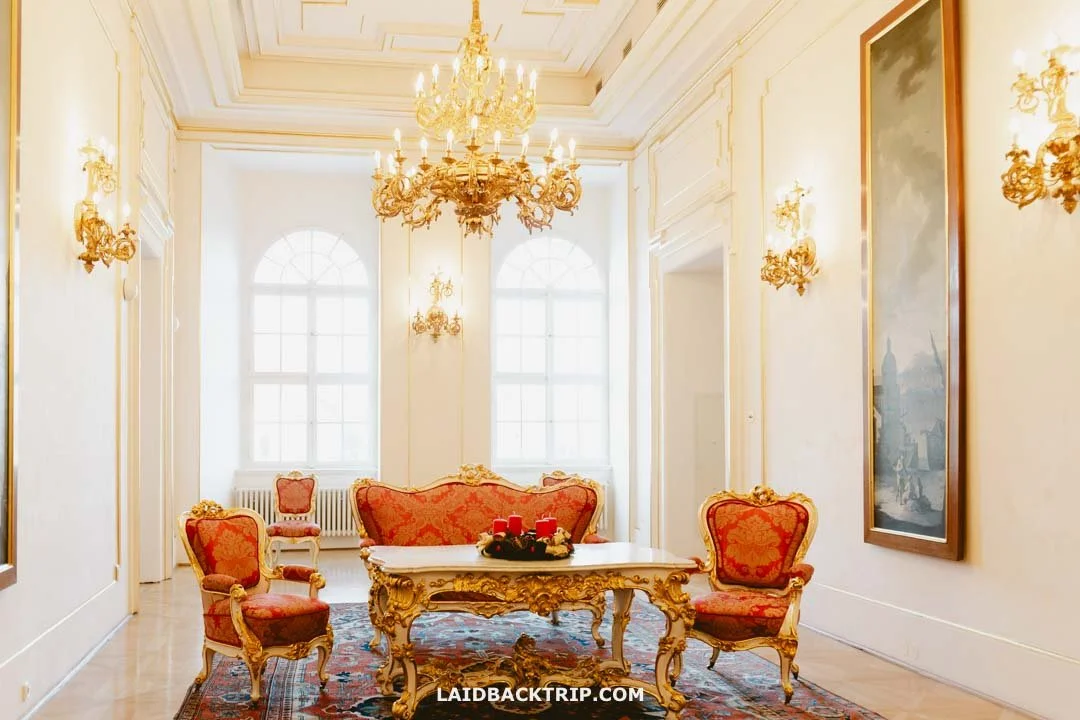
The state rooms are normally closed to the public and open only on special occasions.
The New Palace is normally closed to the public and opens only on special occasions. But since we live in Prague, all we had to do was wait. And we did. The day, simply called Open Days, arrived just before Christmas, and we were really excited because it was the first time we could finally see up close the famous rooms like the Spanish Hall or the Throne Room that we'd only known from TV. Some of the other interesting rooms we got to see inside the New Palace were the Rothmayer Hall, the Habsburg Drawing Room, the Octagon, and the Rudolph Gallery.
For us, it was a really special experience, and the best part was that there was no admission! For tourists, getting to see the rooms of the New Palace is basically just about luck, because you would have to wait until the Open Days are announced, and then plan the whole visit around it. It's not impossible, but not easy either.
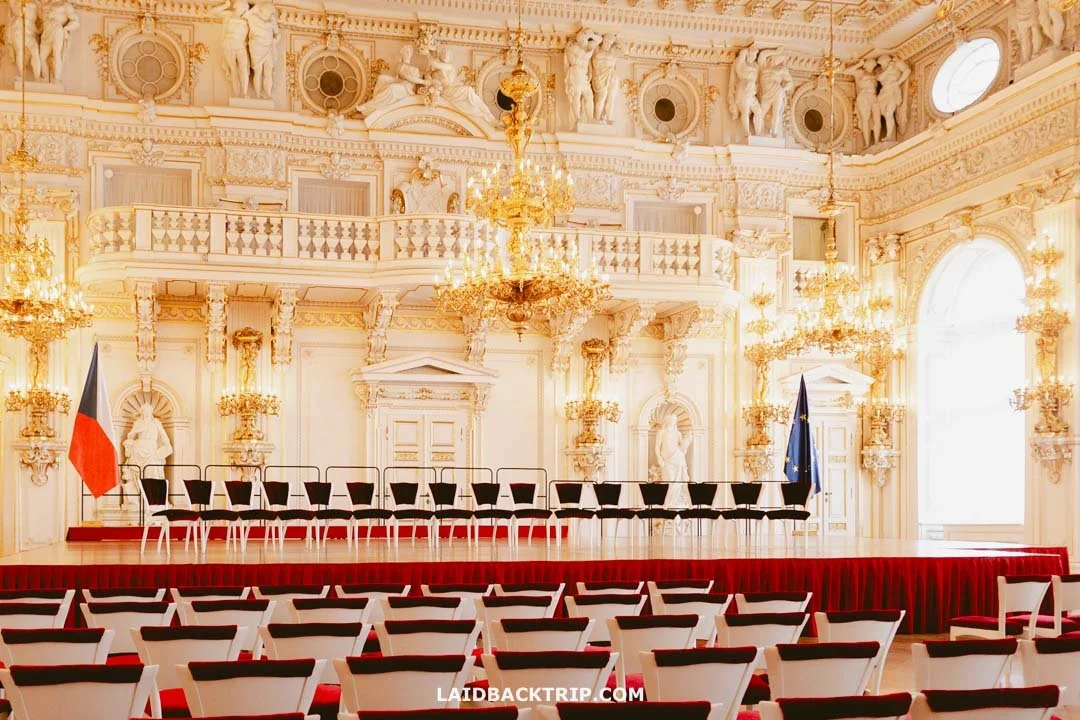
Spanish Hall is a lavishly decorated hall used for official ceremonies.
St. Vitus Cathedral
I never get tired of seeing St. Vitus Cathedral. It does not matter how many times we've been in the complex, because I always can't wait to see the cathedral. That walk between the Second and Third Courtyard is one of my favorites in all of Prague because of how suddenly the cathedral rises in front of you, so tall you instinctively lean back until your neck complains.
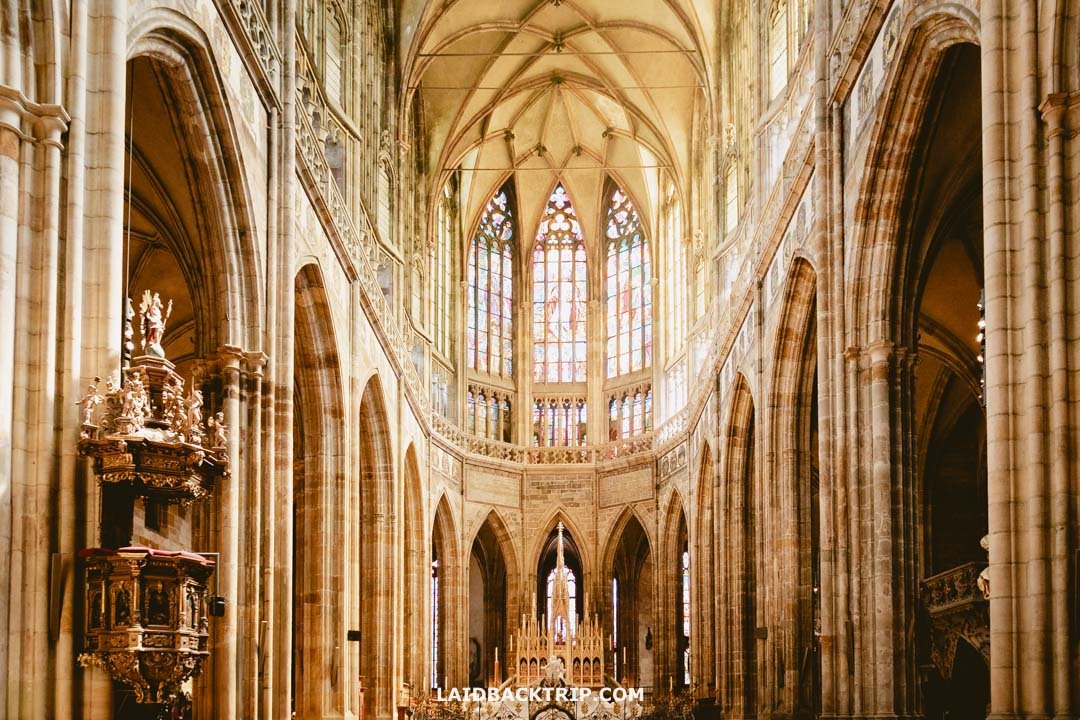
St. Vitus Cathedral is nearly seven hundred years old.
It's the largest church in the Czech Republic, and as such, there's a lot to take in. Construction began in 1344, replacing a 10th‑century rotunda that once stood here. The cathedral is mostly Gothic, but because it took more than 500 years to finish, you can see the city's entire architectural evolution represented by the Renaissance and Baroque touches. While Prague is often described as a medieval gem, St. Vitus is the perfect reminder that it's really much more than that.
Since we got the ticket just a second earlier on the Second Courtyard, we think it's a good idea to start with the cathedral first, as its entrance is right in front of us once we leave the passage (it's the door on the right, the one on the left is an exit). There's lots to see inside, but obviously, it's the huge nave with ribbed vaults and intricate stonework that hits you first. There's also the St. Wenceslas Chapel, lined with semi‑precious stones and medieval frescoes, the tombs of Czech kings, including Charles IV, and the silver‑laden tomb of St. John of Nepomuk, plus the Art Nouveau stained glass by Alfons Mucha.
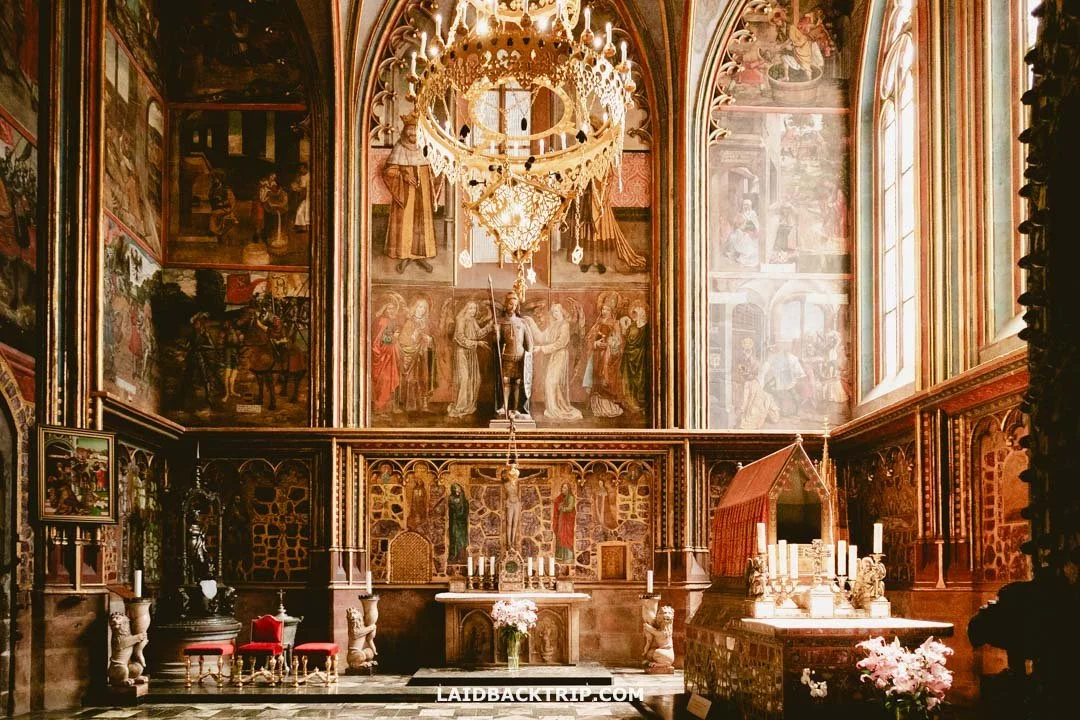
St. Wenceslas Chapel is a richly decorated chapel honoring the Czech patron saint.
Great South Tower
I hope you got the ticket for the Great South Tower, because once we leave the cathedral, that's where we're headed next. The entrance is on the south side of the cathedral, past the Obelisk and the Fountain with Saint George, but before we start the climb, I always take a step back to see the whole cathedral in its full glory. If the weather is nice, we sometimes sit on the bench there and enjoy the view in a more relaxed way.
Obviously, this side is dominated by the Great South Tower, which is over 100 meters tall. There's one more thing that's really cool here. Right of the tower entrance is the Last Judgment mosaic, created in the 14th century and truly incredible.
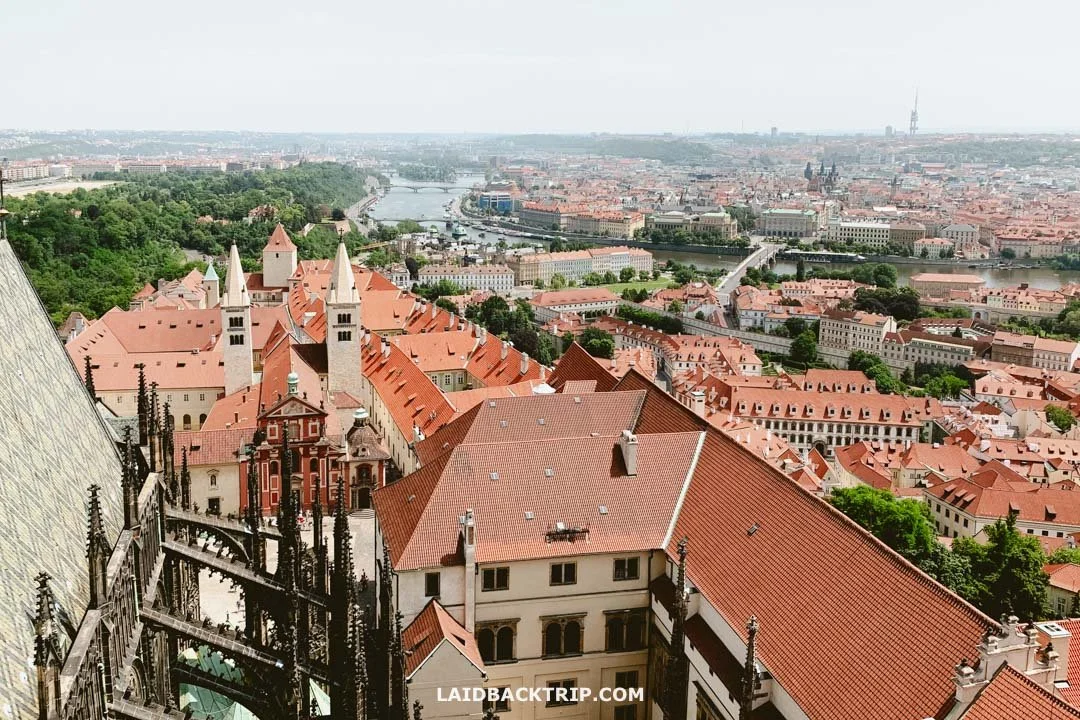
The views from the top of the Great South Tower are just breathtaking.
Once inside the tower, there's really not much else to do than show the ticket and start tackling the narrow spiral steps with over 280 steps. It's a fairly quick ascent along which we'll see the cathedral's historic bells, including Zikmund, the largest bell in Czechia, cast in 1549. Once at the top, there's a gallery around the whole tower that offers a 360‑degree view of Prague, the Vltava, and the entire castle complex. It's honestly one of the best views we have in the city, and definitely worth the effort.
According to old legends, if the bells of St. Vitus Cathedral ever fall silent, it foretells a national disaster or tragedy. The last time the great bell Zikmund's heart cracked was in June 2002, and just two months later, the country was hit by devastating floods. Spooky, right?
Old Royal Palace
While still on the Third Courtyard, only a few steps from the Great South Tower, is the entrance to the Old Royal Palace, which is part of our combination ticket, so that's where we head next. We are mostly surrounded by the buildings of the New Royal Palace, where today's president's offices are located, but we are about to step into history once again. This time into the 12th century, when Prince Soběslav transformed the original, mostly wooden, residence from the turn of the 9th and 10th centuries into a stone Romanesque palace.
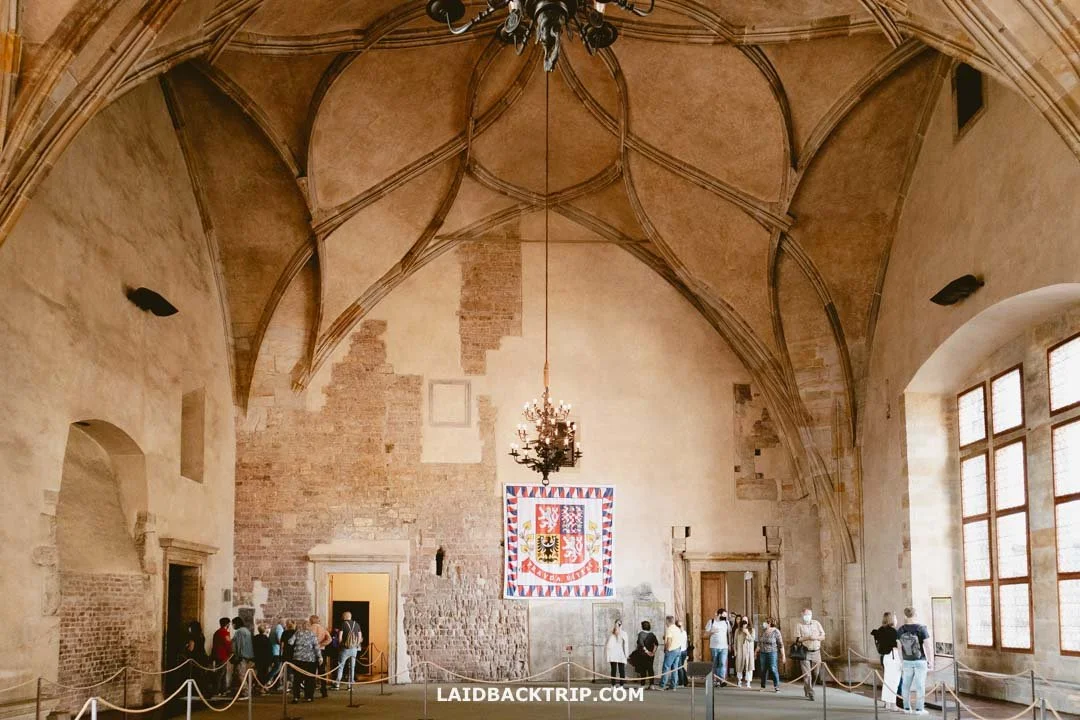
The Old Royal Palace is a complex of halls, small chambers, and corridors that are very significant for Czech people and our culture, but the main highlight is without any doubt the Gothic Vladislav Hall, with its impressive ribbed vaulted ceiling and wooden floor. From the 16th century, inaugurations, coronations, jousting tournaments, and many other important events took place in this beautiful ceremonial hall (and still take place). On the left side of Vladislav Hall, take a detour to the New Appeal Court and the Hall of Diet. Here you'll find the Land Rolls, the official books of the Court of Justice of the Realm.
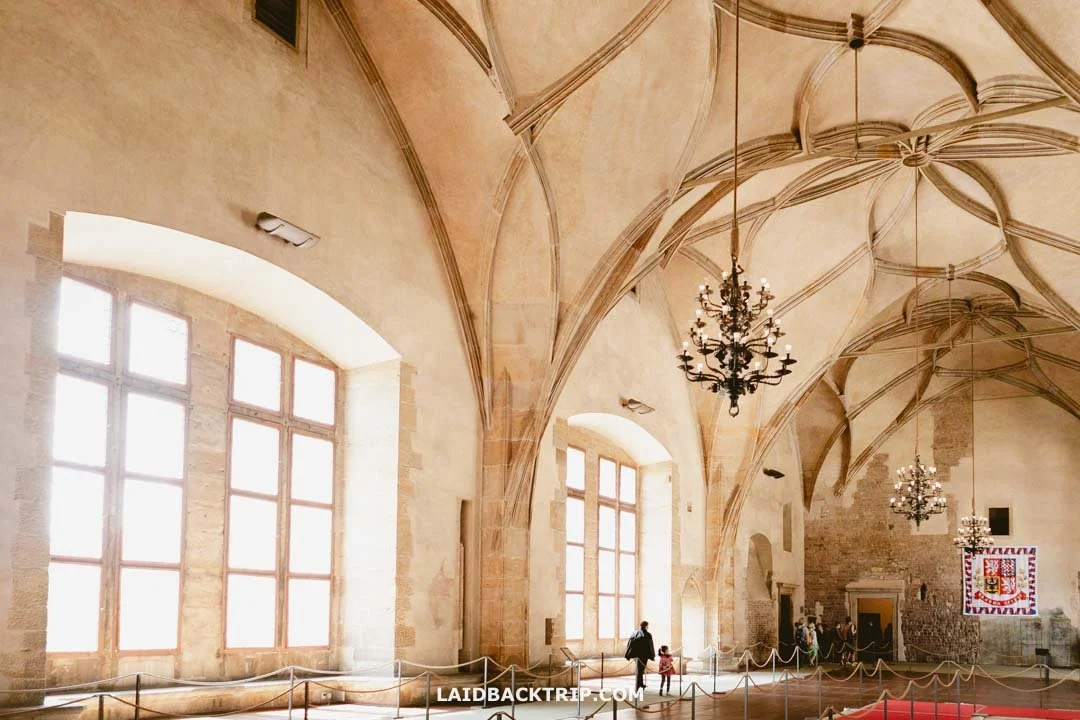
Vladislav Hall was built between 1493 and 1502 during the reign of Vladislav II Jagiellon.
One of the corridors will take you to a smaller chamber called Bohemian Chancellery, famous for Prague's second defenestration of 1618 (or third, because we had a couple more of them, so it depends on how you count them). Here, the Protestant Bohemian nobles threw Catholic imperial governors from a window.
It doesn't look like it now, but this is the place, which sparked the events that led to the Thirty Years' War, one of the most deadly conflicts in European history. It started as a religious war between Protestants and Catholics within the Holy Roman Empire and evolved into a huge political struggle for European power.
Part of the Old Royal Palace are two more spots, but they are sort of separate areas. The All Saints' Chapel is only accessible during church services, and the Theresian Wing is accessed through a separate entrance, as it holds the Story of Prague Castle exhibition.
The Story of Prague Castle
On our way to St. George's Basilica, there's an entrance on the right to the Story of Prague Castle, housed in the Theresian Wing I mentioned earlier. While it's technically part of the Old Royal Castle, it's entered through a separate doorway. As the museum covers almost 12 centuries of Prague Castle's history, it's a great place to visit after (or before) exploring the Old Royal Castle. The only downside is that it's not included in our Main Circuit ticket, but in the Permanent Exhibitions one.
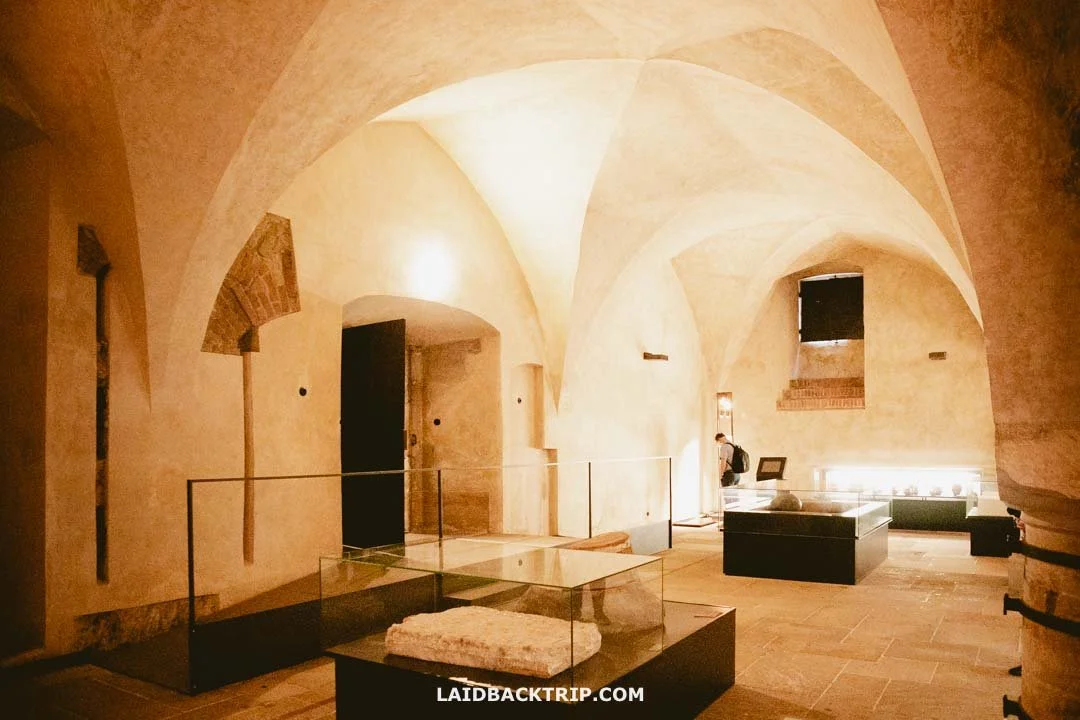
The Story of Prague Castle is basically a museum that tells the castle's history from its beginnings.
The series of displays housed in vaulted rooms built by Maria Theresa tells the story from the very first settlements (archaeological findings show that the hill where Prague Castle was built in the 9th century CE was inhabited since prehistoric times), and the original fort, to the eras of princes and kings, Renaissance emperors, and finally modern, presidential times.
We really enjoyed the experience, and even though we know the basics, learning about the castle's history, legendary figures, important Czech rulers in more detail, and seeing models showing how the complex evolved, along with artifacts from different periods, was awesome. It's a nice, informative museum worth seeing for anyone interested in deeper history (so probably not ideal for families with really small kids).
Mihulka Powder Tower and Castle Guard Museum
The Mihulka Powder Tower is the largest of Prague Castle's defensive towers, dating back to the late 15th century. While it originally served as part of the castle's fortifications, it was later used as a barracks, ammunition storage, and even a workshop for Rudolf II's alchemists.
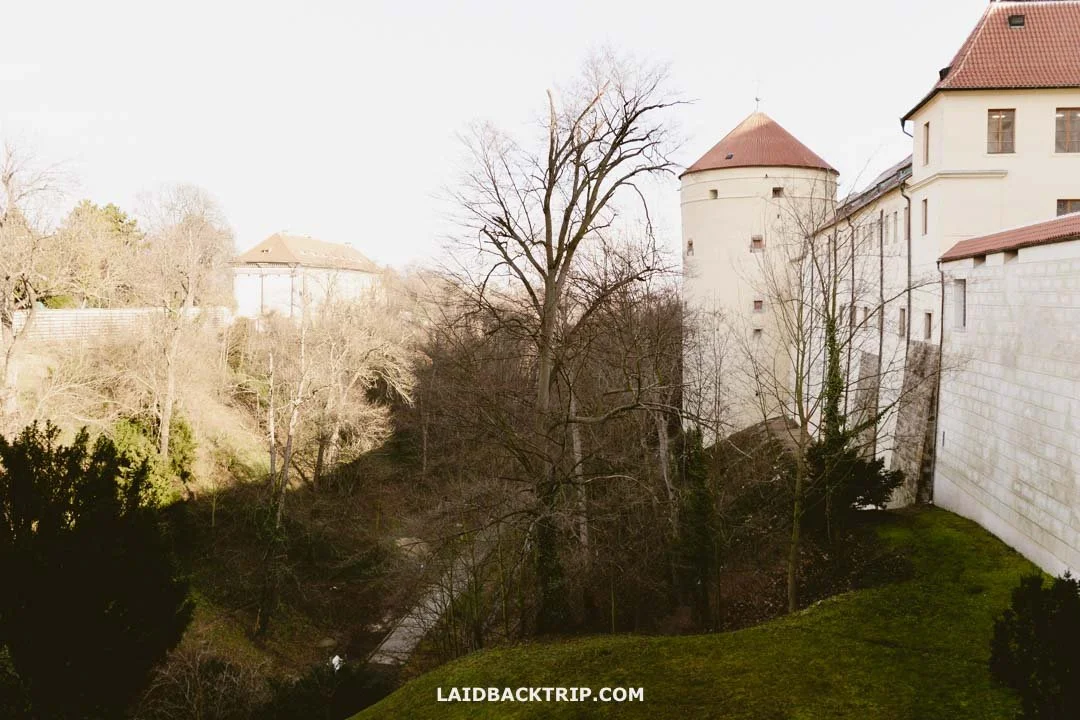
Mihulka is a historic tower that was originally used for gunpowder storage and the castle's defense.
Today, it houses the Castle Guard Museum, which covers the history, uniforms, and traditions of the elite unit that protects the president. It's not exactly a must‑see unless you're really into military history, but if you have the Permanent Exhibitions ticket, it's a good place to learn a bit more about Prague Castle and escape the crowds. The entrance is from Vikářská Street, tucked behind the northern side of St. Vitus Cathedral.
St. George's Basilica
We cannot even tell how many times we walked around St. George's Basilica, but we never went inside. It wasn't that it never crossed our mind to go in, but we simply didn't have the Main Circuit ticket that was needed to enter it. So, during the task we set for ourselves of seeing Prague Castle as tourists, we decided to get it and finally explore St. George's Basilica's interiors.
You might be wondering whether it's worth going to St. George's Basilica when we just visited the much grander St. Vitus Cathedral, but since it's included in the main ticket, there's really no reason to skip it in the first place. The entrance is from Náměstí svatého Jiří, only a few steps from the Old Royal Palace.
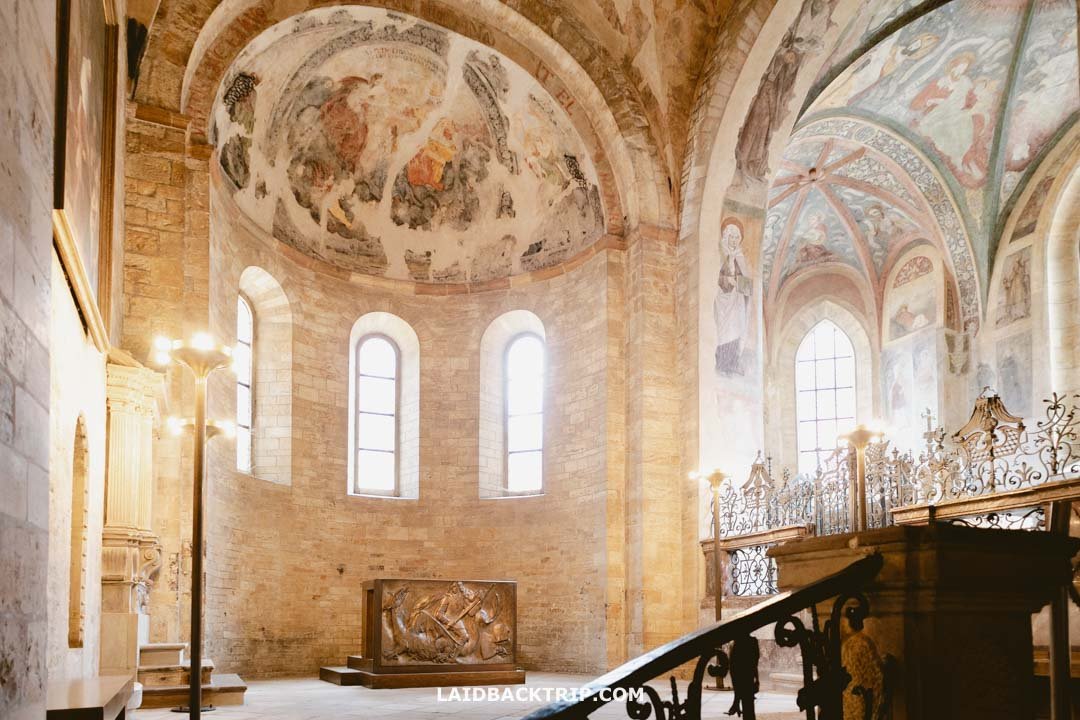
St. George's Basilica is one of the oldest churches in Prague.
Founded in 920 by Prince Vratislav I, St. George's Basilica is the oldest surviving church within Prague Castle, which during medieval times became the spiritual center of the early Přemyslid dynasty. Although a lot of time has passed since then and the Baroque façade was added, its inner architecture remains very Romanesque, with thick walls, narrow windows, and a simple interior that contrasts with the grandeur of St. Vitus Cathedral nearby.
After a devastating fire in 1142, the church was rebuilt in the form we largely see today, including its iconic twin white towers. It houses the tombs of Přemyslid princes and princesses, including St. Ludmila's chapel, which was added in the 13th century. Unlike the cathedral, it doesn't take that much time to see St. George's Basilica as it's much smaller and has far fewer details and decorations. By the way, St. George's Basilica has great acoustics and is used as a concert venue (it's not heated, though, so wear an extra layer).
Golden Lane
From St. George's Basilica, we head to the last stop in the Main Circuit, and that's the iconic Golden Lane. This historic, narrow street is lined with brightly painted houses that together make one of the most charming corners of Prague Castle. With history reaching back to the 15th century, the houses were once home to castle guards, craftsmen, and later writers and bohemians. The name comes from the goldsmiths who likely lived here too. The entry point is on the left of Jiřská Street here: 50.09184, 14.40384.
Today, the houses are restored and arranged as small souvenir shops and museum rooms, each recreating a different era in the lane's history. During regular opening hours, everything is open here, but you need a Main Circuit ticket. With it in hand, you can step into an old guard's room or a medieval herbalist's workshop to see how cramped these dwellings were and how modest life here once was. I have to admit this was our first time going there during the day, because the alley, being so narrow, gets crowded very quickly.
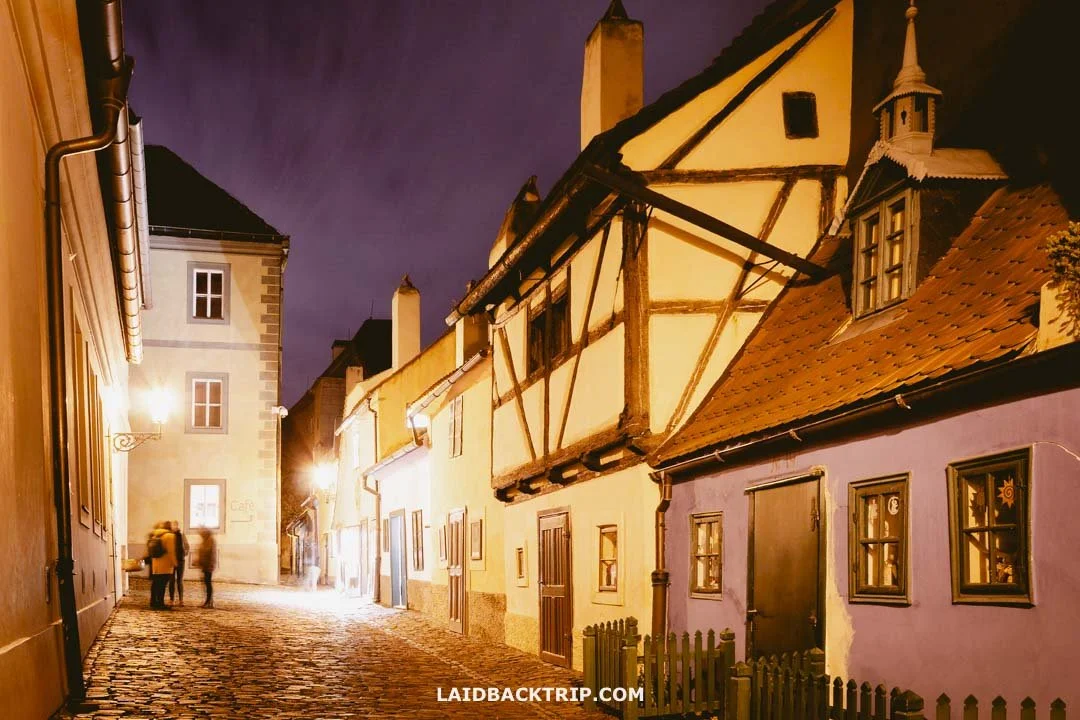
We like visiting Golden Lane after dark, when it's free to enter and so much quieter.
The most famous house is number 22, where the renowned author Franz Kafka lived between 1916 and 1917. Kafka was deeply connected with Prague, and the castle is far from the only place in the city where you'll run into his legacy. If you're into modern art, don't forget to visit Kafka's Head near Národní. You can also visit the house where he was born, right by the Old Town Square. And of course, pack a book or two for your trip to Prague. And we really mean it, because we're huge fans of his work. So do yourself a favor and start with The Metamorphosis and The Trial.
At the very end of Golden Lane is an entrance to Daliborka Tower, which served as a jail until the end of the 18th century. Inside, there's a small torture museum, but beyond that, there's not much else to see. This charming tower with its not‑so‑charming history is actually one of the most famous buildings in our country thanks to a well‑known legend.
In the 15th century, Dalibor was imprisoned here (hence the tower's name), and out of desperation, he learned to play the violin. His playing made him a symbol of resistance, and people from outside brought him food until he was executed. Thanks to this legend, we have the saying “Nouze naučila Dalibora housti,” roughly translated as “Need taught Dalibor to play the violin,” meaning hardship forces people to do new things.
Outside opening hours, Golden Lane stays open and free to enter. And both Lucie and I really prefer visiting this little street at that time. Sure, the shops and museum rooms are closed, but with the crowds gone, we don't mind at all. And by the way, while Golden Lane is incredibly picturesque, it's just a tourist attraction today, since the last residents were moved out in 1951.
Rosenberg Palace
Now that we've covered all the sites from the Main Circuit, there are still a few more interesting places to see in this part of Prague Castle. The next one is the Rosenberg Palace, a Renaissance palace later rebuilt in Baroque style and used as a residence for unmarried noblewomen. The residence belonged to the Rosenberg family (hence the name), who are also tied to several major attractions in South Bohemia, such as Český Krumlov Castle or Rožmberk Castle.
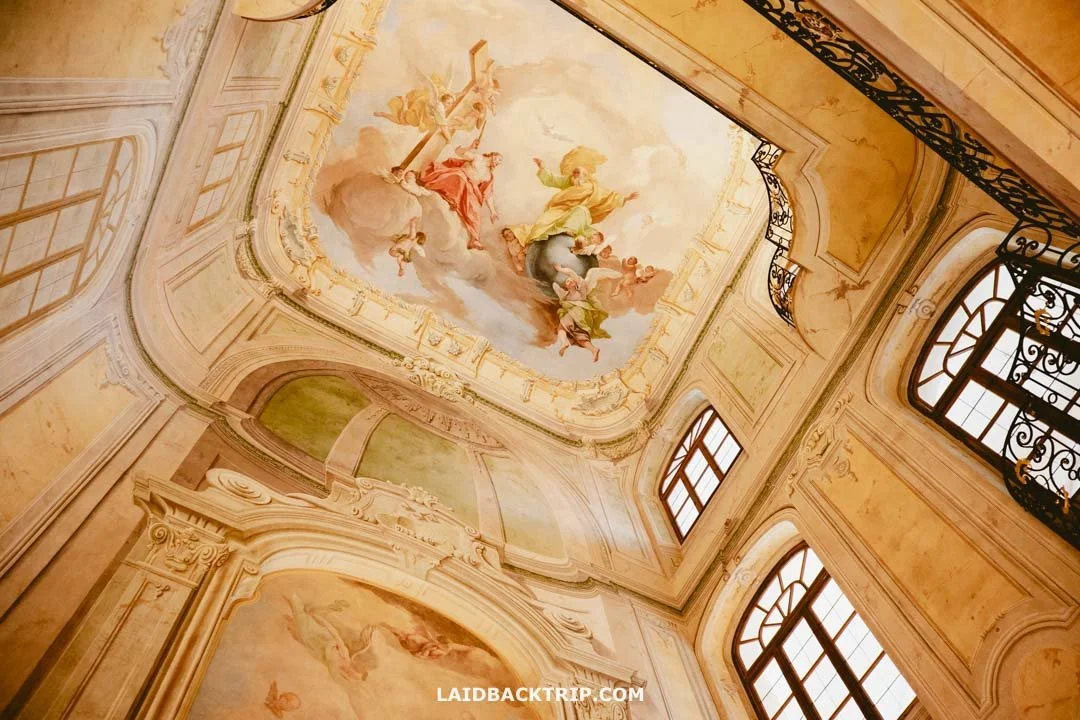
Rosenberg Palace has some truly stunning frescoes.
It's worth going inside to see the lovely courtyard, the beautiful fresco‑decorated chapel (best viewed in a mirror reflection) that spans three floors, and the restored rooms with historical Baroque furnishings. When we visited, it was very quiet here, which was great, as we could enjoy a few peaceful moments away from the crowds. The only small drawback is that you will need the Permanent Exhibitions ticket for the Rosenberg Palace. The entrance is on Jiřská Street on your right‑hand side (just a few steps after the turnoff to Golden Lane).
Lobkowicz Palace
The final place that's worth exploring on our journey through the Prague Castle is the Lobkowicz Palace. And if you've been paying attention, you'll notice this site wasn't included in any of the ticket options. That's because the Lobkowicz Palace is the only privately owned building within Prague Castle, and it has its own separate tickets.
It costs 380 CZK, which is almost the same as the Main Circuit and more than the Permanent Exhibitions. It's also the only place we haven't explored here yet, simply because of how much the ticket costs. One day, we'll definitely give in, but for now, we just pass by the entrance, which is also on Jiřská Street, just before the Na Opyši Gate, which, together with the Black Tower, marks the eastern entrance (in our case, exit) of Prague Castle.
Lobkowicz Palace is a museum that houses the Lobkowicz family's private art collection, including paintings, decorative arts, military objects, and personal treasures. Highlights include paintings by Canaletto and Bruegel, exquisite musical manuscripts by Beethoven and Mozart, and the family's richly decorated ceremonial arms. The museum can be visited with a 90‑minute audio guide narrated by members of the Lobkowicz family. As I said, one day.
My Favorite Viewpoints in Prague Castle
Now that we've reached Na Opyši and finally left the Prague Castle, it's time to enjoy some amazing views. And from Opyš are easily some of the best we can find here. I love this viewpoint, though the platform is admittedly small and often crowded, so getting to the wall takes a bit of patience. But it's absolutely worth it, because from this square you get one of the classic views of Prague, the kind that makes you understand why we call it the city of a hundred spires, and the best part is that it's completely free.
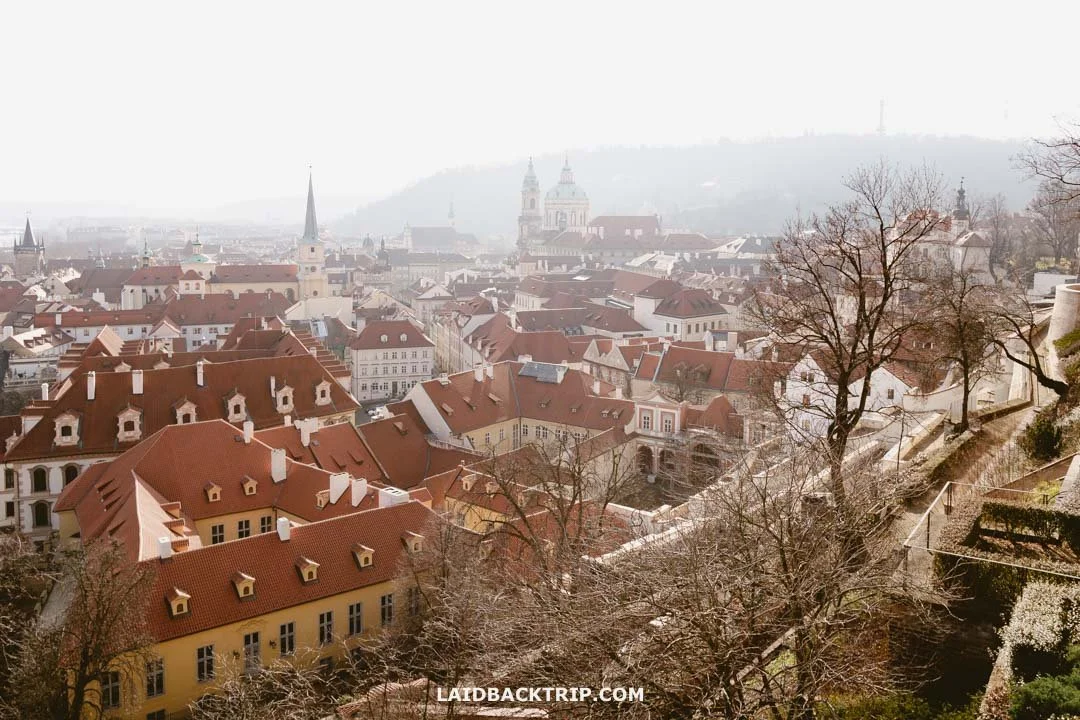
Prague Castle has plenty of great viewpoints, but Na Opyši is easily the most scenic.
You could get a similar view from the balcony of the Lobkowicz Palace restaurant (if you don't mind ordering some mediocre food) or from Rosenberg Palace, which requires a ticket. Either way, the view from Opyš is more than enough.
I've already talked about the view from Hradčanské náměstí, where New Castle Stairs and Ke Hradu Street meet. The view is once again amazing, though slightly different from Opyš. Something in between, and yet another great view from Prague Castle is from the South Garden. It's a bit hidden and easy to miss, but well worth finding.
All these viewpoints show Prague's center from above, but what if you want to see the castle itself? My two favorites are from the Powder Bridge and the Royal Garden, especially the area around Queen Anne's Summer Palace. Both views are incredible and show just how massive Prague Castle really is.
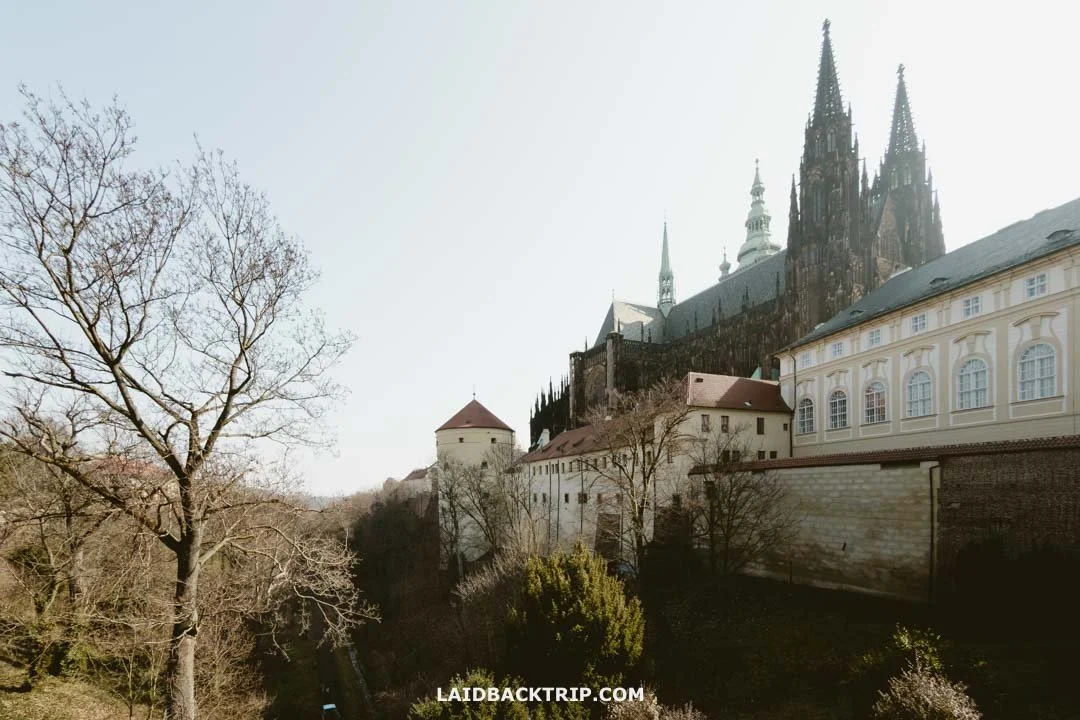
Powder Bridge offers a stunning view of Prague Castle with St. Vitus Cathedral rising above it.
And if you want to enjoy the classic Prague Castle panorama, you need to get back to the Charles Bridge area. My favorite spot is the small area on Alšovo nábřeží, right in front of the luxurious Four Seasons Hotel. But honestly, the views of Prague Castle are stunning from almost anywhere, not just along the Vltava River, but also from places like nearby Strahov Monastery, the National Museum, or even far away from from Vyšehrad.
From Na Opyši, you can walk right up to the nearby St. Wenceslas Vineyard with Villa Richter, where you can try local wine that's been produced here for more than a thousand years, making it the oldest vineyard in Bohemia. Or you can walk down the Old Castle Stairs and explore other Prague gems like our favorite Waldstein Garden. Or you can stay a bit longer, head back into the castle, and enjoy it one more time, but this time without worrying about lines or opening hours. And of course, there are also the gardens.
Royal Garden, Stag Moat, and South Gardens
If you still have some energy left, you can explore the beautiful gardens of Prague Castle. If you've followed our guide all the way through and ended your journey at Na Opyši, then you can easily start exploring the South Gardens, as the entrance is right there. We've already talked about the views from here just a moment ago, so now it's time to enjoy the gardens themselves.
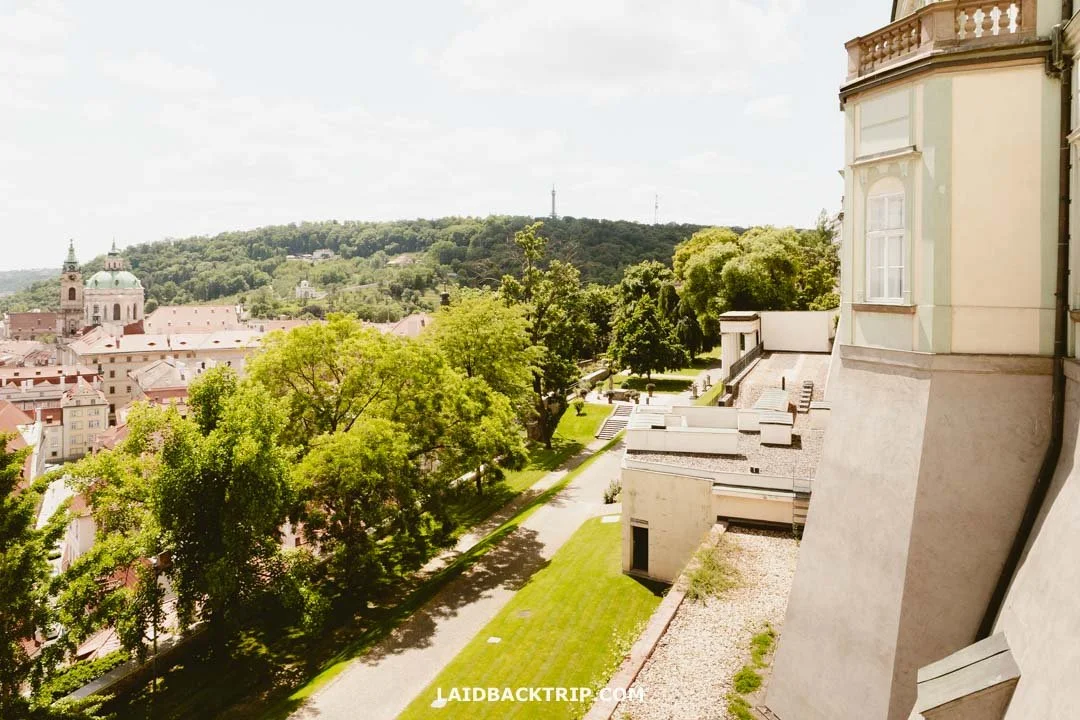
The South Gardens offer plenty of greenery and some really beautiful views.
Getting to the Royal Garden and Stag Moat from here is a bit trickier because you need to walk back to Powder Bridge, which serves as the entrance to the Royal Garden. This beautiful Renaissance garden was founded in the 16th century by the Habsburg Ferdinand I. It was used for summer leisure, featured rare plant species, and included buildings like the Ball Game Hall, the Royal Summer Palace, and the Lion Court.
The Stag Moat got its name because stags and other game animals were kept here between the 17th and 18th centuries. The western entrance to the Stag Moat is from U Brusnice, while the eastern entrance is from the Royal Garden. Keep in mind that the gardens are open only from April to October, usually from 10 AM to 5 PM or 8 PM depending on the season. And one more thing to remember is that the gardens in April are still pretty barren, and while nice for a quiet walk, they're not as beautiful as in, let's say, June.
We Visit the Prague Castle at Any Time of the Year
As a local, I would say there is no best or worst time to visit Prague Castle, and while we both have our favorites, we come here whenever we feel like it. Honestly, we don't really mind the crowds because it's our most famous landmark in Prague, and where else should tourists go if not here? And while I'm not gonna pretend I don't enjoy it more when it's quieter, seeing all the people around really adds a sense of grandeur to the whole place.
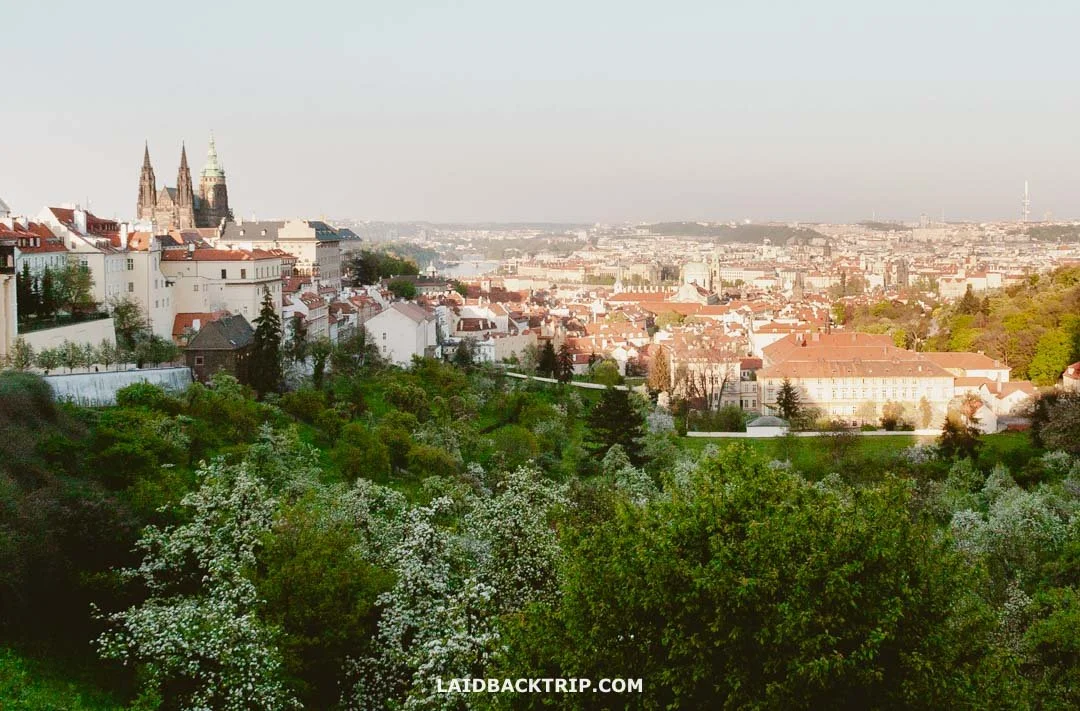
Prague Castle and the whole city are absolutely amazing in springtime.
The big crowds were only a problem when there were security checks at the entrances, since everyone had to go through them. Waiting in line was definitely not our favorite activity, so we were really glad when they were removed. It also means this is no longer an issue, and we can visit Prague Castle without those delays.
Most people visit Prague Castle in the summer, between June and August. The days are warm and long, but you can expect the biggest crowds. It's the only time of year when we intentionally avoid Prague Castle, not just because of the crowds, but also because we simply don't like spending summer in the city (we love exploring the outdoors, whether it's Šumava, Krkonoše, or even our beloved Beskydy). Make sure you bring extra water, as the whole place gets really hot.
During winter, Prague Castle is more peaceful, and I'd say this is when we visit the most. Of course, except for December, when the Christmas Markets take over here (and many other Prague squares). That leaves us with January and February, which could be considered off-season here. Days are cold, gray, rainy, and sometimes snowy, but the snow usually doesn't last long. The only thing to remember is that sunrise is quite late, between 7 and 8 AM, and sunset is early, between 4 PM and 5 PM.
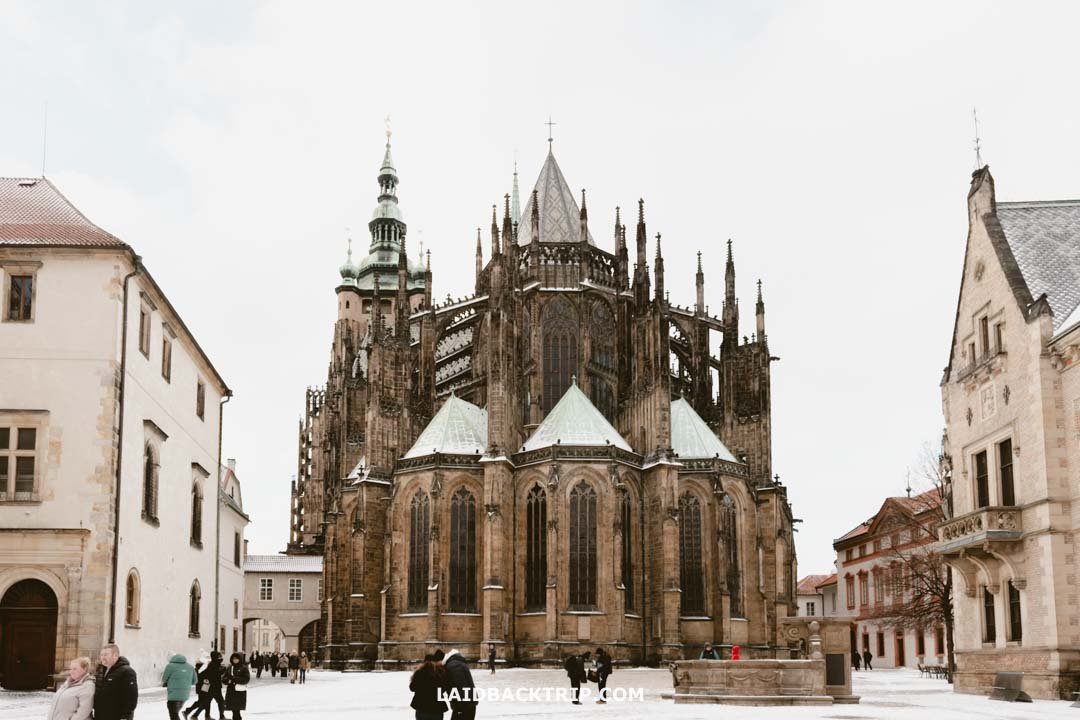
The atmosphere at Prague Castle is much calmer in the winter months.
Prague Castle is also great in spring and autumn (as is all of Prague), but the closer you get to summer, the busier it becomes (May is super busy), so we usually stick with April and October. The weather can be hit or miss, though. As locals, we just look out our apartment window and decide what to do, but if you're planning this trip far in advance, all you can do is hope for good weather. But hey, if it's cold and raining, the crowds will definitely be thinner, especially on Hradčanské Square and around St. Vitus Cathedral.
For us, the best time of the day to visit Prague Castle depends on what we want to see. Even though the historical buildings open at 9 AM, the grounds open at 6 AM, so we sometimes come early to enjoy the place without the big groups. The same goes for visiting after hours (after either 4 or 5 PM), since the gates close at 10 PM. If you're only interested in the exteriors, early morning is ideal, but I love coming after dark when the whole place is beautifully lit.
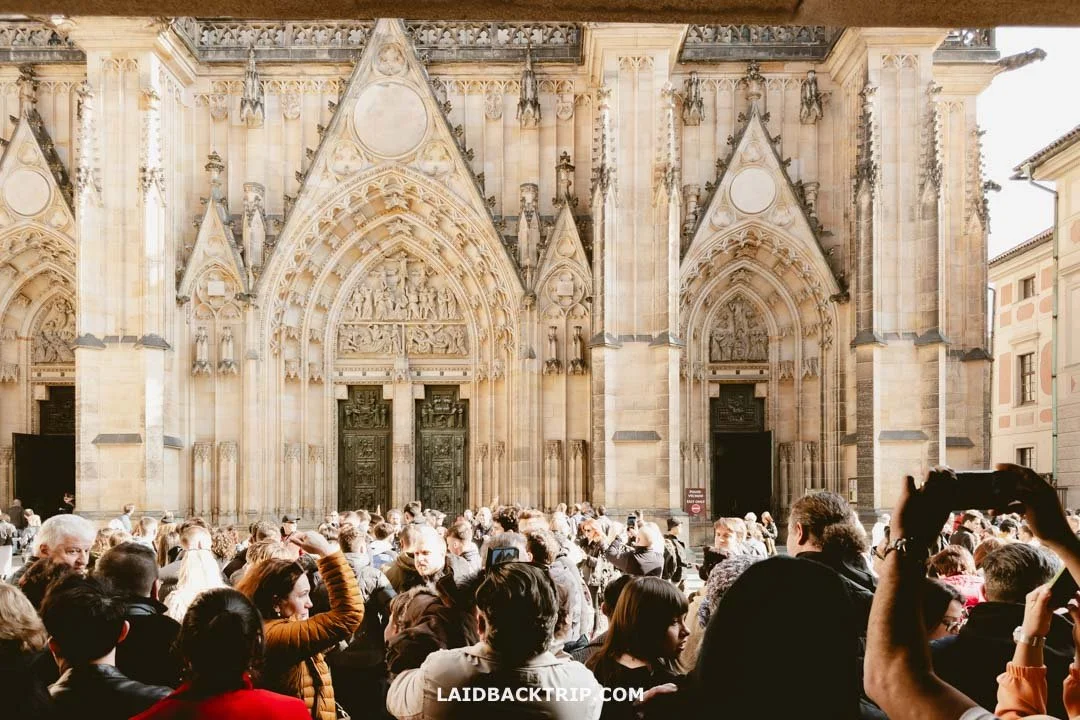
The tight space in front of St. Vitus Cathedral often turns into a bottleneck, so keep an eye out for pickpockets.
Since we usually come to the Prague Castle in our free time, it often means weekends. Prague is always more crowded from Friday to Sunday, and the castle is no exception. So if you can plan your visit for a weekday, definitely do it. So, in case you can plan your visit for weekdays, do it.
Speaking of crowds, while Prague Castle is generally very safe, keep an eye out for pickpockets in busy areas, especially in front of St. Vitus Cathedral or during the changing of the guard at Hradčanské Square.
World Nomads provides travel insurance for travelers to cover their trip essentials, including sports and adventure activities.
SafetyWing is affordable travel insurance for backpackers, long-term travelers, and digital nomads.
Is It Worth Staying Near Prague Castle?
There are tons of great accommodations near Prague Castle, but as a local, I can only say that, since this is not the only place you will visit, it's good to figure out first whether this location is a good fit for you. By staying in Lesser Town, which is the area below the castle where most of the hotels are clustered, you will be in an ideal spot to come to see Prague Castle pretty much whenever you want, plus it might be a bit quieter here after the big crowds leave.
That's definitely something to think of, but I personally would probably look into Old Town/New Town (or around these areas) simply because there's more to see and do, at least if I were a first-timer here. Over the years, we on some occasions stayed in some really nice hotels like the Hilton Prague Atrium or the W Prague, and while they were a bit further from the castle, we always managed to reach it just fine.
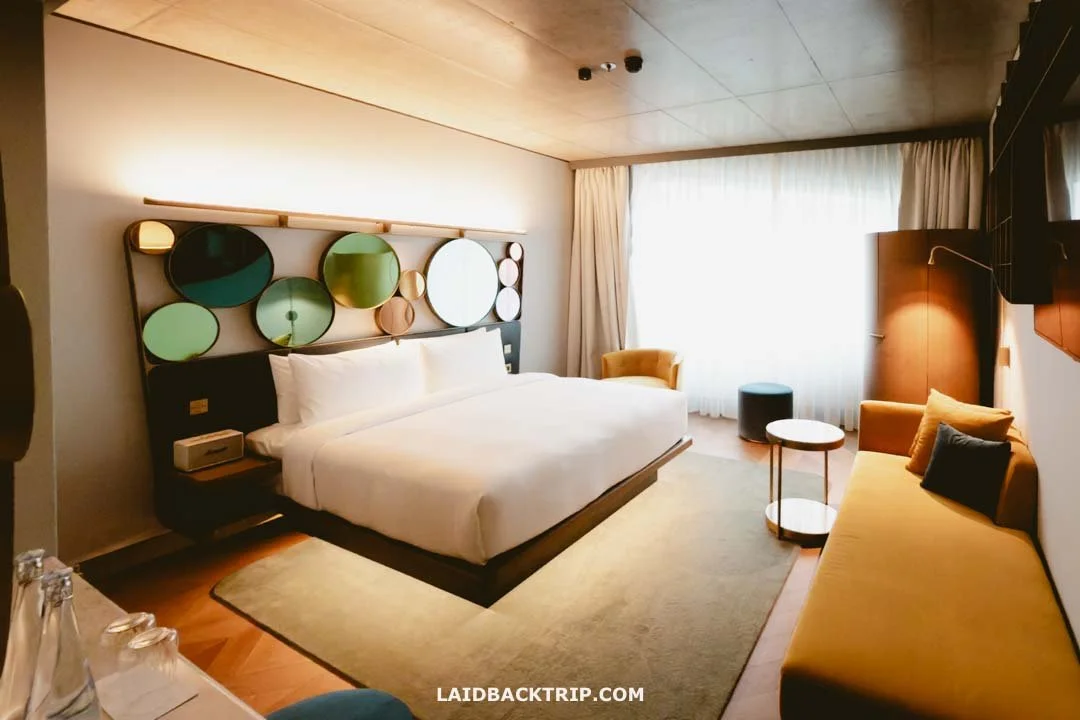
There are some nice hotels around Prague Castle, but it's totally fine to stay farther away, like in New Town.
Now, the Lesser town is filled with everything from luxurious hotels like the Augustine and Mandarin Oriental to charming boutique places like the Golden Well or Hotel Constans. The only thing you won't really find here are the cheap hotels, maybe apart from Hostel Little Quarter, but that's expected. We'd probably find these too expensive for our budget (another reason we would stay elsewhere), but there are definitely a few more budget-friendly options like Hotel Sax or Residence Thunovská.
Our secret tip would be Hotel Monastery, which is located in the enclosed garden of Strahov Monastery (great if you're looking for a really quiet place). There's also the Diplomat Hotel, which sits on the metro station Dejvická (Green line), a nice 4-star hotel for a reasonable price, if you want to escape the hectic tourist center.
We Skip the Restaurants and Cafes at Prague Castle
Since it's easy to spend a few hours at Prague Castle, you're probably going to get a bit hungry from all that sightseeing. The good news is that there are a few places to eat inside the castle complex and many more just outside it. The bad news is that they're mostly tourist spots where you never really know what to expect or what the experience will be like. And as a local, I'm definitely more critical, because the food is, at best, okay to mediocre, and it always costs way more than it should (same story everywhere, we didn't find the best pizzeria by the Colosseum or creperie by Eiffel Tower either).
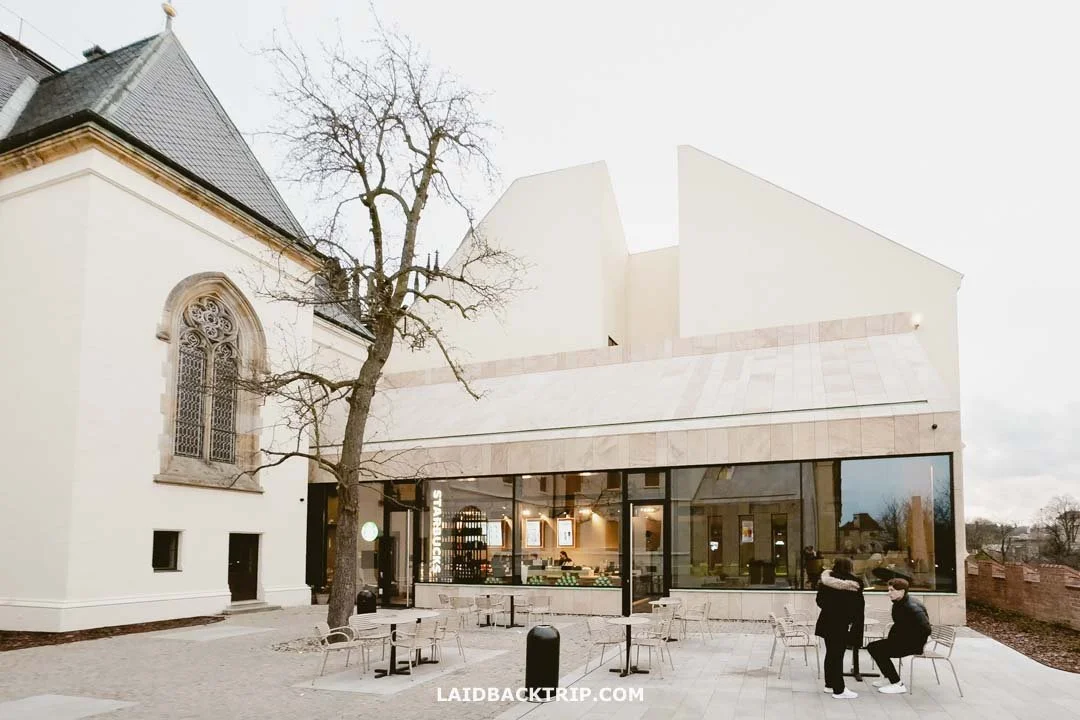
Besides a few restaurants, there are also a couple of Starbucks around.
Inside Prague Castle, there's the traditional Vikárka Restaurant and Bistro U Kanovníků right by St. Vitus Cathedral and Restaurant Lví dvůr, just a few steps from the Pražský hrad stop. And from what we've seen, the food is nothing special, but the prices certainly are. Then there are a few cafes of varying quality (some look nice, some look like classic tourist traps) and also a couple of Starbucks (one on Hradčanské náměstí and one in a courtyard entered from Náměstí u Sv. Jiří). Prague Castle is also one of the places where Christmas Markets are held, and I've already written a post about them, and if you want the short version, I'm not a fan.
Like everyone else, we get hungry too, but since it's us, we either eat at home or just bring water and snacks. As locals, we haven't found a reason to visit any of these places, simply because they're typical tourist spots. I've never heard anyone I know say, "You know what, Martin, we should check out that place right by St. Vitus Cathedral." A lot of places at Prague Castle (and around it) exist only because tourists visit once and never return, and that often shows in the quality or the price (sometimes both).
Now that we've covered the castle grounds, it's time to look beyond them. And here the situation repeats itself. Along Nerudova Street or at the base of the Old Castle Stairs, you'll find plenty of tourist walk‑up windows selling "tourist food" like trdelník or fried potato spirals for ridiculous prices. We see them as standard tourist traps, and we would never buy anything here, nor would any other local, if you ask me.
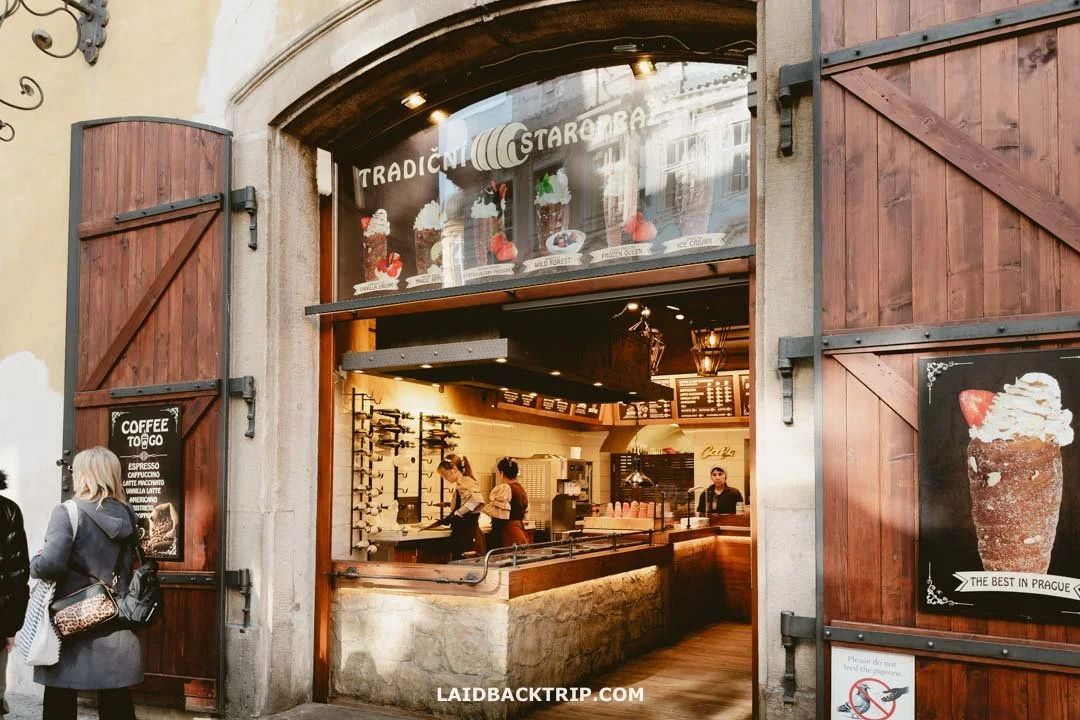
You'll pass lots of places selling "traditional" trdelník on the way to Prague Castle, but it's best to skip them.
Aside from traditional pubs like U Hrocha or U Dvou slunců, where we've had a beer or two, there really aren't many places around Prague Castle where we'd go out to eat. The only places that come to mind are spots like U Zlaté Studně, but that's a fine dining spot we visit as a treat, not for a casual lunch. Another interesting option is the nearby Strahov Monastery, where they brew their own beer. It's touristy, but the beer is really great.
Travel Resources
Here you can find links to all the travel resources we use and which you might find helpful when planning your next holiday.
Accommodation: When looking for accommodation, we usually search hotels via Booking.com or Hostelworld.
Tours: Although we love to travel independently, some places are better to visit with a guided tour.
We prefer GetYourGuide for its easy-to-use interface and solid reputation. Another great alternative is Viator.
Rental Cars: When going on a road trip, we always use Rentalcars.com, a reliable site for booking a rental car in advance.
Get Around: Buses and trains are an affordable way to get around the Czech Republic. Regiojet offers clean and modern buses and trains with all the amenities.
Flight Tickets: When looking for flight tickets, you can search Skyscanner to find the best price.
Travel Insurance: World Nomads and SafetyWing cover against risks of travel.
Visiting the National Museum in Prague? This guide covers everything you need to know, including what to see inside the museum, opening hours, ticket prices, how to get there, and our favorite exhibitions.