A Guide to Climbing the St. Peter's Dome
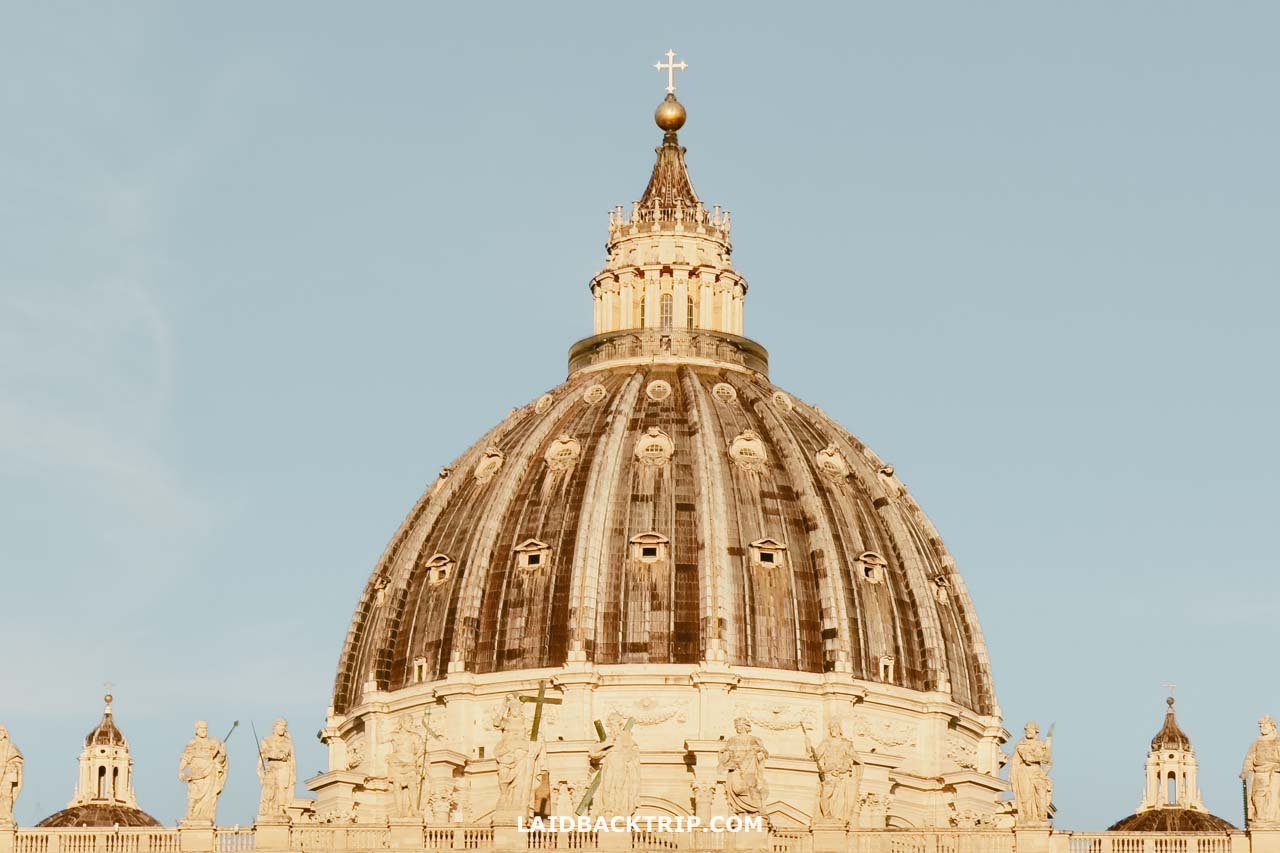
St. Peter's Dome is definitely one of the most incredible structures we have ever climbed.
This is how we climbed St. Peter's Dome and everything we saw and learned along the way.
For both Lucie and me, climbing to the top of St. Peter's Dome was easily the highlight of our entire visit to St. Peter's Basilica. The basilica itself, with its enormous nave, richly decorated chapels, and Renaissance architecture, was incredible, but getting the chance to explore one of its most impressive engineering features up close was, for us, the most unforgettable experience.
I did the Dome climb about 25 years ago, but when I talked about it with Lucie while we were planning what to see and do in Vatican City, there was surprisingly very little I remembered about it, except telling her that the view from the top was like no other in Rome. And the stairs. Lots of stairs.
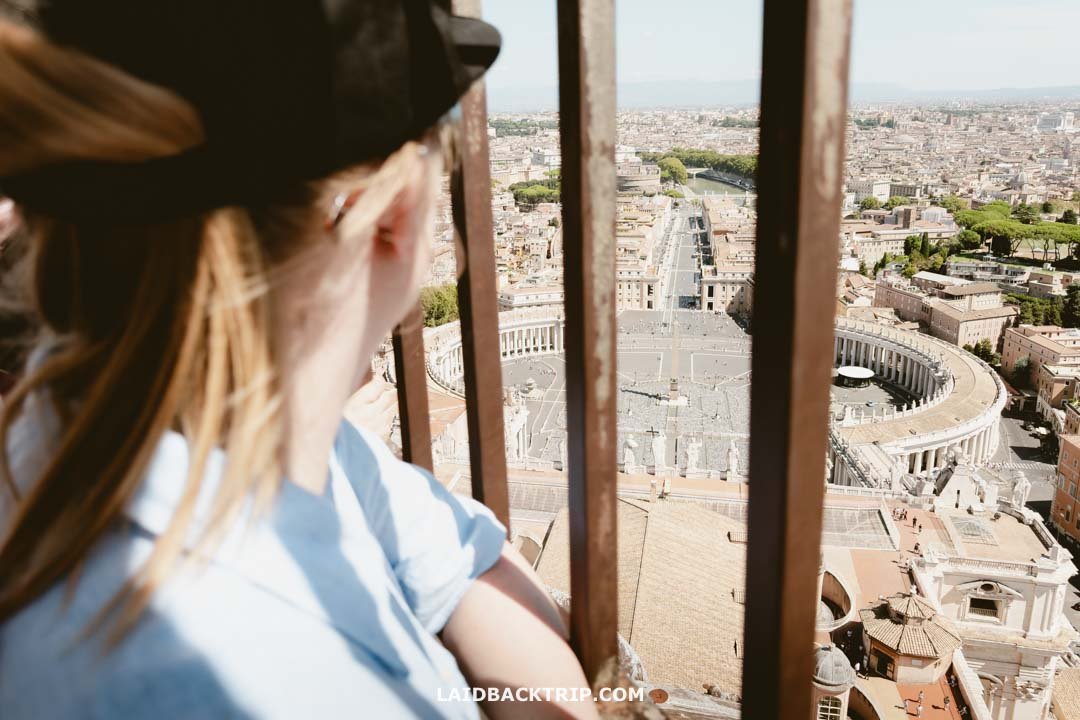
The climb to St. Peter's Dome is mostly about the views.
Every climb to St. Peter's Dome starts with visiting St. Peter's Basilica first, because that is where the entrance is. And since we want to focus mostly on the climb here, we recommend reading our full guide to St. Peter's Basilica, which has tons of general information and will make this post even more useful, as it will allow you to plan the whole trip more smoothly. So let's start climbing to enjoy the best view in Rome!
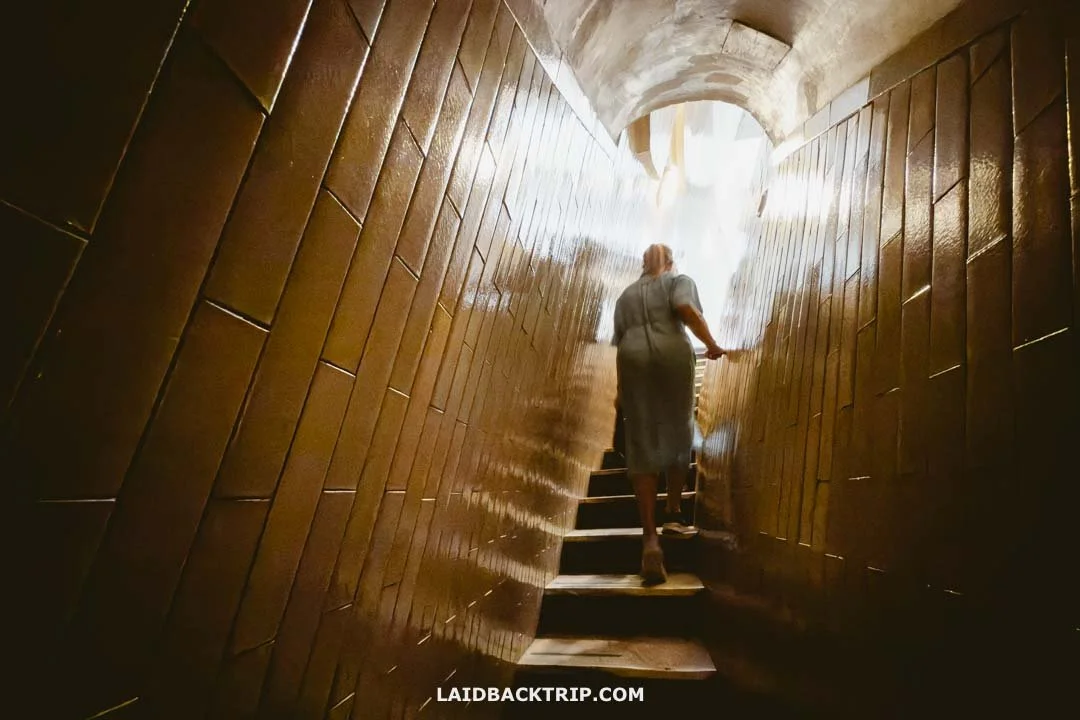
St. Peter's Dome is famous not just for its amazing views but also for its narrow stairs.
Booking a St. Peter's Dome Ticket in Advance
While we knew that St. Peter's Basilica was technically free to visit, we were not surprised to learn that St. Peter's Dome could only be accessed with a ticket. And since the ticket also included a timed entry, which meant we could avoid a long wait in the line for visitors without tickets if there was one, and a digital audio guide, which we hoped would provide all the essential information about St. Peter's Basilica, we decided to purchase this one.
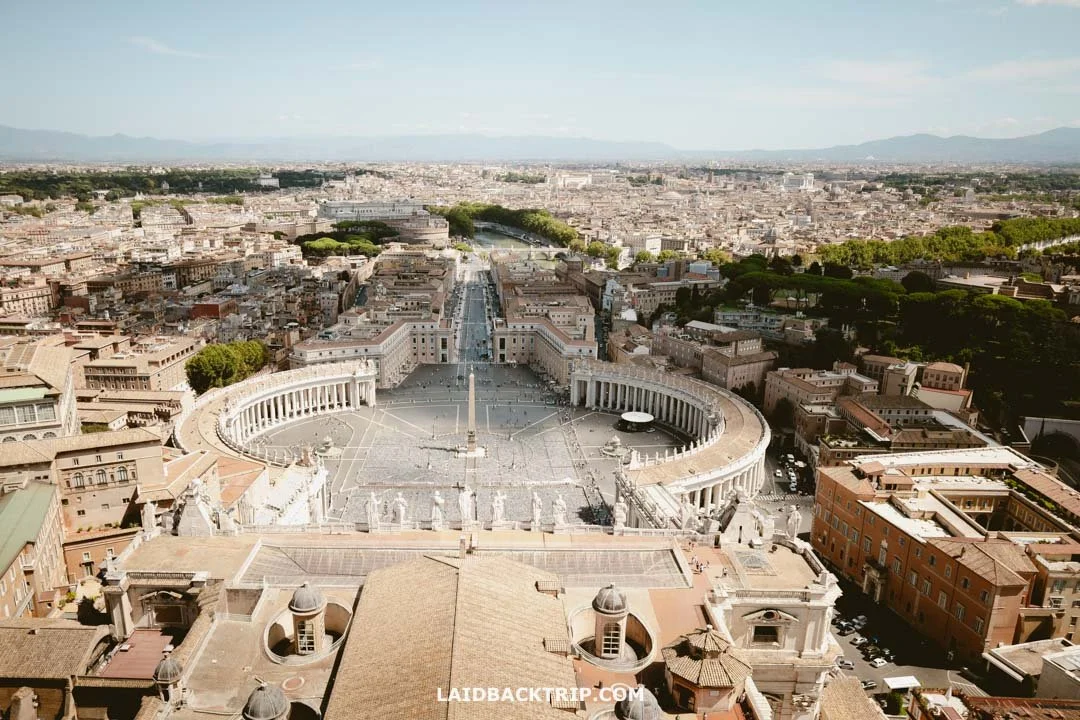
With a view like this, it was totally worth paying to visit St. Peter's Dome.
It cost €17, and the main difference from the €22 version was that it did not include the lift for the first section. Since we planned to climb St. Peter's Dome on our own, we booked our tickets through the official Basilica San Pietro website. There were also plenty of tours that combine St. Peter's Basilica with the Vatican Museums, which can be a big time saver. We toured the Vatican Museums with a guide, and it was really great, though slightly more expensive.
There was also the option to purchase a ticket just for St. Peter's Dome at the kiosk inside St. Peter's Basilica. That option would likely make sense on many other days, but in this case, we wanted to be sure we understood what we were seeing inside the church. And because we were visiting during the busy season, we did not want to risk spending hours in the queue, which is why we chose the more expensive ticket.
Arriving at St. Peter's Basilica around Midday in Summer
Midday is usually the busiest time to visit St. Peter's Basilica, but on the day we went, the crowds were not too bad. Of course, doing the climb early in the morning would be much better from a crowd perspective, but since our plan was to visit the museums first, we really did not have another option this time. Because we were staying at a quiet hotel near Navona Square, it took us only about 20 minutes to reach the basilica on foot.
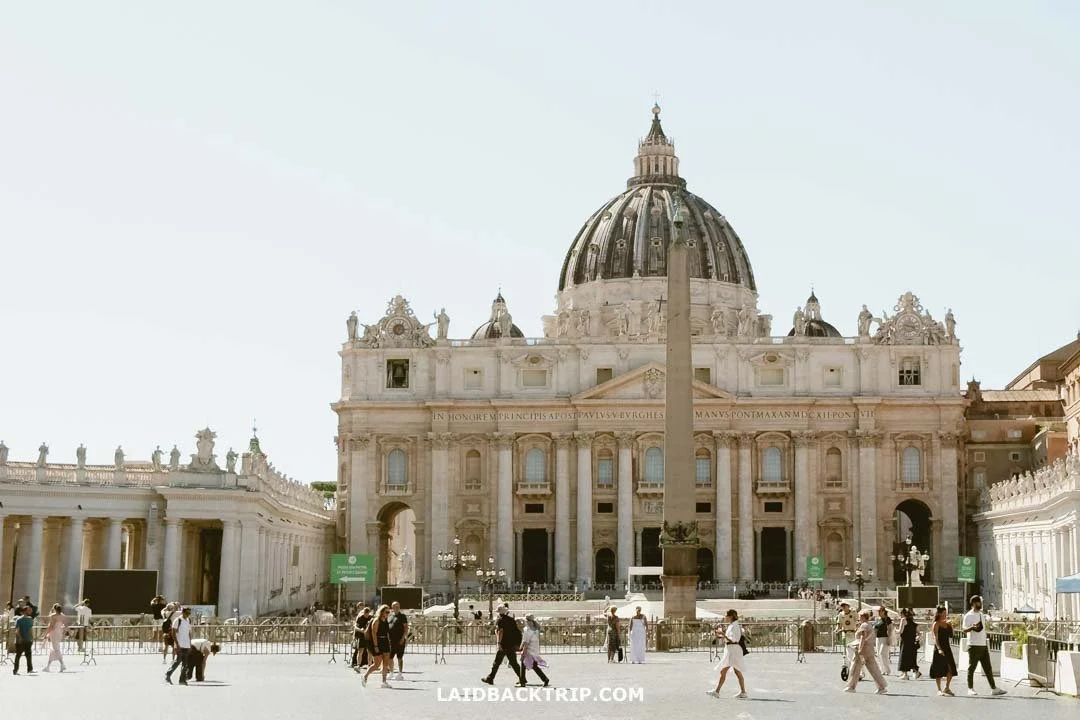
We got to St. Peter's Basilica around midday.
St. Peter's Dome is usually open daily from 7:30 AM to 6:00 PM for summer climbs (5:00 PM in winter), with last entry a bit earlier. The hours are a little shorter than the basilica's, so keep that in mind. Also, opening times can change on religious holidays, special events, or for papal ceremonies, so it's best to check the Vatican's official schedule before your visit. For instance, we did the climb during the Jubilee, and while the Vatican was quite busy, everything was open on the dates we went.
Exploring the St. Peter's Basilica
The basilica is typically entered from St. Peter's Square, through the colonnade area on its northern side. After joining the line for visitors with tickets, it took us about 15 minutes to pass through security and enter the basilica, or in our case, the Papal Grottoes, an underground area containing papal tombs built above the ancient Roman necropolis (Scavi).
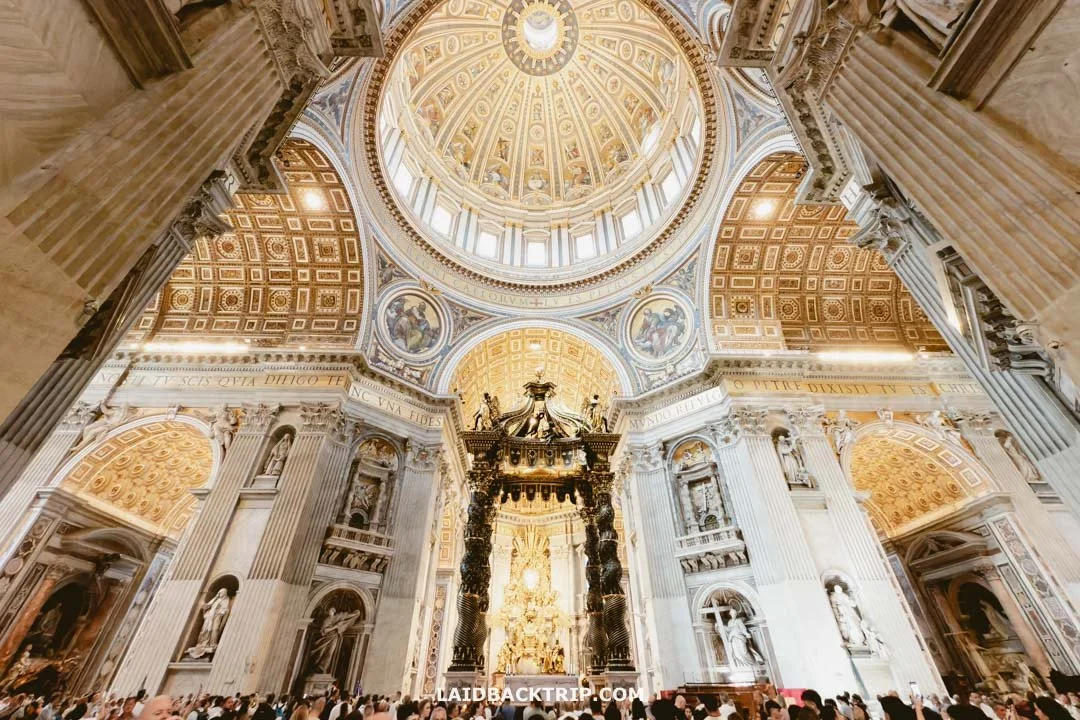
Before climbing the dome, we took some time to enjoy it, along with St. Peter's Baldachin, from below.
We then explored all the major highlights of St. Peter's Basilica on the ground floor, guided by the digital audio guide included with our ticket (we brought our own earbuds specifically for this), and once we finished, we were ready to climb to the top of St. Peter's Dome.
As mentioned earlier, we had a timed-entry ticket, and because we explored the Vatican Museums with a guide, which made our visit shorter than exploring on our own, we ended up climbing the dome at one of the busiest times of the day. Fortunately, it was not as bad as we expected, though this is clearly something that can vary quite a bit from visit to visit.
Locating the Dome Entrance
Finding the Dome entrance was not an issue at all, since it is located inside the basilica on the southeast side (when entering the basilica from the square, it is on the left). So we simply followed the green signs labeled Ingresso Cupola (Entrance to the Dome). The big advantage of doing the climb via the stairs was that there really was not any line when we arrived, since most people take the lift instead. So we showed our tickets and started making our way up.
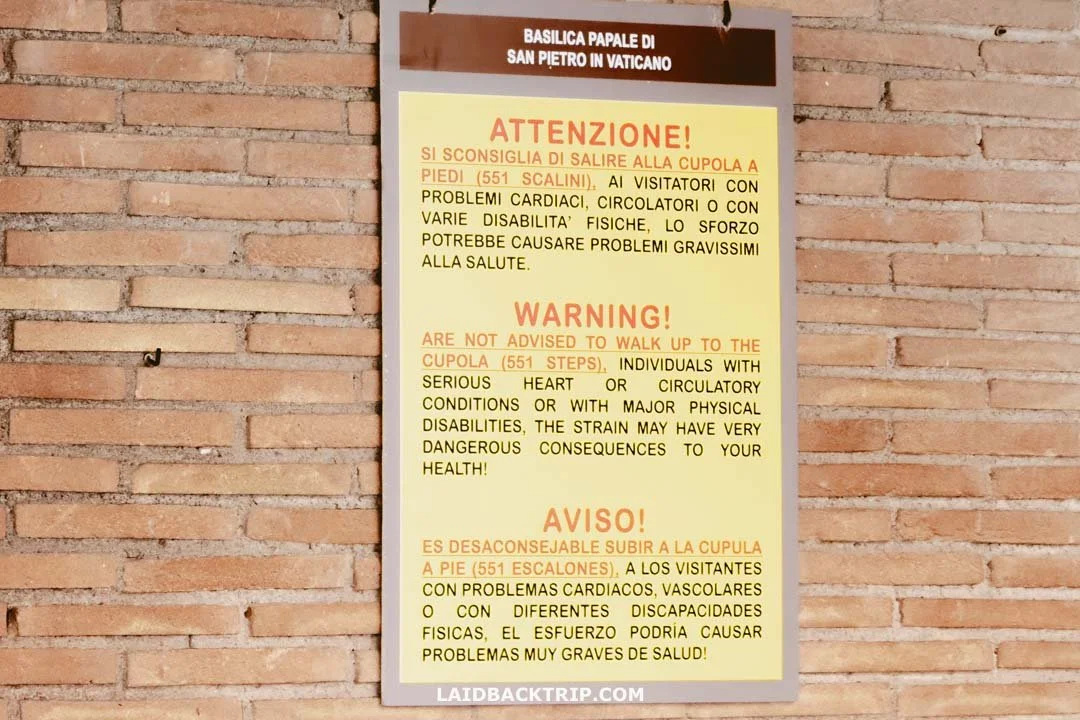
The warning at the start of the climb to St. Peter's Dome.
The whole climb was divided into two main parts: the first leg of the journey led us to the inner cupola and the terrace, and then we climbed to the top of the dome. Along the way, we had to tackle 230 steps in the first section and 321 in the other, making it 551 steps in total. For comparison, when we climbed St. Vitus Cathedral at Prague Castle, it was "just" 287 steps.
Climbing 230 Steps to the St. Peter's Terrace
Although this post focuses on climbing the Dome, the first section of the ascent actually takes you only through the basilica's internal structure. It may sound obvious, but I suspect not everyone realizes this before arriving. In the end, though, it is just a small detail that makes no real difference.
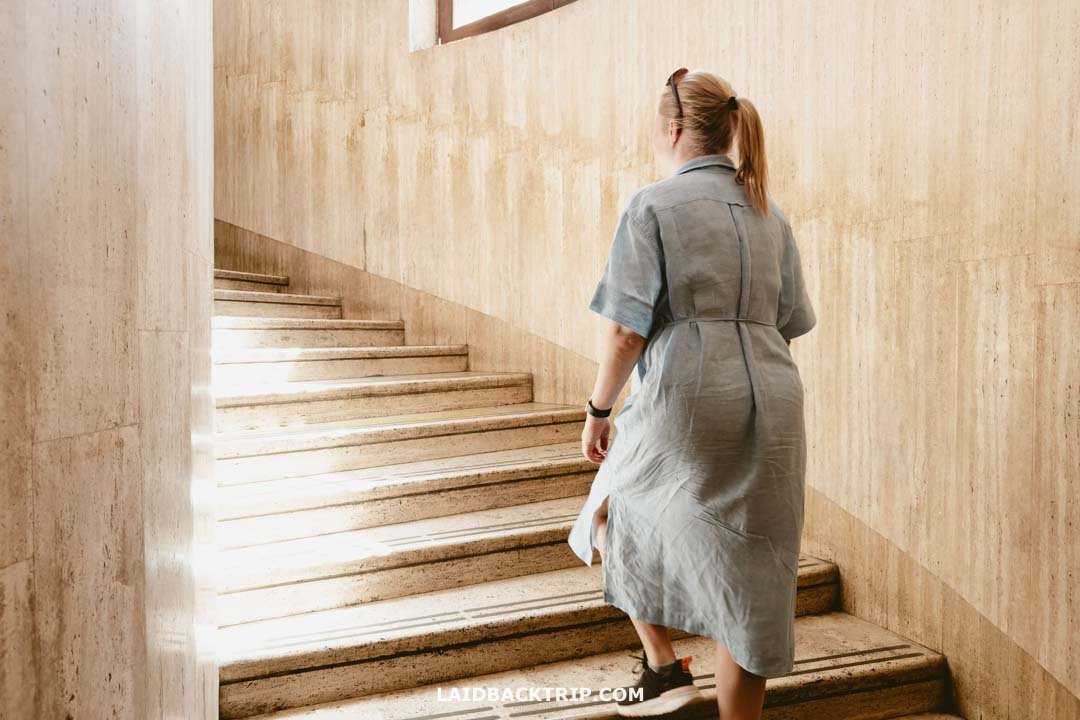
Lucie climbing the first set of stairs as we made our way up to St. Peter's Dome.
I remember that when we were in Munich climbing the Frauenkirche, where the only way to reach the top was by lift, we felt pretty disappointed. So this time, being able to skip the lift and take the stairs was great. It made the experience more enjoyable and gave us a bit of extra exercise, something we usually miss when traveling, especially on shorter trips.
Besides the magnificent view of St. Peter's Square, I vividly remembered those strange, shallow stairs, called cordonata, in the first section of the climb. I do not know why, but this was something that really stuck with me even after all those years.
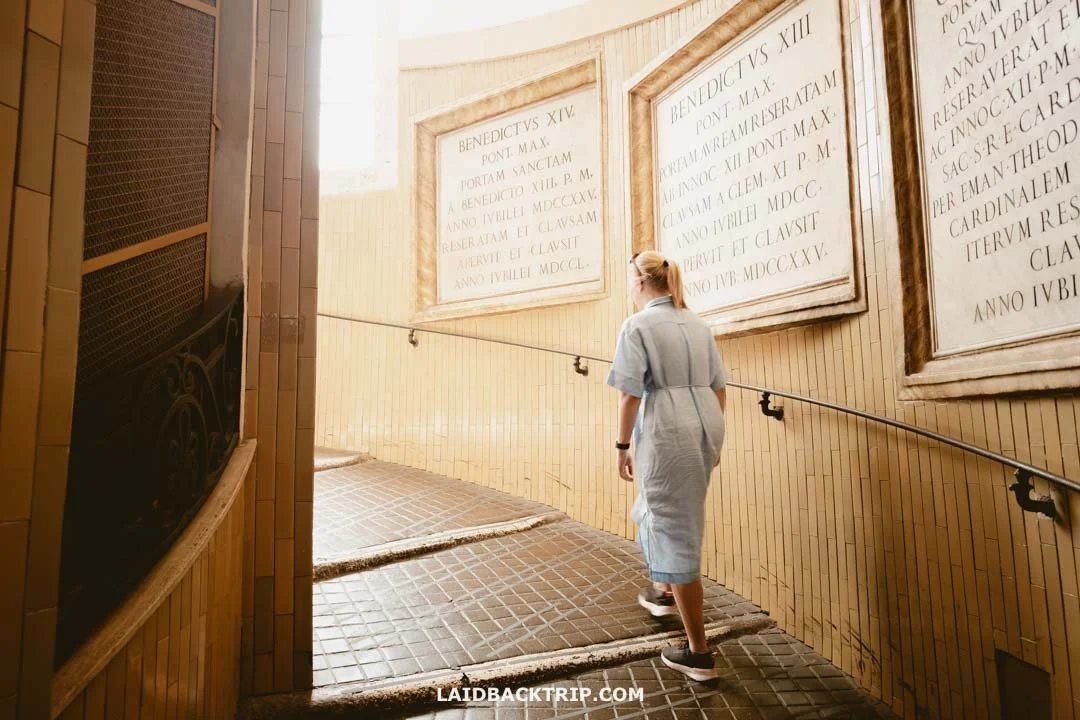
The classic cordonata stairs I still remembered from my earlier climb to St. Peter's Dome.
They looked more like a ramp than traditional steps and were located right past the entrance. In the following days, we visited Castel Sant'Angelo, and the ramp inside the Roman mausoleum, although much wider and without actual steps, really reminded us of these stairs. We also encountered a cordonata on our way to the Capitoline Museums, which serves as their main entrance and was designed by none other than Michelangelo himself.
The corridor itself was quite bright thanks to the windows. We looked outside from time to time, but it was more like brief glimpses of what we were about to see. After a few minutes of climbing, we finally arrived at the lower terrace.
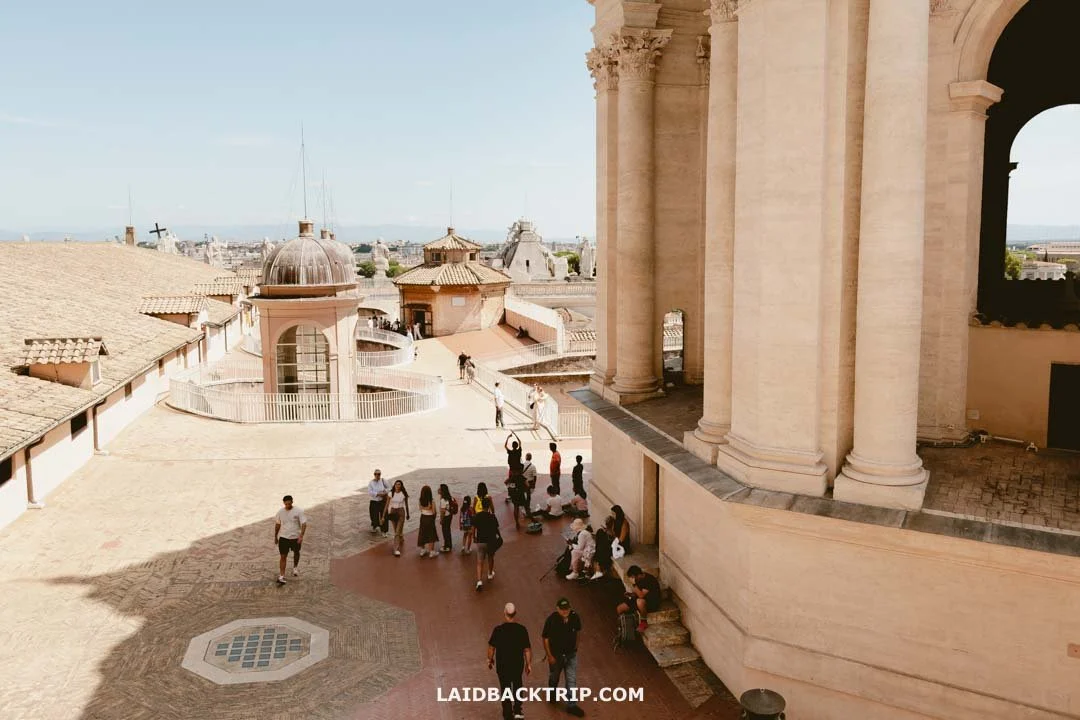
The view of the terrace of St. Peter's Basilica, right before we headed into the dome.
Exploring the Lower Terrace of St. Peter's Basilica
Once we stepped outside, we found ourselves on a lower terrace (technically a roof), an outdoor area connecting both staircases. We first turned right to examine the massive statues and enjoy one of the few views from this level. They were the same ones visible from St. Peter's Square on the basilica's front facade: the 13 statues of Jesus and the Apostles, each more than five meters tall. One interesting thing we noticed was that from behind, they lacked detail and looked rather plain.
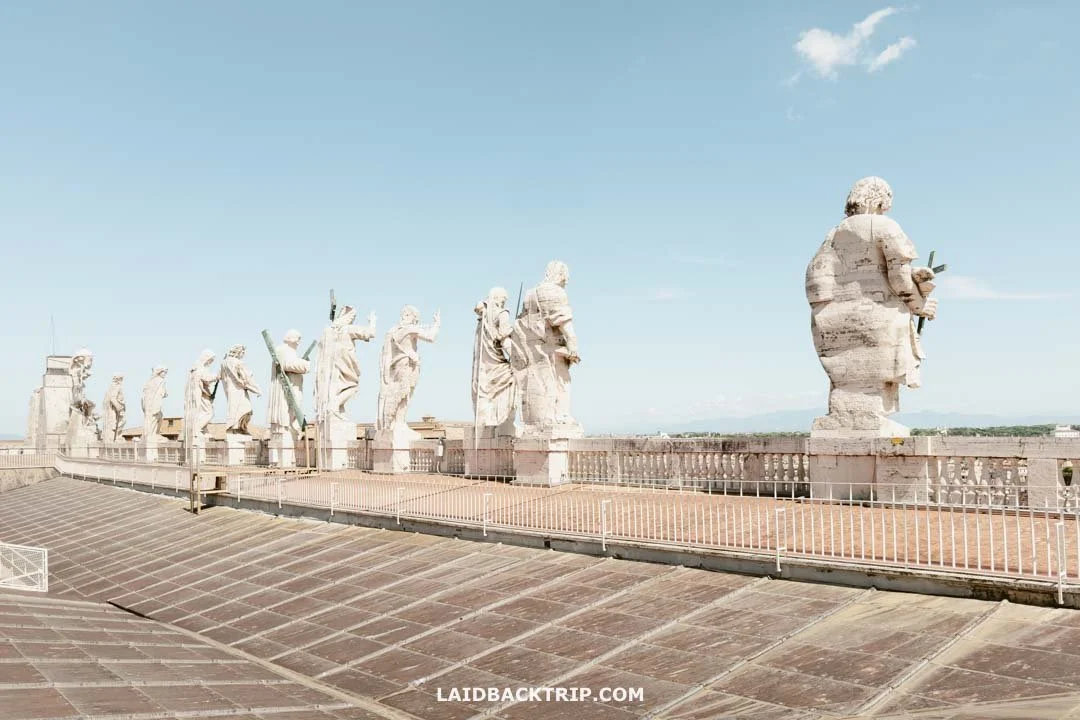
Everything about St. Peter's Basilica is huge, including the five-meter-high statues of the Apostles.
After turning back, we continued toward St. Peter's Dome, passing a few more smaller cupolas along the way. On the way up, we did not spend much time here, and after taking a few photos, we continued to complete the second leg of the journey. On the way down, however, we stopped and explored the area more thoroughly. There was a conveniently located water fountain next to the restrooms, also very convenient since there were none inside the basilica.
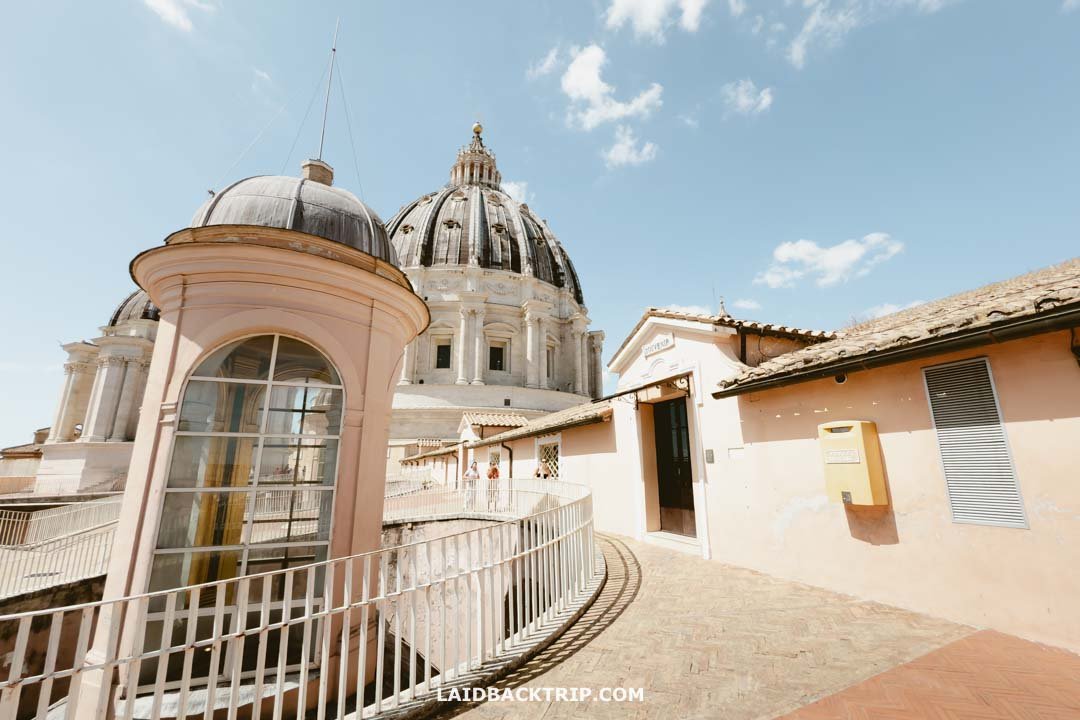
It really was not a surprise to find a Vatican Post Office on the roof of St. Peter's Basilica.
We also sat for a few minutes in the shade of the large cupola to take a short break before continuing the descent. There was also another Vatican Post Office (we had seen one in the museums and another in the square), complete with the traditional yellow post box and a small shop where you can buy postcards and "Vatican City" stamps and even send them, if that is your thing.
Admiring the Architecture of St. Peter's Dome
But for now, we were heading into the dome. From the terrace, we had a pretty great view of its exterior, and we stopped to take a closer look from this vantage point. Designed by Michelangelo, the cupola of St. Peter's Basilica serves as the church's symbolic and architectural crown, unifying the basilica's vast interior and exterior. Reaching 133 meters in height (without the cross on top), it is visible across Rome, showing the Church's authority and power.
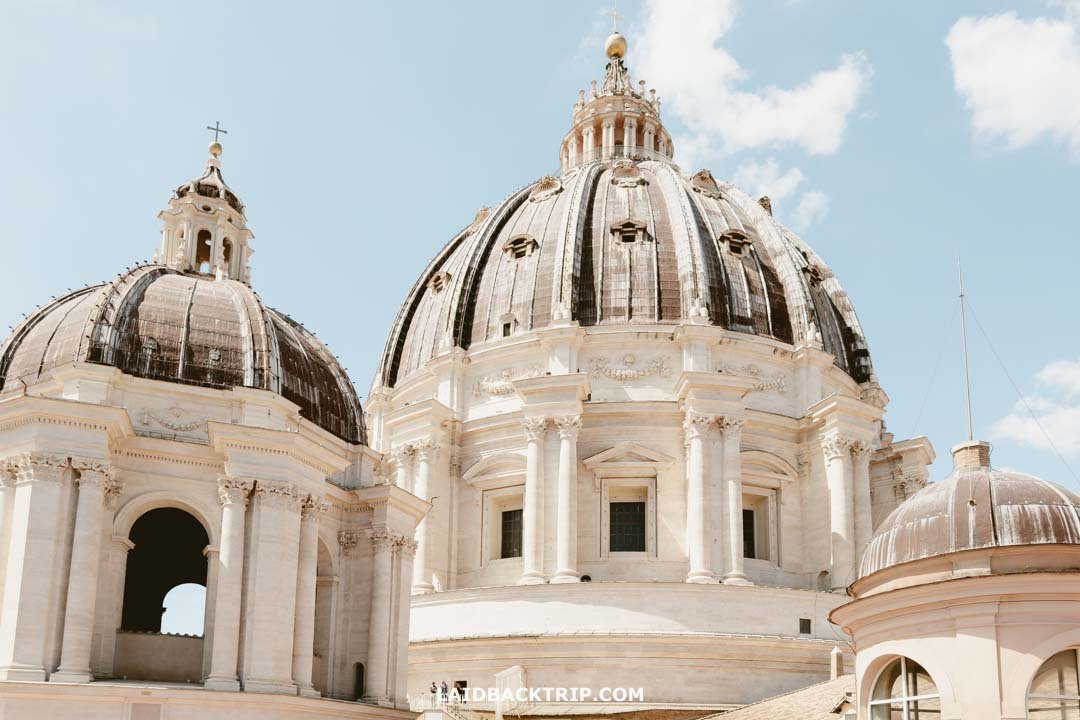
At the bottom center of my photo, you can see tourists, giving a sense of just how massive St. Peter's Dome really is.
Like Bernini's Baldachin below it, the dome marks the tomb of St. Peter, drawing the eye upward to evoke heaven and divine presence. Similar to the famous Pantheon, its windows channel light toward the high altar, reinforcing spiritual focus (the Pantheon has only the oculus, however, and no central altar). The outer diameter measures almost 60 meters, while the inner diameter is about 42 meters.
It is often described as one of the true marvels of Renaissance engineering, but being so close to it put everything into a completely different perspective. And while the exterior was incredible, the interior was just as fascinating. Interestingly, the Pantheon's dome is about 1.5 meters wider, which makes it even more mind-blowing considering it is about 1,400 years older.
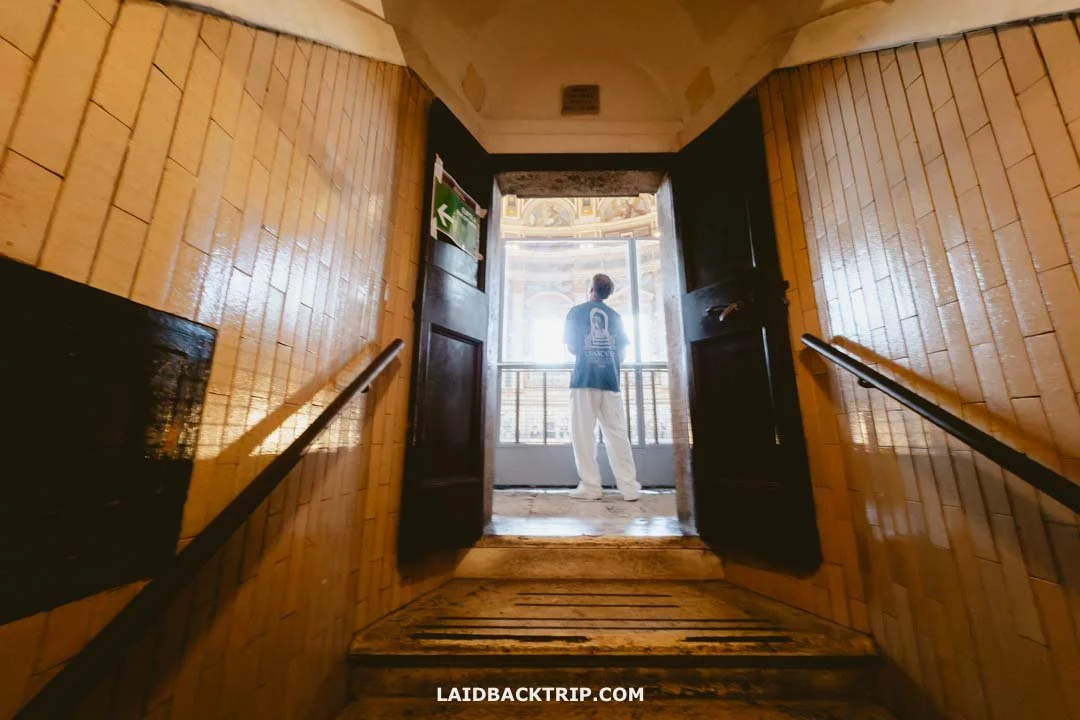
After enjoying the views of the dome from outside, we were ready to finally see it from the inside.
Exploring the Inner Dome Balcony
From the lower terrace, we climbed the outer stairs that brought us inside the dome itself. But before heading up, we went to explore the balcony in the inner dome. This turned out to be one of our favorite parts of the whole climb, as this is where all those stunning mosaics we had seen from the basilica's main level were located. Now, however, we were almost 50 meters higher, and the mosaics were within our reach.
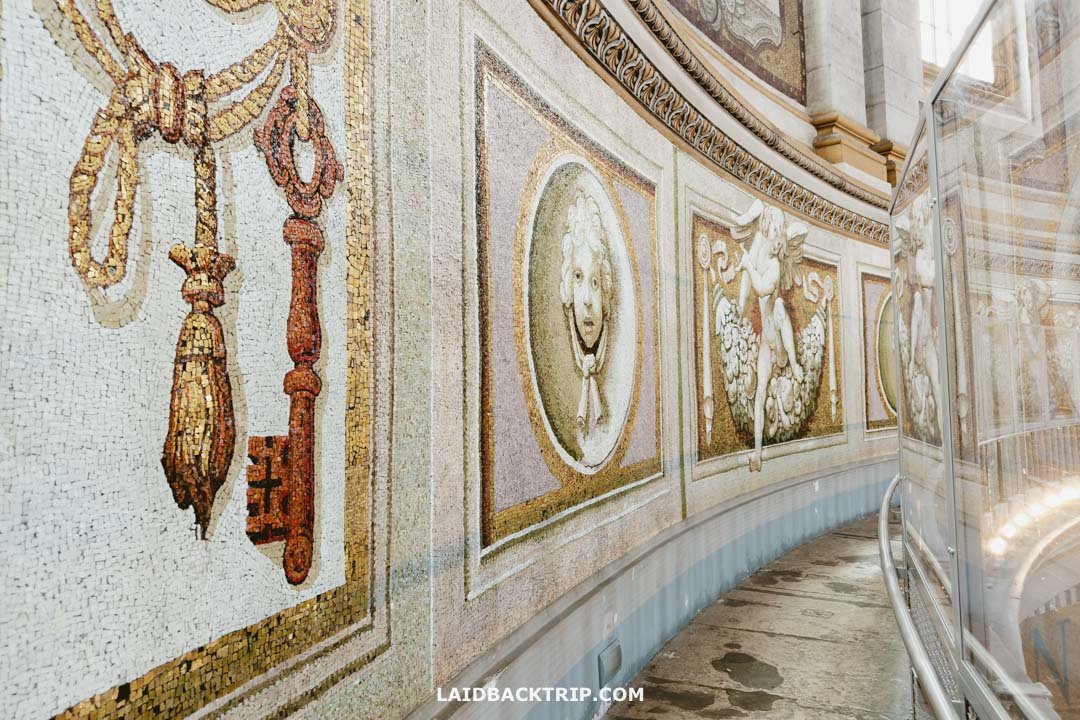
The mosaics that adorn the walls of the inner balcony of St. Peter's Dome.
Quite literally, because the walls of the balcony were decorated with huge mosaics, as was the frieze below us bearing the Latin words that translate to: You are Peter, and on this rock I will build my church... Again, when seeing the inscription, it was hard to realize that each letter was about two meters tall.
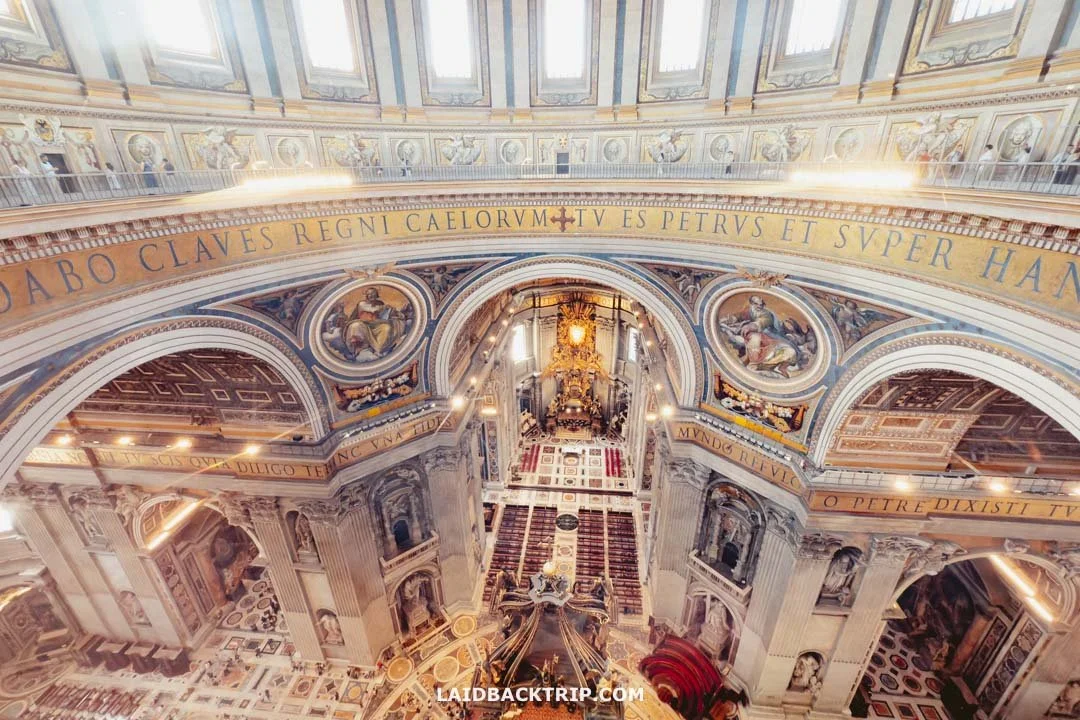
Just below the inner balcony is the famous inscription: You are Peter, and on this rock I will build my church.
Just under the letters (technically below the dome) were four enormous medallions of the evangelists, depicted as an angel and with a lion, ox, or eagle, each about 8.5 meters in diameter. All these mosaics show just how huge everything in St. Peter's Basilica is.
When we looked up, we could see more mosaics of angels, prophets, decorative cherubs, and ornamental motifs in gold and white stucco. The dome is divided into 16 ribs, with several tiers of horizontal mosaics. At the very top, we could see God the Father looking down from the highest point of the "heavens."
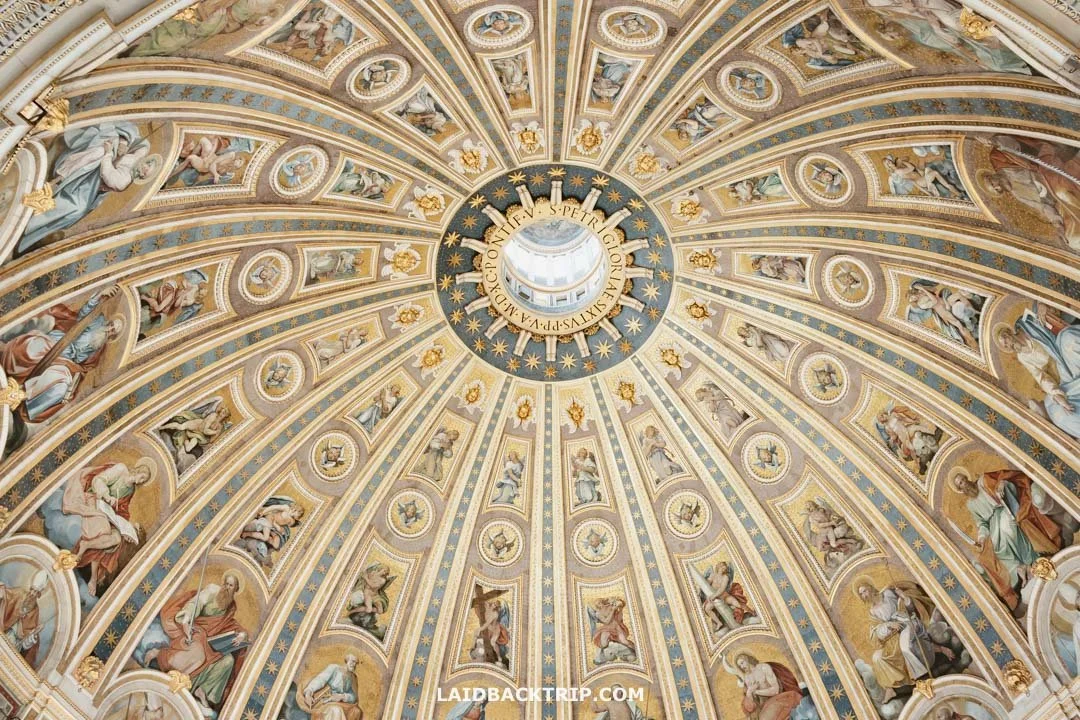
The inner dome is adorned with stunning mosaics.
While the mosaics around us were incredible, we also really enjoyed the view of the basilica's ground floor. The balcony was protected by a safety glass panel that, despite not being exactly clean, created many reflections, so it was not ideal for photos. Our favorite pastime here was watching fellow tourists walking around the ground floor, as they appeared like tiny dots from up here. Afterward, we walked the full circle around the dome and then set out on the second section of the climb.
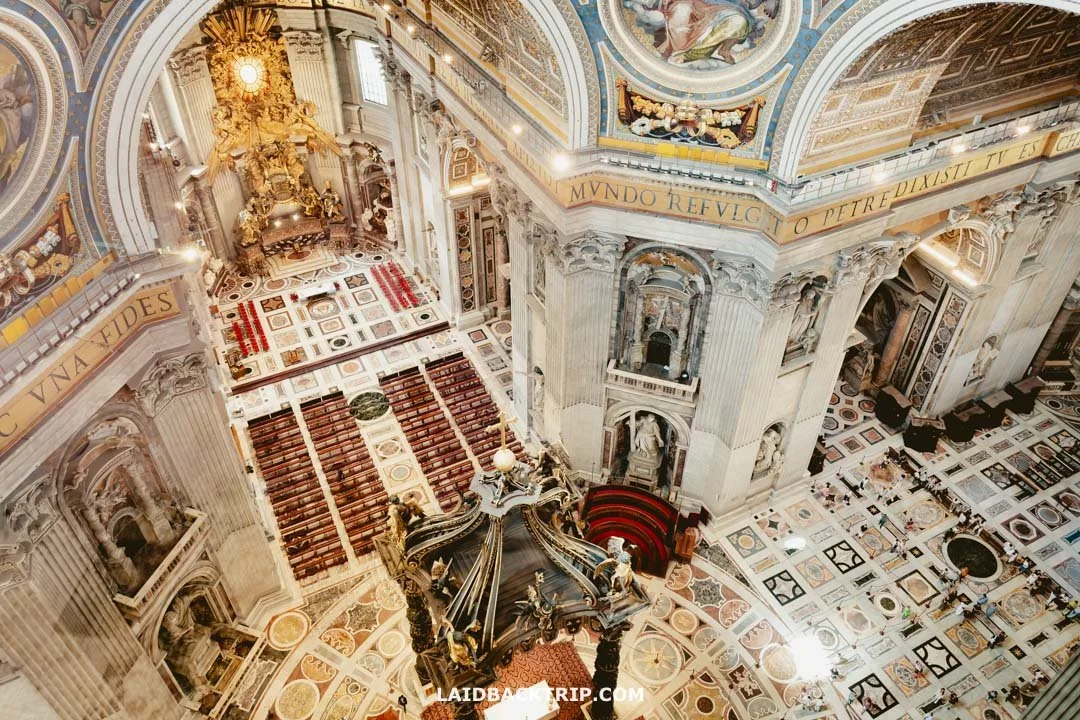
From up here, the people on the basilica's ground floor looked like tiny dots.
Climbing the Last 321 Steps to St. Peter's Dome
Beyond the inner balcony, the climb became much more interesting. From this point on, it was a one-way route to the top. The stairs ahead were far more varied than those in the first section, and we also got the chance to experience one of the most fascinating features of St. Peter's Dome up close.
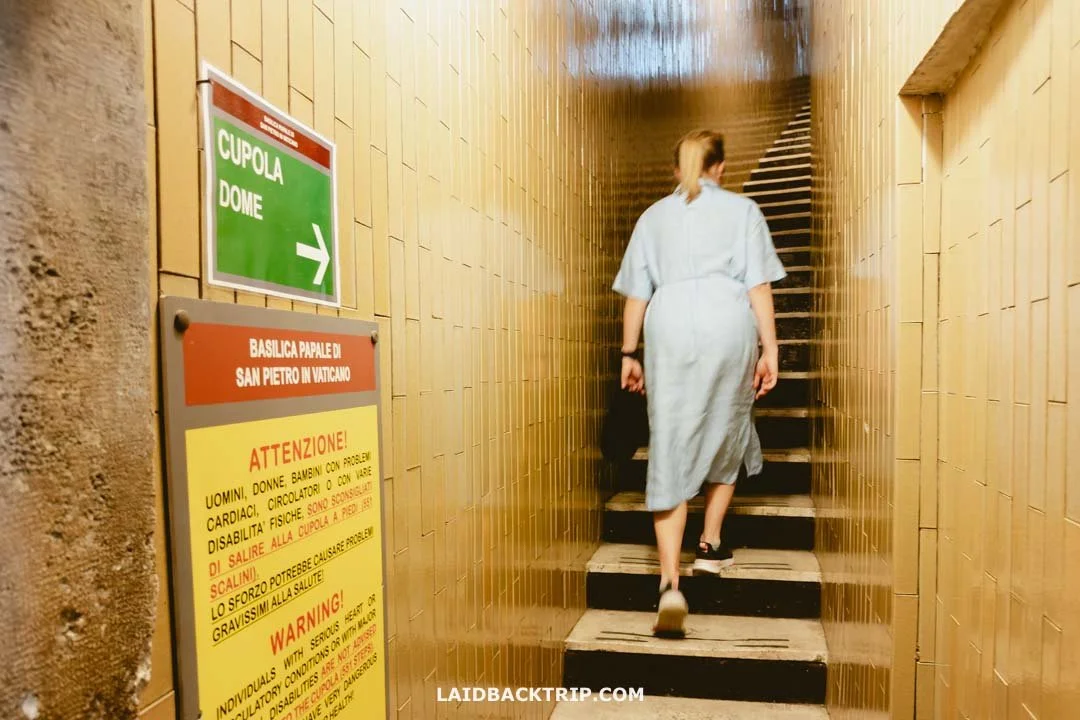
From this point, the climb to the top of St. Peter's Dome was one way only.
As it turned out, Michelangelo designed the dome with two layers. The outer layer is the one that protects the entire structure and is clearly visible from much of Rome. We could see it from the Palatine Hill or even from the Park of the Aqueducts, which was several kilometers away. The outer layer is also the one that is beautifully decorated and that we could see from the basilica's main level and, just a minute earlier, explore via the inner balcony.
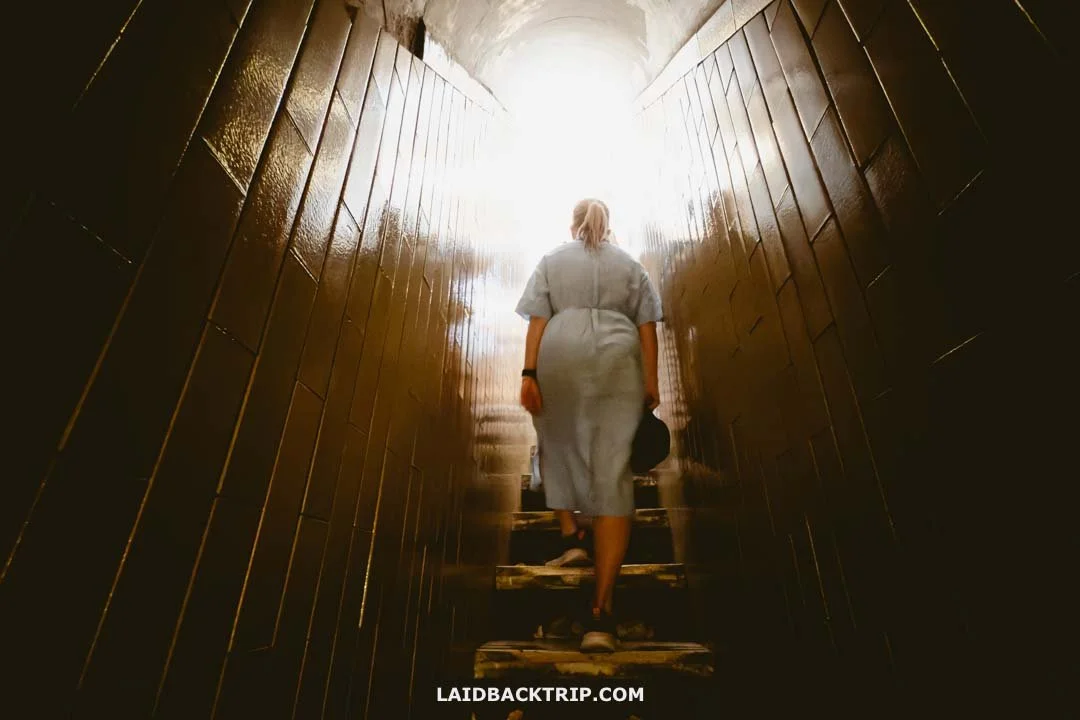
The higher we climbed, the narrower it got.
As we headed upward, we were walking between the inner and outer shells of the dome. As we climbed higher, the walls literally tilted inward, forcing us to lean as we walked. This was incredibly cool. I remember that earlier that year we climbed the Eiffel Tower, and that metal staircase was definitely not as fun as this one.
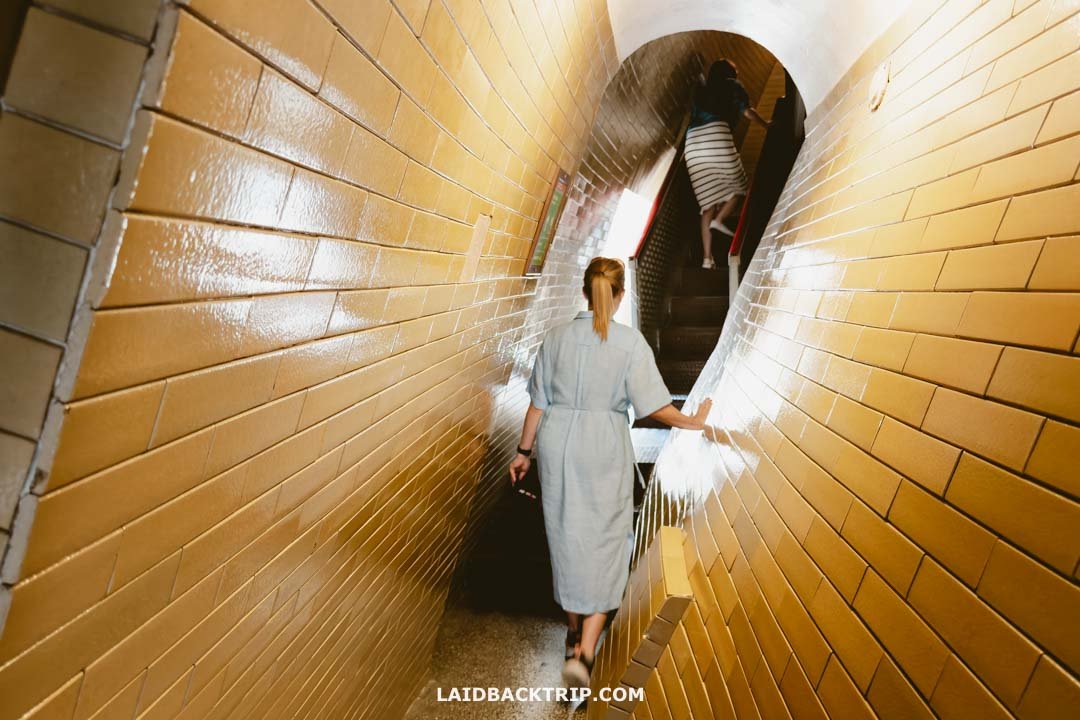
Walking between the shells of St. Peter's Dome meant we had to lean a little.
The final stretch involved a very tight spiral staircase with a thick rope serving as a handrail. It may sound dramatic, but it really was just a narrow spiral staircase that we climbed without ever using the rope. Honestly, the rope looked more dangerous to hold onto than simply climbing without it, though that might just be my opinion.
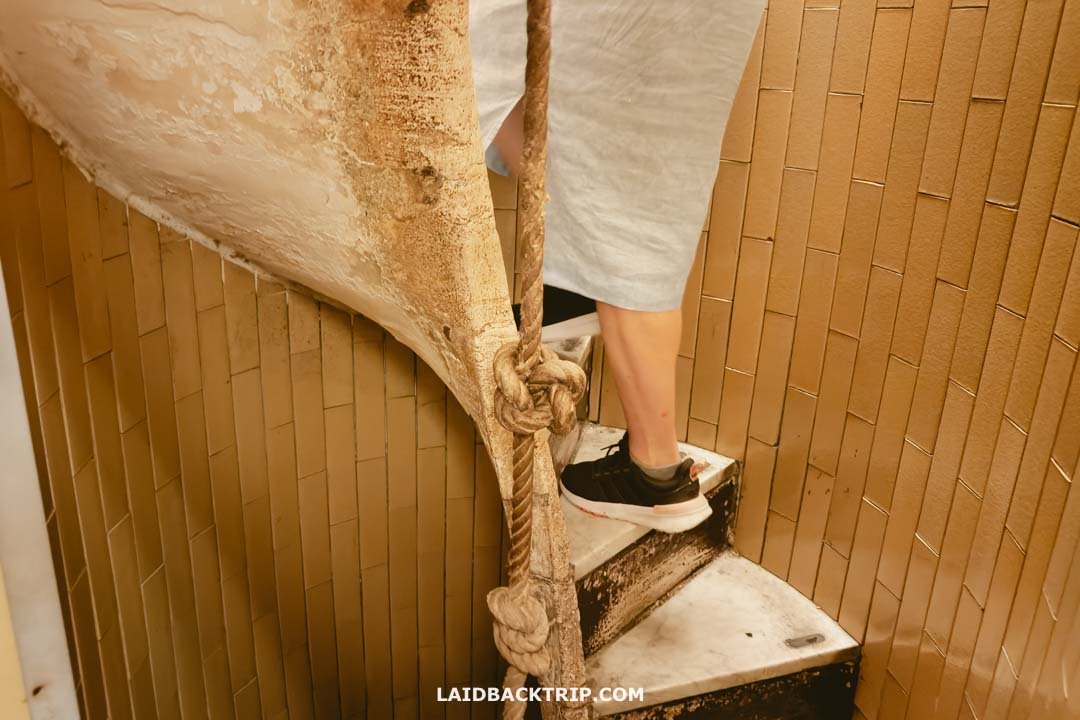
The spiral staircase was tight, but we managed it without holding onto the rope.
I have read that some visitors feel uncomfortable or even dizzy during the second part of the climb because of the narrow and somewhat claustrophobic spaces. We have climbed many church towers over the years, and neither Lucie nor I found this climb any more difficult than the others. Still, everyone is different, and if you are not comfortable in tight spaces, it is worth keeping that in mind. The problem, as always, is that there is really only one way to know for sure.
The only "difficult" section was the one that followed the curve of the cupola, where we had to lean slightly to our right, but again, it was neither very long nor especially narrow. The only part of me that did not like this stretch was my back. Even so, I still really enjoyed it.
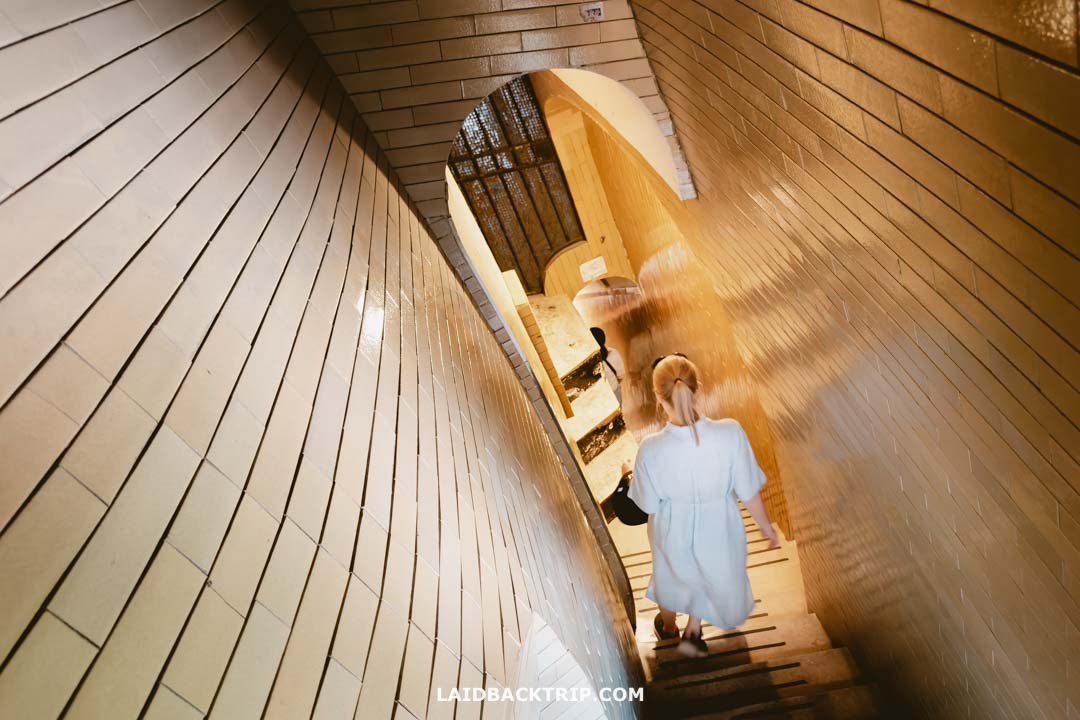
The route down is pretty much the same as the way up.
Enjoying the Breathtaking Views of Rome from the Lantern Balcony
The top viewpoint of St. Peter's Dome, known as the Loggia or Lantern balcony, is a narrow circular walkway on the very exterior of the cupola. Once we emerged there, we realized that it was quite narrow and offered limited space to move around. The walkway was protected by a high metal railing, even from above. It had a somewhat cage-like feel, and while I could imagine how beautiful it would look without it, I understand why it had to be installed. As people stood by the railing enjoying the views, we noticed that there was really just enough space for two people to pass each other.
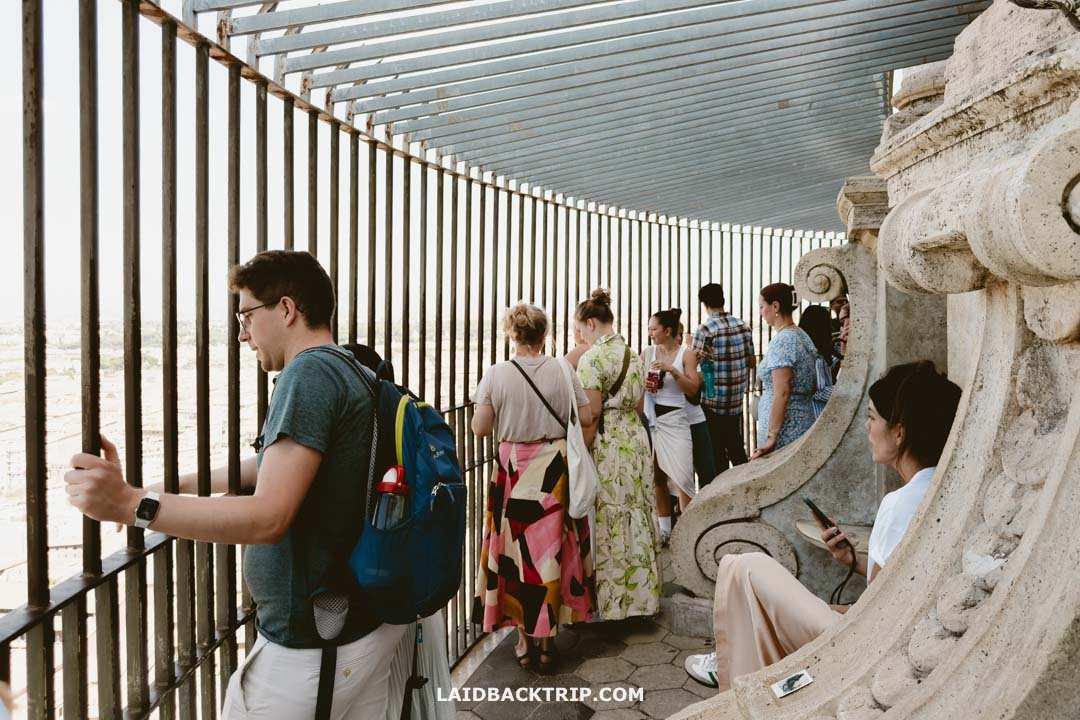
The lantern balcony was not exactly picturesque because of the metal railing.
Naturally, most people gathered on the eastern side of the walkway, which offers the classic view of St. Peter's Square and Rome. This was definitely the section that required the most care to pass through, but with a little patience, it was not that difficult. After a short while, we were able to enjoy this iconic view ourselves. From up here, we could clearly see how the two curved colonnades wrap around the square and symbolically embrace the pilgrims who arrive there.
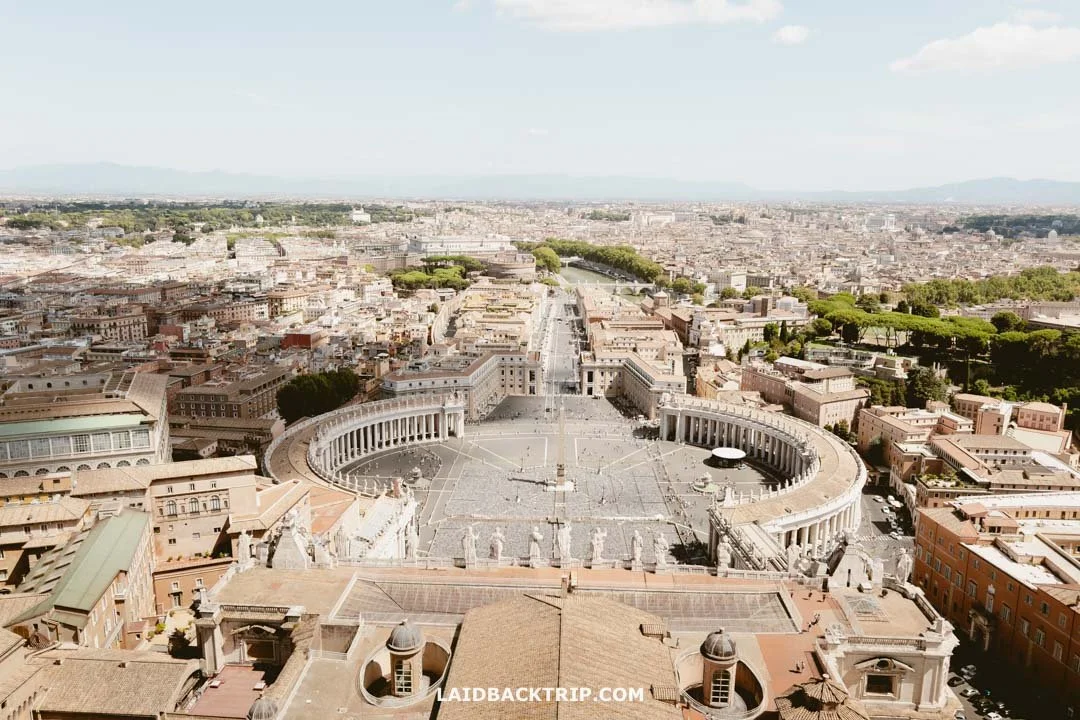
But the views of St. Peter's Square and all of Rome, well, that was a completely different story.
Since, at 136 meters in height, St. Peter's Dome is the highest point in Rome, the entire city, and of course the Vatican and its stunning gardens, spread out before us. Because we happened to be there on a clear day, we could see a great distance.
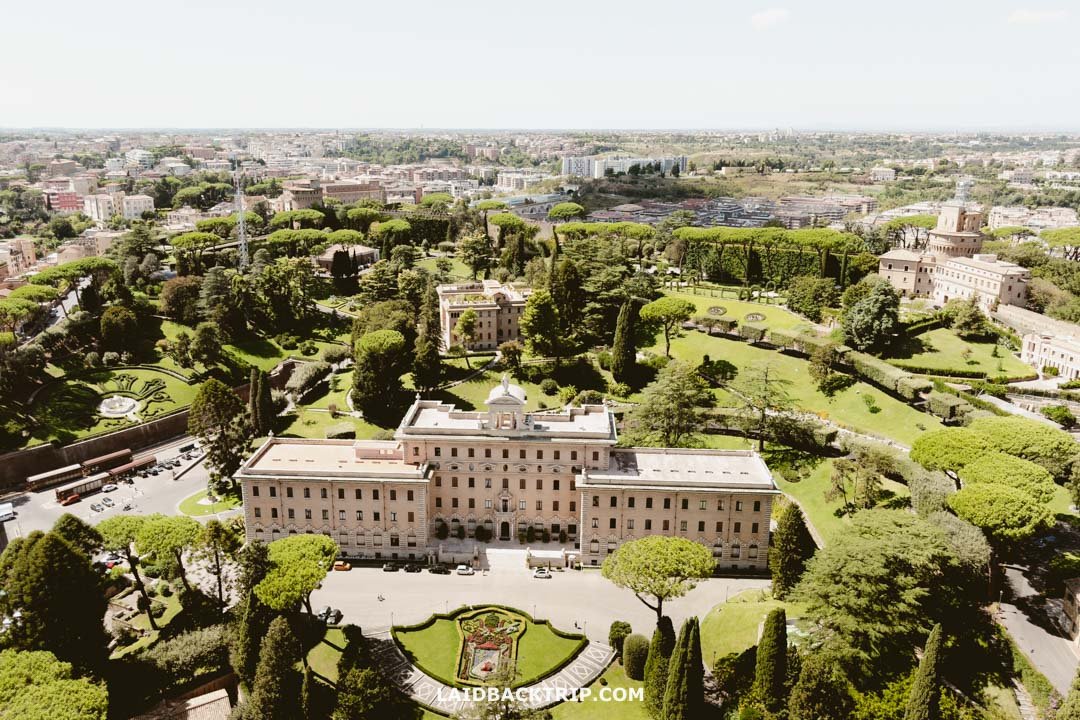
From the top, we could also take in the stunning Vatican Gardens.
It was amazing to spot places such as the Colosseum or the Roman Forum, along with the Palatine Hill that we had visited just a day earlier, as well as landmarks like Trajan's Market or the Pantheon that we were planning to see in the following days.
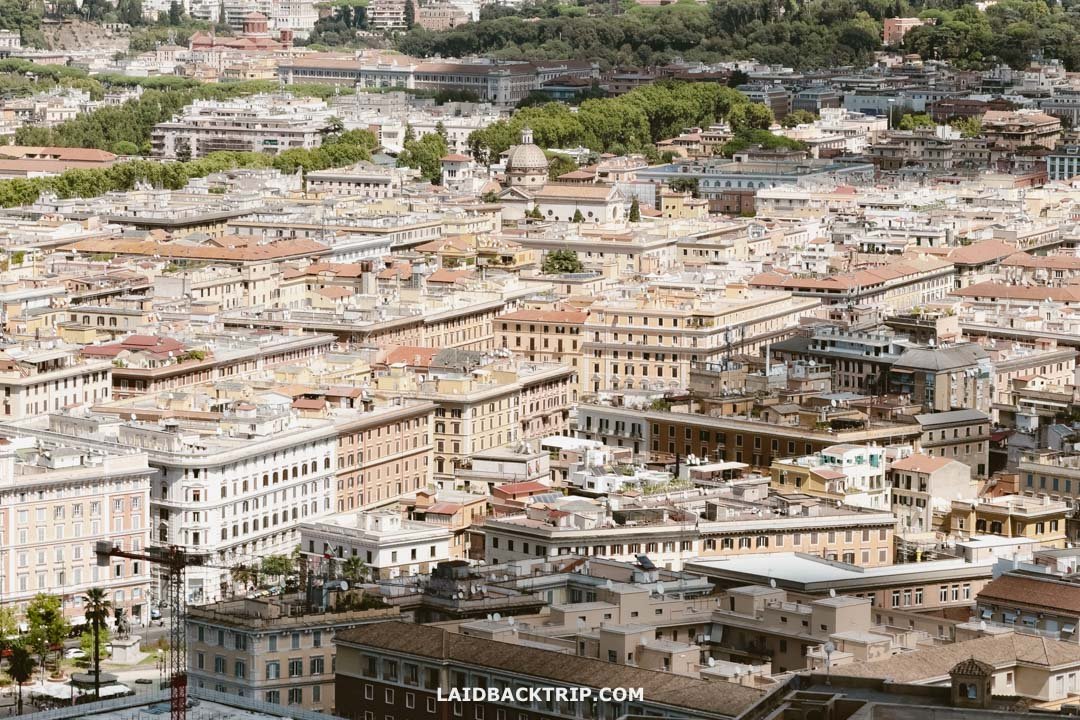
We could also see the charming Prati neighborhood from above.
We could also see the Apennines and even the sacred Alban Hills, which we later glimpsed again while walking the Via Appia. There was definitely much more to see, including Villa Borghese (and even the Borghese Gallery that we also visited), Villa Medici, the Tiber River, and the Victor Emmanuel II Monument.
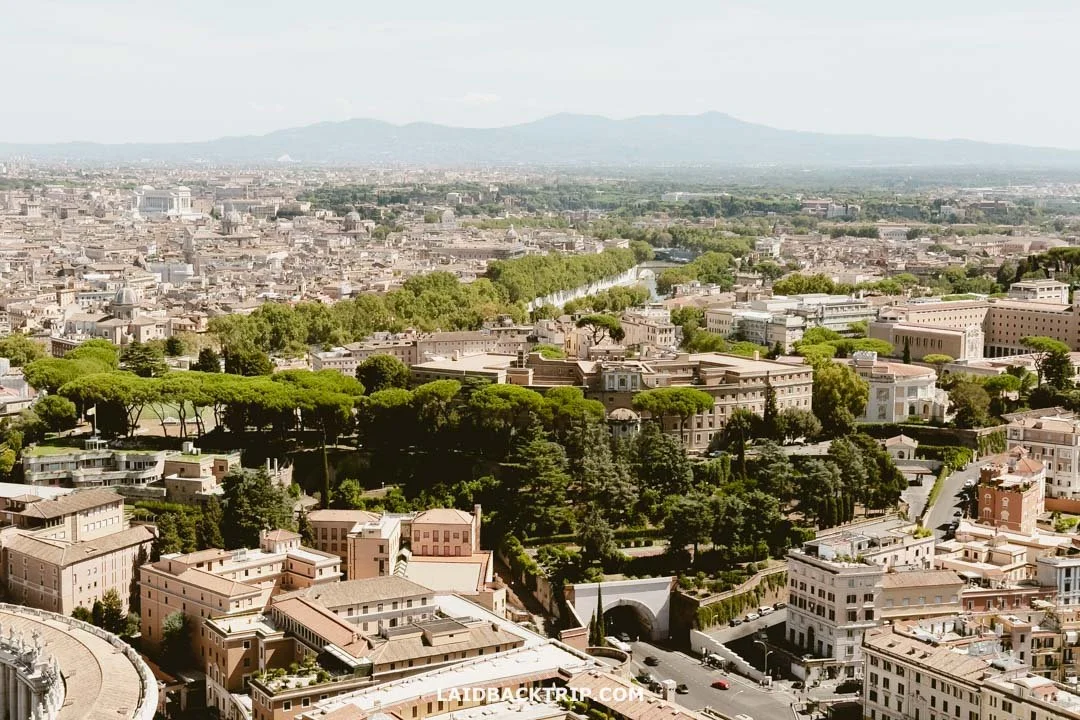
One of my favorite views of Rome, with the Alban Hills in the background.
I will not list every single place visible from up here because that would take quite a while, so I will simply say that the views from St. Peter's Basilica were hard to beat.
From here, we made our way back down to the basilica. The descent generally followed the same route we had taken upward, except that the upper section had a separate exit since it was too narrow to handle two-way traffic.
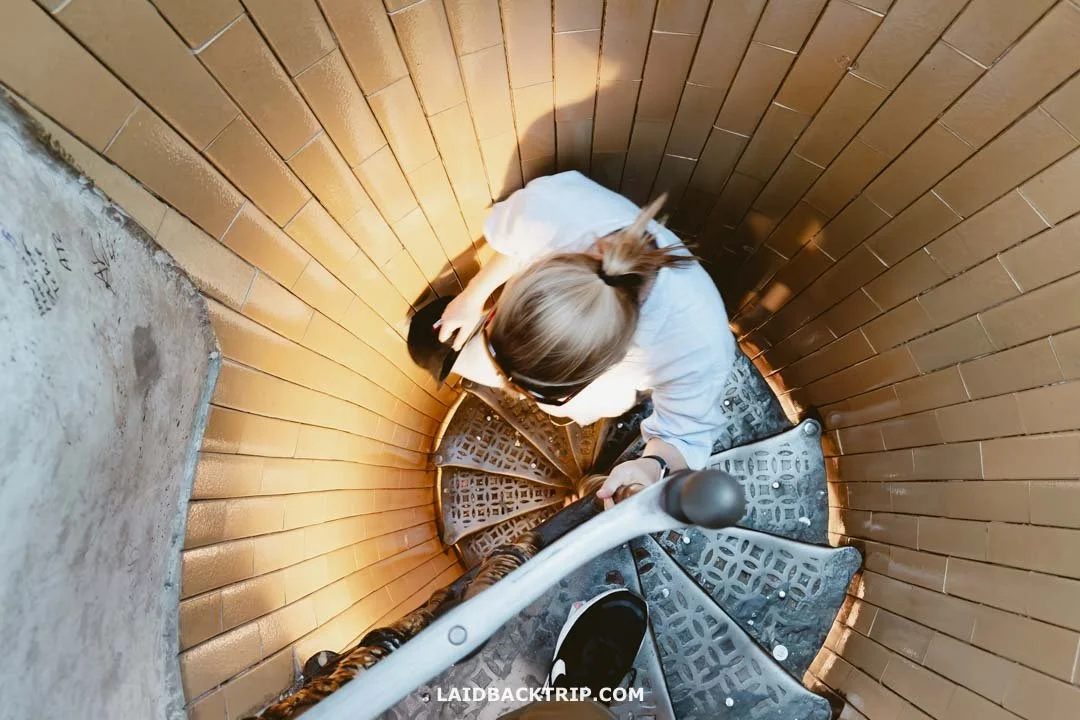
After we were done with the views, the only way to leave St. Peter's Dome was via this narrow staircase.
How Long Does It Take to Climb the St. Peter's Dome?
The whole climb to St. Peter's Dome and back took us about 80 minutes, not including the time needed to enter St. Peter's Basilica through the security check, which in our case was about 15 minutes. This total also does not include any waiting time for the stair climb, simply because there was no line. Had we taken the elevator option, however, it would definitely have added a few minutes to the overall time.
Most importantly, we did not encounter any major jams on the way up or down, which I guess was largely a matter of luck. With a slower pace, lines, or unexpected delays, I would say two hours sounds quite realistic.
The actual climb from the basilica's ground floor all the way to the top of the cupola took us about 15 minutes. The first section lasted around eight minutes, while the second took about seven minutes, which was surprisingly shorter even though it was the trickier part. We spent roughly the same amount of time descending back to the basilica. There was a minor slowdown in the upper section, but we made up for it in the lower one. So overall, the journey to the top and back took us about 30 minutes.
We spent about five minutes in the terrace area on the way up and then around 10 minutes there on the way down as we refilled our water bottle and used the restrooms. The inner walkway with the mosaics took us about 10 minutes to explore.
We stayed for roughly 25 minutes at the top of the cupola, which I would say, given how busy it was, was quite a long time. It was a beautiful sunny day that rewarded us with amazing views, and if not for the crowds, it was one of those places where we could easily have stayed for hours.
All in all, the climb to St. Peter's Dome was definitely worth it, and we loved every part of it. It was a fantastic little adventure wrapped in stunning Renaissance architecture and amazing views, and we simply could not have asked for a better way to end our visit to St. Peter's Basilica than this.
Travel Insurance
We never leave home without travel insurance that was designed to cover our expenses if something goes wrong during the trip. Travel insurance protects against theft, flight delays, injury, illness, cancellations, and much more. Travel smarter and safer!
World Nomads provides travel insurance for travelers to cover their trip essentials, including sports and adventure activities.
SafetyWing is affordable travel insurance for backpackers, long-term travelers, and digital nomads.
Travel Resources
Here you can find links to all the travel resources we use and which you might find helpful when planning your next holiday.
Accommodation: When looking for accommodation, we usually search hotels via Booking.com or Hostelworld.
Tours: Although we love to travel independently, some places are better to visit with a guided tour.
We prefer GetYourGuide for its easy-to-use interface and solid reputation. Another great alternative is Viator.
Rental Cars: When going on a road trip, we always use Rentalcars.com, a reliable site for booking a rental car in advance.
Flight Tickets: When looking for flight tickets, you can search Skyscanner to find the best price.
Travel Insurance: World Nomads and SafetyWing cover against risks of travel.
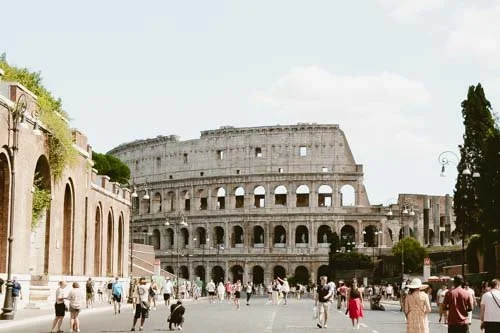
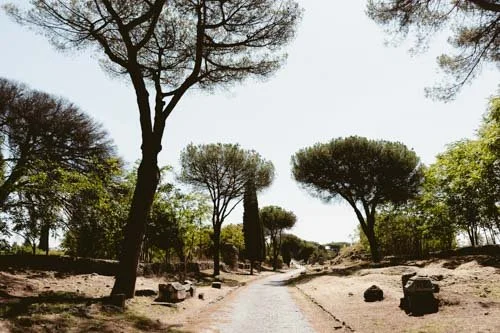
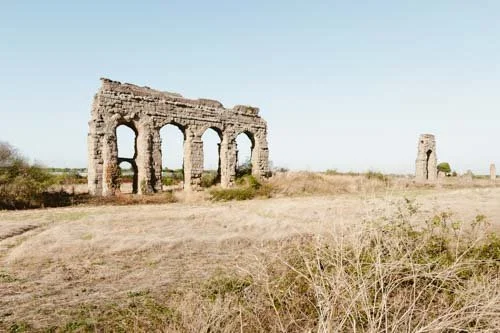
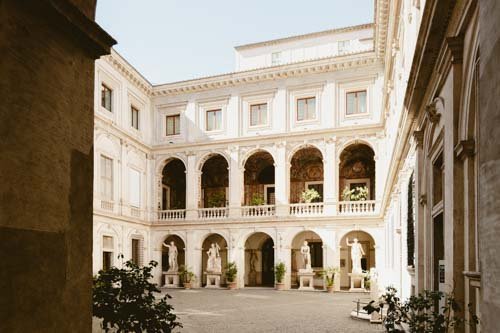
Discover everything you need to know before visiting St. Peter's Basilica in Vatican City, including what to see inside, how to climb the iconic dome, opening hours, ticket prices, guided tours, and the easiest ways to get there.